
电力热力燃气及水生产和供应业

Search documents
5.2%
中国基金报· 2025-09-15 04:19
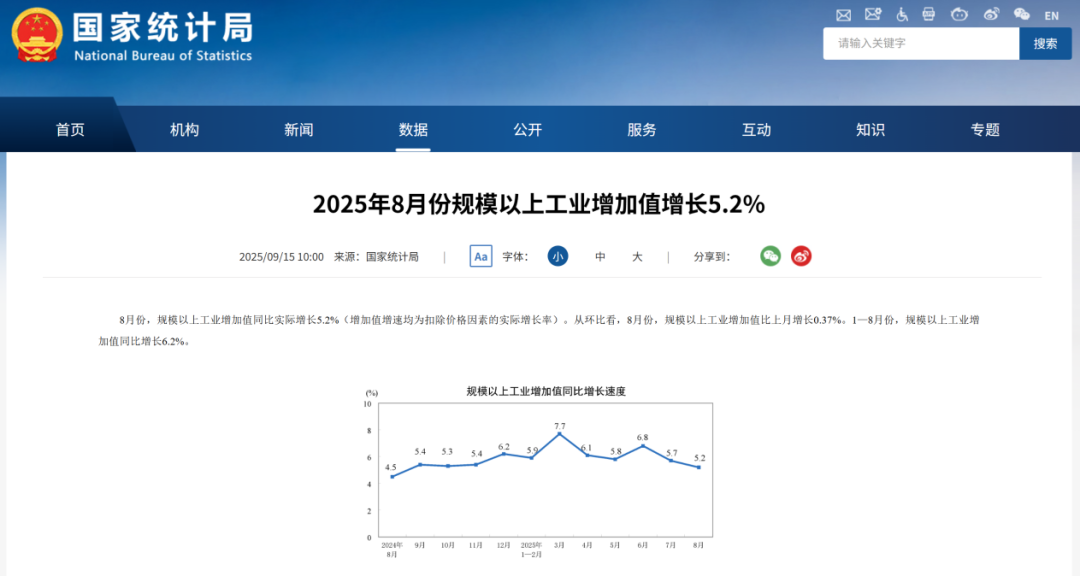
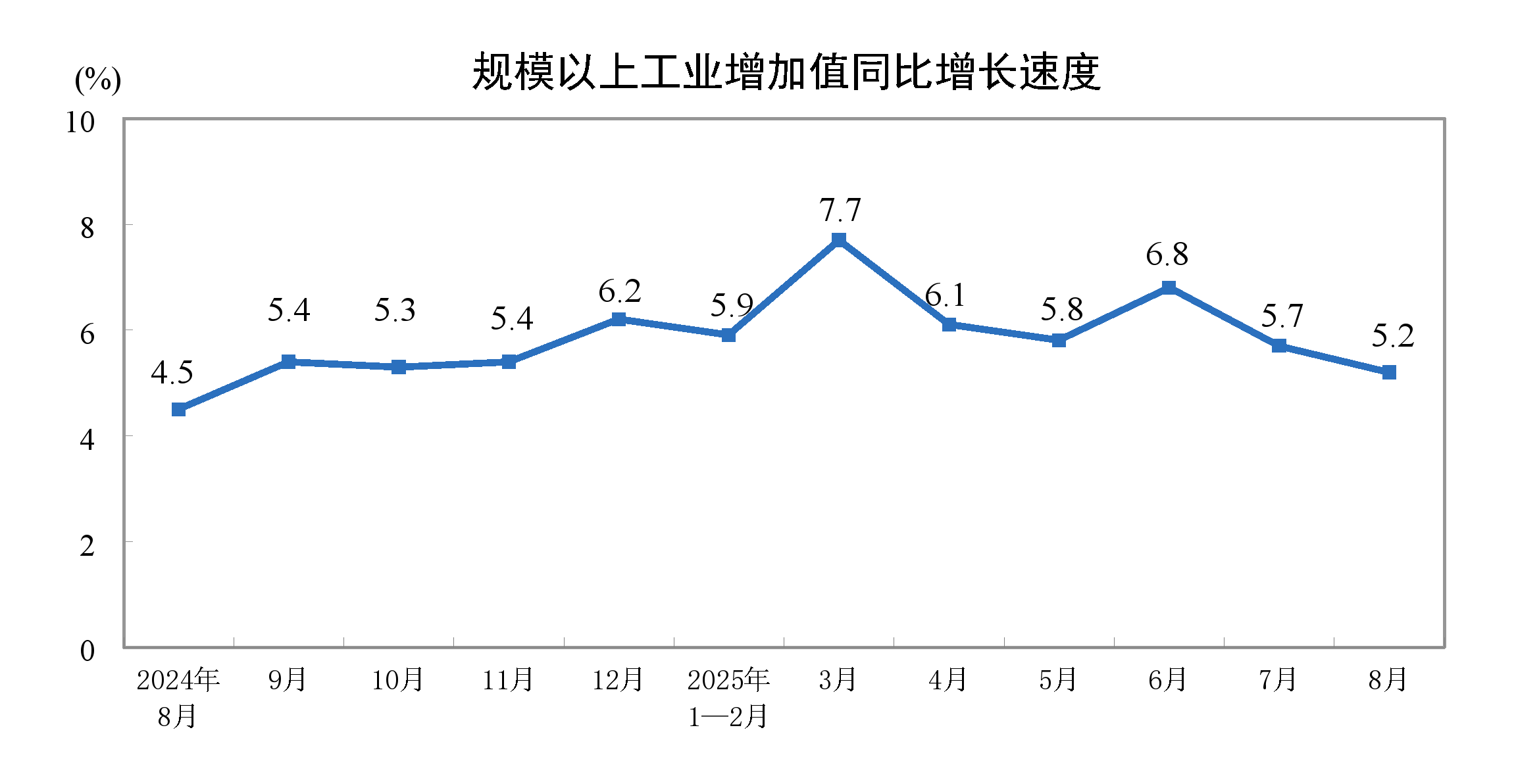
Core Viewpoint - The macroeconomic indicators for August show a stable and improving trend in China's economy, with notable growth in industrial production, service sector, and retail sales, despite challenges in fixed asset investment and external uncertainties [12]. Group 1: Industrial Production - In August, the industrial added value for large-scale enterprises increased by 5.2% year-on-year and 0.37% month-on-month [1][4] - From January to August, the industrial added value grew by 6.2% year-on-year [1][4] - The manufacturing sector saw a 5.7% increase, with equipment manufacturing and high-tech manufacturing growing by 8.1% and 9.3% respectively [4] Group 2: Service Sector - The service sector production index rose by 5.6% year-on-year in August, with significant growth in information transmission, finance, and business services [5] - From January to August, the service sector production index increased by 5.9% year-on-year [5] Group 3: Retail Sales - In August, the total retail sales of consumer goods reached 39,668 billion yuan, a year-on-year increase of 3.4% [2][6] - Online retail sales for the first eight months totaled 99,828 billion yuan, growing by 9.6% year-on-year [7] Group 4: Fixed Asset Investment - From January to August, fixed asset investment (excluding rural households) was 326,111 billion yuan, with a year-on-year growth of 0.5% [3][8] - Real estate development investment saw a significant decline of 12.9% year-on-year [3][8] Group 5: Trade and Employment - In August, the total value of goods imports and exports was 38,744 billion yuan, with exports growing by 4.8% [9] - The urban surveyed unemployment rate in August was 5.3%, showing a slight increase from the previous month [10] Group 6: Price Indices - The Consumer Price Index (CPI) in August decreased by 0.4% year-on-year, while the core CPI rose by 0.9% [11] - The Producer Price Index (PPI) for industrial producers fell by 2.9% year-on-year, with a narrowing decline compared to the previous month [11]


5.2%
Zhong Guo Ji Jin Bao· 2025-09-15 03:18
Economic Overview - In August, the industrial added value of large-scale enterprises increased by 5.2% year-on-year, with a month-on-month growth of 0.37% [1][3] - The total retail sales of consumer goods reached 39,668 billion yuan in August, growing by 3.4% year-on-year [1][5] - Fixed asset investment (excluding rural households) amounted to 326,111 billion yuan from January to August, with a year-on-year increase of 0.5% [1][7] - The real estate development investment from January to August was 60,309 billion yuan, showing a decline of 12.9% [1][7] Industrial Production - The manufacturing sector saw a year-on-year growth of 5.7%, while the equipment manufacturing and high-tech manufacturing sectors grew by 8.1% and 9.3% respectively [3] - The production index for the service industry increased by 5.6% in August, with significant growth in information transmission, software, and financial services [4] Consumer Market - The online retail sales reached 99,828 billion yuan from January to August, with a year-on-year growth of 9.6% [5] - The retail sales of essential and upgraded consumer goods showed positive growth, with furniture and home appliances retail sales increasing by 18.6% and 14.3% respectively [5] Investment Trends - Manufacturing investment grew by 5.1%, while real estate investment saw a decline of 12.9% [7] - Infrastructure investment increased by 2.0%, indicating a focus on enhancing public facilities [7] Trade Performance - The total import and export value in August was 38,744 billion yuan, with exports growing by 4.8% [8] - Private enterprises accounted for 57.1% of total imports and exports, reflecting their increasing role in the economy [8] Employment and Prices - The urban unemployment rate was stable at 5.3% in August, with a slight seasonal increase [9] - The Consumer Price Index (CPI) decreased by 0.4% year-on-year, while the core CPI rose by 0.9% [10]
国家统计局:8月规模以上工业增加值同比增长5.2% 消费品零售总额增长3.4%
Guo Jia Tong Ji Ju· 2025-09-15 02:19
Economic Overview - In August, under the strong leadership of the Central Committee, the national economy maintained overall stability with a steady development trend, supported by macro policy adjustments and the promotion of a unified national market [1][9]. Industrial Production - In August, the industrial added value of large-scale enterprises increased by 5.2% year-on-year and 0.37% month-on-month. The mining industry grew by 5.1%, manufacturing by 5.7%, and electricity, heat, gas, and water production and supply by 2.4% [2][18]. - The equipment manufacturing industry saw an 8.1% increase, while high-tech manufacturing grew by 9.3%, outperforming the overall industrial growth by 2.9 and 4.1 percentage points respectively [2][18]. - From January to August, the industrial added value increased by 6.2% year-on-year [2][18]. Service Sector - The service production index rose by 5.6% year-on-year in August, with significant growth in information transmission, software, and IT services (12.1%), finance (9.2%), and leasing and business services (7.4%) [3][18]. - For the first eight months, the service production index increased by 5.9% year-on-year [3][18]. Retail Sales - In August, the total retail sales of consumer goods reached 39,668 billion yuan, a year-on-year increase of 3.4% [4][18]. - Online retail sales amounted to 99,828 billion yuan, growing by 9.6% year-on-year, with physical goods online retail sales at 80,964 billion yuan, a 6.4% increase [4][18]. Fixed Asset Investment - From January to August, fixed asset investment (excluding rural households) totaled 326,111 billion yuan, a year-on-year increase of 0.5% [5][18]. - Manufacturing investment grew by 5.1%, while real estate development investment fell by 12.9% [5][18]. Trade and Exports - In August, the total value of goods imports and exports reached 38,744 billion yuan, a year-on-year increase of 3.5%, with exports at 23,035 billion yuan (up 4.8%) and imports at 15,709 billion yuan (up 1.7%) [6][18]. - From January to August, the total value of goods imports and exports was 295,696 billion yuan, also a 3.5% increase year-on-year [6][18]. Employment - The urban surveyed unemployment rate in August was 5.3%, a slight increase of 0.1 percentage points from the previous month [7][18]. - The average working hours for employed persons were 48.5 hours per week [7][18]. Price Trends - In August, the Consumer Price Index (CPI) decreased by 0.4% year-on-year, with food prices down by 2.5% [8][18]. - The Producer Price Index (PPI) for industrial producers fell by 2.9% year-on-year, with the decline narrowing by 0.7 percentage points from the previous month [8][18].
国家统计局:8月规模以上工业增加值增长5.2% 国民经济运行总体平稳、稳中有进
Guo Jia Tong Ji Ju· 2025-09-15 02:17
Economic Overview - In August, the national economy maintained overall stability and progressed steadily, with a focus on implementing the decisions of the central government and enhancing macro policy adjustments [30][38] - The industrial added value above designated size increased by 5.2% year-on-year in August, with a month-on-month increase of 0.37% [31][38] - From January to August, the industrial added value grew by 6.2% year-on-year [31][38] Industrial Performance - The mining industry saw a year-on-year increase of 5.1%, while the manufacturing sector grew by 5.7%, and the electricity, heat, gas, and water production and supply industry increased by 2.4% in August [31][38] - High-tech manufacturing and equipment manufacturing industries performed well, with growth rates of 9.3% and 8.1% respectively, surpassing the overall industrial growth [31][38] Product Output - Among 623 industrial products, 319 saw year-on-year output growth in August, including steel (12.3 million tons, +9.7%), ethylene (314,000 tons, +10.4%), and automobiles (2.752 million units, +10.5%) [7][31] - New energy vehicles experienced significant growth, with production increasing by 22.7% [31][38] Service Sector Growth - The service sector production index rose by 5.6% year-on-year in August, with notable growth in information transmission, software, and financial services [32][38] - The business activity index for the service sector was at 50.5, indicating expansion [32][38] Investment Trends - Fixed asset investment (excluding rural households) reached 326.111 billion yuan from January to August, with a year-on-year increase of 0.5% [34][38] - Manufacturing investment grew by 5.1%, while real estate development investment declined by 12.9% [34][38] Trade Performance - In August, the total value of goods imports and exports was 38,744 billion yuan, a year-on-year increase of 3.5%, with exports growing by 4.8% [35][38] - From January to August, the total value of goods imports and exports reached 295,696 billion yuan, with exports increasing by 6.9% [35][38] Employment and Price Trends - The urban survey unemployment rate was 5.3% in August, showing a slight increase from the previous month [36][38] - The Consumer Price Index (CPI) decreased by 0.4% year-on-year in August, while the industrial producer prices fell by 2.9% [37][38]
国家统计局:8月份,全国规模以上工业增加值同比增长5.2%
Zheng Quan Shi Bao Wang· 2025-09-15 02:06
Core Insights - In August, the national industrial added value above designated size increased by 5.2% year-on-year and 0.37% month-on-month [1] - The mining industry saw a year-on-year increase of 5.1%, manufacturing grew by 5.7%, and the production and supply of electricity, heat, gas, and water increased by 2.4% [1] - The equipment manufacturing industry increased by 8.1% and high-tech manufacturing grew by 9.3%, outperforming the overall industrial added value by 2.9 and 4.1 percentage points respectively [1] Economic Type Analysis - State-controlled enterprises' added value increased by 4.7% year-on-year; joint-stock enterprises grew by 6.0%, foreign and Hong Kong, Macao, and Taiwan-invested enterprises increased by 2.3%, while private enterprises grew by 4.6% [1] Product Performance - The production of 3D printing equipment, new energy vehicles, and industrial robots increased by 40.4%, 22.7%, and 14.4% year-on-year respectively [1] Overall Industrial Performance - From January to August, the national industrial added value above designated size increased by 6.2% year-on-year [1] - In August, the manufacturing purchasing managers' index was 49.4%, up 0.1 percentage points from the previous month; the business activity expectation index rose to 53.7%, an increase of 1.1 percentage points [1] Profitability - From January to July, the total profit of industrial enterprises above designated size reached 40,204 billion yuan, a year-on-year decrease of 1.7% [1]
国家统计局: 工业生产较快增长,装备制造业和高技术制造业增势较好
Xin Lang Cai Jing· 2025-09-15 02:04
Group 1 - In August, the national industrial added value above designated size increased by 5.2% year-on-year and 0.37% month-on-month [1] - By sector, the mining industry added value grew by 5.1%, manufacturing by 5.7%, and the production and supply of electricity, heat, gas, and water by 2.4% [1] - The equipment manufacturing industry saw an 8.1% year-on-year increase, while high-tech manufacturing grew by 9.3%, outperforming the overall industrial added value by 2.9 and 4.1 percentage points respectively [1] Group 2 - By economic type, state-controlled enterprises' added value increased by 4.7%, joint-stock enterprises by 6.0%, foreign and Hong Kong, Macao, and Taiwan-invested enterprises by 2.3%, and private enterprises by 4.6% [1] - In terms of products, the output of 3D printing equipment, new energy vehicles, and industrial robots increased by 40.4%, 22.7%, and 14.4% year-on-year respectively [1] Group 3 - From January to August, the national industrial added value above designated size increased by 6.2% year-on-year [1] - In August, the manufacturing purchasing managers' index was 49.4%, up 0.1 percentage points from the previous month, while the business activity expectation index rose to 53.7%, an increase of 1.1 percentage points [1] - From January to July, the total profit of national industrial enterprises amounted to 40,204 billion yuan, a year-on-year decrease of 1.7% [1]
川渝地区2024年工资价位发布 企业从业人员工资报酬中位数为61954元
Si Chuan Ri Bao· 2025-09-11 06:49
Group 1 - The median salary for employees in the Sichuan-Chongqing region for 2024 is 61,954 yuan, showing an upward trend compared to the previous year [1] - The median salary rankings by industry show that the top three are finance (133,467 yuan), information transmission, software and IT services (97,816 yuan), and electricity, heat, gas, and water production and supply (97,622 yuan) [1] - The median salary rankings by occupation indicate that the top five are financial service personnel (123,660 yuan), information transmission, software and IT service personnel (98,000 yuan), enterprise unit leaders (94,420 yuan), electricity, gas, and water supply service personnel (90,071 yuan), and scientific research personnel (90,000 yuan) [1] Group 2 - The median per capita labor cost for enterprises in the Sichuan-Chongqing region for 2024 is 79,900 yuan [2]
【宏观经济】一周要闻回顾(2025年8月27日-9月2日)
乘联分会· 2025-09-02 09:11
Group 1: Industrial Profit Trends - In the first seven months of 2025, the total profit of industrial enterprises above designated size in China decreased by 1.7% year-on-year, amounting to 40,203.5 billion yuan [3][4] - State-owned enterprises reported a profit of 12,823.4 billion yuan, down 7.5% year-on-year, while private enterprises saw a profit of 11,183.7 billion yuan, an increase of 1.8% [3][4] - The mining industry experienced a significant profit decline of 31.6%, while the manufacturing sector's profit increased by 4.8% [3][4] Group 2: Revenue and Cost Analysis - The total operating revenue for industrial enterprises was 78.07 trillion yuan, reflecting a year-on-year growth of 2.3%, with operating costs rising by 2.5% to 66.80 trillion yuan [4] - The operating profit margin was recorded at 5.15%, a decrease of 0.21 percentage points compared to the previous year [4] - By the end of July, total assets of these enterprises reached 183.67 trillion yuan, a 4.9% increase year-on-year, while total liabilities grew by 5.1% to 106.26 trillion yuan [4][5] Group 3: Purchasing Managers' Index (PMI) Insights - In August 2025, the manufacturing PMI was reported at 49.4%, indicating a slight improvement in manufacturing activity compared to the previous month [7] - Large enterprises had a PMI of 50.8%, while medium and small enterprises reported PMIs of 48.9% and 46.6%, respectively, indicating varying levels of economic health across different enterprise sizes [7][8] - The production index rose to 50.8%, suggesting accelerated manufacturing production, while the new orders index was at 49.5%, indicating slight improvement in market demand [8][9] Group 4: Non-Manufacturing Sector Performance - The non-manufacturing business activity index stood at 50.3%, showing continued expansion in the sector [11] - The construction industry index was at 49.1%, reflecting a decline, while the services sector index improved to 50.5% [11][12] - The new orders index for non-manufacturing was 46.6%, indicating a slight improvement in market demand, particularly in the services sector [11][12]

今年前7个月甘肃省主要经济指标实现稳步增长
Sou Hu Cai Jing· 2025-08-21 00:20
Economic Growth - The main economic indicators in Gansu Province have shown steady growth in the first seven months of the year, with overall economic operation remaining stable [1][2] - The industrial production has increased significantly, with the added value of industrial enterprises above designated size growing by 9.5% year-on-year [1] Industrial Performance - The mining industry saw a value increase of 4.1%, while the manufacturing sector grew by 12.2%, and the electricity, heat, gas, and water production and supply industry increased by 10.2% [1] - Out of 37 major industry categories, 25 reported growth in production activities [1] Fixed Asset Investment - Fixed asset investment in the province grew by 0.8% year-on-year, with a notable increase of 4.4% when excluding real estate development investments [1] - Infrastructure investment rose by 7.4%, and manufacturing investment increased by 10.0%, while real estate development investment declined by 14.2% [1] Consumer Market - The total retail sales of consumer goods reached 2500.8 billion yuan, marking a year-on-year growth of 3.4% [2] - The "old for new" policy has positively impacted retail sales in categories such as home appliances (54.3% growth), communication equipment (37.0% growth), and furniture (20.8% growth) [2] Foreign Trade - The total import and export value reached 394.6 billion yuan, with a year-on-year increase of 24.4% [2] - Exports grew by 33.2% to 95.5 billion yuan, while imports increased by 21.9% to 299.1 billion yuan [2] - Trade with countries involved in the Belt and Road Initiative accounted for 74.4% of total trade, with a growth of 21.0% [2] Fiscal and Financial Stability - The general public budget revenue was 658.3 billion yuan, reflecting a year-on-year growth of 3.7%, while expenditures increased by 5.3% to 2848.6 billion yuan [2] - By the end of July, the balance of deposits in financial institutions reached 30383.8 billion yuan, growing by 8.1%, and the loan balance was 29981.5 billion yuan, up by 4.3% [2]
前7个月河南省规上工业增加值同比增长8.5%
Bei Ke Cai Jing· 2025-08-19 03:32
Core Viewpoint - In July, Henan Province's industrial added value experienced a year-on-year real growth of 8.8%, indicating a robust industrial performance despite economic challenges [1] Summary by Categories Industrial Growth - From January to July, the industrial added value above designated size in Henan grew by 8.5% year-on-year [1] - In July, the mining industry saw an added value growth of 3.5% [1] - The manufacturing sector recorded an increase of 8.7% in added value [1] - The electricity, heat, gas, and water production and supply industry experienced a significant growth of 14.5% [1]