调味品

Search documents
诚通证券-海天味业-603288-2025年半年报点评:核心调味品持续领跑,产品矩阵完善支撑长期增长-250904
Xin Lang Cai Jing· 2025-09-05 07:38
Core Viewpoint - The company reported continuous revenue and net profit growth in the first half of 2025, although there was a noticeable pressure in the single quarter performance [1] Financial Performance - In the first half of 2025, the company achieved revenue of 15.23 billion yuan, an increase of 7.59%, and a net profit attributable to shareholders of 3.91 billion yuan, up 13.35% [1] - The gross profit margin was 40.12%, an increase of 3.26 percentage points year-on-year [1] - For Q1 and Q2 of 2025, revenues were 8.31 billion yuan and 6.91 billion yuan, respectively, with year-on-year growth of 8.08% and 7.00% [1] - The net profit for Q1 and Q2 was 2.20 billion yuan and 1.71 billion yuan, reflecting year-on-year growth of 14.77% and 11.57% [1] - The gross profit margins for Q1 and Q2 were 40.04% and 40.21%, showing year-on-year increases of 2.73% and 3% [1] Product Performance - The core condiment categories, including soy sauce, oyster sauce, and seasoning sauces, continued to lead the market, with revenues of 7.93 billion yuan, 2.50 billion yuan, 1.63 billion yuan, and 2.51 billion yuan, respectively [1] - Year-on-year growth rates for these products were 9.14%, 7.74%, 12.01%, and 16.73%, with respective market shares of 54.44%, 17.18%, 11.17%, and 17.21% [1] Strategic Initiatives - The company is advancing its domestic channel penetration and enhancing coverage in town and village markets, building a fully digital ecosystem to improve sales efficiency and user experience [1] - The global strategy is being accelerated through the establishment of subsidiaries in the US and Indonesia, leveraging the A+H share listing platform [1] Capital Structure and Shareholder Returns - The company significantly increased its cash reserves by 35.65% year-on-year through H-share issuance, with capital reserves surging by 6224.15% [1] - A cash dividend of 2.60 yuan per 10 shares (including tax) is proposed for all shareholders, totaling approximately 1.52 billion yuan, which accounts for 39.1% of the net profit for the first half of the year [1] Investment Outlook - The company is positioned as a leading player with a clear first-mover advantage, likely to benefit from the industry's increasing concentration [1] - The management team has substantial experience, effectively navigating industry adjustments [1] - The ongoing A+H share listing is expected to support the implementation of the global strategy and accelerate the internationalization of the company's expertise [1]

涪陵榨菜:榨菜销量下滑
2 1 Shi Ji Jing Ji Bao Dao· 2025-09-05 03:26
Group 1 - The core viewpoint is that Fuling Zhacai is reassessing its key pickled vegetable business due to changing market dynamics and declining sales volume [1][2] - In the first half of 2025, Fuling Zhacai reported a revenue increase of 0.5% to 1.31 billion yuan, while net profit attributable to shareholders decreased by 1.7% to 440 million yuan [1] - The revenue breakdown shows that pickled vegetables, radishes, and pickled cabbage generated 1.12 billion yuan, 30 million yuan, and 120 million yuan respectively, with year-on-year growth rates of 0.5%, 38.35%, and a decline of 8.4% [1] Group 2 - The company acknowledges challenges in sales channels, attributing them to changing consumer preferences and a reduction in the target population due to urban population shifts [2] - To address these challenges, Fuling Zhacai is focusing on expanding product categories and market reach, enhancing new product development, and increasing channel expansion efforts [2] - The company is also adjusting its production plans by reducing conventional pickled vegetable production lines and adding multi-specification product lines, as well as new production lines for sauce products [2][3]



调味品半年报:8家企业营收净利双增,跨界、出海寻增量
Bei Ke Cai Jing· 2025-09-05 03:07
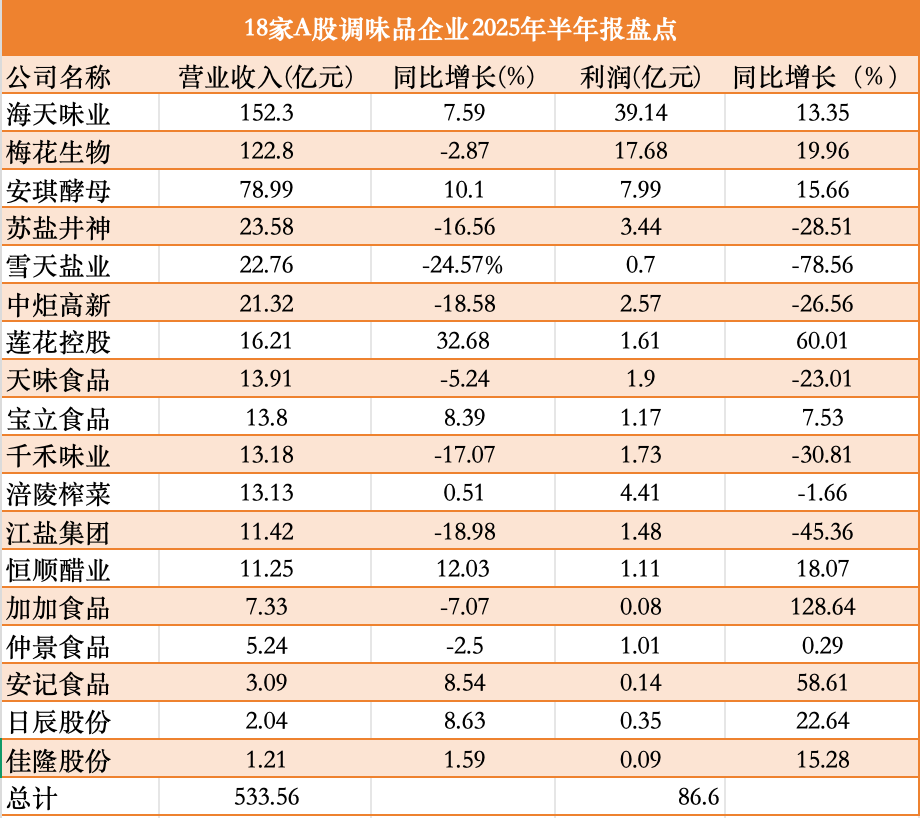
Core Insights - The A-share condiment companies reported a dual growth in revenue and net profit for the first half of 2025, with a shift towards high-end and health-oriented product upgrades due to a slowdown in the soy sauce market [1][4][9]. Group 1: Financial Performance - In the first half of 2025, 18 A-share condiment companies achieved a total revenue of 53.356 billion yuan and a net profit of 8.66 billion yuan, with 8 companies reporting growth in both metrics [4][5]. - Notable performers include Haitian Flavor Industry with a revenue of 15.23 billion yuan (up 7.59%) and a net profit of 3.914 billion yuan (up 13.35%), while companies like Su Yan Jingshen and Xue Tian Salt Industry experienced significant declines in both revenue and profit [5][6][7]. - The industry shows a "stronger getting stronger" trend, with only two companies exceeding 10 billion yuan in revenue, while 15 companies reported revenues below 2.5 billion yuan [6]. Group 2: Market Trends - The soy sauce market is entering a phase of stock competition, with a compound annual growth rate of only 2.3% over five years, significantly lower than the overall condiment industry growth rate of 4.5% [9][10]. - The per capita demand for soy sauce has decreased from 7.28 kg in 2015 to less than 5 kg in 2023, indicating a supply surplus in the market [9]. Group 3: Regulatory Changes - The new national food safety standard GB 7718-2025 prohibits the use of "zero additives" labels, which is expected to push the industry towards more standardized and healthier development [2][13]. - Companies are adjusting their marketing strategies in response to the new regulations, moving away from "zero additives" claims to focus on product quality and health benefits [12][13]. Group 4: Strategic Initiatives - Many companies are accelerating diversification and internationalization strategies, such as Fuling Zhacai's acquisition of Weimeizi and Haitian Flavor Industry's listing on the Hong Kong stock exchange [3][14][16]. - The health sector is becoming a significant focus, with companies like Zhongjing Food entering the health food market and Jia Long Co. expanding into soy sauce production [15][17]. - Companies are also exploring overseas markets, with Haitian Flavor Industry aiming to increase its overseas revenue share to 15% within three years [16][17].
涪陵榨菜:榨菜销量下滑丨消费参考
2 1 Shi Ji Jing Ji Bao Dao· 2025-09-04 23:41
Group 1 - The core viewpoint is that Fuling Zhacai is reassessing its key pickled vegetable business due to changing market dynamics and consumer preferences [1][4] - In the first half of 2025, Fuling Zhacai reported a revenue increase of 0.5% year-on-year to 1.31 billion yuan, while net profit attributable to shareholders decreased by 1.7% to 440 million yuan [1] - Revenue from the pickled vegetable category was 1.12 billion yuan, with a year-on-year growth of 0.5%, while sales volume declined by 1.2% [1] Group 2 - The company is facing challenges in sales channels as consumer preferences shift towards alternative products, and urban population trends are affecting its market coverage [3] - Fuling Zhacai is implementing a strategy to expand product categories and market reach, focusing on new product development and channel expansion [3] - The company is adjusting its production plans by reducing conventional pickled vegetable production lines and increasing the production of multi-specification products and sauces [3] Group 3 - The stock price of Fuling Zhacai was reported at 13.24 yuan per share, with a slight increase of 0.76% [5] - The consumer index for the sector showed a decline, with the consumption index dropping by 2.21% [6]
国内知名调料酿造商太和坊登陆新三板
Bei Jing Shang Bao· 2025-09-04 14:52
Group 1 - The company Chengdu Taihefang Food Co., Ltd. has officially listed for public transfer on the National Equities Exchange and Quotations system with the stock name "Taihefang" and stock code 874750 [1] - The company specializes in the field of compound and fermented seasonings, operating two core brands: "Taihe" and "Shuxiang" [1] - The product range includes various series such as sausage seasonings, hot pot bases, and Sichuan cuisine seasonings [1]
食品饮料行业2025年半年度业绩综述:白酒加速出清,大众品结构分化
Dongguan Securities· 2025-09-04 09:15
Investment Rating - The report maintains an "Overweight" rating for the food and beverage industry [1] Core Insights - The food and beverage industry experienced a revenue growth of 2.47% year-on-year in H1 2025, totaling 582.81 billion yuan, while net profit decreased by 0.60% to 127.67 billion yuan [3][11] - The report highlights a significant performance divergence among sub-sectors, with the liquor sector facing challenges while other segments like snacks and soft drinks showed better performance [3][11] Summary by Sections 1. Industry Overview - The food and beverage industry achieved a total revenue of 582.81 billion yuan in H1 2025, with a year-on-year growth of 2.47%, a decline of 2.79 percentage points compared to the previous year [3][11] - The net profit attributable to shareholders was 127.67 billion yuan, down 0.60% year-on-year, with a notable decline in growth rate of 14.64 percentage points [3][11] 2. Liquor Sector - The liquor sector's revenue in H1 2025 was 241.51 billion yuan, a decrease of 0.86% year-on-year, with net profit at 94.56 billion yuan, down 1.18% [24][28] - In Q2 2025, the liquor sector's revenue was 88.09 billion yuan, down 5.01% year-on-year, and net profit decreased by 7.50% to 31.17 billion yuan [24][28] 3. Beer Sector - The beer sector showed a revenue growth of 2.36% in H1 2025, with a double-digit increase in net profit [3][11] - The sector's profitability improved steadily, benefiting from cost reductions and product structure optimization [3][11] 4. Seasoning Sector - The seasoning sector experienced a year-on-year revenue growth in Q2 2025, indicating a recovery in dining consumption [3][11] 5. Dairy Sector - The dairy sector's performance improved in Q2 2025, with growth driven by a low base effect [3][11] 6. Snack Sector - The snack sector showed a mixed performance in Q2 2025, with some companies benefiting from core products and online channels [3][11] 7. Investment Strategy - The report suggests focusing on high-certainty stocks in the liquor sector, such as Kweichow Moutai and Wuliangye, and highlights the potential in the snack and dairy sectors due to improving consumption trends [3][11]





涪陵榨菜(002507) - 002507涪陵榨菜投资者关系管理信息20250904
2025-09-04 08:46
Group 1: Financial Performance - The company experienced slight revenue growth in the first half of the year, but profits declined due to expenses related to new product launches and ongoing marketing activities [3] - The cost structure includes raw materials (40%), packaging (20%), labor (13%), manufacturing expenses (20%), and auxiliary materials (10%) [8] - Inventory increased due to a rise in raw material purchases, with over 400,000 tons of raw materials acquired this year, ensuring sufficient stock until mid-next year [9] Group 2: Strategic Initiatives - The acquisition of Weizimei is expected to enhance the company's product matrix and market reach in the compound seasoning sector [4] - The company is adjusting its production lines based on consumer demand, reducing conventional pickled vegetable production while increasing multi-specification product lines [5] - The company is optimizing its distributor network by evaluating performance and maintaining a "pay first, deliver later" sales model for regular distributors [6][7] Group 3: Market Positioning - The company targets mid-to-high-end positioning in the restaurant sector, catering to chain restaurants and star-rated hotels [10] - Export revenue has shown single-digit growth, primarily serving overseas Chinese consumers, with no large-scale marketing efforts planned for international markets [11] Group 4: Consumer Trends and Challenges - There is a shift in consumer preferences towards alternative products, prompting the company to accelerate new product development and market expansion strategies [12] - The company is responding to consumer demand for cost-effective products by maintaining quality while offering a variety of products at different price points [15]
9月4日午间涨停分析
Xin Lang Cai Jing· 2025-09-04 03:48
Group 1: Company Developments - Anzheng Fashion focuses on mid-to-high-end brand fashion, achieving a turnaround in net profit year-on-year in the first half of the year [2] - Zhengye Technology's subsidiary has mastered the "silver-free process" for heterojunction battery technology [2] - Meibang Clothing, a leading domestic leisure apparel brand, is set to enhance its production capacity for foldable screens significantly by 2025 [3] Group 2: Industry Trends - The State Council emphasizes the acceleration of service consumption and new consumption growth points [2] - The demand for data centers and energy storage is expected to grow rapidly [4] - The National Development and Reform Commission is promoting the development of the biopharmaceutical industry among central enterprises [4] Group 3: Market Movements - Companies like Tongrun Equipment and China Ruilin are experiencing stock price increases, with Tongrun Equipment's stock rising for two consecutive days [4] - The international gold price has reached a historical high, benefiting companies like Eurasia Group, which collaborates with well-known gold brands [4] - The stock price of Pop Mart has reached a new historical high, indicating strong market interest in IP economy [5]



复盘106家食品企业半年报:70家公司业绩下滑,蒙牛液奶缩水40亿,农夫逆袭净赚76亿
3 6 Ke· 2025-09-03 08:50
Overall Industry Performance - In the first half of 2025, 70 out of 106 companies reported varying degrees of performance decline, with 57 experiencing revenue drops and 48 facing net profit declines, indicating a trend of prioritizing profit preservation over revenue growth [1][2] - The consumer market remains weak, leading to supply-demand imbalances, intense competition, and price wars [1] Dairy Industry - The dairy sector is significantly impacted, with 25 out of 33 listed companies reporting performance declines, primarily due to falling liquid milk sales [1][3] - Major players like Yili and Mengniu saw substantial revenue drops in their liquid milk segments, with Yili's liquid milk revenue decreasing by 7.61 billion yuan and Mengniu's by 40.48 billion yuan [3][4] - Conversely, the milk powder segment shows signs of structural recovery, with some companies reporting revenue growth due to market consolidation and subsidy policies [3][5] Snack Industry - Snack companies are largely struggling, with brands like Liuyinpuzi and Laiyifen reporting losses, while others like Qiaqia and Three Squirrels experienced significant profit declines [1][2] - The challenges stem from channel transformations and rising costs, particularly in raw materials, leading to increased customer acquisition costs [1] Beverage Industry - The beverage sector shows mixed results, with companies like Nongfu Spring and Dongpeng achieving record net profits, while others like China Resources Beverage faced revenue declines [9][10] - Nongfu Spring's tea beverage segment surpassed 10 billion yuan in revenue for the first time, indicating strong market performance [9] Seasoned Food Industry - The seasoning industry is experiencing increasing differentiation, with leading companies like Haitian maintaining stable growth while others like Zhongju Gaoxin face significant declines [7][8] - Many companies are adjusting their channel strategies in response to market saturation, with a focus on international expansion [8] Convenience Food Industry - The convenience food sector shows slight recovery among leading companies, with Shuanghui Development reporting a revenue increase of 2.97% [13] - Notably, Guoquan Foods achieved remarkable growth, with revenue and net profit increasing significantly [14] Overall Conclusion - The food industry is facing a challenging environment with more companies reporting declines than gains, but there are still structural growth opportunities for those willing to adapt and innovate [14]
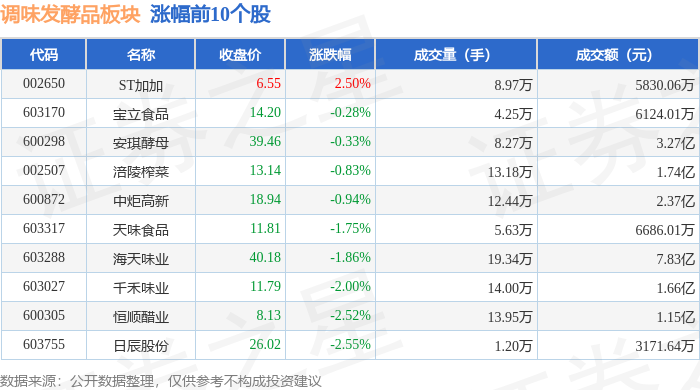
调味发酵品板块9月3日跌1.68%,安记食品领跌,主力资金净流出1.39亿元
Zheng Xing Xing Ye Ri Bao· 2025-09-03 08:40
Market Overview - The seasoning and fermentation sector experienced a decline of 1.68% on September 3, with Anji Food leading the drop [1] - The Shanghai Composite Index closed at 3813.56, down 1.16%, while the Shenzhen Component Index closed at 12472.0, down 0.65% [1] Individual Stock Performance - ST Jiajia (002650) saw an increase of 2.50%, closing at 6.55, with a trading volume of 89,700 shares and a turnover of 58.30 million yuan [1] - Anji Food (603696) reported a significant drop of 8.47%, closing at 11.99, with a trading volume of 227,700 shares and a turnover of 285 million yuan [2] - Hai Tian Flavoring (603288) decreased by 1.86%, closing at 40.18, with a trading volume of 193,400 shares and a turnover of 783 million yuan [2] Capital Flow Analysis - The seasoning and fermentation sector experienced a net outflow of 139 million yuan from institutional investors, while retail investors saw a net inflow of 102 million yuan [2] - The table of capital flow indicates that major stocks like Angel Yeast (600298) had a net outflow of 15.16 million yuan from institutional investors [3] - Tianwei Food (603317) had a net inflow of 11.17 million yuan from retail investors, despite a net outflow from institutional and speculative investors [3]