加密货币

Search documents
美国“诈骗中心打击小组”成立,已查获4亿美元加密货币
Sou Hu Cai Jing· 2025-11-13 12:25
Core Viewpoint - The establishment of a new inter-agency task force, the "Fraud Center Strike Team," aims to combat cryptocurrency investment scams in Southeast Asia, with significant recoveries of stolen assets already reported [1][3]. Group 1: Task Force Objectives and Achievements - The task force has seized $400 million in cryptocurrency and plans to confiscate an additional $80 million to return to victims [1][3]. - The initiative is part of a broader effort to ensure investment safety in the U.S. as the country seeks to become a global hub for the cryptocurrency industry [3]. - The task force is composed of various agencies, including the U.S. Attorney's Office for the District of Columbia, the Department of Justice, the FBI, the Treasury Department, and the Secret Service [3]. Group 2: Scope of Operations - The task force has initiated operations in multiple Southeast Asian locations, including Myanmar, Bali, and Thailand, targeting internet and money laundering activities [3]. - In Myanmar, the task force seized satellite terminals used for internet connectivity and fraudulent activities [3]. - In Thailand, FBI agents are collaborating with local authorities to dismantle scam operations, including those in the KK Park area [3]. Group 3: Infrastructure and Legal Actions - The task force is focused on shutting down infrastructure within the U.S. that supports fraudulent activities, including internet services and social media accounts [4]. - Recent legal actions include the indictment of the founder of the Cambodian "Prince Group" for human trafficking and cyber fraud, with $15 billion worth of Bitcoin seized as part of the investigation [4].


合丰集团|香港为稳定币立法,这到底是什么“币”?
Sou Hu Cai Jing· 2025-11-13 08:27
Core Insights - Hong Kong is embracing the rise of stablecoins with the implementation of the "Stablecoin Ordinance" effective August 1, 2025, establishing a licensing framework for this emerging digital asset [1][14] - Stablecoins are designed to maintain price stability, serving as a payment tool rather than an investment vehicle, by being pegged to stable assets like fiat currencies or commodities [3][5] - The mechanism for maintaining stability involves issuing institutions holding high-quality, liquid assets equivalent to the circulating stablecoin supply, ensuring a 1:1 backing [5][6] Group 1: Definition and Mechanism - Stablecoins are a type of cryptocurrency aimed at price stability, contrasting with volatile cryptocurrencies like Bitcoin and Ethereum [3] - They are issued by private entities and are pegged to assets such as fiat currencies or gold to maintain their value [3] - The stability of stablecoins is achieved through a reserve system where the issuing entity holds assets equal to the value of the stablecoins in circulation [5][6] Group 2: Applications and Benefits - Stablecoins act as a cash-like medium in the virtual asset space, facilitating transactions and serving as a store of value [8] - They offer advantages over traditional payment methods, including 24/7 operation and near-instantaneous transactions, which can significantly reduce costs and time for cross-border payments [8][10] - The potential applications of stablecoins span across various sectors, including cross-border payments, international trade settlements, decentralized finance (DeFi), and financial inclusion for unbanked populations [12][14] Group 3: Future Outlook - The implementation of the Stablecoin Ordinance positions Hong Kong as a key player in the global digital asset landscape, balancing financial innovation with regulatory oversight [14] - Stablecoins are expected to play a crucial role in the ongoing trend of "de-dollarization" in global trade, integrating into the real economy [14]

牛市前夕?XRP、狗狗币、PEPE有望引领上涨,三大币种亮点解析!
Sou Hu Cai Jing· 2025-11-13 06:12
Core Insights - Bitcoin reached a historical high of $126,080 but experienced a significant drop of over 20% following Trump's announcement of a 100% tariff on China, leading to a month-long adjustment period [2] - The market is stabilizing, and with the new year approaching, there is potential for renewed momentum, particularly for XRP, Dogecoin (DOGE), and Pepe (PEPE) [2] XRP - XRP aims to revolutionize global transactions with its fast and low-cost payment network, targeting to replace outdated systems like SWIFT [2] - Ripple's influence is growing, with major banks collaborating and recognition from the UN and the White House, positioning XRP's market cap at $146 billion [2] - XRP has surged 269% over the past year, reaching a high of $3.65 in July, outperforming Bitcoin's 22% increase [2][4] - Technical indicators suggest a bullish trend, with a potential target of $10 by early 2026 if the U.S. approves an XRP spot ETF and reforms securities laws [4] Dogecoin (DOGE) - Launched in 2013, Dogecoin remains the leading meme coin with a market cap of $26.7 billion, supported by a loyal community [6] - The coin gained mainstream attention in 2021, driven by endorsements from celebrities like Elon Musk [6] - Currently priced at $0.16, Dogecoin is poised for a potential breakout, with supporters believing it could surpass $1 in the next bull market [6] Pepe (PEPE) - Pepe, launched in April 2023, gained popularity through the "Boy's Club" comic and has a market cap exceeding $2.5 billion [6] - The current price is $0.0000061, down 79% from its peak of $0.00002803 in late 2024, but showing signs of stabilization [8] - With a strong meme culture and low price point, PEPE is expected to break historical highs if market sentiment improves [8] Market Outlook - The adjustment phase in the crypto market is seen as a healthy reset, setting the stage for potential growth in XRP, DOGE, and PEPE as the new year approaches [2][8] - The combination of XRP's technological advancements, DOGE's resilient ecosystem, and PEPE's meme-driven popularity positions them as key candidates for the next market rally [8]

比特币涨不动了?28亿资金已然撤离,机构大买家“悄然退场”
Jin Shi Shu Ju· 2025-11-13 04:17
Core Insights - Bitcoin is struggling to recover after a poor performance in October, lacking the strong institutional support that previously drove its price to record highs [1] - Institutional investors, who were once the backbone of Bitcoin's legitimacy and price stability, have retreated from the market, leading to a shift in market expectations [1][2] - The overall inflow into spot Bitcoin ETFs has exceeded $25 billion, but recent outflows indicate a potential loss of confidence among large investors [2][3] Group 1 - The market shows signs of fatigue, with Bitcoin only achieving a 10% increase this year, significantly underperforming compared to gold and tech stocks [2] - Professional investors are losing patience, and there is a risk that they may advise clients to reduce their Bitcoin holdings if prices continue to stagnate [2] - Recent data indicates a net outflow of approximately $2.8 billion from spot Bitcoin ETFs in the past month, suggesting a cautious approach from new investors [2][3] Group 2 - On-chain signals reveal that long-term holders are selling at highs, and if Bitcoin falls below the critical support level of $93,000, more holders may be forced to exit [3] - The number of Bitcoin "whales" (wallets holding over 1,000 BTC) is decreasing, while the number of small holders is increasing, indicating a shift in market dynamics [3] - Citigroup analysts note that the current stagnation in fund inflows is suppressing price increases, as typically $1 billion in weekly inflows can boost prices by about 4% [3] Group 3 - Despite the weakening momentum in the crypto market, there are no signs of panic, and Bitcoin's price has still seen significant increases over the past 18 months [4] - Bitfinex analysts caution against interpreting recent data as panic selling, suggesting that large holders are not in a state of distress but are taking profits in a soft ETF demand environment [5] - The current rebalancing phase may reset market positions and volatility, potentially setting the stage for the next price increase once liquidity improves [5]
Taiwan May Add Bitcoin to National Reserves — Lawmakers Push for Full Audit by Year-End
Yahoo Finance· 2025-11-13 01:44
Core Viewpoint - Taiwan's legislature is urging the government to audit its Bitcoin holdings and consider the cryptocurrency for strategic reserves, aiming to diversify away from reliance on the US dollar [1][3][4]. Group 1: Legislative Actions and Concerns - Kuomintang legislator Ju-Chun Ko raised concerns about Taiwan's heavy exposure to the US dollar and the increasing relevance of digital currencies during a Legislative Yuan session [3]. - Over 90% of Taiwan's foreign exchange reserves, totaling $602.94 billion as of September 2025, are in US dollars, which lawmakers argue increases risk from currency fluctuations and policy changes [4]. - Ko warned that over-reliance on the US dollar could lead to currency depreciation risks, threatening the purchasing power of reserves and macroeconomic stability [5]. Group 2: Bitcoin Audit and Strategic Use - Ko called for an immediate inventory of all government-held Bitcoin, including assets seized in legal cases, highlighting the potential value of these digital assets [6][7]. - In 2024, Taiwanese prosecutors confiscated approximately $146 million in cryptocurrency, emphasizing the importance of holding these assets for strategic use rather than liquidating them quickly [6][7]. Group 3: Government Response and Global Context - Premier Cho Jung-tai acknowledged the dominance of the US dollar but expressed openness to evaluating emerging digital assets, with a commitment to provide a balanced report on a Bitcoin reserve strategy by the end of 2025 [8]. - Taiwan's exploration of Bitcoin reserves aligns with a global trend, as seen in the US where President Trump signed an executive order for a Strategic Bitcoin Reserve [9]. - Several US states are also advancing Bitcoin reserve laws, including the BITCOIN Act of 2025, which mandates the US Treasury to purchase up to one million Bitcoin over five years [10].
道指创新高 中概股多数下跌 大全新能源跌近10% 金价重回4200美元
2 1 Shi Ji Jing Ji Bao Dao· 2025-11-12 23:33
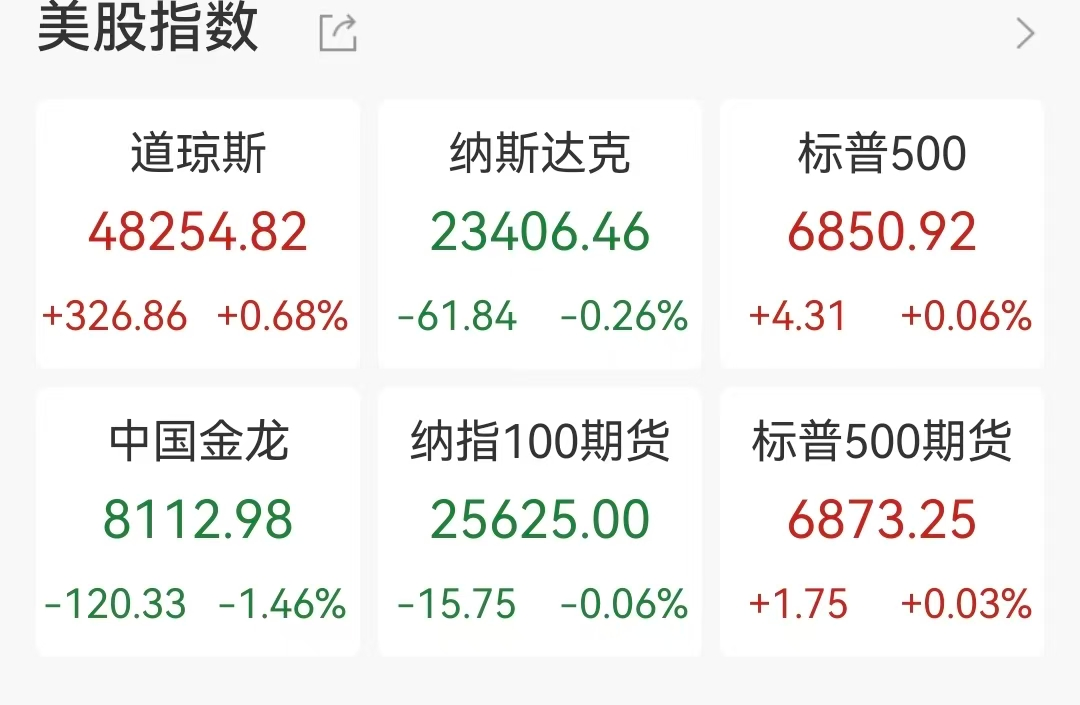
Market Performance - On November 12, the U.S. stock indices closed mixed, with the Dow Jones rising by 0.68% to 48,254.82 points, marking a new closing high [1][2] - The S&P 500 index increased by 0.06%, while the Nasdaq fell by 0.26% [1][2] Sector Performance - The technology sector showed mixed performance, with the semiconductor sector leading gains; the Philadelphia Semiconductor Index rose by 1.47% [2] - AMD's stock surged by 9% after the company projected an overall revenue growth of approximately 35% annually over the next three to five years, with AI chip business growth potentially reaching 80% annually [2] - Oracle's stock dropped by 3.88% following a downgrade of its debt rating to "underweight" by Barclays, which warned of a potential downgrade to BBB-, just one step above "junk" status [2] Chinese Stocks - The Nasdaq China Golden Dragon Index fell by 1.42%, with notable declines in several Chinese stocks, including Daqo New Energy down nearly 10% and Tencent Music down over 8% [3] Commodity Market - Crude oil prices fell, with the WTI crude oil contract down by 4.19% and Brent crude down by 3.74%, influenced by OPEC's downward revision of global oil demand forecasts [3] - Gold prices rose, with spot gold reaching $4,200 per ounce, marking a 2% increase [3] Cryptocurrency Market - The cryptocurrency market saw a decline, with Bitcoin down by 1.04% and Solana down nearly 2%, leading to over 147,000 liquidations in the past 24 hours, totaling $562 million [4] Economic Outlook - Analysts noted that weak U.S. employment data has strengthened market expectations for a Federal Reserve rate cut, contributing to a more optimistic market sentiment [4] - AMD's CEO provided a positive outlook for the AI market, predicting the global AI chip market could reach $1 trillion by 2030 [4] - JPMorgan's report indicated that the semiconductor cycle driven by AI is far from peaking, with its duration expected to extend until 2027 [4]

迪拜法院冻结 4.56 亿美元资产,涉 Justin Sun 救助 TrueUSD 发行方案件
Xin Lang Cai Jing· 2025-11-12 19:37
来源:市场资讯 迪拜数字经济法院已对与 Justin Sun 为稳定币 TrueUSD 发行方 Techteryx 提供救助相关的 4.56 亿美元资 金发出全球资产冻结令。案件焦点在于 TrueUSD 储备资金是否被违规转入总部位于迪拜的贸易融资公 司 Aria Commodities DMCC,用于大宗商品、矿业及其他非流动性项目投资。法院裁定 Techteryx 已提 出可信的信托侵占主张,并指出 Aria 未能提供资金流向及资产归属的证据,存在资产转移风险。 (CoinDesk) (来源:吴说) ...
SEC Chair Paul Atkins Reveals Which Crypto Tokens He Thinks Are Securities
Yahoo Finance· 2025-11-12 15:45
Core Viewpoint - SEC Chair Paul Atkins clarified the regulatory stance on crypto tokens, indicating that many popular tokens may not be classified as securities under SEC jurisdiction [1][4]. Group 1: Categories of Crypto Tokens - Certain categories of crypto tokens, such as "network tokens" linked to decentralized blockchain networks, are not considered securities [2]. - "Digital collectibles," which represent rights to media or reference internet memes and trends, are also exempt from SEC regulation [3]. - "Digital tools," which provide practical functions like tickets or memberships, are classified as non-securities [3]. Group 2: SEC's Regulatory Approach - Atkins emphasized that an asset should only be deemed a security if third-party managerial efforts are essential to its future value [4]. - Most crypto tokens are purchased with the expectation of future profits, but they will not be classified as securities unless purchasers expect profits from the managerial efforts of others [5]. - If a crypto token qualifies as an investment contract, it could revert to a non-security status if the issuer fulfills or fails to meet their promises [5]. Group 3: Tokenized Securities - Tokenized securities, which represent already regulated securities trading on-chain, will continue to be regulated by the SEC [5].
稳定币巨头Circle(CRCL.US)Q3业绩超预期,USDC流通量同比翻倍
Zhi Tong Cai Jing· 2025-11-12 13:05
Group 1 - Circle's Q3 revenue exceeded analyst expectations, reaching $740 million, a 65.9% year-over-year increase, with earnings per share at $0.64, surpassing the expected $0.46 [1] - The company's net profit for Q3 was $214.4 million, compared to $71 million in the same period last year [1] - Circle's stablecoin USDC circulation increased over 100% year-over-year, reflecting growing market enthusiasm for stablecoins [1] Group 2 - Despite a cumulative stock price increase of over 200% since its IPO, Circle's stock has fallen more than 60% from its summer peak [2] - Analysts express concerns that a significant portion of Circle's revenue is derived from U.S. Treasury bonds and other interest-bearing instruments, which may be under pressure following the Federal Reserve's interest rate cuts [2] - Circle is actively diversifying its revenue streams by launching new products, including a blockchain-based payment network and tokenized money market funds [2]

算力争霸:比特币挖矿背后,中美正在争夺全球经济的新权力钥匙
Sou Hu Cai Jing· 2025-11-12 12:30
Core Insights - China was once the global center for cryptocurrency, controlling 80% of Bitcoin production and 85% of trading volume, but has now been overtaken by the U.S. following the "9.24 ban" which classified cryptocurrency mining as an "eliminated industry" [1][35][36] - The U.S. is promoting "green mining" by utilizing wasted energy as a strategic asset, positioning itself as the new leader in the cryptocurrency space [1][10] Group 1: Bitcoin as an Energy Resource - Bitcoin mining is often criticized for wasting energy, with the energy required to mine one Bitcoin equivalent to the annual electricity consumption of about 80 American households [4][5] - Both the U.S. and China experience significant amounts of wasted electricity annually, with China alone discarding 5.59 billion kilowatt-hours of wind and solar energy in 2024 [8] - In the U.S., 19% of wasted electricity is projected to be consumed by mining operations by 2025, resulting in a reduction of 1.3 million tons of CO₂ emissions [11] Group 2: U.S. Strategic Initiatives - The U.S. has introduced the "FLARE Act" to utilize associated gas from oil extraction for powering mining operations, effectively reducing pollution while mining [16][17] - The merger of Hut8 and the Trump family's "American Data Center Company" to form "American Bitcoin Company" highlights the political and financial interests in the mining sector [21][22] - The Trump administration has positioned Bitcoin alongside gold and oil, promoting it as a tool for economic stability and risk hedging [27][28] Group 3: China's Potential Strategies - Experts suggest that China could convert its wasted electricity into Bitcoin as a form of energy reserve, adopting a model similar to Texas's "solar + storage + mining" approach [40] - Establishing a digital RMB stablecoin and enhancing cross-border settlements could help China regain its footing in the cryptocurrency market [41][42] - Accelerating the production of advanced chips domestically to reduce reliance on foreign suppliers like TSMC is crucial for China's competitiveness in the mining hardware sector [45][46] Group 4: The Broader Implications - The CEO of Core Scientific emphasizes that the U.S. aims to "weaponize" Bitcoin by controlling energy through mining operations [48] - China's ability to convert wasted electricity into computational power, combined with a stablecoin strategy, could reshape the balance of power in the global economy [49][51] - The next decade will see Bitcoin mining evolve beyond a technical competition to a significant shift in civilizational dynamics [52]