
高风险资产

Search documents
比特币升破88000美元,加密货币近1个月蒸发万亿美元市值
2 1 Shi Ji Jing Ji Bao Dao· 2025-11-25 10:30
Core Insights - The cryptocurrency market has experienced a significant rebound, with Bitcoin briefly surpassing $88,000, reflecting a 1.45% increase in the last 24 hours, while Ethereum rose over 3% and XRP nearly 8% [1][2] - Despite the rebound, over 110,000 traders faced liquidation, with a total liquidation amount of $366 million [1][2] - Bitcoin's price has seen a drastic decline from a peak of approximately $125,000 in early October to around $80,000, marking a 35% drop and resulting in a total market cap loss of about $1 trillion [2][4] Market Dynamics - The primary reason for Bitcoin's price drop is the changing macroeconomic expectations in the U.S., particularly regarding the Federal Reserve's stance on interest rates, which has led to reduced liquidity in the market [4] - Institutional investors are reducing leverage and selling high-risk assets like Bitcoin in response to rising funding costs, creating initial selling pressure [4] - The anticipated favorable regulatory environment for cryptocurrencies has not materialized, leading to a decline in market sentiment and a subsequent downward spiral in prices [4] Market Sentiment - As the market enters a downtrend, investor sentiment deteriorates, prompting accelerated deleveraging and reduced trading willingness, which perpetuates the downward cycle [4] - Increasing global regulatory scrutiny on cryptocurrencies has shattered the illusion of "absolute safety" associated with crypto assets, leading to a more cautious market outlook [4]

比特币升破88000美元,加密货币近1个月蒸发万亿美元市值
21世纪经济报道· 2025-11-25 10:26
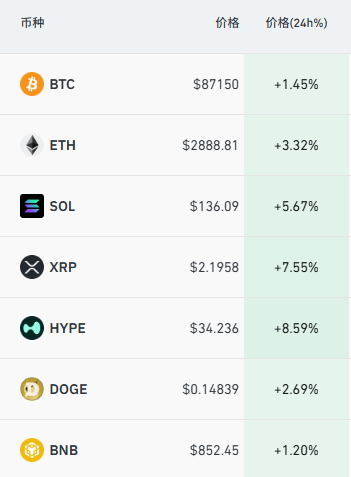
Market Overview - The cryptocurrency market experienced a significant rebound, with Bitcoin briefly surpassing $88,000, reflecting a 1.45% increase over the past 24 hours. Ethereum rose over 3%, SOL increased by more than 5%, and XRP saw an increase of nearly 8% [1][2]. - Over 110,000 traders faced liquidation, with a total liquidation amount of approximately $3.81 billion in the last 24 hours [3]. Price Movements - Bitcoin reached a price of $87,150, marking a 1.45% increase [2]. - Ethereum was priced at $2,888.81, with a 3.32% rise [2]. - SOL was valued at $136.09, reflecting a 5.67% increase [2]. - XRP traded at $2.1958, showing a 7.55% increase [2]. - HYPE and DOGE also saw increases of 8.59% and 2.69%, respectively [2]. Liquidation Details - In the last 24 hours, the total liquidation amount was $3.81 billion, with significant amounts liquidated over various time frames, including $26.26 million in 4 hours and $74.96 million in 1 hour [3]. - The total liquidation amount over the past 12 hours was approximately $139 million [3]. Market Dynamics - Bitcoin's price fell from a peak of about $125,000 in early October to around $80,000, representing a decline of 35%. This drop led to a loss of approximately $1 trillion in total market capitalization, erasing all gains made since the beginning of the year [3][5]. - The primary reasons for Bitcoin's decline include changing macroeconomic expectations in the U.S., where the Federal Reserve's stance on interest rates has tightened liquidity, impacting high-risk assets like Bitcoin [5]. - Additionally, the anticipated favorable regulatory environment for cryptocurrencies has not materialized, leading to a loss of bullish sentiment in the market [5]. - The increasing global regulatory scrutiny on cryptocurrencies has also contributed to a shift in market perception, challenging the notion of cryptocurrencies as both speculative tools and safe-haven assets [5].

帮主郑重:比特币年内涨幅全蒸发,机会还是陷阱?
Sou Hu Cai Jing· 2025-11-17 06:08
Core Viewpoint - Bitcoin has experienced a significant decline, dropping from a historical high of $126,000 in early October to below $93,700, erasing over 30% of its gains for the year and entering a "technical bear market" [1] Group 1: Reasons for the Decline - Institutional investors are withdrawing large amounts of capital, leading to a loss of core market support, with Bitcoin ETF inflows shifting from stable to net outflows [3] - Changes in the macroeconomic environment, including the impact of Trump's tariff policies and a cooling of Federal Reserve rate cut expectations, have negatively affected risk assets, with Bitcoin being sold off as a high-risk asset [3] - A leveraged bubble has burst, resulting in 160,000 liquidations within 24 hours and a total liquidation amount of $580 million, exacerbating losses and triggering a chain reaction of sell-offs [3] - Long-term holders are accelerating their sell-off, with some early investors viewing $100,000 as a psychological profit-taking point, selling at a rate of over 1,000 BTC per hour [4] Group 2: Implications for Medium to Long-term Investors - Caution is advised for short-term investors as market sentiment is extremely pessimistic and institutional funds have not yet returned, suggesting a need to wait for stabilization signals before attempting to buy the dip [6] - The long-term investment thesis remains intact due to Bitcoin's scarcity and institutional demand, with potential buying opportunities if prices drop to key support levels (e.g., $60,000 to $65,000) [6] - Investors should be wary of high leverage traps, as the volatility in cryptocurrency markets can lead to significant losses; focusing on spot trading is recommended [7]

连续被血洗!今年前十个月的涨幅,币圈一个月跌完了
美股研究社· 2025-11-10 11:07
Core Viewpoint - The cryptocurrency market has erased nearly all gains accumulated in the first ten months of the year within just over a month, with Bitcoin's price dropping significantly from its record high [2][4]. Group 1: Market Performance - Bitcoin's price rebounded to above $103,000 after a week of sharp declines but remains approximately 18% lower than its record high of $120,000 set on October 6 [2][3]. - The total market capitalization of cryptocurrencies peaked at nearly $440 billion on October 6 but has since fallen by about 20%, leaving only a 2.5% gain year-to-date [4]. Group 2: Investor Sentiment - The decline in cryptocurrencies is causing concern among Wall Street, as Bitcoin is viewed as a leading indicator for high-volatility stocks [4][16]. - The previously successful "buy the dip" strategy is failing, leading to increased market caution [6][10]. - Recent data shows that investors withdrew over $700 million from digital asset ETFs in just one week, with nearly $600 million coming from BlackRock's Bitcoin fund [12]. Group 3: Correlation with Tech Stocks - The recent cryptocurrency crash coincides with concerns over the valuation of AI tech stocks, indicating a cooling risk appetite in high-risk asset classes [6][8]. - Stocks like Palantir, which are closely associated with AI and cryptocurrencies, have seen significant declines, reflecting a broader trend affecting meme stocks and unprofitable tech companies [6][11]. Group 4: Market Dynamics - The lack of new capital inflow into alternative tokens and DeFi projects has been noted, with most areas of the crypto market remaining stagnant [13]. - A significant liquidation of leveraged positions worth approximately $19 billion occurred weeks ago, and the market has yet to recover from this shock [15]. - The number of long-term "whale" investors is declining, raising concerns about tightening liquidity in the market [17].

巨鲸抛售加剧,连续被血洗,今年前十个月的涨幅,币圈一个月跌完
Sou Hu Cai Jing· 2025-11-09 10:23
Core Viewpoint - The cryptocurrency market has experienced significant volatility, with Bitcoin's price dropping from a peak of $120,000 to around $99,000 in just over a month, leading to a substantial decrease in overall market capitalization [1][3][17] Market Performance - On October 6, Bitcoin reached a high of $120,000, contributing to a total cryptocurrency market capitalization of approximately $4.4 trillion [1] - By early November, Bitcoin fell below $100,000, with a low around $99,000, marking a decline of nearly 20% in total market capitalization over the month [3][17] - The overall gains from the beginning of the year have diminished significantly, leaving only a fraction of the initial increase [3] Investor Behavior - There has been a notable shift in investor sentiment; previously, dips in cryptocurrency prices prompted buying, but this behavior has ceased [10] - In the past week, over $700 million was withdrawn from digital asset ETFs, with nearly $600 million flowing out of BlackRock's Bitcoin fund alone [10] - The number of long-term Bitcoin holders, referred to as "whales," has decreased, raising concerns about market liquidity [15] Market Dynamics - The cryptocurrency downturn coincided with a broader sell-off in AI technology stocks, indicating a correlation between high-risk assets [6][17] - A significant number of investors faced liquidation, with over 400,000 being liquidated globally, resulting in losses exceeding $2 billion, predominantly from long positions [3][12] - Analysts suggest that the lack of new capital entering the market is exacerbating the situation, as existing investors exit without sufficient new investment to stabilize prices [12] Future Outlook - Analysts warn that if Bitcoin falls below the $100,000 mark, further declines could occur, potentially dropping to $70,000 [15] - The recent market turbulence serves as a reminder of the inherent risks associated with high-risk assets, emphasizing the importance of careful investment strategy [17][18]
道富集团:投资者对风险资产的乐观情绪恐已过度
Ge Long Hui A P P· 2025-10-23 10:45
Core Viewpoint - Investor confidence in high-risk assets may be overstated, as indicated by Dwyfor Evans, the Asia-Pacific Macro Strategy Head at State Street Global Markets [1] Group 1: Market Trends - Investors are currently buying U.S. stocks while hedging against dollar risk and selling U.S. Treasury bonds [1] - Evans anticipates a gradual rise in U.S. inflation due to increases in both imported and domestic goods prices, suggesting that "3% has become the new 2%" [1] Group 2: Implications for Monetary Policy - The rising inflation is crucial for the Federal Reserve, as fewer rate cuts could lead to a rebound in the dollar [1] - Given the ongoing policy uncertainty, Evans warns that current market risk positions may be overly optimistic [1]
道富:9月机构投资者持续增持高风险资产
Ge Long Hui A P P· 2025-10-08 13:01
Core Insights - State Street Corporation's institutional investor risk appetite indicator remained positive in September, marking five consecutive months of optimistic sentiment, with the latest value matching the 2025 high reached in July [1] - As of the end of September, long-term investors maintained their asset allocation in equities, fixed income, and cash, indicating that funds have not returned to long-duration bonds, with fixed income holdings significantly below long-term averages, suggesting a continued preference for high-risk assets among institutional investors [1] Group 1 - The foreign exchange market has seen significant dollar selling, with the reduction reaching the highest level since early 2021, as funds flow into carry trade currencies, with investors increasing their positions in high-risk commodity currencies like the Canadian dollar and Australian dollar [1] - In the equity market, North America remains the most favored region, with increased buying momentum in U.S. stocks pushing up positions, while buying in Asian emerging market stocks has slowed [1] - Demand for fixed income products is moderate, but emerging market bonds have regained popularity among investors [1]
