
电子商务

Search documents
高盛CEO“敲警钟”:若规模再飙升且经济疲软,美国政府债务将面临“清算”
Zhi Tong Cai Jing· 2025-11-12 03:21
Core Viewpoint - Goldman Sachs CEO David Solomon warns about the rising U.S. national debt, stating that if the current fiscal path continues without significant economic expansion, there will be consequences [1][4] Debt Concerns - Solomon highlights the accelerated growth of U.S. debt over the past five years, with total debt increasing from approximately $10 trillion in 2008 to over $30 trillion currently, more than three times the original amount [1] - The U.S. federal debt is projected to grow from $37 trillion to $38 trillion in 2025, marking the fastest increase outside of the pandemic [1] Economic Growth vs. Revenue Generation - Solomon emphasizes that addressing the debt issue should focus on economic growth rather than increasing taxes or finding new revenue sources, noting a significant gap between a 3% compound growth rate and the current 2% potential growth rate [2] - He expresses optimism about higher economic growth potential due to factors like corporate technology applications and ongoing infrastructure investments, with major companies expected to invest $350 billion in infrastructure this year [2] Short-term Economic Outlook - Despite long-term debt concerns, Solomon assesses the current short-term economic situation as relatively positive, suggesting a low likelihood of recession in the near term [3] - He acknowledges the unpredictability of U.S. policies and the necessity for business leaders to adapt to policy changes [3] Financial Stability and Debt Management - Solomon stresses the importance of maintaining key financial stability mechanisms, including the independence of the Federal Reserve, which has played a positive role globally [3] - He warns that if debt continues to grow, the responsibility for addressing U.S. fiscal issues will ultimately fall on the country itself rather than other nations [4]
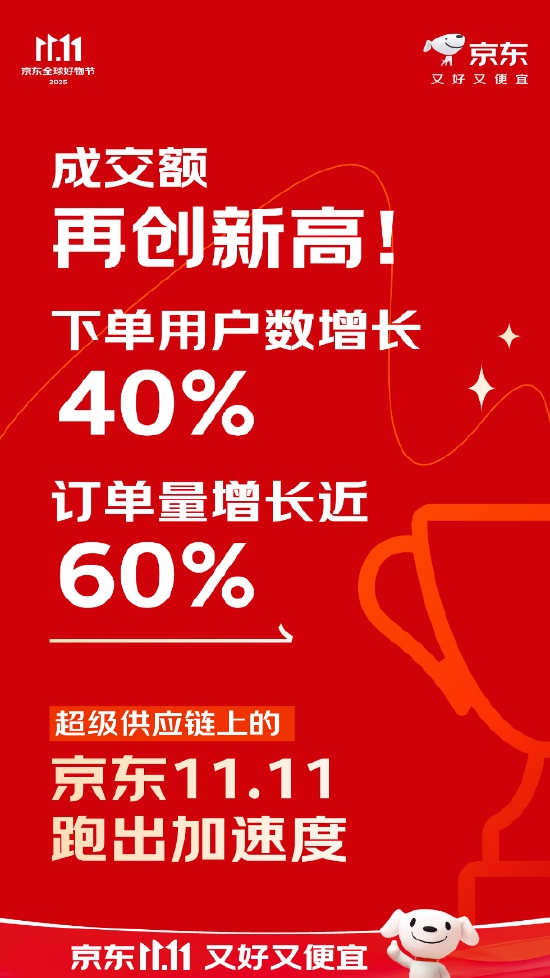
京东披露“双11”成绩单:下单用户数增长40%,订单量增长近60%
Mei Ri Jing Ji Xin Wen· 2025-11-12 03:20
Core Insights - JD.com achieved a record high transaction volume during the "Double 11" shopping festival, with a 40% increase in the number of users placing orders and nearly a 60% increase in order volume [1] Summary by Categories - **Transaction Performance** - JD.com's "Double 11" transaction volume reached a new high [1] - The number of users placing orders increased by 40% [1] - The total order volume saw a growth of nearly 60% [1]

传唯品会(VIPS.US)考虑最早明年在香港上市
Zhi Tong Cai Jing· 2025-11-12 02:57
Group 1 - Vipshop (VIPS.US) is considering a potential listing in Hong Kong as early as next year, with discussions ongoing and no confirmation yet on the plan [1] - Founded in August 2008 and headquartered in Guangzhou, China, Vipshop is a leading brand discount e-commerce platform focused on "brand flash sales" [1] - Vipshop went public on the New York Stock Exchange (NYSE) in March 2012, raising $71.5 million at an initial price of $6.5 per share [1] - The company's stock price has increased by 47% this year, bringing its market capitalization to $10.2 billion [1] Group 2 - For Q2 2025, Vipshop reported revenue of 25.8 billion RMB, a year-over-year decline of 4.09% [2] - The Non-GAAP net profit attributable to shareholders was 2.1 billion RMB, down from 2.2 billion RMB in the same period last year [2] - Adjusted earnings per ADS were 4.06 RMB, compared to 3.91 RMB in the previous year [2] - The total Gross Merchandise Volume (GMV) for Q2 was 51.4 billion RMB, reflecting a year-over-year growth of 1.7% [2] - Active user count decreased to 43.5 million from 44.3 million year-over-year, while total order volume fell to 193 million from 197.8 million [2] - Vipshop expects Q3 2025 net revenue to be between 20.7 billion and 21.7 billion RMB, indicating a year-over-year growth of approximately 0% to 5% [2]

新股消息 | 传唯品会(VIPS.US)考虑最早明年在香港上市
智通财经网· 2025-11-12 02:36
Group 1 - The core viewpoint of the news is that Vipshop (VIPS.US) is considering a potential listing in Hong Kong as early as next year, with discussions ongoing with financial advisors [1] - Vipshop was founded in August 2008 and is headquartered in Guangzhou, China, focusing on brand discount e-commerce [1] - The company went public on the New York Stock Exchange in March 2012, raising $71.5 million at an initial price of $6.5 per share [1] - Vipshop's stock price in the US has increased by 47% this year, bringing its market capitalization to $10.2 billion [1] Group 2 - For Q2 2025, Vipshop reported revenue of 25.8 billion RMB, a year-on-year decrease of 4.09% [2] - The company's Non-GAAP net profit for the same period was 2.1 billion RMB, down from 2.2 billion RMB in the previous year [2] - The adjusted earnings per ADS were 4.06 RMB, compared to 3.91 RMB in the same quarter last year [2] - The total Gross Merchandise Volume (GMV) for Q2 was 51.4 billion RMB, reflecting a year-on-year growth of 1.7% [2] - The number of active users decreased to 43.5 million from 44.3 million year-on-year, and total orders fell to 193 million from 197.8 million [2] - Vipshop expects Q3 2025 net revenue to be between 20.7 billion and 21.7 billion RMB, indicating a year-on-year growth of approximately 0% to 5% [2]
别让价格欺诈寒了消费者的心
Xin Hua Wang· 2025-11-12 02:23
Group 1 - The core issue of price fraud during the "Double Eleven" shopping festival has emerged, with platforms and merchants employing tactics such as "price hikes followed by discounts" and new deceptive practices [1][2] - Consumers have reported various forms of price manipulation, including sudden cessation of subsidies, unselected consumption coupons, and higher prices for pre-sale items compared to current stock [1][2] - The competitive logic in the industry has become distorted, leading to price fraud as a means for some merchants to balance costs and profits, which could harm brand reputation and competitiveness in the long run [2] Group 2 - Regulatory bodies have begun to take notice of the issues surrounding "Double Eleven," issuing consumer alerts to promote rational and informed shopping practices [2] - To effectively address price fraud, a comprehensive approach is needed, including stronger regulatory oversight and a shift in focus for platforms and merchants towards transparent pricing and improved product quality [2] - The industry must abandon short-sighted strategies focused on traffic acquisition and return to a consumer-friendly approach that emphasizes value and service [2]
价格迷局不破,“双11”终将失去人心
Xin Lang Cai Jing· 2025-11-12 02:22
Core Insights - The "Double 11" shopping festival, originally intended to benefit consumers, has become a complex pricing maze, leading to widespread consumer dissatisfaction [1][2][3] Group 1: Pricing Issues - Consumers are experiencing a phenomenon of "price manipulation," where prices are raised before discounts are applied, creating a false sense of savings [1] - The issue of "big data price discrimination" allows for dynamic pricing strategies that result in different prices for different consumers, undermining fair competition [1] - The revised Anti-Unfair Competition Law prohibits practices like "big data price discrimination," but enforcement challenges remain due to technical barriers [1] Group 2: Regulatory and Platform Responsibilities - Regulatory bodies need to enhance enforcement and technical capabilities to ensure price fairness and transparency in the market [2] - Shopping platforms must take responsibility by clarifying marketing terms, standardizing price displays, and establishing a blacklist for dishonest merchants [2] - Consumers should be vigilant against deceptive pricing tactics and retain evidence of transactions to protect their rights [2] Group 3: Consumer Sentiment and Market Impact - The complexity of discount rules and misleading pricing strategies are leading to a decline in consumer trust and participation in the "Double 11" event [2] - The core appeal of "Double 11" lies in providing genuine discounts; without this, the event risks losing its relevance [2][3] - A transparent and predictable shopping environment is essential for restoring consumer confidence and ensuring the healthy development of the e-commerce ecosystem [3]


消息确认:巨头宣布大裁员!涉及多个核心部门
Sou Hu Cai Jing· 2025-11-12 02:22
Core Insights - Amazon has announced a global organizational optimization, resulting in a net reduction of approximately 14,000 corporate jobs, marking the largest restructuring since late 2022 [1][2] - The layoffs affect multiple core departments, including Human Resources, AWS, Advertising, and Devices & Services, with a significant impact on the China region where some departments have seen a 50% reduction [2] - Since 2022, Amazon has laid off over 27,000 employees, driven by a strategy focused on AI transformation and organizational flattening [2][3] Organizational Changes - The layoffs are part of Amazon's strategy to focus on AI transformation and make the organization more agile, reallocating resources to priority areas [3] - Amazon's Senior Vice President of Human Experience and Technology, Beth Galetti, stated that the layoffs are necessary despite the company's strong performance, as the world is rapidly changing [3] - The company reported a net sales figure of $167.7 billion for Q2 of fiscal year 2025, a 13% year-over-year increase, with net profits rising 35% to $18.2 billion [3] International Business Performance - Amazon's international business growth has slowed, with a reported growth rate of 4.9% in Q1 of 2025, attributed to increased uncertainty in the global trade environment and competition from emerging platforms [4] - Employees have reported that middle management has been the primary target for layoffs, with strict criteria set by headquarters for those with fewer than seven direct reports [4] Strategic Shift - Amazon is transitioning from a strategy of "scale expansion" to "efficiency priority," with layoffs in the China region reflecting this global strategic adjustment [6] - The company aims to concentrate resources on high-profit and high-growth areas such as AI and cloud computing to enhance overall operational efficiency and profitability [6]


京东11.11:下单用户数增长40%,订单量增长近60%
Xin Lang Ke Ji· 2025-11-12 00:33
Core Insights - JD.com achieved record sales during the 11.11 shopping festival, with a 40% increase in the number of users placing orders and nearly a 60% increase in order volume compared to the previous year [1] - The sales of new mobile products surged over four times year-on-year, with significant growth in AI-related products and home appliances [1][2] - Innovative business models, including JD's entry into food delivery and travel services, saw substantial growth in order volumes and user engagement [2][3] Group 1: Sales Performance - JD.com’s 11.11 sales reached new heights, with mobile product sales increasing over 400% year-on-year [1] - AI tablet sales grew by 200%, while large-screen AI smartphones saw a 150% increase [1] - Home appliance sales increased by 150%, and the order volume for delivery and installation services rose by over 90% [1] Group 2: Category Growth - Nearly 500 categories in apparel, beauty, and sports saw sales growth exceeding 100% [1] - Over 30,000 brands in JD Supermarket experienced sales growth of over 100% [1] - The introduction of the "28-day fresh milk delivery" service led to a 110% increase in related milk product sales [1] Group 3: Innovative Business Models - JD's food delivery service partnered with over 2 million quality restaurants, resulting in a 13-fold increase in daily orders for top 300 restaurant brands [2] - JD Travel saw hotel orders increase nearly 8 times and flight orders grow by 6.3 times [2] - The number of JD's 3C digital stores exceeded 4,200, with sales growth over 100% [2] Group 4: Live Streaming and User Engagement - Live streaming orders during the 11.11 period increased by over 150%, with total user viewing time tripling [3] - The number of merchants participating in JD's live streaming was three times that of the previous year, and user viewing time for merchant live streams increased by 2.5 times [3]
韩国一电商平台正式破产!负债超20亿元!“受害人一分钱都拿不回来”……
Huan Qiu Wang Zi Xun· 2025-11-12 00:14
Group 1 - The South Korean e-commerce platform, Weimip, has officially declared bankruptcy due to debt issues, following a restructuring process that lasted 1 year and 4 months [1] - Approximately 108,000 victims are affected by the Weimip debt incident, with total losses amounting to about 580 billion KRW (approximately 2.8 billion CNY) [1] - Weimip's total assets are reported to be 48.6 billion KRW (approximately 2.4 million CNY), while total liabilities stand at 4.462 trillion KRW (approximately 22 billion CNY), indicating a severe financial crisis with almost no liquid assets [1] Group 2 - A committee formed by the victims has stated that the recovery rate is "0%", meaning they will not receive any compensation [3] - The committee criticized the current legal system in South Korea for failing to address the realities of the online commerce industry [3] Group 3 - Weimip is a subsidiary of the Singapore-based Korean e-commerce company Qutian and was once the fourth-largest e-commerce platform in South Korea [5] - The company applied for restructuring in late July last year, citing operational difficulties due to unpaid merchant payments and failure to refund consumers [5]

新供给、新场景、新技术——从“双11”看电商竞争新生态
Shang Hai Zheng Quan Bao· 2025-11-11 23:59
Core Insights - The "Double 11" shopping festival has evolved beyond a simple promotional event into a window for observing the evolution of the e-commerce ecosystem, marking its 17th year [1] - The focus has shifted from merely pursuing GMV (Gross Merchandise Volume) to a comprehensive competition based on supply precision, scene diversity, and technological depth, leading to a more resilient and innovative e-commerce ecosystem [1] New Supply Driving Growth - E-commerce platforms are proactively creating new supply by collaborating with brands and leveraging user insights to stimulate and lead potential consumption trends [2] - Suining Yigou has introduced personalized custom appliances tailored for county-level markets, resulting in over 85% year-on-year growth in sales of customized appliances during the "Double 11" period [2] - JD.com is also leveraging C2M (Customer-to-Manufacturer) reverse customization, with significant sales growth in AI products during the "Double 11" period, achieving over 100% year-on-year increase [3] New Scenarios Creating Demand - The rise of instant retail has blurred the boundaries of consumption scenarios, with platforms integrating online and offline channels and exploring deep content-consumption integration [4] - Taobao has implemented a new operational model by deeply coordinating Tmall and Taobao flash sales, resulting in over 1 billion orders during the "Double 11" period [4] - New retail formats are emerging, with JD.com reporting over 150% growth in online orders for its restaurant brand during the first week of "Double 11" [5] New Technologies Reshaping Experiences - Artificial intelligence is fundamentally transforming the e-commerce landscape, enhancing efficiency and optimizing experiences across the entire supply chain [7] - AI applications have been fully implemented in Tmall's "Double 11," offering various shopping assistance tools that cater to different consumer needs [7] - In logistics, AI and robotics have significantly automated the supply chain, with JD Logistics achieving over 95% automation coverage and a 1153% increase in the deployment of autonomous vehicles compared to the previous year [8]