
资产管理

Search documents
加密货币ETF的里程碑时刻! 资管巨头先锋放开交易 或将点燃比特币上攻之势
智通财经网· 2025-12-02 07:14
Core Viewpoint - Vanguard Group, the world's second-largest asset management company, has reversed its long-standing cautious stance on cryptocurrencies by allowing the trading of ETFs and mutual funds primarily holding cryptocurrencies on its platform, marking a significant policy shift [1][2][3]. Group 1: Vanguard's Decision - Starting from Tuesday, Vanguard will permit the trading of ETFs and mutual funds that hold specific cryptocurrencies, including Bitcoin, Ethereum, XRP, and Solana, on its platform [2][3]. - This decision comes after a significant market downturn, where the cryptocurrency market lost over $1 trillion in value since early October, suggesting a potential rebound for Bitcoin and other cryptocurrencies [2][6]. - The demand for cryptocurrency ETFs from both retail and institutional investors has been a core factor driving Vanguard's change in attitude [2][3]. Group 2: Market Context - Despite recent declines in cryptocurrency prices, related ETFs remain one of the fastest-growing segments in the U.S. fund management industry [3][8]. - Vanguard's move is seen as a psychological boost for cryptocurrency bulls, indicating that traditional financial institutions can no longer resist the allure of digital assets [3][6]. - The overall market has experienced significant sell-offs, but the embrace of cryptocurrency ETFs by Vanguard is viewed as a potential catalyst for a major price rebound in Bitcoin and other cryptocurrencies [6][8]. Group 3: Future Outlook - Vanguard will not immediately create its own cryptocurrency products like its competitors BlackRock and Ark Invest, and funds linked to "meme cryptocurrencies" will still be excluded [4]. - The company aims to provide a secure brokerage platform for its diverse client base, allowing them to invest in products of their choice [4]. - Analysts predict that the current downturn in Bitcoin prices may be a temporary correction, with expectations of a rebound as the market finds a new bottom [7][8].
财通资管董事长马晓立出席2025分析师大会暨第七届新浪财经金麒麟分析师盛典
Xin Lang Cai Jing· 2025-12-02 07:11
专题:2025分析师大会:资本市场"奥斯卡"启幕 11月28日,2025分析师大会重磅启幕,百位行研首席、公私募掌舵人、权威学者齐聚一堂,共寻穿越周 期的投资真谛。财通资管董事长马晓立出席2025分析师大会暨第七届新浪财经金麒麟分析师盛典并担任 颁奖嘉宾。 图:马晓立先生为获奖 责任编辑:石秀珍 SF183 专题:2025分析师大会:资本市场"奥斯卡"启幕 11月28日,2025分析师大会重磅启幕,百位行研首席、公私募掌舵人、权威学者齐聚一堂,共寻穿越周 期的投资真谛。财通资管董事长马晓立出席2025分析师大会暨第七届新浪财经金麒麟分析师盛典并担任 颁奖嘉宾。 马晓立 财通资管董事长 马晓立 财通资管董事长 图:马晓立先生为获奖 分析师颁奖 分析师颁奖 责任编辑:石秀珍 SF183 ...


高盛(GS.US)发力资管赛道!斥资20亿美元收购主动型ETF发行商Innovator
Zhi Tong Cai Jing· 2025-12-02 07:04
Core Viewpoint - Goldman Sachs is expanding in the rapidly growing asset management sector by acquiring Innovator Capital Management for approximately $2 billion in cash and stock, with the deal expected to close in the second quarter of 2026 [1] Group 1: Acquisition Details - The acquisition involves cash and stock valued at around $2 billion [1] - Key executives from Innovator, including co-founder and CEO Bruce Bond, will join Goldman Sachs Asset Management [1] - An additional 60 employees from Innovator are expected to integrate into Goldman Sachs' third-party wealth management and ETF teams [1] Group 2: Innovator's Performance - As of September 30, 2025, Innovator manages 159 outcome-oriented ETFs with an asset size of $28 billion, focusing on income, buffer, and growth strategies [1] - The shift towards active management has been driven by declining returns from passive index products due to tightening monetary policies [1] Group 3: Market Trends - The global active management ETF asset size has reached $1.6 trillion, growing at a compound annual growth rate of 47% since 2020 [2] - Goldman Sachs CEO David Solomon highlighted that active ETFs are a vibrant and transformative segment, representing one of the fastest-growing areas in public investment today [2]

当“稳健”不再等于保本 大资管如何重建客户信任?
Jing Ji Guan Cha Bao· 2025-12-02 03:21
Core Insights - The Chinese asset management industry is undergoing a significant transformation from "guaranteed returns" to "net value rationality" in the context of low interest rates and high market volatility [1][8] - The focus is shifting towards multi-asset and multi-strategy allocation paths to meet the changing wealth management needs of residents [1][3] Group 1: Industry Trends - The low interest rate environment is compressing traditional fixed-income asset yields, prompting a shift from "everything + fixed income" to "fixed income + everything" in asset allocation logic [1][3] - The wealth structure of Chinese residents is changing, with a decrease in the proportion of fixed deposits and an increase in demand for asset management products [3][4] - The collaboration between public funds and bank wealth management is increasing, leveraging the strengths of both sectors to enhance investment strategies [4][5] Group 2: Client-Centric Strategies - The essence of "stability" is subjective and should bridge the gap between professional logic and client perception through product transformation and clear communication [2][6] - The ultimate goal of asset management is not just numerical returns but ensuring clients' "sense of gain" through understanding product logic and managing expectations [6][8] - Financial institutions must focus on providing suitable products for different risk profiles, ensuring that clients can understand and manage their investments effectively [3][7] Group 3: Risk Management and Strategy - Financial institutions are prioritizing risk control and the achievement of certain returns within limited timeframes, especially in a low-yield, high-volatility market [3][7] - The integration of various strategies and the ability to assess their effectiveness is crucial for wealth management firms to meet client needs [4][5] - A comprehensive approach that includes strategy selection, language simplification, and ongoing client support will enhance market recognition and client loyalty [7][8]
汇丰投管:预计美联储本月将降息25个基点,明年1月再降息25个基点
Ge Long Hui A P P· 2025-12-02 02:17
格隆汇12月2日|汇丰投资管理预期,2026年环球GDP及利润增长将会趋于一致,加上与美国相比的估 值差距较大,两者将支撑市场回报表现扩大,但亦不排除美国投资表现保持稳健的可能性。在人工智能 (AI)投资的推动下,美国企业盈利或会保持强劲,虽估值看似偏高,但远不及互联网泡沫爆破时期般极 端。惟AI商业模式尚存在不确定性,或会在明年年引发更剧烈的市场波动。此外,美联储将于下周议 息,汇丰投管预计将降息25个基点,明年1月再降息25个基点。 汇丰投资管理亚洲区首席投资总监Michael Cross 表示,去年汇率波动及市场重估在推动回报方面发挥 关键作用,估值倍数上升、股票风险溢价下降及信贷息差收窄共同塑造了市场格局。展望2026年,市场 驱动力或会迎来转变,突显稳健的基本面对于可持续进步的重要性。 ...
上交所:中铁建资产管理有限公司债券12月3日上市,代码244322
Sou Hu Cai Jing· 2025-12-02 02:16
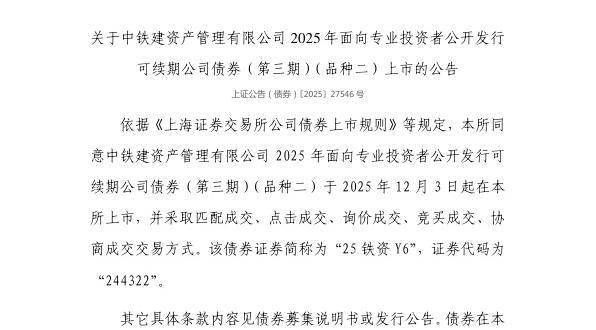
12月2日,上交所发布关于中铁建资产管理有限公司2025年面向专业投资者公开发行可续期公司债券 (第三期)(品种二)上市的公告。 来源:市场资讯 依据《上海证券交易所公司债券上市规则》等规定,上交所同意中铁建资产管理有限公司2025年面向专 业投资者公开发行可续期公司债券(第三期)(品种二)于2025年12月3日起在上交所上市,并采取匹 配成交、点击成交、询价成交、竞买成交、协商成交交易方式。该债券证券简称为"25铁资Y6",证券 代码为"244322"。 ...
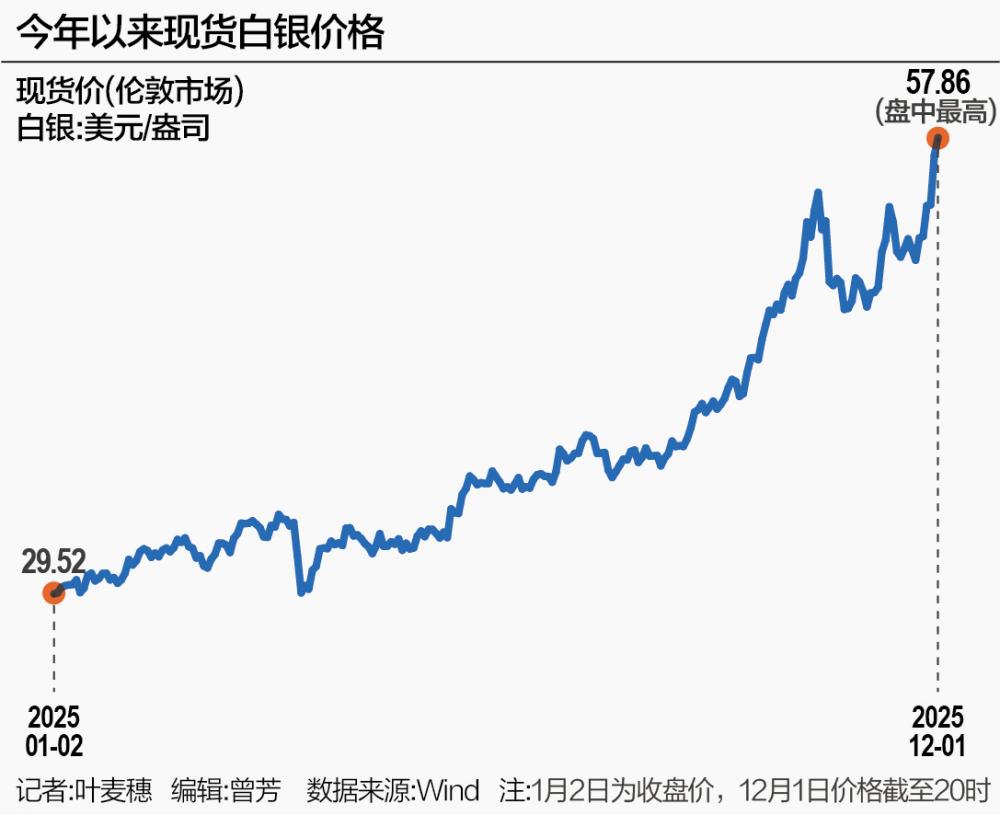
白银大涨创新高 年内价格几乎翻倍
2 1 Shi Ji Jing Ji Bao Dao· 2025-12-01 23:13
Group 1 - The core viewpoint of the articles highlights the significant rise in silver prices, driven by a combination of supply-demand dynamics and expectations of interest rate cuts by the Federal Reserve [4][5][6]. - Silver has experienced a remarkable increase, with prices reaching $57 per ounce, marking a year-to-date gain of nearly 100% [5][6]. - The Shanghai Futures Exchange reported that the main silver contract price surged to 13,520 yuan per kilogram, reflecting an increase of over 7% and marking eight consecutive months of price growth [5][6]. Group 2 - The Federal Reserve is expected to lower interest rates in December, with a probability of 87.4% for a 25 basis point cut, which is anticipated to support precious metal prices [4][5]. - The global silver supply has been in a state of shortage for the past five years, with increasing demand from the solar energy sector contributing to the price surge [5][6]. - Analysts suggest that the current economic environment, characterized by rising inflation and a weakening job market, is favorable for silver, which possesses both precious and industrial metal attributes [7][8]. Group 3 - The inflow of speculative funds and strong fundamentals have led to silver exhibiting greater price elasticity compared to gold [8]. - The largest silver ETF, SLV, reported a holding of 15,610.54 tons, indicating a daily increase of 28.21 tons, maintaining high levels of investment interest [9]. - Sales of silver investment products, such as silver bars and coins, have surged by over 40% year-on-year due to the recent price increases [10].
美联储未来会议分歧频现恐加剧市场波动风险
Sou Hu Cai Jing· 2025-12-01 22:07
美联储有时被批评过于追求决策一致性,但未来可能在利率议题上出现一系列分歧表决,这或将削弱其 政策信号效力。无论本次会议结果如何,出现多个反对票的可能性很高。在由12位票委组成的委员会 中,多达五位票委已对进一步降息表达了反对或怀疑态度,而有三位理事希望降息。Threadneedle固收 投资经理阿尔-侯赛因表示:"若出现7:5的分裂局面,将使试图为未来12到18个月利率合理路径定价的 利率市场将是一场混乱。对于寻求美联储政策确定性的风险资产而言,也将是一场混乱。"纽约梅隆投 资管理公司认为:2026年的政策前景将植根于政治经济学——白宫何时能在美联储理事会获得多数席 位?如果出现一系列由联储行长投出的反对票,理事会是否应在行长遴选方面采取行动?国会是否应采 取措施,改变由非总统任命、未经参议院确认的官员投票决定货币政策的现状?(格隆汇) ...
深耕投资能力 做好“五篇大文章”
Zhong Guo Zheng Quan Bao· 2025-12-01 20:25
Core Viewpoint - The China Securities Regulatory Commission (CSRC) emphasizes the importance of investor-centric principles in the public fund industry, highlighting the need for financial institutions to focus on the best interests of investors while promoting key areas such as technology finance, green finance, inclusive finance, pension finance, and digital finance as part of the strategy for building a strong financial nation [1] Group 1: Investor-Centric Approach - The company has served over 70 million clients and achieved a total profit of 97.123 billion yuan for investors, with dividends amounting to 56.416 billion yuan as of June 30 [1] - The company actively responds to the public fund industry's fee reform by lowering management fees for multiple products and initiating trials for floating fee rate products, thereby aligning the interests of management and investors [1][2] Group 2: Technology Finance Development - The company has increased its investment in technology-related sectors, with a focus on new energy, new materials, semiconductors, biotechnology, and clean energy, resulting in a technology stock holding of 83.7 billion yuan, accounting for 48% of its total holdings as of June 30 [3] - The company has expanded its technology research team, increasing the number of technology-focused fund managers by 70% since the end of 2020, to enhance its investment capabilities in the technology sector [3][4] Group 3: Product Innovation - The company manages 40 technology-themed funds with a total scale of 94.372 billion yuan, including actively managed funds focused on new energy and technology innovation [4] - The company has launched various ETFs related to strategic emerging industries, extending its investment tools to include technology-themed bond ETFs [4] Group 4: Pension Finance Initiatives - The company has established a dedicated pension and asset allocation department, managing six pension target funds with a total scale of 1.731 billion yuan as of September 30 [7] - The company emphasizes pension education through community outreach and educational initiatives to enhance public understanding of personal pension planning [7] Group 5: Green Finance Commitment - The company manages six green finance-themed funds with a total scale of 11.022 billion yuan, focusing on ESG-related investments since 2008 [8] - The company has developed a localized ESG rating system covering all A-shares and Hong Kong stocks, integrating international standards with local characteristics [8] Group 6: Digital Transformation - The company has strengthened its information technology team and enhanced AI capabilities to improve digital governance and operational efficiency [9] - The company has implemented digital platforms for investment research and trading, improving lifecycle management of investment instructions [9]
高盛宣布同意收购创新者资本管理公司
Ge Long Hui A P P· 2025-12-01 13:05
格隆汇12月1日丨高盛集团股份有限公司今天宣布,已达成协议,收购InnovatorCapitalManagement (Innovator),Innovator是固定结果交易所交易基金的先驱。截至2025年9月30日,Innovator管理着159 只固定收益ETF中的280亿美元AUS,有能力在收入、目标缓冲和增长战略方面为客户带来成果。该交 易将显著扩大高盛资产管理公司的ETF阵容和未来产品路线图,并增强该公司在增长最快的活跃ETF类 别之一的产品。 ...