
Internet

Search documents
百度大涨超6% AI时代公司优势尽显 申万宏源上调其至“买入”评级
Ge Long Hui· 2025-12-30 02:53
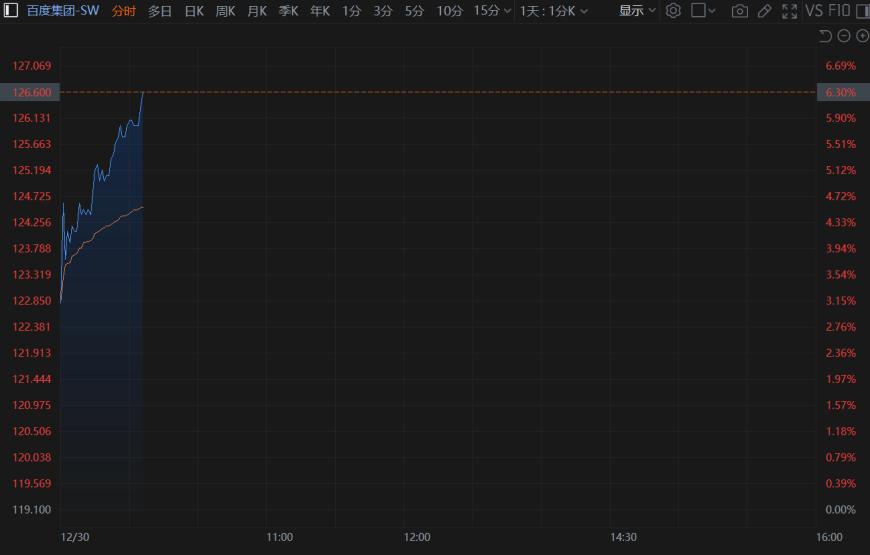
Core Viewpoint - Baidu Group's stock has risen significantly by 6.3% to HKD 126.6, with a total market capitalization of HKD 347.5 billion following an upgrade to "Buy" by Shenwan Hongyuan in their recent report [1] Financial Performance - The report forecasts Baidu Group's revenue to reach RMB 128.5 billion, RMB 133.1 billion, and RMB 141.0 billion for the years 2025 to 2027 respectively [1] - Using the SOTP valuation method, the overall target valuation for the group is set at RMB 430.2 billion, corresponding to a target price of HKD 172.54 per share [1] Business Developments - In the AI sector, Baidu is making significant advancements, with plans for full-stack AI development showing promising results by 2025 [1] - Baidu has launched the Kunlun M series chips, the multimodal Wenxin model 5.0, and several enterprise-level intelligent applications at a global conference [1] - The intelligent cloud business is experiencing accelerated growth, with Q3 2025 AI cloud revenue reaching RMB 6.2 billion, and total revenue for the first three quarters of 2025 at RMB 19.33 billion, marking a year-on-year increase of 31% [1] - The self-developed AI chip Kunlun is expected to enter a mass production phase, with successful commercialization across multiple fields and integration into leading customer systems [1] - In the smart driving sector, the order volume for "Luo Bo Kua Pao" has seen significant growth, leading to substantial improvements in profitability [1]


腾讯、阿里、字节、百度等千亿重注AI
2 1 Shi Ji Jing Ji Bao Dao· 2025-12-30 02:27
Core Insights - AI has become the central theme in China's technology industry throughout 2025, viewed as a key driver for the next productivity revolution and business model iteration [2] - Major internet companies like Tencent, Alibaba, and ByteDance are intensifying their focus on AI, with significant investments and strategic moves to secure their positions in the market [2][4] Investment Trends - Alibaba announced a three-year investment plan of 380 billion yuan for cloud and AI hardware infrastructure, which is more than its total investment over the past decade [4] - ByteDance plans to increase its capital expenditure to 150 billion yuan in 2025, marking an 88% year-on-year increase, with expectations to further raise it to 160 billion yuan in 2026 [4] - Tencent's capital expenditure is projected to reach around 100 billion yuan in 2025, with a 386% year-on-year increase in Q4 2024 [5] Financial Performance - Alibaba's cloud revenue grew by 34% year-on-year in Q3 2025, with AI-related product revenue maintaining triple-digit growth for nine consecutive quarters [5] - Tencent's marketing services revenue increased by 21% year-on-year, driven by improvements from AI-driven advertising platforms [5][10] - Baidu's AI business revenue grew over 50% year-on-year, becoming a core growth engine despite a decline in total revenue [5] AI Integration in Business - Major companies are integrating AI into their core business lines to enhance operational efficiency and create new growth engines [8][9] - Alibaba's AI tools improved operational efficiency for 500,000 merchants during the "Double 11" shopping festival, with an average efficiency increase of 1.5 times [9] - AI is transforming advertising from traditional methods to intelligent advertising, enhancing user engagement and return on investment [10] New Market Opportunities - The competition for AI-native applications is emerging as a new growth area, with companies vying to establish the next "super entrance" in the AI era [12] - The market is witnessing the rise of AI hardware, such as smart glasses, with significant growth in shipments and market share in China [14] - The introduction of AI-integrated smartphones represents a new direction in user interaction and data aggregation [14] Future Outlook - The competition among major players in AI applications, hardware, and native applications is still in its early stages, with the potential for significant developments in user engagement and commercial viability [15]




张朝阳:走过迷失,重构自己
Jing Ji Guan Cha Wang· 2025-12-30 01:48
Core Insights - The article highlights the journey of Zhang Chaoyang, the founder of Sohu, emphasizing his transformation from a rebellious student to a prominent figure in the internet industry, and his recent efforts to revitalize the company through personal engagement and innovative strategies [2][3][12]. Group 1: Early Life and Education - Zhang Chaoyang grew up in a factory area in Xi'an and was initially a reluctant student, later excelling at Tsinghua University and pursuing a PhD at MIT, where he developed an interest in the internet [3][4]. - His exposure to the internet at MIT, particularly through a physics lab, sparked his passion for technology and set the stage for his future entrepreneurial endeavors [3][5]. Group 2: Entrepreneurial Journey - In the mid-1990s, Zhang recognized the potential of the internet in China and returned to start Sohu, facing significant challenges in securing funding as the concept of venture capital was not well established in China at the time [5][6]. - After overcoming initial funding difficulties, Sohu became the first Chinese startup to attract venture capital, with investments from notable figures like Nicholas Negroponte [6][7]. Group 3: Business Development and Challenges - Sohu launched its strategic product "Sohu" and positioned itself as a navigation tool for the Chinese internet, successfully going public on NASDAQ in 2000 [8][9]. - Despite initial success, Sohu faced challenges in monetizing its services due to inadequate payment infrastructure, leading to a focus on SMS services and online gaming for revenue generation [9][10]. Group 4: Crisis and Reflection - Zhang experienced a personal and professional crisis during the rapid growth of Sohu, leading to a period of self-reflection and a reevaluation of his values and business practices [10][12]. - He acknowledged that his detachment from product details and overemphasis on personal fame contributed to missed opportunities, particularly in the social media space [10][11]. Group 5: Return and Transformation - After a hiatus from the public eye, Zhang returned to Sohu with a renewed focus on product engagement, conducting live English classes and emphasizing the importance of direct user feedback [12][13]. - He has shifted Sohu's strategy towards video content and social media, aiming to leverage his personal brand to drive the company's transformation [13][14]. Group 6: Future Outlook - Zhang remains cautious about the AI trend, opting for a measured approach rather than following industry fads, while focusing on enhancing Sohu's video social platform [14][15]. - His commitment to ethical business practices and self-improvement reflects a significant shift in his leadership style, prioritizing employee motivation and sustainable growth over aggressive expansion [15].

张朝阳:走过迷失,重构自己|我们的四分之一世纪
Jing Ji Guan Cha Wang· 2025-12-30 01:45
Core Insights - The article highlights the journey of Zhang Chaoyang, the founder of Sohu, emphasizing his transformation from a rebellious student to a prominent figure in the internet industry, and his recent return to the forefront of the company after a period of personal and professional challenges [3][4][19]. Group 1: Early Career and Founding of Sohu - Zhang Chaoyang's early life was marked by a rebellious spirit during his studies at MIT, where he developed an interest in the internet and technology [5][6]. - In the mid-1990s, recognizing the potential of the internet in China, Zhang returned to China to establish Sohu, facing significant challenges in securing funding due to the lack of a venture capital culture at the time [8][10]. - Sohu became the first Chinese startup to attract venture capital, with investments from notable figures such as Nicholas Negroponte and Edward Roberts [11]. Group 2: Growth and Challenges - Sohu went public on NASDAQ in 2000, raising approximately $300 million, which marked a significant milestone for the company [13][14]. - Despite initial success, Sohu faced difficulties in monetizing its services due to inadequate payment infrastructure, leading to a focus on SMS services and online gaming for revenue generation [14][18]. - Zhang Chaoyang's leadership style evolved as he navigated the complexities of corporate governance and investor expectations, ultimately choosing to remain at the helm of the company despite pressures to step down [12][18]. Group 3: Personal Crisis and Recovery - Zhang experienced a personal crisis around 2011, which he described as a culmination of years of pressure and the challenges of maintaining success in a rapidly changing industry [19]. - His recovery involved a deep introspection and a shift in focus towards personal responsibility and a commitment to product quality, leading to a more hands-on approach in Sohu's operations [20][24]. - Since 2019, Zhang has re-engaged with the company, emphasizing the importance of product usage and innovation, particularly in video and social media [20][21]. Group 4: Current Strategy and Future Outlook - Sohu is now focusing on video content and self-media as a new strategic direction, with Zhang actively participating in content creation and product testing [21][23]. - The company aims to leverage Zhang's personal brand to enhance its video and live-streaming business, while maintaining a cautious approach towards emerging technologies like AI [23][24]. - Sohu's recent financial performance indicates a recovery, with gaming revenues contributing positively, and the company remains committed to ethical business practices amidst industry challenges [23][26].

百度(BIDU):监管限制拟人化AI,或受影响
Sou Hu Cai Jing· 2025-12-29 22:52
【12月29日,中国监管机构出手限制拟人化AI服务诱导自残行为】中国监管机构正着手限制拟人化AI 服务诱导用户自残的行为,同时加强对未成年人的保护。分析师表示,百度等公司可能会受到影响。 本文由 AI算法生成,仅作参考,不涉投资建议,使用风险自担 ...
Could This Underrated AI Stock Be the Best Growth Story of 2026 and the Next Decade?
The Motley Fool· 2025-12-29 22:46
Core Viewpoint - Alphabet is positioned as a significant player in the AI sector, with strong growth potential both in the near term and long term, making it an attractive investment opportunity [1] Group 1: Competitive Positioning - Alphabet's Google search engine faced competition from AI chatbots, which ultimately reinforced its market position by allowing it to retain its dominant market shares in Chrome and Android despite antitrust challenges [2][3] - The ruling in the antitrust case preserved Alphabet's distribution advantages, ensuring Google Search remains the default internet gateway for users globally, facilitating the integration of its Gemini AI model [4] Group 2: AI Innovations - The competition from AI has catalyzed Alphabet's internal innovations, leading to the development of its Gemini large language model (LLM), which is now driving query and revenue growth [6] - Alphabet's long-term investment in Tensor Processing Units (TPUs) has positioned it favorably in the AI landscape, allowing for cost-effective training and inference of LLMs compared to Nvidia's GPUs [7][8] Group 3: Revenue Potential - Morgan Stanley estimates that Alphabet could generate approximately $13 billion in annual revenue for every 500,000 TPUs deployed, with projections of renting out 5 million TPUs in 2027 and 7 million in 2028 [9] Group 4: Technological Integration - Alphabet's TPUs are optimized for its TensorFlow framework and other neural network training frameworks, enhancing the efficiency of AI workloads while reducing power and memory usage [11] - The company is expanding its vertical integration by acquiring cybersecurity firm Wiz and energy infrastructure company Intersect, further strengthening its tech stack [12] Group 5: Long-term Growth Outlook - Alphabet is recognized as the most comprehensive end-to-end AI company, with its vertical integration and control over the tech stack expected to enhance its growth trajectory in the AI sector over the next decade [13]


百度集团-SW(09888.HK):全栈AI 云+芯+ROBOTAXI重估(百度深度之三)
Ge Long Hui· 2025-12-29 21:45
Group 1 - The core viewpoint of the articles highlights the acceleration of AI cloud revenue in China, with major internet companies like Alibaba and Tencent increasing their AI capital expenditures starting from Q3 2024, with projected capital expenditures and revenues exceeding 10% in the first three quarters of 2025, approaching the levels of overseas cloud providers in 2023 [1] - Baidu is advancing its AI full-stack construction, with its intelligent cloud business experiencing rapid growth. In Q3 2025, Baidu's AI cloud revenue reached 6.2 billion yuan, with a year-on-year increase of 33% in AI infrastructure revenue and a 128% increase in accelerator subscription revenue [1] - Baidu's intelligent cloud revenue for the first three quarters of 2025 was 19.33 billion yuan, reflecting a year-on-year growth of 31%, with cloud revenue accounting for 37% of Baidu's core revenue [1] Group 2 - Baidu's self-developed AI chip, Kunlun, is expected to enter a phase of significant volume production, with a product matrix established from cloud to data center. The Tianchi 32 and 64 super nodes were launched in 2025, and the Tianchi 512 super node is set to be released in 2026 [2] - In the field of intelligent driving, Baidu's order volume has significantly increased, with over 310,000 orders in Q3 2025, reflecting a year-on-year growth of over 200%. The company is benefiting from enhanced economies of scale and reduced costs, achieving positive profitability per vehicle [2] - The company has a comprehensive technology system for "car, road, cloud, and map," and is expanding its presence in high-value overseas markets such as Europe and the Middle East [2] Group 3 - The company has upgraded its rating to "Buy," projecting overall revenues for Baidu Group to be 128.5 billion yuan, 133.1 billion yuan, and 141 billion yuan for 2025, 2026, and 2027 respectively, with growth rates of -3%, 4%, and 6% [3] - Using the SOTP valuation method, the overall target valuation for the group is set at 430.2 billion yuan, corresponding to a target price of 172.54 HKD per share [3]
Robinhood's Stephanie Guild on if the bull market still has room to run into 2026
Youtube· 2025-12-29 19:51
Market Outlook - The company anticipates a strong year in 2026, but does not expect returns to match the S&P level seen in previous years, predicting around 8.7% growth for the S&P 500, reaching approximately 7500 points [2][3]. - There is a noted decline in net buying from customers since the peak period around October 29, but overall participation remains high [2][3]. Sector Performance - The technology sector is projected to grow at 27%, significantly higher than its historical average of 12% since 2011, indicating high expectations already built into tech stocks [6]. - Other sectors are expected to outperform tech, suggesting a more diversified support for S&P growth in the upcoming year [6][7]. Global Market Trends - The MSCI All Country World Index, excluding the United States, has outperformed the U.S. market by the widest margin since the 2009 financial crisis, indicating strong international investment opportunities [11]. - Europe has seen significant returns primarily due to euro appreciation against the dollar, but this trend may be stabilizing [12]. - There is bullish sentiment towards Japan and the Chinese tech sector, with expectations of continued growth and attractive valuations in Asia [13][14].


Alphabet Isn't a Search and Ad Company Anymore. Now It's Valued Like an AI Stock
247Wallst· 2025-12-29 17:46
Core Insights - Alphabet remains the dominant force in search and digital advertising, holding approximately 90% of the global search engine market share [1] - The company captures over 85% of search advertising spend worldwide [1] Company Overview - Alphabet's market share in the global search engine market is approximately 90% [1] - The company's share of search advertising spend is over 85% [1]

Why Alphabet Just Paid $4.75 Billion for Intersect -- and What It Means for the Future of Artificial Intelligence (AI)
Yahoo Finance· 2025-12-29 15:20
Core Insights - Alphabet has recently made significant moves, including a $4 billion investment from Berkshire Hathaway and the acquisition of Intersect for $4.75 billion, which has led to a surge in its stock price to all-time highs [1][2]. Group 1: Acquisition Details - Alphabet announced a definitive agreement to acquire Intersect, a company specializing in data center and energy infrastructure solutions, for $4.75 billion [2]. - The acquisition aligns with Alphabet's strategy to enhance its capabilities in artificial intelligence (AI) and energy management, which are critical for the future of its operations [2][8]. Group 2: Importance of Intersect - Intersect develops utility-scale renewable energy solutions for data centers, utilizing various power generation sources like wind, solar, and battery, which allows for efficient energy management [5][6]. - The rising costs of energy are a significant concern for AI developers, and Intersect's expertise in energy management can help Alphabet mitigate these costs as AI workloads increase [6][7]. Group 3: Strategic Implications - By acquiring Intersect, Alphabet aims to gain control over its future energy costs, improving efficiency in accessing data center capacity compared to relying on external utility providers [8]. - This move is consistent with Alphabet's vertically integrated business model across its various sectors, including search, cloud, advertising, and consumer electronics [9].
