百度AI云

Search documents
2025年百度靠AI赚了多少钱?答案首次揭晓
Xin Lang Cai Jing· 2026-02-27 09:37
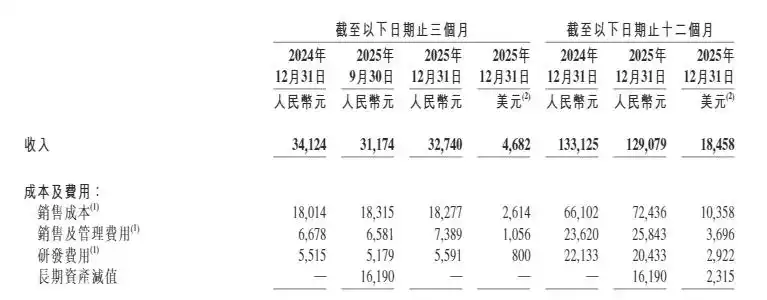
Core Viewpoint - Baidu's AI business has become a significant growth engine, contributing over 40% to its revenue, marking a shift from a cost center to a profit center [1][3][19] Financial Performance - In 2025, Baidu's total revenue reached 129.1 billion yuan, with AI business revenue at 40 billion yuan, and Q4 revenue at 32.7 billion yuan, exceeding market expectations [5][26] - The core AI new business revenue surpassed 11 billion yuan in Q4, accounting for 43% of Baidu's general business revenue [5][26] - Operating cash flow turned positive in the second half of 2025, generating 3.9 billion yuan, with Q4 operating profit increasing by 28% to 2.8 billion yuan [7][29] AI Business Transformation - Baidu's AI business has transitioned from a long-term investment focus to a quantifiable and trackable core revenue segment, reflecting a clear commercialization strategy [3][27] - The AI cloud infrastructure revenue for 2025 was 19.8 billion yuan, a 34% year-on-year increase, with Q4 revenue at 5.8 billion yuan [8][30] - The self-evolving super-intelligent agent "Famu" attracted over 2,000 enterprise applications in its first month, demonstrating significant efficiency improvements in various sectors [8][32] User Engagement and Market Penetration - Baidu's AI applications generated over 10.2 billion yuan in revenue for 2025, with Q4 revenue reaching 2.7 billion yuan [8][34] - The monthly active users of Wenxin Assistant reached 202 million by December 2025, with a fourfold increase since the Spring Festival promotional activities [8][34] Capital Market Response - Baidu announced a new share repurchase plan of $5 billion (approximately 34.3 billion yuan), representing nearly 10% of its current market value, signaling confidence in future cash flow and profitability [15][37] - The planned IPO of Kunlun Chip, which holds a 40.4% market share in the self-developed GPU cloud market, indicates a shift towards a segmented valuation approach for Baidu's various business units [15][38] - Major financial institutions have raised their target prices for Baidu, with Morgan Stanley increasing its target to $200 and Benchmark to $215, reflecting a positive market sentiment towards Baidu's AI commercialization [18][40]


2026-02-27期:所长早读-20260227
Guo Tai Jun An Qi Huo· 2026-02-27 01:52
1. Report Industry Investment Ratings - The report does not explicitly provide an overall industry investment rating. However, trend intensities for various commodities are given, which can be used as a reference for investment sentiment: - Strongly bullish: Iron ore, tin, cotton, palm oil, soybean oil, sugar [57][36][187][170][181] - Bullish: Logs,动力煤 [78][75] - Neutral: Gold, silver, copper, zinc, lead, aluminum, alumina, cast - aluminum alloy, platinum, palladium, nickel, stainless steel, lithium carbonate, industrial silicon, polysilicon, rebar, hot - rolled coil, ferrosilicon, silicomanganese, coke, coking coal, p - xylene, PTA, MEG, rubber, synthetic rubber, LLDPE, PP, caustic soda, pulp, glass, methanol, urea, styrene, soda ash, LPG, propylene, short - fiber, bottle - chip, offset printing paper, pure benzene, soybean meal, soybeans, corn, peanuts [22][25][28][31][38][40][44][50][53][59][63][67][79][88][92][95][100][105][111][114][119][122][125][127][155][158][163][171][174][195] - Bearish: PVC, fuel oil [137][140] - Strongly bearish: Live pigs [193] 2. Core Views 2.1 Exchange Rate - After the holiday, the RMB exchange rate against the US dollar continued its pre - holiday strong trend. On February 26, the on - shore and off - shore RMB exchange rates against the US dollar reached new highs since April 2023. The appreciation is supported by factors such as the weakening of the US dollar index, the reduction of US tariffs on China, the withdrawal of US dollar long positions, and market expectations for favorable policies. However, there are also factors that may cause the RMB to depreciate in the short term [7]. 2.2 Commodities - **Cotton**: After the holiday, Zhengzhou cotton futures rose due to the increase in foreign markets and technical buying. However, there is no obvious fundamental support, and the futures price has fallen back. It is expected to maintain a relatively strong trend, but further upward movement may require new fundamental drivers [10]. - **Manganese silicon**: The price of manganese silicon futures rose due to the news of South African mineral tax, but it is mainly an emotional push. Fundamentally, the short - term supply has not decreased, and the price may be under pressure due to high inventory [11][12]. - **Steam coal**: After the Spring Festival, the steam coal market continued its pre - holiday strong trend, mainly driven by the reduction of imported coal supply. However, in March, the market will enter the traditional off - season, and the upward support for coal prices is expected to weaken [13][14]. 3. Summary by Relevant Catalogs 3.1 Pre - market Focus - **Exchange rate**: The RMB exchange rate against the US dollar reached a three - year high, and the pricing is not extremely deviated. The appreciation is supported by multiple factors, and the future trend is affected by both positive and negative factors [7]. - **Commodities**: The所长 recommends cotton, manganese silicon, and steam coal, with a high attention index of ★★★★. The prices of these commodities are affected by different factors, and their future trends need to pay attention to fundamental changes [10][11][13]. 3.2 Commodity Research Morning Report - **Precious metals**: Gold is expected to move up in a volatile manner, and silver is in a volatile pattern [22]. - **Base metals**: Copper's price recovery is restricted by increasing inventory; zinc needs to pay attention to geopolitical disturbances; lead lacks driving forces and is in a volatile state; tin is expected to be strongly volatile; aluminum is in a range - bound state; alumina's supply pressure is not relieved; cast - aluminum alloy follows the trend of electrolytic aluminum; platinum is in a box - shaped oscillation; palladium's high - frequency data is weak; nickel still has speculative sentiment, and attention should be paid to the contradiction of nickel ore; stainless steel's cost support center moves up, but the off - season inventory accumulation restricts its elasticity [25][28][31][34][38][40][44]. - **Energy and chemicals**: Lithium carbonate's supply and demand are tight, and attention should be paid to market sentiment changes; industrial silicon should pay attention to the resumption of production of upstream enterprises; polysilicon should pay attention to post - holiday spot transactions; iron ore's price is expected to rise in a volatile manner; rebar and hot - rolled coil are in a volatile and repeated state; ferrosilicon's price fluctuates widely due to sector sentiment; manganese silicon's price is pulled up at a low level by funds; coke and coking coal are in a weakly volatile state; steam coal's price is strong in the short term; logs are expected to be strongly volatile; p - xylene, PTA, and MEG are in a range - bound state; rubber is in a wide - range volatile state; synthetic rubber is in a high - level volatile state; LLDPE has oil price risks to be released, and its supply - demand pattern is average; PP's C3 raw material is strong, and PDH maintenance is still high; caustic soda has large near - month delivery pressure but cost support; pulp is in a volatile state; glass's original sheet price is stable; methanol is in a volatile state; urea is in a short - term volatile state; styrene is in a strongly volatile state; soda ash's spot market has little change; LPG is affected by Middle - East supply disturbances and is waiting for CP to be announced; propylene's supply and demand are tight, and the spot price is stable; PVC is in a weakly volatile state; fuel oil is in a weak state; low - sulfur fuel oil is in a narrow - range volatile state; the container shipping index (European line) should be treated with a volatile mindset; short - fiber and bottle - chip are in a high - level volatile state and should pay attention to geopolitical fluctuations; offset printing paper should be on the sidelines; pure benzene is in a strongly volatile state [50][53][56][59][63][67][73][76][79][88][92][95][100][105][111][114][119][122][125][127][137][140][143][155][158][163]. - **Agricultural products**: Palm oil's production reduction is realized, and a short - term long - buying strategy on dips can be adopted; soybean oil is strongly affected by the implementation of the US biofuel policy; soybean meal may be volatile due to the slight decline of overnight US soybeans; soybeans' spot price is stable, and the futures price is strong; corn is expected to be strongly volatile; sugar's price - increasing sentiment is spreading; cotton's futures price has回调; eggs are in a weakly volatile state; live pigs' futures price has advanced the trading of inventory accumulation, but it is difficult to reduce inventory in the off - season; peanuts are in a volatile state [167][171][174][178][182][188][191][195].
观点与策略:国泰君安期货商品研究晨报-20260227
Guo Tai Jun An Qi Huo· 2026-02-27 01:46
Market Ratings - The report does not provide an overall investment rating for the industries. Core Views - The report provides short - term trend outlooks for various commodities, including precious metals, base metals, energy, agricultural products, and chemical products. Each commodity's outlook is based on its specific supply - demand situation, market sentiment, and macro - economic factors [2][4]. Summary by Commodity Category Precious Metals - **Gold**: Expected to oscillate upwards. The trend strength is 1. Gold prices are affected by factors such as geopolitical events and macro - economic data [2][7]. - **Silver**: In an oscillating pattern. The trend strength is 1. Silver prices are influenced by market sentiment and industrial demand [2][6]. - **Platinum**: In a box - shaped oscillation. The trend strength is 0. Platinum prices are affected by supply - demand balance and market sentiment [25][27]. - **Palladium**: High - frequency data is weak. The trend strength is 0. Palladium prices are influenced by automotive industry demand and supply factors [25][27]. Base Metals - **Copper**: Inventory is continuously increasing, which restricts price recovery. The trend strength is 0. Global supply - demand balance and geopolitical factors affect copper prices [2][10]. - **Zinc**: Attention should be paid to geopolitical disturbances. The trend strength is 0. Zinc prices are influenced by geopolitical events and supply - demand fundamentals [2][13]. - **Lead**: Lacks driving forces, and prices oscillate. The trend strength is 0. Lead prices are affected by supply - demand balance and market sentiment [2][16]. - **Tin**: Oscillates with a slightly upward trend. The trend strength is 1. Tin prices are influenced by supply - demand situation and market sentiment [2][19]. - **Aluminum**: In a range - bound oscillation. The trend strength is 0. Aluminum prices are affected by supply - demand balance and cost factors [23][24]. - **Alumina**: Supply pressure remains unrelieved. The trend strength is - 1. Alumina prices are influenced by supply - demand fundamentals and production costs [23][24]. - **Nickel**: Speculative sentiment in Shanghai nickel still exists, and continuous attention should be paid to nickel ore contradictions. The trend strength is 0. Nickel prices are affected by supply - demand balance and policy factors [29][34]. - **Stainless Steel**: The cost support center moves up, but off - season inventory accumulation restricts elasticity. The trend strength is 0. Stainless steel prices are influenced by cost and demand factors [29][34]. Energy - **Crude Oil**: Although not directly mentioned in the title, it affects related products. - **Fuel Oil**: Night - session prices declined, and weakness reappeared. The trend strength is - 1. Fuel oil prices are affected by crude oil prices and market demand [2][124]. - **Low - Sulfur Fuel Oil**: Narrow - range oscillation, and the spread between high - and low - sulfur fuels in the overseas spot market is temporarily stable. The trend strength is 0. Low - sulfur fuel oil prices are influenced by crude oil prices and regulatory policies [2][125]. - **Natural Gas**: Not specifically mentioned in the report. - **Coal**: - **Coking Coal**: Affected by warehouse - receipt disturbances, prices oscillate weakly. The trend strength is 0. Coking coal prices are influenced by supply - demand balance and market sentiment [2][54]. - **Coking Coke**: Oscillates weakly. The trend strength is 0. Coke prices are affected by coking coal prices and steel industry demand [2][53]. - **Steam Coal**: Upstream quotes are firm, and short - term coal prices are strong. The trend strength is 1. Steam coal prices are influenced by supply - demand balance and seasonal factors [2][59]. Agricultural Products - **Palm Oil**: Production cuts are realized, and a short - term buy - on - dips strategy is recommended. The trend strength is 1. Palm oil prices are affected by production, demand, and weather conditions [151][154]. - **Soybean Oil**: The US bio - diesel policy is gradually implemented, and US soybean oil shows a strong performance. The trend strength is 1. Soybean oil prices are influenced by US policies and global supply - demand balance [151][154]. - **Soybean Meal**: Overnight US soybeans slightly declined, and Dalian soybean meal may oscillate. The trend strength is 0. Soybean meal prices are affected by US soybean prices and domestic demand [155][157]. - **Soybean**: Spot prices are stable, and the futures market is strong. The trend strength is 0. Soybean prices are influenced by domestic supply - demand balance and international market conditions [155][157]. - **Corn**: Oscillates with a slightly upward trend. The trend strength is 0. Corn prices are affected by supply - demand balance and policy factors [158][161]. - **Sugar**: The price - increase sentiment is spreading. The trend strength is 1. Sugar prices are influenced by global supply - demand balance and policy factors [162][165]. - **Cotton**: Futures prices have回调. The trend strength is 1. Cotton prices are affected by domestic and international supply - demand balance and market sentiment [166][171]. - **Eggs**: Oscillate weakly. The trend strength is - 1. Egg prices are influenced by supply - demand balance and feed costs [172][173]. - **Hogs**: The futures market anticipates inventory accumulation in advance, but it is difficult to reduce inventory in the off - season. The trend strength is - 2. Hog prices are affected by supply - demand balance and market sentiment [175][177]. - **Peanuts**: Oscillate. The trend strength is 0. Peanut prices are influenced by supply - demand balance and market sentiment [179][181]. Chemical Products - **Para - Xylene (PX)**: Follows cost fluctuations and is in a range - bound market. The trend strength is 0. PX prices are affected by crude oil prices and supply - demand balance [65][70]. - **Purified Terephthalic Acid (PTA)**: Follows cost fluctuations and is in a range - bound market. The trend strength is 0. PTA prices are influenced by PX prices and downstream demand [65][70]. - **Ethylene Glycol (MEG)**: In a range - bound market, with a strategy of going long on PTA and short on MEG. The trend strength is 0. MEG prices are affected by supply - demand balance and cost factors [65][70]. - **Rubber**: Wide - range oscillation. The trend strength is 0. Rubber prices are influenced by supply - demand balance and macro - economic factors [73][74]. - **Synthetic Rubber**: Oscillates at a high level. The trend strength is 0. Synthetic rubber prices are affected by raw material prices and market demand [77][79]. - **Linear Low - Density Polyethylene (LLDPE)**: Crude oil risks need to be released, and its own supply - demand pattern is average. The trend strength is - 1. LLDPE prices are influenced by crude oil prices and supply - demand balance [80][83]. - **Polypropylene (PP)**: C3 raw materials are strong, and PDH maintenance is still high. The trend strength is 0. PP prices are affected by raw material prices and supply - demand balance [80][83]. - **Caustic Soda**: There is great pressure for near - month delivery, but costs still provide support. The trend strength is 0. Caustic soda prices are influenced by supply - demand balance and production costs [85][87]. - **Paper Pulp**: Oscillates. The trend strength is 0. Paper pulp prices are affected by supply - demand balance and market sentiment [90][92]. - **Glass**: The price of raw sheets is stable. The trend strength is 0. Glass prices are influenced by supply - demand balance and production costs [96][97]. - **Methanol**: Oscillates. The trend strength is 0. Methanol prices are affected by supply - demand balance and cost factors [99][103]. - **Urea**: Oscillates in the short term. The trend strength is 0. Urea prices are influenced by supply - demand balance and policy factors [104][106]. - **Styrene**: Oscillates with a slightly upward trend. The trend strength is 0. Styrene prices are affected by supply - demand balance and market sentiment [107][109]. - **Soda Ash**: The spot market has little change. The trend strength is 0. Soda ash prices are influenced by supply - demand balance and production costs [110]. - **Liquefied Petroleum Gas (LPG)**: Affected by Middle - East supply disturbances, waiting for the release of CP. The trend strength is 0. LPG prices are influenced by Middle - East supply and market sentiment [112][117]. - **Propylene**: Supply - demand remains tight, and spot prices are stable. The trend strength is 0. Propylene prices are affected by supply - demand balance and raw material prices [112][117]. - **Polyvinyl Chloride (PVC)**: Oscillates weakly. The trend strength is - 1. PVC prices are influenced by supply - demand balance and production costs [121][122]. Others - **Log**: Expectations are improving, and prices oscillate with a slightly upward trend. The trend strength is 1. Log prices are influenced by real - estate policies and market demand [62][64]. - **Container Freight Index (European Line)**: Adopt an oscillating approach. The trend strength is 0. The index is affected by supply - demand balance in the shipping market and geopolitical factors [127][138]. - **Short - Fiber**: Oscillates at a high level, and attention should be paid to geopolitical fluctuations. The trend strength is 0. Short - fiber prices are affected by raw material prices and market demand [139][140]. - **Bottle Chip**: Oscillates at a high level, and attention should be paid to geopolitical fluctuations. The trend strength is 0. Bottle - chip prices are influenced by raw material prices and market demand [139][140]. - **Offset Printing Paper**: Adopt a wait - and - see approach. The trend strength is 0. Offset printing paper prices are affected by supply - demand balance and market sentiment [142]. - **Pure Benzene**: Oscillates with a slightly upward trend. The trend strength is 0. Pure benzene prices are affected by supply - demand balance and market sentiment [147][149].
华尔街见闻早餐FM-Radio | 2026年2月27日
Hua Er Jie Jian Wen· 2026-02-26 23:26
Market Overview - Nvidia's strong earnings report did not alleviate market concerns, leading to a nearly 5.5% drop in its stock, which negatively impacted the broader US stock market, AI concept stocks, and the semiconductor sector [2] - The Dow Jones Industrial Average saw a slight increase, while the Nasdaq Composite fell nearly 1.2%, almost erasing all gains from the previous day [2] - The yield on US Treasury bonds across various maturities fell by 3 to 4 basis points, with the 10-year yield reaching its lowest point since November 28 of last year [2] Company News - Baidu reported Q4 revenue of 32.74 billion yuan, with AI computing subscription revenue increasing by 143% year-on-year; the company anticipates AI cloud revenue to reach 30 billion yuan by 2025 [7] - CoreWeave's Q4 revenue doubled, with backlog revenue reaching 66.8 billion yuan, although losses unexpectedly widened, leading to a post-market drop in stock price [28] - Dell's earnings and guidance exceeded expectations, with AI server revenue expected to double this year, causing a stock price increase of over 12% in after-hours trading [29] - Netflix rejected a higher acquisition offer for Warner Bros. Discovery and announced a stock buyback plan, resulting in a 13% increase in after-hours trading [30] Industry Insights - The AI computing demand surge is driving significant growth in companies like Baidu and Chipone, with Chipone's revenue projected to grow by 35.77% year-on-year by 2025 [7][24] - The global AI model API aggregation platform OpenRouter reported that Chinese models surpassed US models in usage, indicating a strong growth momentum for Chinese AI firms [47] - SK Hynix and SanDisk are collaborating to standardize High Bandwidth Flash (HBF) technology, which aims to fill the storage gap between HBM and SSDs, expected to be integrated into major products by 2027-2028 [50]





向市场亮剑,百度2025年Q4 AI业务增长为行业注入信心
Sou Hu Cai Jing· 2026-02-26 22:33
Core Insights - The AI industry experienced significant growth in 2025, with Baidu emerging as a leading player and a benchmark for the sector [1][3] - Baidu's total revenue for 2025 reached 129.1 billion RMB, with AI business revenue accounting for 40 billion RMB, representing 43% of its general business revenue [1][4] Financial Performance - In Q4 2025, Baidu's total revenue was 32.7 billion RMB, showing a year-on-year growth of 5% [2] - AI-related business segments demonstrated robust growth, with AI cloud revenue increasing by 34% year-on-year, and AI high-performance computing subscription revenue soaring by 143% in Q4 [4][5] Strategic Positioning - Baidu's AI business is transitioning from a cost center to a profit center, indicating a shift towards quantifiable revenue streams [4][8] - The company has positioned itself as a leading AI firm with a strong internet foundation, as evidenced by its strategic focus on AI commercialization [5][8] Market Impact - Baidu's AI applications have shown significant commercial value, with AI application revenue surpassing 10 billion RMB in 2025 [4][9] - The launch of "Robotaxi" services has expanded Baidu's market presence, with over 3.4 million rides in Q4 2025, marking a growth of over 200% [16][18] Future Outlook - Baidu announced a new stock buyback plan of $5 billion and introduced a dividend policy for 2026, signaling confidence in its AI profitability and market valuation [19][21] - The potential spin-off of Baidu's Kunlun chip business is expected to unlock further value and enhance the company's growth trajectory [21][22]
百度AI云2025年营收300亿元
Hua Er Jie Jian Wen· 2026-02-26 13:11
Core Insights - Baidu's AI Cloud revenue for the year 2025 reached 30 billion yuan, indicating significant growth in the sector [1] - Subscription-based revenue from AI high-performance computing facilities grew by 143% year-on-year in the fourth quarter, becoming a major growth driver [1] - In 2025, Baidu Smart Cloud achieved the highest number of large model-related bidding projects and bid amounts, maintaining its position as the leading cloud vendor for two consecutive years [1]

百度2025年营收达1291亿元 第四季度AI业务收入占比43%
Zheng Quan Ri Bao Wang· 2026-02-26 13:05
Core Insights - Baidu's total revenue for 2025 reached 129.1 billion yuan, with AI business revenue accounting for 40 billion yuan, indicating a significant shift towards AI as a core business driver [1] - The company reported that AI-related services are expanding rapidly, with AI cloud revenue growing by 34% year-on-year and AI native marketing services increasing by 301% in 2025 [2][3] Group 1: Financial Performance - In Q4 2025, Baidu's total revenue was 32.7 billion yuan, with AI business revenue constituting 43% of general business income [1] - AI cloud's subscription revenue surged by 143% year-on-year in Q4, reflecting strong demand for high-performance computing [1] - AI native marketing services revenue reached 2.7 billion yuan in Q4, marking a 110% year-on-year increase [2] Group 2: User Engagement and Application Growth - Baidu App's monthly active users reached 679 million, while Wenxin Assistant's monthly active users hit 202 million, showcasing strong user engagement [2] - The launch of the Wenxin Assistant during the Spring Festival led to a fourfold increase in active users [2] - Baidu's AI applications generated over 10 billion yuan in revenue for the year, with significant growth in various sectors [2] Group 3: Autonomous Driving and Market Expansion - In Q4 2025, Baidu's autonomous driving service, "Luobo Kuaipao," recorded over 3.4 million rides, a year-on-year increase of over 200% [3] - The service has expanded to 26 cities globally, with a total of over 20 million rides provided [3] - Baidu's autonomous driving technology has accumulated over 300 million kilometers of total driving distance, with over 190 million kilometers being fully autonomous [3] Group 4: Capitalization and Strategic Moves - Baidu's subsidiary Kunlun Chip has submitted a listing application to the Hong Kong Stock Exchange, indicating a strategic move to capitalize on its AI chip business [4] - The company announced a share buyback plan of up to 5 billion USD and plans to declare its first dividend in 2026, enhancing shareholder returns [4] - These initiatives are expected to optimize Baidu's valuation structure and open financing channels for long-term technological investments [5]
李彦宏:2025年是AI成为百度新核心的关键一年
Xin Lang Cai Jing· 2026-02-26 09:18
Core Insights - Baidu's total revenue for 2025 reached 129.1 billion yuan, with AI business revenue at 40 billion yuan, indicating a strong performance in AI sectors [1][4] - In Q4 2025, Baidu's total revenue was 32.7 billion yuan, a 5% year-over-year increase, with AI business revenue accounting for 43% of general business income, exceeding market expectations [1][4] AI Business Growth - The AI cloud segment saw a revenue increase of 34% year-over-year for 2025, with Q4 subscription revenue from high-performance computing facilities growing by 143%, accelerating from 128% in Q3 [1][4] - Baidu's AI-native marketing services experienced a remarkable 301% year-over-year revenue growth in 2025 [5] - The AI application revenue surpassed 10 billion yuan in 2025, showcasing the company's expanding capabilities in AI solutions [5] User Engagement and Expansion - By December 2025, Baidu App had 679 million monthly active users, while Wenxin Assistant reached 202 million monthly active users, with a fourfold increase in active users since the launch of the Spring Festival red envelope activity [5] - The "Luobo Kuaipao" autonomous driving service recorded 3.4 million global rides in Q4, more than doubling year-over-year, with a peak of over 300,000 rides per week [6] - As of February 2026, "Luobo Kuaipao" had provided over 20 million global rides, covering 26 cities worldwide [6] Technological Advancements - The total mileage for "Luobo Kuaipao" autonomous driving exceeded 300 million kilometers, with fully autonomous driving mileage surpassing 190 million kilometers [3][6] - The self-evolving super-intelligent agent "Baidu Famou" received applications for trials from over 2,000 enterprises, indicating strong interest in innovative AI solutions [5]
全栈即王道?百度AI的入口战略拆解
3 6 Ke· 2026-02-05 09:54
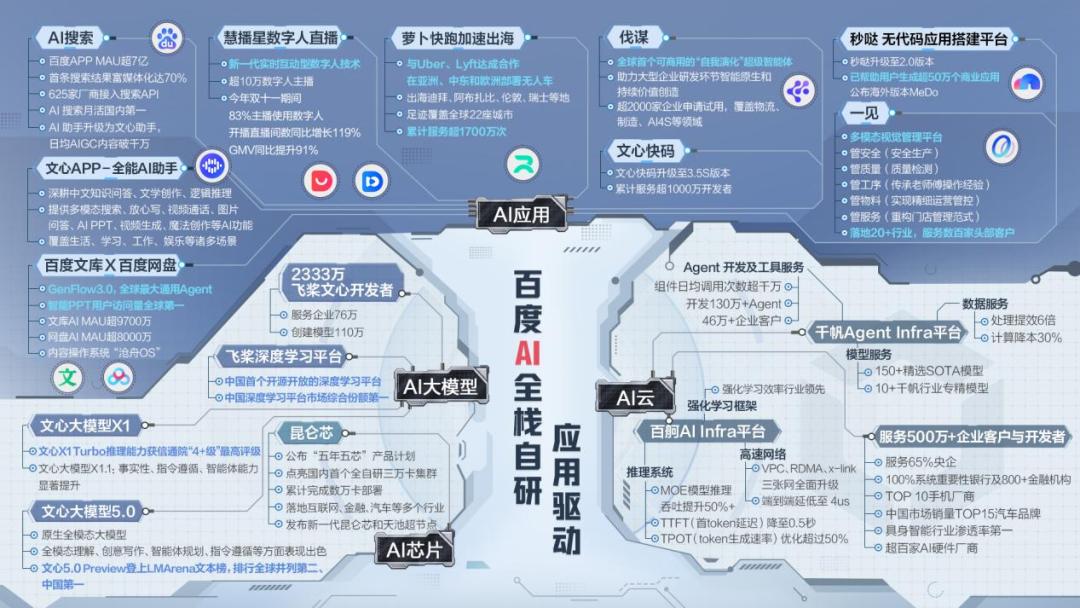
Group 1 - Baidu's CEO emphasized the importance of applications in the AI era, defining "AI applications as intelligent agents" and identifying four types of intelligent agents: search agents, digital human agents, code agents, and evolutionary agents [1] - The company has adjusted its structural framework to focus on a "chip-cloud-model-agent" strategy, highlighting the advantages of a full-stack capability in AI competition [1][10] - Baidu clarified the relationship between its search engine and the Wenxin assistant, indicating a shift from traditional search to AI-driven intelligent agents [1] Group 2 - The return of founders from major tech companies (BAT) signifies the onset of a competitive AI landscape in 2026, with each company adopting unique strategies to capture the AI market [3] - Alibaba's founder is focusing on a triad of AI narratives involving large models, cloud computing, and chips, while Tencent is reviving its "red envelope strategy" to engage users [3] - The competition for AI entry points has intensified, with major players like Baidu, Alibaba, and ByteDance vying for dominance in the AI space [5] Group 3 - The AI entry battle has evolved into a "three-legged race" among Doubao, Wenxin, and Qianwen, with a significant financial commitment of 6 billion in cash incentives [5] - Baidu's strategy involves integrating AI seamlessly into its existing app ecosystem, aiming to reduce user friction and enhance engagement [6][8] - The company is leveraging its existing user base of over 700 million monthly active users to promote AI adoption without requiring additional downloads [8][9] Group 4 - Baidu's full-stack approach, encompassing chip, cloud, model, and agent capabilities, positions it favorably in the AI competition, focusing on efficiency and cost reduction [10][14] - The launch of Wenxin 5.0, with advanced capabilities in multimodal understanding, showcases Baidu's technological leadership in the AI space [13] - Baidu's self-developed infrastructure allows for optimized performance and cost efficiency, crucial for meeting the demands of its large user base [14][15]
【百度集团-SW(9888.HK)】广告业务企稳为主,AI云业务支撑中长期逻辑——2025年四季报业绩前瞻(付天姿/杨朋沛)
光大证券研究· 2026-02-04 23:06
Core Viewpoint - The article discusses the anticipated performance of Baidu in Q4 2025, highlighting challenges in advertising revenue and a temporary slowdown in cloud business growth, while Non-GAAP profit recovery becomes a key marginal variable [4]. Group 1: Online Marketing Business - Baidu's advertising revenue is expected to be approximately 62.2 billion yuan in 2025, reflecting a year-on-year decline of 14.7%. The current advertising business is not a primary focus for the company, as traditional search advertising continues to lose its share in the revenue structure due to user attention being diverted to AI search and applications [5]. Group 2: Non-Online Marketing Business - The AI cloud revenue for Baidu is projected to reach around 27.2 billion yuan in 2025. The growth rate in Q4 2025 is expected to slow down sequentially due to seasonal factors and a high base effect, but this does not indicate a weakening demand trend. The core drivers of growth remain AI training and inference demand [6]. Group 3: Profitability - Following the completion of a one-time asset impairment in Q3 2025, there will be no further depreciation and amortization related to this impairment, which is expected to provide ongoing positive contributions to Non-GAAP operating profit starting from Q4 2025. Overall, the improvement in profitability is more reflective of accounting-level marginal recovery, while the operational fundamentals still await stabilization in revenue [7]. Group 4: Business Progress - Baidu has begun to disclose progress in AI applications separately since Q3 2025, covering various products such as document libraries, cloud storage, enterprise-level AI tools, and overseas products. The company maintains a positive outlook on the commercialization prospects of these applications, emphasizing their synergy with AI cloud and Kunlun chip. In terms of autonomous driving, the order volume for Robotaxi continues to grow rapidly, with partnerships established with Uber and Lyft, and plans for trial runs of driverless taxis in the UK, marking a significant step in international expansion. However, these businesses are still in the investment and scale expansion phase, contributing limited short-term earnings [8][9]. Group 5: Kunlun Chip - Kunlun chip, as an important part of Baidu's self-developed AI chip and computing platform, is gaining increasing market attention. It is deeply involved in the overall delivery of Baidu's intelligent cloud and is starting to target industries such as telecommunications, finance, energy, and manufacturing, becoming part of the "cloud + computing" solution. In early 2026, the company announced plans to spin off Kunlun chip for independent listing, aiming to enhance its image among customers, suppliers, and potential strategic partners, and to strengthen its position in business negotiations, allowing the company to benefit from Kunlun chip's growth through its retained shares [10].