
铁路运输

Search documents
2026年春运首日出行火热
Xin Lang Cai Jing· 2026-02-03 01:15
新华社北京2月2日电 (记者叶昊鸣)记者2日从综合运输春运工作专班获悉,根据专班数据显示,2026 年春运首日(2月2日,农历腊月十五),全社会跨区域人员流动量预计为18791万人次,比2025年春运 首日增长13%。 (来源:唐山劳动日报) 铁路客运量预计为1200万人次,比2025年同期增长15.5%;水路客运量预计为60万人次,比2025年同期 增长12.7%;民航客运量预计为219万人次,比2025年同期增长5.3%。 具体来看,公路人员流动量预计为17312万人次,比2025年同期增长13%,其中高速公路及普通国省道 非营业性小客车人员出行量预计为14308万人次,比2025年同期增长13.5%;公路营业性客运量预计为 3004万人次,比2025年同期增长10.3%。 ...
“高铁通了,家更近了”
Liao Ning Ri Bao· 2026-02-03 01:06
Core Viewpoint - The opening of the Shenyang-Baihe High-Speed Railway (沈白高铁) has significantly improved travel convenience for residents in Fushun and surrounding areas, marking a new era of high-speed rail connectivity in Liaoning Province and enhancing regional accessibility [1][2]. Group 1: Travel Experience - The first Spring Festival travel season after the opening of the Shenyang-Baihe High-Speed Railway saw a large influx of travelers at Fushun Station, with various activities such as writing Spring Festival couplets to celebrate the occasion [1]. - Travelers expressed excitement about the convenience of high-speed rail, with one elderly couple sharing their joy of visiting their daughter in Baihe City, highlighting the ease of carrying home-cooked food compared to previous years [1]. - A mother and daughter traveling from Beijing to Xinbin County noted the reduced travel time from several hours to just over four hours, emphasizing the improved accessibility to their hometown [2]. Group 2: Regional Connectivity - The Shenyang-Baihe High-Speed Railway officially opened on September 28, 2025, ending Fushun's lack of high-speed rail service and marking the beginning of a comprehensive high-speed rail network in Liaoning Province [2]. - The railway creates a closed-loop "O" shape connectivity between Liaoning and Jilin provinces, linking ten cities including Shenyang, Baihe, Tonghua, and Fushun, thus enhancing regional integration and making travel more convenient for residents [2].
回家的路 心里的年(新春走基层·春运一线)
Ren Min Ri Bao· 2026-02-03 00:57
Core Insights - The 2026 Spring Festival travel season is expected to see a total of 9.5 billion people traveling across regions, marking a historical high for the same period [24] - The first day of the travel season anticipates a cross-regional flow of 187.91 million people, a 13% increase compared to the first day of the 2025 travel season [10] Group 1: Transportation Sector - The National Railway Beijing Bureau's high-speed catering production base is set to produce over 15,000 meals daily during the Spring Festival, up from the usual 12,000 [12] - The Beijing-Shanghai Expressway is expected to handle a peak daily traffic of over 80,000 vehicles, which is 3 to 4 times the normal volume [14] - The Qiongzhou Strait is projected to see 200,000 electric vehicles transported during the Spring Festival, utilizing specialized ferries for efficient vehicle movement [17] Group 2: Airport Operations - Beijing Daxing International Airport anticipates handling an average of 80,000 pieces of luggage daily during the Spring Festival, with peak hours seeing up to 3,700 pieces per hour [21] - The airport's luggage handling system has undergone digital upgrades, achieving a zero rate for luggage misplacement and loss [22] Group 3: Technology and Innovation - The Beijing-Shanghai Expressway has implemented an AI system for rapid identification and automatic alerts for road anomalies, enhancing traffic management [16] - The introduction of smart luggage handling systems at Daxing Airport allows for efficient and careful handling of luggage, improving operational efficiency [22]


锚定大市场 激活新动能
Zheng Zhou Ri Bao· 2026-02-03 00:47
Core Insights - Zhengzhou is accelerating its transformation from an inland city to an open hub, leveraging its unique geographical and transportation advantages to enhance its role in the national unified market [2][5] Group 1: Hub Upgrades - Zhengzhou is a key node in the national comprehensive transportation network, with an expected passenger volume of 24.43 million during the 2026 Spring Festival and 1,781 planned passenger train operations [3] - The airport's cargo throughput is projected to grow from 700,000 tons in 2021 to 1 million tons by 2025, with an annual growth rate of approximately 10% [3] - Zhengzhou Airport has attracted 36 all-cargo airlines, with 8 of the world's top 10 cargo airlines operating there, covering 32 countries and 73 cities [3] Group 2: Infrastructure Development - Zhengzhou's high-speed rail network has expanded to 6,810 kilometers, with 2,263 kilometers of high-speed rail, enabling efficient connectivity to major cities within 5 hours [4] - The ongoing expansion of Zhengzhou Airport and the development of a "multi-center, networked" high-speed rail system will enhance its role in the national market [5] Group 3: Reform and Innovation - Zhengzhou is implementing an "intelligent bidding" system to streamline public resource transactions, marking a significant step towards a digitalized public resource trading environment [6][7] - The city has integrated multiple administrative procedures for business relocations, reducing processing time by 80% [7] Group 4: Economic and Trade Development - Zhengzhou has established trade relations with 226 countries and regions, with exports of electromechanical products and high-tech products reaching 345.62 billion and 277.94 billion respectively in 2025 [14] - The city's total import and export volume reached 650.18 billion in 2025, accounting for 69.5% of the province's total, with a year-on-year growth of 16.8% [14] Group 5: Future Outlook - Zhengzhou aims to unify market infrastructure, government actions, and regulatory practices while expanding both domestic and international openness [15]

春运变了
吴晓波频道· 2026-02-03 00:30
Core Viewpoint - The transportation industry in China is transitioning from a phase of "extensive coverage and inclusivity" to one of "highly productized and commercialized" services, driven by rising costs and changing consumer expectations [3][29]. Group 1: Industry Overview - During the Spring Festival travel period, the expected cross-regional passenger flow is projected to reach 9.5 billion trips, with railway and civil aviation passenger volumes hitting 540 million and 95 million respectively, both likely to set historical records [3]. - The primary modes of passenger transport in China are railways and civil aviation, which together account for over 80% of the national passenger turnover [9]. Group 2: Price Trends - High-speed rail ticket prices have been on the rise, with significant increases noted in 2021, 2023, and the latest in May 2024, where prices for certain routes increased by approximately 20% [10]. - Civil aviation experienced a dramatic drop in average ticket prices during 2020, with prices falling from 758 yuan in 2019 to 598 yuan, but has since seen a recovery, with average prices reaching 779 yuan by the 2025 May holiday [11][13]. Group 3: Financial Performance - The civil aviation industry is projected to achieve a profit of 6.5 billion yuan in 2025, a significant increase from 120 million yuan in 2024, with passenger transport volume growing by 5.5% [15]. - Despite overall industry recovery, individual airlines face challenges, with major carriers like China Southern, China Eastern, and Air China still reporting losses in 2025 [21][22]. Group 4: Operational Challenges - The profitability of the railway sector is concentrated in a few key routes, with many lines in less populated areas operating at a loss, while the China Railway Group continues to face high construction and maintenance costs [23][24]. - The debt ratio of the China Railway Group has remained around 63% since 2015, indicating ongoing financial pressure despite recent profitability [25]. Group 5: Service Evolution - The transportation sector is evolving to offer more tailored services, such as specialized offerings for winter sports travelers and enhanced customer experiences like "quiet carriages" and pet transport services [30][33]. - Airlines and railways are also launching new routes and services based on consumer preferences, such as direct flights to popular destinations and themed flights [34]. Group 6: Technological Advancements - The transportation system is integrating artificial intelligence to improve operational efficiency, including monitoring and maintenance processes [37]. - Infrastructure improvements are being made, such as enhanced 5G coverage on high-speed rail lines, which aim to improve customer experience [37]. Conclusion - The transportation industry is navigating a complex landscape of rising costs and changing consumer expectations, leading to price increases as a potential strategy for sustainability and improved service delivery [39][42].

失物能“自助回家” 行李可“甩手中转” 春运首日 百米之间看暖意
Si Chuan Ri Bao· 2026-02-03 00:21
Core Viewpoint - The 2026 Spring Festival travel season in Chengdu is set to enhance passenger experience through innovative services and increased transportation capacity, with a focus on both convenience and warmth for travelers [1][2]. Group 1: Transportation Capacity and Services - Chengdu anticipates a 4.7% year-on-year increase in outbound travel volume and a 4% increase in local transportation capacity during the Spring Festival [2]. - The transportation department is dynamically adjusting capacity to meet the surge in passenger flow, including adding 118 pairs of temporary trains and special buses for migrant workers and students [2]. - Specific forecasts include 46,000 flight takeoffs at Tianfu Airport and 4.28 million passengers at Shuangliu Airport during the travel period [2]. Group 2: Innovative Services - The introduction of smart services such as the intelligent consultation robot "Xiao Tie" at Chengdu East Station allows travelers to quickly find ticketing information through facial recognition or input [2]. - Over 400 smart storage lockers have been set up at the Chengdu East Station to assist travelers with their luggage [2]. - The "hand-free transfer" service allows travelers to store their luggage at one airport and have it delivered to another, enhancing convenience during transit [5]. Group 3: Warmth and Community Engagement - Complimentary tangyuan (sweet dumplings) are being offered to travelers at Chengdu East Station, along with various cultural activities to enhance the festive atmosphere [3]. - Initiatives such as the 24-hour "shared home" service at the station provide resting areas for late-night arrivals, showcasing a commitment to traveler comfort [3]. - The establishment of a "love help" mechanism at the airport aims to provide comprehensive support for special needs travelers [3]. Group 4: Efficiency in Lost and Found Services - The introduction of self-service retrieval systems for lost items at Chengdu East Station has significantly improved efficiency, reducing the time taken to retrieve lost items from three minutes to thirty seconds [6]. - The self-service kiosks for lost items and identification documents have streamlined the process, allowing travelers to reclaim their belongings quickly and conveniently [6].
春运第一天,返乡路上暖意浓
Xin Lang Cai Jing· 2026-02-03 00:12
Core Viewpoint - The 2026 Spring Festival travel rush (Chunyun) has officially started, with an expected total of 9.5 billion trips across the country, highlighting the focus on enhancing transportation capacity, optimizing services, and leveraging technology to ensure safe and smooth travel for passengers and goods [2][3]. Group 1: Transportation Capacity and Services - The Wuhan Railway Bureau plans to operate 522.5 pairs of trains before the festival and 523.5 pairs after, representing a 9.7% and 9.3% increase in capacity compared to the 2025 Spring Festival [4][5]. - Wuhan Railway Station anticipates sending 2.622 million passengers during the Spring Festival, with a festive atmosphere enhanced by cultural activities and improved facilities [3][4]. - The Fuzhou Railway Station expects to send 4.1 million passengers, a 7.23% increase from 2025, and has implemented various measures to enhance passenger experience and safety [10]. Group 2: Technological Innovations - Fuzhou Railway Station has introduced smart service robots to assist passengers with inquiries, showcasing the integration of technology in enhancing travel experiences [11]. - The railway sector is exploring a "dual transport" model, combining passenger and freight services to optimize logistics and meet rising demand [12]. Group 3: Collaborative Efforts and Community Engagement - Various railway stations, including Lanzhou West Station, are conducting cultural activities to create a festive environment and enhance passenger engagement during the travel rush [6][7]. - The collaboration between railway and aviation sectors at Lanzhou Airport aims to streamline passenger transfers, improving overall efficiency [7][8].
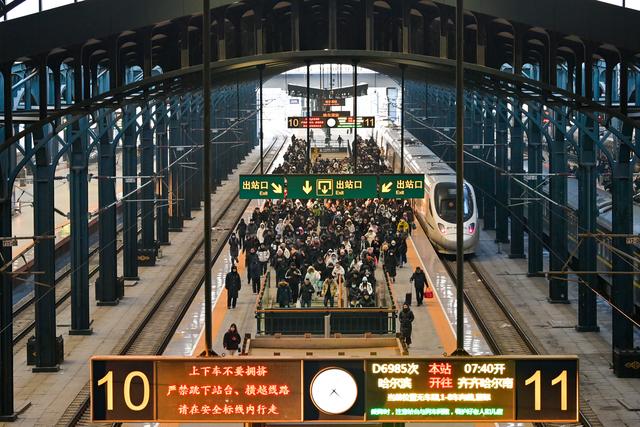
春运首日的四组镜头(新春走基层)
Xin Lang Cai Jing· 2026-02-03 00:12
Core Insights - The Spring Festival travel rush is expected to see a total of 187.91 million cross-regional passenger flows on the first day, marking a 13% increase compared to the same day in 2025 [4]. Group 1: Transportation Sector - The railway catering service is operational early in the morning, with over 2,000 pounds of fresh ingredients being delivered to the Beijing Railway Bureau's high-speed catering production base [5]. - More than 10,000 boxed meals are prepared and distributed to major train stations, ensuring travelers receive quality meals during their journeys [6]. - The Beijing-Shanghai Expressway is experiencing smooth traffic flow, with emergency teams actively managing roadside assistance for stranded vehicles [7]. Group 2: Maritime and Aviation - The first Spring Festival travel rush in Hainan's free trade port features the "Green Source No. 9" ferry, which can carry approximately 180 electric vehicles per trip, facilitating efficient transportation across the sea [8]. - At Beijing Daxing International Airport, a new intelligent baggage handling system is in operation, enhancing the efficiency of luggage processing and ensuring timely delivery to passengers [10].

新春走基层丨2026年春运期间 国铁集团郑州局预计发送旅客2443万人次
He Nan Ri Bao· 2026-02-02 23:38
Group 1 - The Spring Festival travel season (Chunyun) officially started on February 2, 2026, and will end on March 13, with an expected passenger volume of 24.43 million, a year-on-year increase of 3.34% [2] - The demand for travel is expected to rise significantly due to the 9-day extended holiday during the Spring Festival, with direct passenger volume projected at 11.42 million (up 3.78%) and local passenger volume at 13.01 million (up 2.95%) [2] - Peak travel days are anticipated, with February 14 expected to see 606,000 passengers, primarily traveling from Zhengzhou to cities like Luoyang and Nanyang, while the post-holiday peak will occur in two waves on February 24 and March 7, with a maximum of 964,000 passengers on peak days, representing a 15.4% increase [2] Group 2 - To meet travel demand, the Zhengzhou Railway Bureau will implement a peak operation schedule, planning to operate 1,781 passenger trains, including 1,425 regular trains and 356 temporary trains, marking an increase of 127 trains and a 7.7% rise in capacity compared to 2025 [3] - Various passenger convenience measures have been introduced, including the installation of power outlets and USB/Type-C ports in waiting areas, and the introduction of services such as luggage assistance and pet transportation at select stations [3] - Discounts on train tickets are available, with prices as low as 20% of the original fare, and the validity of travel points has been extended to two years, along with a limited-time free refund service within 30 minutes of ticket purchase [3]

新春走基层丨宠物托运 轻装送“行” 解锁春运新体验
He Nan Ri Bao· 2026-02-02 23:38
Core Insights - The article discusses the new pet transportation services introduced by the railway department, allowing pets to travel safely on high-speed trains during the Spring Festival travel rush [1][2]. Group 1: Pet Transportation Services - The railway department has developed specialized pet transport boxes equipped with air circulation, temperature and humidity monitoring, and noise reduction features to ensure the safety and comfort of pets during travel [1]. - A complete and standardized process has been established for pet transportation, including health checks, dedicated passageways, and proper placement in train carriages [1]. - As of January 28, the pilot program for pet transportation has expanded to 110 high-speed train stations and 170 train services nationwide, with reservations available through the 12306 app or the "China Railway Express" WeChat mini-program [1]. Group 2: Additional Services for Travelers - The railway station has launched a "light travel" service, allowing travelers to book door-to-door or station-to-door luggage delivery, with a delivery time of within 5 hours for locations within 35 kilometers [2]. - This service has gained popularity among families, elderly travelers, and those traveling with children, enhancing the overall travel experience during the busy Spring Festival period [2].