
化肥

Search documents
未知机构:为何此刻推荐农业地缘因素推动化肥供应紧张叠加供给收缩这里的黎明静悄悄-20260306
未知机构· 2026-03-06 02:35
Summary of Key Points from the Conference Call Industry Overview - The focus is on the agricultural sector, particularly the dynamics affecting fertilizer supply and agricultural product prices due to geopolitical factors and supply constraints [1][2]. Core Insights and Arguments - Geopolitical factors are driving fertilizer supply tightness, leading to increased agricultural product costs, with corn futures showing a significant upward trend [1][2]. - In Brazil's Mato Grosso state, corn production is expected to decline by over 8%, and national corn forecasts have been lowered by 1 million tons [1][2]. - In South Korea, rising rice prices have prompted the government to release 150,000 tons of reserve rice to alleviate supply pressures and stabilize prices [1]. - Domestic corn spot prices are experiencing widespread increases, with prices in regions like North China and Huanghuai rising over 1.2 yuan per jin, indicating a "one-sided" upward trend [2]. - A critical window for commodity rotation is identified, following a historical pattern where commodities move in a sequence: gold and silver lead, followed by copper, oil, and finally agricultural products [2]. - Current geopolitical tensions, particularly the conflict in Iran, could lead to significant fertilizer supply disruptions, as Iran accounts for 10% of global fertilizer supply, and the Strait of Hormuz is crucial for transporting 25%-35% of ammonia and urea trade [2]. - The agricultural sector is transitioning from a phase of waiting for transmission to one driven by cost pressures and risk-averse positioning [2]. - The domestic agricultural sector has faced a three-year downturn, but signs of a potential reversal are emerging, as indicated by the forecasts from companies like Denghai Seeds [2].
尿素日报:国内供需主导-20260305
Guan Tong Qi Huo· 2026-03-05 11:16
Report Summary 1. Report Industry Investment Rating No information provided. 2. Core Viewpoint Urea prices showed a pattern of opening low and rising, followed by an afternoon correction. Quotes remained stable, but transaction prices softened slightly. With the resumption of gas - based plants, daily production reached around 220,000 tons. The inventory of urea decreased by 6.62% this period. Although a large - scale urea plant in Qatar has stopped production and there are shipping issues in some regions, the international price has no impact on the domestic market in the short term. Due to the nitrogen association's guiding price and strong price - holding intention of upstream factories during the farming season, the urea market will have a narrow - range adjustment in the short term [1]. 3. Summary by Directory 3.1. Market Analysis - Urea opened low and rose, then corrected in the afternoon. Quotes were stable, but transaction prices softened slightly. The factory ex - factory quotes in Hebei, Shandong, and Henan were still in the range of 1,810 - 1,840 yuan/ton [1][5]. - The daily production of urea reached around 220,000 tons with the resumption of gas - based plants, and there were no long - term shutdown and maintenance plans in the short term. The start - up load of compound fertilizer plants increased, but the growth rate was lower year - on - year due to environmental inspections in Hebei. The inventory of urea decreased, mainly because of the continued agricultural demand and increased pick - up of goods by industrial demand. The inventory in Shandong and Henan, the main delivery areas, decreased, with an overall reduction of 6.62% this period [1]. - The 5.8 - million - ton - per - year urea plant of Qatar Energy Company has stopped production. The urea plants in Saudi Arabia, Oman, Bahrain, and the United Arab Emirates are operating normally, but shipping is not smooth. However, since there is no chance of export liberalization in the short term, the international urea price does not affect the domestic market. The price is suppressed by the nitrogen association's guiding price, and upstream factories have a strong intention to hold prices during the farming season, with smooth terminal sales. There is no short - term driving force, and urea will have a narrow - range adjustment [1]. 3.2. Futures and Spot Market Conditions - **Futures**: The main urea 2605 contract opened at 1,818 yuan/ton, opened low and rose, then corrected in the afternoon, and finally closed at 1,814 yuan/ton, with a decline of 0.71%. The trading volume was 248,510 lots, a decrease of 12,723 lots. In the top 20 positions of the main contract, long positions decreased by 6,158 lots, and short positions decreased by 9,778 lots. Among them, Huatai Futures had a net long position of + 1,671 lots, Everbright Futures had a net long position of + 1,197 lots; Guotai Junan had a net short position of + 2,158 lots, and CITIC Futures had a net short position of - 1,673 lots [2]. - **Spot**: Quotes remained stable, but transaction prices softened slightly. The factory ex - factory quotes in Hebei, Shandong, and Henan were still in the range of 1,810 - 1,840 yuan/ton [5]. - **Warehouse receipts**: On March 5, 2026, the number of urea warehouse receipts was 1,275, the same as the previous trading day [3]. 3.3. Fundamental Tracking - **Basis**: The mainstream spot market quotes rose, while the futures closing price fell. Based on the Henan region, the basis weakened compared with the previous trading day, and the basis of the May contract was 36 yuan/ton (a decrease of 2 yuan/ton) [8]. - **Supply data**: On March 5, 2026, the daily production of urea in China was 220,600 tons, an increase of 170 tons compared with the previous day, and the start - up rate was 88.42% [9]. - **Enterprise inventory data**: As of March 6, 2026, the total inventory of Chinese urea enterprises was 1.0981 million tons, a decrease of 77,900 tons compared with last week, a month - on - month decrease of 6.62%. The pre - sale order days of Chinese urea enterprises were 7.71 days, an increase of 0.59 days compared with the previous period, a month - on - month increase of 8.29% [13]. - **Downstream data**: From February 27 to March 5, the capacity utilization rate of compound fertilizers was 37.02%, a decrease of 4.77 percentage points compared with last week. The weekly average capacity utilization rate of melamine in China was 49.45%, a decrease of 6.46 percentage points compared with last week [15].
霍尔木兹海峡若燃,全球粮价谁先倒下?
虎嗅APP· 2026-03-05 11:09
Core Viewpoint - The article emphasizes that modern agriculture is heavily reliant on fossil fuels, and geopolitical tensions, particularly in the Middle East, can significantly impact global food prices through energy and fertilizer supply chains [5][6]. Group 1: Energy and Food Price Correlation - The correlation between Brent crude oil prices and CBOT soybean oil futures has surged to over 81% during global crises, indicating that agricultural products have been systematically "energized" [8][9]. - The U.S. Renewable Fuel Standard (RFS) mandates a certain percentage of renewable biofuels in transportation fuels, which has led to a significant portion of corn and soybeans being diverted from food supply to biofuel production [9][10]. - Approximately 40% of the U.S. corn production (around 140 million tons) is used for ethanol, which is more than half of China's annual corn production [10][12]. Group 2: Fertilizer Supply Chain Vulnerabilities - Modern agriculture's productivity is largely dependent on fertilizers, with nitrogen fertilizers being the most critical and reliant on natural gas for production [16][17]. - The Middle East, particularly Iran, Saudi Arabia, and Qatar, accounts for over 20% of global urea exports, making it a crucial player in the fertilizer supply chain [21][22]. - Disruptions in the Middle East could lead to significant fertilizer supply shortages, impacting agricultural output in major producing countries like Brazil and India [22][24]. Group 3: Logistics and Market Dynamics - Global food trade relies heavily on maritime transport, with 90% of grain being shipped via sea routes. Conflicts in the Middle East could lead to increased shipping costs and delays, further driving up food prices [26][27]. - Iran's potential panic buying in response to geopolitical tensions could exacerbate global food supply issues, triggering a rush for available grain stocks [27][28]. - As inflation pressures mount, food assets may become more attractive than gold as a hedge against economic instability, leading to increased speculative investments in agricultural commodities [28][29]. Group 4: China's Strategic Position - China has developed a robust nitrogen fertilizer industry based on coal, which could mitigate the impact of global fertilizer supply disruptions [31]. - The country maintains a strong maritime fleet and strategic grain reserves, allowing it to manage food security even in times of global supply chain crises [31][32]. - Despite these defenses, China's high dependency on imported soybeans (85%) poses a risk of inflation in domestic food prices if global conditions worsen [32][34].


中国银河证券:CBAM将显著增加中国高排放行业短期碳成本 转型快、已取得一定成果头部企业值得关注
智通财经网· 2026-03-05 02:40
Group 1 - The core viewpoint is that low-carbon technology and industries are essential for high-emission sectors to respond to the Carbon Border Adjustment Mechanism (CBAM) and achieve green transformation during the 14th Five-Year Plan period [1] - The three major high-emission industries—steel, aluminum, and cement—will focus on the circular economy, supported by both policy and corporate transformation needs, becoming a new engine for green low-carbon growth [1] - Leading companies in high-emission industries that have made significant progress in transformation possess technological and financial advantages, which may enhance their international competitiveness through low-carbon transformation [1] Group 2 - The CBAM will officially take effect on January 1, 2026, after a two-year transition period, initially covering six high-emission industries, including steel, aluminum, and cement [1] - Importers will need to pay for carbon emissions from the previous year, with the first CBAM certificate payments due in 2027, and the scope may expand to downstream industries by 2028 [1][2] - The CBAM is part of the EU carbon market reform, which will gradually increase the proportion of paid certificates while phasing out free allowances for relevant industries by 2035 [2] Group 3 - The CBAM is essentially a green trade barrier aimed at revitalizing the EU economy and addressing internal and external challenges, including the post-COVID recovery and energy crisis [3] - The EU is implementing a "Brussels effect" through the CBAM, encouraging other countries to adopt similar measures, thereby strengthening its position as a global regulator in green trade [3] Group 4 - The CBAM will significantly increase short-term carbon costs for China's high-emission industries, with cement facing the highest cost pressure, followed by steel and aluminum [4] - The carbon cost as a percentage of the value of corresponding export products is estimated to be 14.2%-15.9% for cement, 8.5%-9.5% for steel, and 2.9%-3.2% for aluminum [4] - Exporting companies in these sectors will also incur additional "hidden costs" related to carbon auditing and data management to comply with CBAM requirements [4] Group 5 - In response to the CBAM, China has made some preparations and achieved certain industry transformation results, but stricter carbon management and assessment will be enforced during the 14th Five-Year Plan [5] - High-emission industries will face dual carbon costs domestically and internationally, necessitating gradual low-carbon transformation through technological innovation [5] - The evolving trade landscape and supply chain restructuring present opportunities for accelerated transformation, with companies that adapt effectively likely to excel in innovation and operational performance [5]

泸天化:股东中国农业银行四川省分行拟减持不超过1568万股
Zheng Quan Ri Bao· 2026-03-03 13:44
Group 1 - The core point of the article is that Luzhou Laojiao announced a plan for a major shareholder, Agricultural Bank of China Sichuan Branch, to reduce its stake in the company by selling up to 15.68 million shares, which represents no more than 1% of the total share capital [2] Group 2 - The share reduction is set to begin on March 26, 2026, and will take place over a period of three months [2]


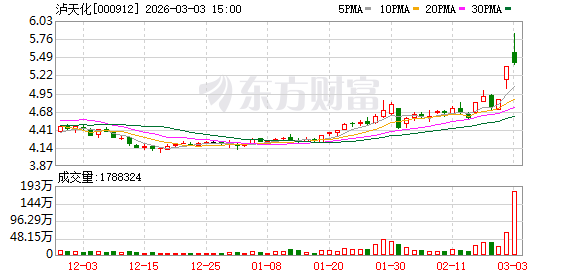
泸天化股东农业银行四川省分行拟减持不超1%公司股份
Zhi Tong Cai Jing· 2026-03-03 13:37
Core Viewpoint - The company, Luzhou Laojiao (000912.SZ), announced that its shareholder, Agricultural Bank of China Sichuan Branch, plans to reduce its stake by up to 15.68 million shares, representing 1% of the company's total share capital, within three months starting from March 26, 2026 [1] Summary by Category - **Shareholder Action** - Agricultural Bank of China Sichuan Branch intends to reduce its holdings in the company through centralized bidding on the stock exchange [1] - The planned reduction will occur within three months after the announcement date [1] - **Impact on Company** - The reduction of 15.68 million shares will account for 1% of the total share capital of Luzhou Laojiao [1]
泸天化(000912.SZ)股东农业银行四川省分行拟减持不超1%公司股份
智通财经网· 2026-03-03 13:25
Group 1 - The core point of the article is that Luzhou Laojiao (000912.SZ) announced that its shareholder, Agricultural Bank of China Sichuan Branch, plans to reduce its stake in the company by up to 15.68 million shares, which represents 1% of the total share capital [1] Group 2 - The reduction will take place through centralized bidding on the stock exchange within three months after the announcement date, starting from March 26, 2026 [1]
泸天化:中国农业银行四川省分行计划减持公司股份不超过1568万股
Mei Ri Jing Ji Xin Wen· 2026-03-03 12:43
Group 1 - Luzhou Laojiao Co., Ltd. announced that its major shareholder, Agricultural Bank of China Sichuan Branch, plans to reduce its holdings by up to 15.68 million shares, which represents 1% of the company's total share capital [1][1][1] - The share reduction will occur through centralized bidding on the stock exchange within three months after the announcement, starting 15 trading days from the date of the notice [1][1][1]
泸天化(000912.SZ):农业银行四川省分行拟减持不超过1%股份
Ge Long Hui A P P· 2026-03-03 12:22
Core Viewpoint - Luzhou Laojiao (000912.SZ) announced that its major shareholder, Agricultural Bank of China Sichuan Branch, plans to reduce its stake by up to 15.68 million shares, representing 1% of the company's total share capital, within three months starting from March 26, 2026 [1] Group 1 - The shareholder holding more than 5% of the shares is Agricultural Bank of China Sichuan Branch [1] - The planned reduction will occur through centralized bidding on the stock exchange [1] - The reduction period is set to begin 15 trading days after the announcement date [1]
瑞达期货尿素产业日报-20260303
Rui Da Qi Huo· 2026-03-03 10:00
1. Report Industry Investment Rating - Not provided in the report 2. Core Viewpoints - Domestic urea production has increased slightly recently. With no planned shutdowns of enterprise equipment this week and 1 - 2 shutdowns possibly resuming, considering short - term restarts, urea is entering its peak demand season, and short - term agricultural demand is expected to improve. [2] - Due to the relatively high temperature in most agricultural areas during the Spring Festival, it is conducive to the application of "green - turning fertilizer" for wheat. The restocking pace of downstream urea may be faster than in previous years. [2] - The production of high - nitrogen fertilizers in compound fertilizer plants is gradually starting, and the industrial consumption of urea has increased significantly. The compound fertilizer operating rate is expected to continue to rise. [2] - Urea enterprise inventories have increased significantly during the Spring Festival due to reduced logistics. With the recovery of logistics and the improvement of downstream industrial operations, urea demand will increase, and factory shipments may accelerate, with inventories possibly decreasing to some extent. [2] - Although agricultural demand is released after the festival and industrial demand is warming up, the price increase may be limited due to high supply. Attention should be paid to the intensity of demand release. The UR2605 contract is expected to fluctuate in the range of 1800 - 1850 in the short term. [2] 3. Summary by Directory 3.1 Futures Market - The closing price of the Zhengzhou urea main contract is 1819 yuan/ton, with a week - on - week increase of 2 yuan/ton; the 5 - 9 spread is 14 yuan/ton, with a week - on - week decrease of 11 yuan/ton. [2] - The position of the Zhengzhou urea main contract is 266,075 lots, with a week - on - week increase of 3,294 lots; the net position of the top 20 is - 44,501 lots, with a week - on - week decrease of 3,814 lots. [2] - The exchange warehouse receipts of Zhengzhou urea are 0. [2] 3.2 Spot Market - The spot prices in Hebei, Henan, Jiangsu, Shandong, and Anhui are 1870, 1860, 1890, 1890, and 1870 yuan/ton respectively, with week - on - week increases of 20, 30, 30, 30, and 30 yuan/ton. [2] - The basis of the Zhengzhou urea main contract is 73 yuan/ton, with a week - on - week increase of 60 yuan/ton. [2] - FOB prices in the Baltic Sea and China's main ports are 408 and 481 US dollars/ton respectively, with no week - on - week change. [2] 3.3 Industry Situation - Port inventories are 17.4 million tons, with a week - on - week increase of 0.8 million tons; enterprise inventories are 117.6 million tons, with a week - on - week increase of 34.13 million tons. [2] - The operating rate of urea enterprises is 93.16%, with a week - on - week increase of 2.57 percentage points; the daily urea output is 219,400 tons, with a week - on - week increase of 6,100 tons. [2] - Urea exports are 28 million tons, with a week - on - week decrease of 32 million tons; the monthly output of urea is 6,289,610 tons, with a month - on - month increase of 271,170 tons. [2] 3.4 Downstream Situation - The operating rate of compound fertilizers is 33.41%, with a week - on - week increase of 8.91 percentage points; the operating rate of melamine is 55.91%, with a week - on - week decrease of 8.26 percentage points. [2] - The weekly profit of compound fertilizers in China is 209 yuan/ton, with a week - on - week increase of 5 yuan/ton; the weekly profit of melamine with externally purchased urea is - 261 yuan/ton, with a week - on - week decrease of 121 yuan/ton. [2] - The monthly output of compound fertilizers is 5.1799 million tons, with a month - on - month increase of 0.1845 million tons; the weekly output of melamine is 29,100 tons, with a week - on - week decrease of 2,500 tons. [2] 3.5 Industry News - As of February 25, the total inventory of Chinese urea enterprises was 117.60 million tons, an increase of 34.13 million tons from the previous period (February 11), a week - on - week increase of 40.89%. [2] - As of February 26, the sample inventory of Chinese urea ports was 17.4 million tons, a week - on - week increase of 0.8 million tons, a rise of 4.82%. [2] - As of February 26, the output of Chinese urea production enterprises was 1.5355 million tons, an increase of 0.0195 million tons from the previous period, a week - on - week increase of 1.29%; the capacity utilization rate was 93.16%, a week - on - week increase of 1.18%. [2] 3.6 Suggested Attention - Pay attention to the enterprise inventory, port inventory, daily output, and operating rate data from Longzhong on Thursday. [2]