
清洁能源

Search documents
对冲AI泡沫完美组合:清洁能源、关键金属、基建和国防?
Hua Er Jie Jian Wen· 2026-01-21 08:57
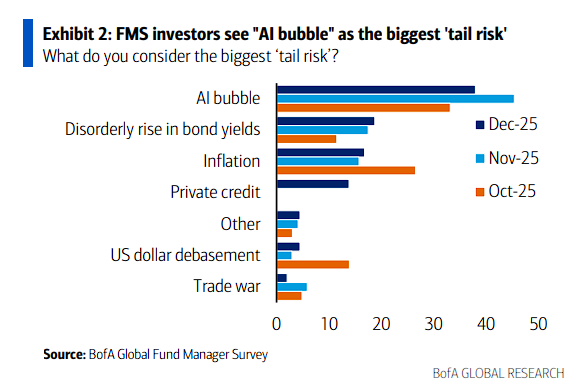
在AI叙事主导市场的当下,资本拥挤带来的脆弱性已不容忽视。美银表示,当AI狂热退潮,真正的机 会藏在那些支撑AI物理运行的"硬资产"中。 1月21日,据追风交易台消息,美银在最新的研报中称,虽然AI是一场根本性的技术革命,但估值过高 和时间周期的不确定性已成为不可忽视的风险。38%的基金经理现在将"AI泡沫"视为最大的尾部风险。 研报称,美银提出的"完美对冲"策略并非做空AI,而是转向"转型投资"(Transition Investing)。与其 直接押注高估值的AI科技股,不如布局AI革命背后必须依赖的物理基础设施:清洁能源、电网基建、 关键金属以及国防安全。 美银的核心逻辑在于:AI的尽头是电力和资源。该行预测到2030年,全球AI相关资本支出将超过1.2万 亿美元。这笔巨资将不可避免地流入到为数据中心提供动力的能源、构建硬件的金属以及保护技术的国 防领域。 与此同时,美银还认为,这些领域拥有政策支持、地缘政治驱动和供应链基本面的支撑,即便AI泡沫 破裂,它们也能提供相对的韧性。 清洁能源:从AI配角到主角的转变 美银指出,投资AI的最佳方式可能是不直接持有AI股票。国防、基础设施和转型金属等策略是AI革 ...

20cm速递|创业板新能源ETF国泰(159387)收涨超1%,近5日资金净流入超1.4亿元,德国电动车补贴利好锂电产业链
Mei Ri Jing Ji Xin Wen· 2026-01-21 08:18
创业板新能源ETF国泰(159387)跟踪的是创新能源指数(399266),单日涨跌幅限制达20%,该指数 从沪深市场中聚焦于新能源领域的技术创新企业,成分股涵盖清洁能源、新能源汽车、储能技术等行 业。指数侧重于筛选具有高成长性与科技创新能力的上市公司证券,以反映新能源行业的发展趋势和技 术进步的整体表现。 (文章来源:每日经济新闻) 1月21日,创业板新能源ETF国泰(159387)收涨超1%,近5日资金净流入超1.4亿元,德国电动车补贴 利好锂电产业链。 华福证券指出,德国政府宣布拨款30亿欧元用于新购入电动汽车的家庭提供最高6000欧元的补贴,旨在 扶持电动车产业发展,补贴倾向纯电汽车和中低收入人群。预计该政策将带动电动车新增需求在0至80 万辆之间,对应电池新增需求0至48GWh,看好锂电需求增长带来的业绩增量。 ...

花旗:中集安瑞科配股集资支持清洁能源业务 重申“买入”评级
Zhi Tong Cai Jing· 2026-01-21 03:26
中集安瑞科管理层解释,虽然合并口径下的现金状况与现金流看似充裕,但部分资金用途受限,尤其是 在化工业务分拆上市(中集环科(301559)(301559.SZ))之后。此外,清洁能源业务的一些营运现金流入 来自船舶客户的预付款,这些资金亦不能用于资本开支。因此,安瑞科需要依靠外部融资,以支持清洁 能源业务的资本开支。 花旗发布研报称,中集安瑞科(03899)公布配售最多共7,970万股新股,预估扩大后股本约3.77%,每股作 价9.79港元,净集资约7.74亿港元。花旗维持对中集安瑞科的"买入"评级,目标价12.5港元。 ...

中集安瑞科20260120
2026-01-21 02:57
中集安瑞科 20260120 摘要 公司以 9.79 港币的价格配售新股,较 1 月 19 日收盘价折让 7.73%, 集资用于清洁能源资本支出和一般公司用途,包括偿还银行贷款和满足 营运资本需求。 清洁能源项目是公司主要投资领域,包括已投产和在建的干焦项目,以 及预计 2027 年投产的绿色甲醇二期项目,总投资额预计在 18 至 19 亿 人民币左右。 公司预计 2025 年资本性开支约为 10 亿人民币,2026 年预计在 8 至 15 亿人民币之间,主要用于干焦项目、绿甲二期建设以及日常固定资产 开支。 截至 2025 年 6 月 30 日,公司账面现金接近 78 亿人民币,但可自由动 用现金有限,营运资金需求约 36 亿人民币,资产负债率为 57%,接近 集团红线 60%。 第五个干焦项目位于印尼,是公司首个海外项目,设计产能为 18 万吨 LNG 和 10 万吨甲醇,总投资额超过 20 亿元,预计 1 至 1 年半内投产。 绿甲二期公司将控股,但股权比例和合作模式与一期不同,将引入新的 合作方,一期公司股比为 70%。 公司分红不受账面现金限制影响,黄科和纯科有 50%的股息派发率,且 分红现金已提 ...
每日投资策略:关税战恐重燃,市场续观望-20260121
Guodu Securities Hongkong· 2026-01-21 01:55
Group 1: Market Overview - The report indicates that the market is currently cautious due to the potential resurgence of trade wars between the US and Europe, leading to a soft performance in A-shares and a continuation of weakness in Hong Kong stocks, particularly in technology sectors [3][4] - The Hang Seng Index closed down 76 points or 0.29%, at 26,487 points, marking a four-day decline totaling 512 points or 1.9% [3] - The total market turnover was 237.766 billion, with a net inflow of 3.662 billion from northbound trading [3] Group 2: Investment Insights - UBS forecasts a 15% upside potential for the Hong Kong and China stock markets this year, favoring H-shares over A-shares due to a positive outlook on Hong Kong-listed Chinese tech stocks, with expected average earnings growth of 25% or more in the coming years [7] - The report highlights interesting investment themes in Chinese stocks, including technology autonomy, healthcare, new consumption, and high-yield financial stocks, despite a muted overall economic growth outlook for China [7] - UBS anticipates a 4.5% economic growth for China this year, with real estate investment expected to decline by 17% year-on-year, posing a significant economic risk [8] Group 3: Company-Specific Developments - China Duty Free Group plans to acquire DFS Group's Greater China retail business for up to $395 million (approximately 3.081 billion HKD), with the acquisition funded by internal resources [12] - The acquisition will involve issuing new H-shares at a price of 77.21 HKD, which represents an 11.66% discount to the closing price of 87.4 HKD [12] - China Duty Free Group aims to establish a strategic partnership with LVMH in retail sectors, enhancing cooperation in product sales, store openings, brand promotion, and customer experience [12] Group 4: Sector Analysis - China International Capital Corporation predicts a 40% increase in gold prices this year, making gold a more attractive investment amid rising geopolitical tensions and expectations of lower US interest rates [9] - The report emphasizes that central banks and insurance companies are increasing their gold holdings, with a significant rise in gold purchases in 2022, which is expected to continue in 2023 and 2024 [9]
进展与分歧并存:2025全球可持续发展政策盘点
Xin Lang Cai Jing· 2026-01-20 09:26
Group 1: Global Sustainable Development Trends - In 2025, global sustainable development is progressing amidst uncertainties, with climate and sustainability goals generally advancing, but geopolitical tensions and energy security concerns leading to significant policy divergence among countries [1][16] - The global sustainable development policy is no longer simply about "tightening" or "loosening" but requires understanding the direction and logic behind policy changes, especially for Chinese enterprises participating in international competition [1][16] Group 2: International Cooperation and Climate Governance - The COP30 held in Brazil in November 2025 is viewed as a critical meeting for global climate governance, reaffirming the Paris Agreement as the core framework and calling for a tripling of climate adaptation funding from developed to developing countries by 2035 [2][17] - The G20 summit in Johannesburg saw record participation, with 42 countries and regional economic communities, emphasizing the active role of developing countries in international governance and multilateral cooperation [3][18] Group 3: EU ESG Adjustments - The EU Commission introduced the "Omnibus I Package" in February 2025, simplifying various sustainability reporting and compliance regulations to enhance competitiveness while maintaining core climate goals [4][19] - Key adjustments include raising the reporting threshold for the Corporate Sustainability Reporting Directive (CSRD) to companies with 1,000 employees, delaying compliance timelines for large enterprises under the Corporate Sustainability Due Diligence Directive (CSDDD), and simplifying the EU Taxonomy disclosure requirements by about 70% [21][19] Group 4: US ESG Policy Dynamics - In 2025, federal ESG policies in the US are retracting, with the Trump administration announcing a withdrawal from the Paris Agreement and canceling several clean energy incentives, contrasting with progressive state-level actions in Democratic-led states [6][20][22] - The divergence between federal and state ESG policies increases complexity for businesses in compliance and investment decisions, characterized by a "federal swing and state-level differentiation" [7][20] Group 5: Singapore's Carbon Trading Initiatives - Singapore aims to become Asia's carbon trading service center, having implemented an International Carbon Credit framework in January 2024, allowing companies to offset up to 5% of taxable emissions [8][23] - The country is enhancing its carbon market through international cooperation, including forming a Carbon Market Development Alliance and signing climate cooperation agreements with Vietnam [8][23] Group 6: UK's Transition to Clean Energy - 2025 marks the UK's first full year of zero coal power generation, with significant legislative measures like the Great British Energy company established to drive clean energy projects [10][24] - The UK aims for 45-47 GW of solar capacity by 2030, focusing on large-scale rooftop solar deployment in public sectors [10][24] Group 7: International ESG Standards and Practices - In 2025, international ESG organizations are revising standards based on corporate feedback to enhance practical applicability, including updates to the IFRS S2 climate-related disclosure standards and the GRI's climate and energy disclosure standards [12][25][26] - The Science Based Targets initiative (SBTi) is developing a new net-zero standard, emphasizing the need for companies to reassess their targets every five years to ensure alignment with actual progress [12][26] Group 8: China's Sustainable Development Context - China's carbon intensity reduction targets are on track to meet the 2030 Nationally Determined Contributions (NDC) goals, supported by a comprehensive ESG policy framework [13][27] - The increasing complexity and uncertainty of international policies necessitate that Chinese enterprises establish compliance systems that adapt to various regional regulations and maintain operational stability [13][27][28]
中集安瑞科早盘跌近7% 公司拟配股筹资约7.8亿港元 用于清洁能源业务
Zhi Tong Cai Jing· 2026-01-20 01:41
Group 1 - The core viewpoint of the article is that 中集安瑞科 plans to issue new shares at a discount to raise approximately 780 million HKD for capital expenditures in clean energy and general business operations [1] - The company’s stock price fell nearly 7% in early trading, with a current price of 10.34 HKD, reflecting a decrease of 2.54% [1] - The share placement price of 9.79 HKD represents a discount of about 7.73% compared to the previous closing price of 10.61 HKD [1] Group 2 - Citigroup's recent report indicates that strong demand for LNG bunkering vessels is driving new offshore clean energy orders, projected to reach 10 billion and 22 billion RMB for 2025 [1] - The expected increase in offshore clean energy revenue for 2026 is at least 1 billion RMB, with an anticipated improvement in net profit margins by 1 to 2 percentage points [1] - Citigroup has raised its earnings forecasts for 2026 and 2027 by 1% and 2% respectively, and increased the target price from 9.5 HKD to 12.5 HKD while maintaining a "buy" rating [1]
港股异动 | 中集安瑞科(03899)早盘跌近7% 公司拟配股筹资约7.8亿港元 用于清洁能源业务
智通财经网· 2026-01-20 01:37
Group 1 - The core point of the article is that 中集安瑞科 (CIMC Enric) announced a share placement at a discount, leading to a decline in its stock price [1] - The company plans to issue up to 79.7 million new shares at a price of HKD 9.79 per share, which is approximately 7.73% lower than the closing price of HKD 10.61 on Monday [1] - The proceeds from the placement are expected to be around HKD 780 million, with about 50% allocated for capital expenditures in clean energy and the other 50% for general business operations [1] Group 2 - Citigroup recently released a report indicating that strong demand for LNG bunkering vessels is driving new orders and backlog for offshore clean energy, projected to reach RMB 10 billion and RMB 22 billion respectively by 2025 [1] - The company anticipates that revenue from offshore clean energy will increase by at least RMB 1 billion in 2026, with net profit margins expected to improve by 1 to 2 percentage points [1] - As a result, Citigroup has raised its earnings forecasts for 2026 and 2027 by 1% and 2% respectively, and increased the target price from HKD 9.5 to HKD 12.5, maintaining a "buy" rating [1]
中集安瑞科将配售新股份筹资约7.8亿港元
Xin Lang Cai Jing· 2026-01-20 00:05
Group 1 - The company, CIMC Enric, announced a placement of up to 79.7 million new shares at a price of HKD 9.79 per share [1] - The placement price represents a discount of approximately 7.73% compared to the closing price of HKD 10.61 on Monday [1] - The proceeds from the placement are expected to be around HKD 780 million, with approximately 50% allocated for capital expenditures in the clean energy business and the remaining 50% for general business operations [1]
中国—东盟自贸区3.0版升级议定书签署 推动双方合作向数字、绿色、标准等新兴领域拓展 中国与东盟经贸合作提质升级
Ren Min Ri Bao· 2026-01-19 22:27
Core Insights - China has maintained its position as ASEAN's largest trading partner for 16 consecutive years, while ASEAN has been China's largest trading partner for 5 years, with trade volume reaching 6.82 trillion RMB in the first 11 months of last year, a year-on-year increase of 8.5% [1] Economic Cooperation - The China-ASEAN Free Trade Area 3.0 upgrade protocol has been signed, marking a significant milestone in economic integration, expanding cooperation into digital, green, and standardization fields [1] - The implementation of the Regional Comprehensive Economic Partnership (RCEP) has facilitated deeper integration of regional supply chains, enhancing the trade relationship between China and ASEAN [6] Digital Economy - China and ASEAN are accelerating digital infrastructure cooperation, with projects in Malaysia and Indonesia enhancing regional computing power and digital economy collaboration [2] - The digital economy is expected to grow significantly, with cross-border e-commerce transactions between China and ASEAN maintaining over 20% annual growth, driven by digital technologies [2] Green Development - China is supporting green transformation in ASEAN through projects like large-scale solar power in Laos, which is expected to reduce coal consumption by 510,000 tons and CO2 emissions by 1.4 million tons annually [4] - The China-ASEAN Free Trade Area 3.0 is designed to facilitate green cooperation, promoting sustainable development and financial products for green projects [5] Industrial Cooperation - The China-ASEAN Free Trade Area 3.0 is expected to create a more stable environment for emerging industries, such as electric vehicles, by reducing compliance costs and enhancing local production capabilities [6] - Chinese companies are actively participating in ASEAN's industrial development, with examples like Changan Automobile establishing a new energy vehicle base in Thailand, contributing to local supply chains [6] Trade Growth - Trade in agricultural products between China and ASEAN reached $51.3 billion in the first ten months of 2025, reflecting an 8.9% year-on-year increase, facilitated by improved supply chain connectivity [7] - The establishment of a comprehensive strategic partnership between China and ASEAN marks a new historical starting point for bilateral cooperation, enhancing regional stability and prosperity [7]