社交网络

Search documents
警企联动创新“群聊反诈”新范式 Soul App筑牢Z世代数字安全“防火墙”
Zheng Quan Ri Bao Wang· 2025-12-12 11:44
Group 1 - Soul App, in collaboration with the Pudong Public Security Bureau's Anti-Fraud Center, launched a themed chat party aimed at enhancing fraud prevention awareness among young people, reaching a total of 11,426 individuals with a peak online attendance of 1,200 [1] - The event highlighted the vulnerability of young people to online scams, emphasizing that they are not immune to fraud and that criminals are leveraging internet strategies to exploit psychological weaknesses [1] - The immersive chat format effectively engaged participants, breaking away from traditional educational methods and significantly improving the risk perception of young users [1] Group 2 - The successful chat party reflects Soul App's ongoing commitment to ecological safety, as evidenced by the release of its "2025 Q3 Ecological Safety Report" and "2025 Minor Network Protection Social Responsibility Report," showcasing advancements in fraud risk control and minor protection [2] - Soul App has implemented a dual approach of "technology + system" in minor protection, including a strict rule prohibiting users under 18 from registering, and has introduced AI models to enhance user behavior analysis, achieving a 99% contribution rate in identifying fake adult users [2] - The company has actively addressed harmful content, processing over 50 cases during critical periods and establishing psychological support mechanisms in collaboration with authoritative medical institutions to safeguard youth development [2] Group 3 - The Pudong Anti-Fraud Center emphasized that combating telecom fraud is a long-term and systematic effort, with plans for continued collaboration and innovative educational methods to create a safer online environment [3] - Soul App is committed to prioritizing user safety and will continue investing in AI technology development, working alongside law enforcement and various sectors to build a genuine, warm, and secure social space for Generation Z [3]
小红卡成“弃子”,小红书本地生活再试错
3 6 Ke· 2025-12-12 11:18
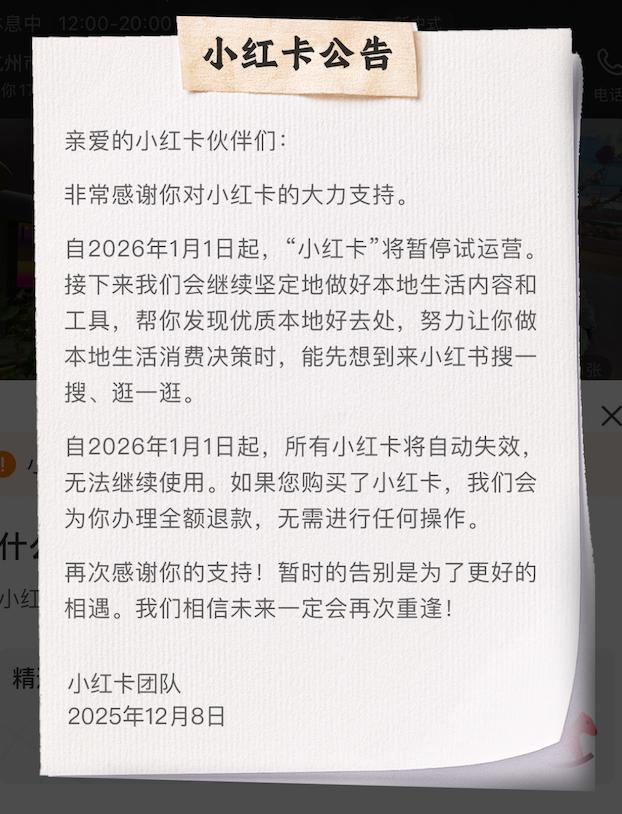
Core Insights - Xiaohongshu has decided to suspend the trial operation of its membership product "Xiaohong Card" starting January 1, 2026, indicating a strategic retreat from its local lifestyle business [1][5][21] - The Xiaohong Card, launched in September during the third Xiaohongshu Street Life Festival, aimed to provide a "selected card for food, drink, and entertainment" but faced challenges in user engagement and merchant satisfaction [2][3][10] Product Performance - The Xiaohong Card was introduced in three cities: Shanghai, Hangzhou, and Guangzhou, partnering with thousands of selected stores but lacked significant subsidies, leading to limited user appeal [2][3] - Users reported that the card's benefits were minimal, with discounts not competitive enough compared to other platforms, resulting in low usage after initial interest [8][9][10] Merchant Feedback - Merchants involved in the Xiaohong Card program expressed disappointment, noting that the initiative did not drive significant customer traffic or sales, leading to a lack of enthusiasm for the program [10][12] - Many merchants were unaware of the card's operational issues and were not incentivized to promote it due to insufficient customer flow and high operational costs [19][20] Strategic Implications - The suspension of the Xiaohong Card reflects Xiaohongshu's recognition of the challenges in transitioning from a community-driven platform to a transactional model in the local lifestyle sector [5][13][21] - Despite the setback, Xiaohongshu plans to continue exploring opportunities in the local lifestyle market, emphasizing the importance of community engagement and user experience in future initiatives [21][25][26] Market Context - The local lifestyle service market in China is projected to grow significantly, with estimates suggesting a market size of 35.3 trillion yuan by 2025, highlighting the competitive landscape that Xiaohongshu is navigating [25] - Competitors like Meituan and Douyin have established strong footholds in the local lifestyle sector, making it imperative for Xiaohongshu to leverage its community strengths to differentiate itself [20][26]

账面狂赚2.8亿,Soul藏隐忧,180万人难撑IPO
Sou Hu Cai Jing· 2025-12-11 16:16
Core Viewpoint - Soul is making its fourth attempt to go public in Hong Kong, showcasing impressive financials but heavily reliant on a small number of paying users, raising concerns about its long-term sustainability [3][9]. Financial Performance - Projected revenue for 2025 is 1.683 billion, with a year-on-year growth of 17.8%, and an adjusted net profit margin reaching 17% [3]. - The majority of revenue, 82.3%, is generated from the top 10% of users, who spend an average of 919 yuan per month, a significant increase from 646 yuan in 2022 [10]. User Base Dynamics - Monthly active users stand at 28 million, down from a peak of over 30 million during the pandemic, and decreased by 1.4 million compared to 2022 [3][10]. - The number of paying users has dropped from 170,000 to 150,000, indicating a potential issue with user retention despite a rise in average revenue per user (ARPU) by 21.8% [10]. Market Position and Competition - Major investors like Tencent and miHoYo recognize the potential in monetizing emotional connections, viewing it as a more stable business model than traditional gaming [11]. - Competitors like Summer, which require educational verification, are attracting users seeking a more curated social experience, highlighting Soul's struggle with user quality [13]. AI Integration and User Sentiment - Soul is heavily promoting AI features, mentioning "AI" 264 times in its prospectus, but user feedback indicates skepticism towards AI's ability to provide genuine social interaction [16][17]. - Despite 4.6 million daily users engaging with AI features, many view it as a novelty rather than a replacement for real human connection [16]. Debt and Financial Health - Soul carries a debt of 12.4 billion, with obligations that include an 8% annual interest rate, complicating its financial outlook despite recent profitability [19]. - The company is perceived as seeking emergency funding rather than a genuine IPO, as it struggles to align its business model with user needs [19][23]. User Experience and Community Engagement - The remaining 180,000 paying users are primarily seeking authentic connections rather than expensive virtual goods or AI interactions [21]. - The company needs to focus on improving its matching algorithms and community atmosphere to better meet user expectations and reduce churn [23].

杰富瑞下调Roblox目标价 上调Reddit目标价
Ge Long Hui A P P· 2025-12-11 10:08
Group 1 - Jefferies has lowered the target price for the online gaming platform Roblox from $115 to $100 [1] - Jefferies has raised the target price for Reddit from $300 to $325 [1]

民进党倒行逆施阻挡不了台湾民意潮流
Ren Min Ri Bao Hai Wai Ban· 2025-12-11 02:56
Group 1 - The core viewpoint of the article is that the Taiwanese authorities' decision to temporarily ban the social media platform Xiaohongshu for one year is seen as an act against the interests of the Taiwanese people, particularly the youth, and reflects a broader trend of restricting access to platforms popular among them [1][2] - The spokesperson for the State Council Taiwan Affairs Office criticized the ban, stating that it is a political maneuver aimed at suppressing the flow of information and interaction between Taiwanese youth and their counterparts in mainland China [1][2] - Xiaohongshu is described as a "lifestyle interest community" that is well-received by Taiwanese users, who utilize the platform to understand the realities of mainland China and engage in friendly interactions, which undermines the Taiwanese authorities' narrative [1] Group 2 - The spokesperson also accused the Taiwanese authorities of using the pretext of "anti-fraud" measures to infringe upon democratic freedoms and the rights of the Taiwanese people, particularly the youth, to access information and use social media platforms [2] - The ban on Xiaohongshu has faced significant opposition within Taiwan, with various media and public figures criticizing the government's actions as politically motivated and detrimental to the livelihoods of those who rely on the platform [2] - The upcoming Cross-Strait Entrepreneurs Summit, scheduled for December 16-17 in Nanjing, will focus on topics such as innovation and cooperation in the context of the 14th Five-Year Plan, with around 800 participants expected [2][3] Group 3 - Fujian Province has recently announced a new set of policy measures aimed at supporting Taiwanese enterprises and businesspeople, which includes 12 specific initiatives to enhance tax services and promote trade and cultural exchanges [3] - These measures are designed to address the needs of Taiwanese businesses and are expected to accelerate the integration of development between Fujian and Taiwan [3]
国台办评台当局封禁小红书:民进党倒行逆施阻挡不了台湾民意潮流
Xin Hua She· 2025-12-10 10:59
新华社北京12月10日电(记者尚昊、李寒芳)针对民进党当局宣布"暂定封禁"大陆社交平台小红书一 年,国务院台办发言人陈斌华10日在例行新闻发布会上答记者问表示,从封锁大陆购物平台、影音平 台,再到封禁大陆社交平台,民进党已经成了名副其实和老百姓作对的"民禁挡",凡是台湾民众常用的 就非禁不可,凡是台湾青年爱用的就非挡不可。多行不义必自毙,民进党当局恣意妄为,必将自食恶 果。其倒行逆施阻挡不了台湾民众特别是青年了解大陆、与大陆同胞相交相知的民意潮流。 日前,民进党当局以"被检测出多项资安指标不合格""诈骗多"等为由,对小红书"暂定封禁"一年。陈斌 华在回答记者有关提问时作上述表示。 他说,众所周知,小红书是定位为"生活兴趣社区"的社交平台,以丰富多元的生活化内容、贴近青年兴 趣的社区氛围、便捷的互动方式,深受台湾民众特别是青年的喜欢。他们借由小红书了解大陆真实情 况,与大陆网友亲切、友善互动,这让民进党当局刻意制造的"信息茧房"和对大陆的污蔑抹黑塌了房、 破了功。民进党当局因此如芒在背,恼羞成怒。其封禁理由中的所谓"资安",暴露的正是他们内心的恐 惧和"不安"。 至于所谓"反诈",陈斌华表示,民进党当局名为"反 ...
聚焦文化体验和兴趣探索 豆瓣推出“我的签到足迹”功能
Xin Lang Cai Jing· 2025-12-10 07:42
新浪科技讯 12月10日下午消息,豆瓣即将推出一项全新的地点签到与主题集章功能"我的签到足迹"。 今日,该功能的试玩版"我的冬日漫游集章册"活动率先上线,产品1.0版本计划于2026年1月份正式上 线。 新浪科技讯 12月10日下午消息,豆瓣即将推出一项全新的地点签到与主题集章功能"我的签到足迹"。 今日,该功能的试玩版"我的冬日漫游集章册"活动率先上线,产品1.0版本计划于2026年1月份正式上 线。 据介绍,"我的签到足迹"是一个基于设备位置信息的地点签到和主题集章功能,用户到达某个地点后可 以发起签到,并在已领取的主题集章册中为该地点盖章。首批已上线包括全国的公园和博物馆,约 6 万 多条地点数据,2026 年 1 月正式产品上线时将新增包括全国的美术馆、天文馆、科技馆、动物园、植 物园、文物古迹、景区景点等约 5 万多个地点。 豆瓣方面表示,该产品整体将围绕文化、科普、旅游与休闲娱乐相关的地点来构建,更希望该产品聚焦 在文化体验与个人兴趣探索,而不是泛生活消费。后续会陆续上线的地点类型还包括剧场、音乐厅、电 影院、书店、体育场馆等,但不考虑收录购物类、餐饮类、休闲服务等相关场所,且目前暂不支持用户 自 ...
台当局禁小红书 国台办:民进党已成“民禁挡”
Zhong Guo Xin Wen Wang· 2025-12-10 07:26
Core Viewpoint - The Taiwanese government's ban on the social media platform Xiaohongshu is seen as a political maneuver against the interests of the Taiwanese youth and public, reflecting the ruling party's fear of losing control over information and communication with mainland China [1][2]. Group 1: Ban on Xiaohongshu - The Taiwanese authorities have banned Xiaohongshu citing multiple security concerns and fraud issues, which has been criticized as a tactic to suppress democratic freedoms and the public's right to information [1][2]. - Xiaohongshu has over 3 million users in Taiwan, with 70% being post-90s generation, indicating its popularity among the youth [1]. - The ban is perceived as an attempt to maintain an "information bubble" and prevent Taiwanese citizens from engaging with mainland Chinese perspectives [1]. Group 2: Political Implications - The spokesperson from the State Council Taiwan Affairs Office criticized the ban as a reflection of the ruling party's antagonism towards the public, labeling it as "民禁挡" (blocking the people's access) [1][2]. - Reports indicate that the number of fraud cases on Facebook in Taiwan far exceeds those attributed to Xiaohongshu, suggesting that the government's anti-fraud rationale is inconsistent and politically motivated [2]. - The ban has faced widespread opposition within Taiwan, with various sectors condemning the government's actions as politically motivated rather than genuinely concerned about public safety [2]. Group 3: Cross-Strait Relations - The spokesperson noted that the communication mechanism between the Association for Relations Across the Taiwan Straits and the Taiwan Strait Exchange Foundation has been stalled due to the Taiwanese government's refusal to acknowledge the "1992 Consensus" [3]. - There is an expressed desire for Taiwanese citizens to share in the opportunities presented by the development of the mainland's internet, highlighting a potential for increased mutual understanding between the two sides [3].
民进党当局封禁小红书一年,国台办回应
中国基金报· 2025-12-10 04:53
从封锁大陆购物平台、影音平台,再到封禁大陆社交平台,民进党已经成了名副其实和老百姓作对 的"民禁挡",凡是台湾民众常用的就非禁不可,凡是台湾青年爱用的就非挡不可。多行不义必自毙, 民进党当局恣意妄为,必将自食恶果。其倒行逆施阻挡不了台湾民众特别是青年了解大陆、与大陆同胞 相交相知的民意潮流。 12月10日,国务院台办举行例行新闻发布会。总台记者提问:大陆社交平台小红书在台湾地区拥有超 300万用户,其中70%是90后,已成为台湾民众特别是青年常用、爱用的社交媒体。12月4日,民进 党当局以"被检测出多项资安指标不合格"、"诈骗多"等为由,对小红书"暂定封禁"1年。请问发言人 对此有何评论? 发言人陈斌华表示,这让我不禁想到《左传·桓公十年》的名句"匹夫无罪,怀璧其罪"。众所周知,小 红书是定位为"生活兴趣社区"的社交平台,以丰富多元的生活化内容、贴近青年兴趣的社区氛围、便 捷的互动方式,深受台湾民众特别是青年的喜欢。他们借由小红书了解大陆真实情况,与大陆用户亲 切、友善互动,这让民进党当局刻意制造的"信息茧房"和对大陆的污蔑抹黑塌了房、破了功。因此民 进党当局如芒在背,恼羞成怒。其封禁理由中的所谓"资安",暴 ...

民进党当局封禁小红书一年 国台办回应
证券时报· 2025-12-10 04:35
证券时报各平台所有原创内容,未经书面授权,任何单位及个人不得转载。我社保留追 究相关 行 为主体 法律责任的权利。 12月10日,国务院台办举行例行新闻发布会。 总台记者提问 :大陆社交平台小红书在台湾地区拥有超300万用户,其中70%是90后,已成为台湾民众 特别是青年常用、爱用的社交媒体。12月4日,民进党当局以"被检测出多项资安指标不合格"、"诈骗 多"等为由,对小红书"暂定封禁"1年。请问发言人对此有何评论? 发言人陈斌华表示,这让我不禁想到《左传·桓公十年》的名句"匹夫无罪,怀璧其罪"。众所周知,小红 书是定位为"生活兴趣社区"的社交平台,以丰富多元的生活化内容、贴近青年兴趣的社区氛围、便捷的互 动方式,深受台湾民众特别是青年的喜欢。他们借由小红书了解大陆真实情况,与大陆用户亲切、友善互 动,这让民进党当局刻意制造的"信息茧房"和对大陆的污蔑抹黑塌了房、破了功。因此民进党当局如芒在 背,恼羞成怒。其封禁理由中的所谓"资安",暴露的是他们内心的恐惧和"不安"。 至于所谓"反诈",据岛内媒体报道,脸书在岛内去年涉诈近6万件,今年也已超过3万件,远超民进党当 局所指控的小红书涉案数量。因此,民进党当局名为 ...