超市

Search documents
赵崇甫:永辉超市的困局,品牌战略“无根之木”与未来挑战
Sou Hu Cai Jing· 2026-01-22 01:09
文/赵崇甫 品牌的价值不在于规模与门面,而在于植根于顾客信任的战略性资产。当永辉超市在2025年录得惊人亏 损,其背后不仅是一份令市场失望的财报,更暴露了一场品牌战略的深层危机。 错位模仿:当"形似"无法转化为"神似" 永辉对胖东来模式的模仿,是近年最引人瞩目的商业实验之一。 然而,这种模仿更多停留在门店环境、商品陈设和营销策略的表面层,却忽视了胖东来模式最核心的品 牌根基:长期积累的供应链管控力与深入人心的员工价值文化。 品牌战略的核心在于构建难以复制的系统性能力,而非简单复制成功者的外在表现。 转型成本:战略调整的必然之痛与可控风险 品牌转型必然伴随着阵痛,但关键在于这种阵痛是否能够换来品牌价值的系统性提升。 永辉大规模调改与闭店,带来的不仅是直接的财务损失,更是品牌在消费者心中定位的又一次摇摆。 传统大卖场模式积累的庞大资产和人员结构,在向中小型社区店转型过程中,成了沉重的历史包袱。 相比之下,奥乐齐、盒马NB等新兴品牌能够"轻装上阵",精准切入细分市场,正是因为他们没有这种 历史负担。 永辉在调改过程中,试图将自身传统大卖场模式压缩为中小型社区店,追求"瘦身"的同时,却未建立与 之匹配的新价值主张。 ...


北京GDP总量突破5万亿,TCL拟控股索尼电视业务 | 财经日日评
吴晓波频道· 2026-01-22 00:29
Group 1: Beijing Economic Performance - In 2025, Beijing's GDP reached 52,073.4 billion yuan, growing by 5.4% year-on-year, surpassing the national average of 5% and marking it as the second city in China to exceed 50 trillion yuan in GDP after Shanghai [2] - The per capita disposable income in Beijing was 89,090 yuan, a year-on-year increase of 4.3%, with urban residents earning 96,292 yuan and rural residents 42,012 yuan, reflecting a narrowing income gap [3] - The growth in Beijing's economy is supported by a high proportion of the tertiary sector and strong performance in high-energy industries, despite a slowdown in operating income growth and stagnant property net income [3] Group 2: 6G Technology Development - China has completed the first phase of 6G technology trials and is now entering the second phase, focusing on typical application scenarios and verifying technical feasibility [4] - The integration of air, land, sea, and space in 6G technology is expected to create revolutionary applications and drive upgrades in related industries such as chips and smart terminals [5] Group 3: TCL and Sony Joint Venture - TCL is set to acquire a controlling stake in Sony's television and audio business, forming a joint venture with 51% ownership by TCL and 49% by Sony, expected to start operations in April 2027 [6] - TCL's television shipment is projected to reach 30.41 million units in 2025, with a market share increase to 13.8%, narrowing the gap with the leading brand Samsung [6] Group 4: Vanke Bond Repurchase Plan - Vanke A's bondholders approved a plan to adjust the repayment arrangement for its bonds, allowing for a fixed repayment of 100,000 yuan and 40% principal repayment, providing some relief from potential default [7] - The company faces significant cash flow challenges, with a total debt of approximately 6.5 billion yuan maturing in the second quarter, raising concerns about its ability to avoid substantial defaults [8] Group 5: Douyin's New App Development - Douyin is developing an app called "Dou Sheng Sheng," aimed at enhancing offline consumption through group buying, with a focus on providing value and convenience [9] - Douyin's local life services are showing significant growth, with a total transaction volume increase of over 59% in 2025, indicating a successful expansion into the local service market [10] Group 6: Yonghui Supermarket's Financial Struggles - Yonghui Supermarket expects a net loss of 2.14 billion yuan in 2025, a 45.6% increase in losses compared to the previous year, primarily due to strategic adjustments and store closures [11] - The company's restructuring efforts, while necessary, have led to significant short-term losses, raising questions about its long-term viability in a changing retail landscape [11] Group 7: Netflix's Acquisition Strategy - Netflix reported a fourth-quarter revenue of $12.05 billion, exceeding expectations, and announced a shift to an all-cash acquisition of Warner Bros. for $72 billion [12][13] - The acquisition aims to bolster Netflix's content library with top-tier IPs, although it raises concerns about increased debt and financial risk as the company transitions from rapid growth to a more mature phase [13]




8点1氪丨西贝获新融资;永辉已申请多枚胖小辉商标;全球最大钻石生产商宣布降价
3 6 Ke· 2026-01-22 00:10
Group 1 - Inner Mongolia Xibei Catering Group has increased its registered capital from approximately 89.9 million RMB to about 102 million RMB, marking an increase of approximately 13% [2] - The company was established in October 2017 and is involved in various sectors including catering services, food production, and investment activities [2] Group 2 - Yonghui Supermarket has applied for multiple "Fat Little Hui" trademarks, covering categories such as tobacco, food, and beverages, with the status of these trademarks currently being in application [3] - In November 2024, Yonghui also registered several "Fat Yonghui" trademarks, which have been successfully registered [3] Group 3 - De Beers, the world's largest diamond producer, has announced a price reduction of 25% for diamonds due to declining demand and the rise of synthetic diamonds, marking a significant shift in the diamond market [4] - The company previously held a 90% market share in diamond supply and still controls 60% of the rough diamond trade [4] Group 4 - Beijing's GDP has surpassed 5 trillion RMB, reaching 52,073.4 billion RMB in 2025, with a year-on-year growth of 5.4%, making it the second city in China to achieve this milestone after Shanghai [6] Group 5 - Ford is recalling over 119,000 vehicles in the U.S. due to a fire risk associated with engine block heaters, which may crack and leak coolant, posing a fire hazard [6] - The recall involves specific models and owners are advised to contact dealers for free inspections [6] Group 6 - Burberry reported a 3% increase in same-store sales for the third quarter of the 2026 fiscal year, with notable growth in the Greater China region, which accelerated to 6% [19] - The Asia-Pacific region also saw a growth rate of 5%, with strong performance in the South Korean market, which grew by 13% [19] Group 7 - Netflix announced plans to increase its film production spending by 10% in 2026, while also pursuing the acquisition of Warner Bros' studio and streaming business [20] - In the fourth quarter, Netflix reported revenues of $12.05 billion, exceeding expectations, and a free cash flow of $1.87 billion [20]
猛料!网红超市奥乐齐,有望来盐城!
Sou Hu Cai Jing· 2026-01-21 13:28
继M会员店、盒马,之后,又一家知名超市有望进驻盐城。 它全球门店超1.3万家,火遍很多城市的德国"穷鬼超市"——奥乐齐。 据悉,盐南高新区以"开局即冲刺"的奋进姿态,紧扣"场景焕新、业态融合、服务升级"核心导向,正在 积极推动奥乐齐首店落地聚龙湖商圈,为盐南高质量发展注入强劲动能。 不得不说,相较于此前传统的超市,如今更贴合居民日常需求的 "高质、精品、场景化"的商业模式, 更让大家所接受。 可以说,今年盐城商业版图中加速落地,悄然生花。 比如叮咚买菜盐城首个配送站点已经开始营业,接下来M会员店、盒马也都将会开业。 未来,随着更多优质商业项目的落地,盐城居民的日常购物选择将愈发丰富,这座城市的商业活力也将 在 "接地气" 的民生导向中持续升级。 最后,对于奥乐齐要来盐城的消息,大家期待吗? 抖音小红书上更是铺天盖地的奥乐齐扫货攻略,热度直接爆棚。 作为盐城市唯一的一级综合服务中心,这里集行政、科创、商务金融等五大功能于一体,坐拥盐南高新 区近60万常住人口。年轻消费群体在此高度集聚,催生出旺盛的品质消费需求。 商圈内,13万平方米的聚龙湖金鹰综合体与金地中心、欧风花街等多个商业载体相互联动,共同构建 出"商业 ...
胖东来的第一批学徒,已经挂科了
远川研究所· 2026-01-21 13:03
Core Viewpoint - The article discusses the challenges and complexities faced by companies in the retail sector, particularly in learning from the successful model of "胖东来" (Pang Donglai), highlighting the difficulties in replicating its success due to deep-rooted operational and management issues within traditional supermarket structures [9][14][73]. Group 1: Industry Challenges - The retail industry is undergoing significant adjustments, with companies like 美特好 (Meitehao) announcing plans to learn from Pang Donglai while struggling with operational issues, including store closures and financial instability [3][6]. - Major players in the supermarket sector, such as 永辉超市 (Yonghui Supermarket), are facing severe financial challenges, including projected annual losses and significant revenue declines [6][11]. - The traditional supermarket model relies heavily on fees from brands and suppliers, which can create conflicts and inefficiencies in operations [16][20]. Group 2: Learning from Pang Donglai - Companies attempting to adopt the "Pang Donglai model" often fail to grasp its core principles, which emphasize a fundamental shift in how supermarkets operate, moving away from reliance on key accounts (KA) to focusing on direct consumer sales [15][21]. - The success of Pang Donglai is attributed to its ability to redefine product offerings and supplier relationships, allowing for greater control over inventory and pricing [22][23]. - The challenges of implementing such a model include overcoming entrenched procurement practices and the complexities of managing supplier relationships [24][27]. Group 3: Management and Employee Dynamics - Pang Donglai's approach includes high employee compensation and generous benefits, which are seen as strategies to reduce corruption and improve operational integrity [35][43]. - The management practices at Pang Donglai are characterized by strict performance standards and a focus on efficiency, which may be difficult to maintain as the company scales [49][50]. - The article highlights the importance of aligning employee incentives with company goals to foster a culture of accountability and performance [46][47]. Group 4: Historical Context and Market Dynamics - The evolution of the retail market has seen many once-dominant players fade, illustrating the challenges of sustaining success in a rapidly changing environment [60][62]. - The article emphasizes that successful business models are often context-specific and may not be easily replicated across different markets or conditions [73]. - The historical perspective on retail evolution suggests that many companies may fall into the trap of believing that they can easily replicate the success of others without understanding the underlying factors that contributed to that success [64][66].

氪星晚报|联想集团与英伟达联合推出“联想人工智能云超级工厂”;OpenAI与盖茨基金会将向非洲医疗人工智能领域投资5000万美元;我国去年电影全产业链产...
3 6 Ke· 2026-01-21 11:40
Group 1: Nuclear Energy - Japan's Tokyo Electric Power Company has restarted the Kashiwazaki-Kariwa Nuclear Power Plant Unit 6, which had been offline since the 2011 earthquake [1] Group 2: Artificial Intelligence and Technology - Lenovo and NVIDIA have announced a collaboration to launch the "Lenovo AI Cloud Super Factory," aimed at transforming traditional data centers into efficient AI factories [1] - OpenAI has introduced an age prediction model in its ChatGPT service to help identify accounts belonging to users under 18, implementing protective measures for minors [2] - OpenAI and the Gates Foundation are investing $50 million in the "Horizon 1000" project to support AI applications in healthcare across Africa, starting with Rwanda [8] - Microsoft CEO Satya Nadella emphasized that the focus in the AI era should be on computational infrastructure and model orchestration rather than a single model [8] Group 3: Strategic Partnerships - Data堂 and 灵心巧手 have signed a strategic cooperation agreement to integrate their capabilities in the field of embodied intelligence, aiming for technological innovation and industry application [4] Group 4: Market Developments - The Qatar Investment Authority, valued at $580 billion, is considering a major restructuring to separate its overseas assets from domestic investments, enhancing its global investment strategy [2] - 永辉超市 has applied for multiple "胖小辉" trademarks, indicating potential expansion into various sectors [6] - 呷哺呷哺集团 is launching a new sub-brand "呷牛排," entering the steak market with its first store opening in February [7] Group 5: Film Industry - China's film industry is projected to reach a total output value of 817.26 billion yuan by 2025, with a box office multiplier of approximately 1:15.77, ranking among the top globally [9]

巨亏21亿,永辉学胖东来,越学越穷
3 6 Ke· 2026-01-21 10:44
Core Viewpoint - Yonghui Supermarket has reported a projected net loss of 2.14 billion yuan for 2025, marking its fifth consecutive year of losses [1] Group 1: Financial Performance - Yonghui Supermarket's cumulative losses since 2021 have approached 10 billion yuan [2] - The company expects a net profit loss of 2.14 billion yuan and a non-recurring net profit loss of 2.94 billion yuan for 2025 [1] - The financial impact of the reform efforts, termed "learning from Pang Donglai," has resulted in over 1.2 billion yuan in losses due to store closures and renovations [11][12] Group 2: Strategic Changes - Yonghui initiated a reform plan in May 2024, aiming to emulate the successful strategies of Pang Donglai, including store renovations and employee salary increases [5][7] - The company has closed 381 stores that do not align with its new strategic direction while renovating 315 others [11] - Despite these efforts, the company has struggled to achieve profitability, with its strategic direction remaining inconsistent [10][20] Group 3: Comparison with Competitors - Pang Donglai has achieved significant success, with revenues exceeding 18 billion yuan and high customer demand, contrasting sharply with Yonghui's ongoing losses [2][12] - The success of Pang Donglai is attributed to its founder's long-term operational philosophy and focus on employee welfare, which Yonghui has failed to replicate effectively [8][13] Group 4: Operational Challenges - Yonghui's overexpansion in the 2010s has led to inefficiencies and a loss of management control, resulting in a shift to a "store closure for survival" strategy [14][15] - The company's supply chain capabilities are weak, relying heavily on third-party logistics, leading to higher costs and waste [17] - Yonghui's frequent shifts in strategic focus over the past five years have hindered its ability to establish a stable market position [18] Group 5: Future Outlook - Yonghui is planning a 3.114 billion yuan capital increase, with 77% allocated for store upgrades and further alignment with Pang Donglai's model [22] - The company is advised to focus on consolidating its strengths in traditional markets rather than pursuing widespread changes [24] - A more targeted approach in developing high-efficiency stores could be essential for reversing its financial decline [24]
一年关店381家!知名超市公告:连续5年亏损
Xin Lang Cai Jing· 2026-01-21 10:25
Core Viewpoint - Yonghui Supermarket is undergoing a significant strategic shift from "scale expansion" to "quality growth," leading to substantial losses in 2025 due to store closures and renovations [3][9]. Group 1: Financial Performance - In 2025, Yonghui Supermarket reported a net loss of 2.14 billion yuan attributable to shareholders, with a net loss of 2.94 billion yuan after excluding non-recurring items [6]. - The cumulative loss since 2021 has reached approximately 11.64 billion yuan, with 2025's losses exceeding those of 2023 and 2024 [6]. Group 2: Strategic Adjustments - The company has redefined its strategy as "New Yonghui, New Quality," involving the deep adjustment of 315 stores and the closure of 381 stores that do not align with its future strategic positioning [3][9]. - The adjustments have resulted in asset write-off losses and one-time costs totaling approximately 910 million yuan, along with an estimated gross profit loss of 300 million yuan due to store renovations [3][9]. Group 3: Future Plans and Expectations - Yonghui Supermarket initiated a transformation strategy on May 6, 2024, adopting a dual approach of store adjustments and closures [11]. - The new CEO, Wang Shoucheng, indicated that it would take 2 to 3 years to stabilize the company, 3 to 5 years to regain customer trust, and 5 to 10 years to become a supermarket that customers feel proud of [11]. - Data from the company's recent conference showed an average customer traffic increase of 80% in adjusted stores, with over 60% of stabilized stores achieving profitability levels surpassing the highest in the past five years [11].
永辉超市2025年预亏,调改、关闭门店近700家
Bei Ke Cai Jing· 2026-01-21 07:15
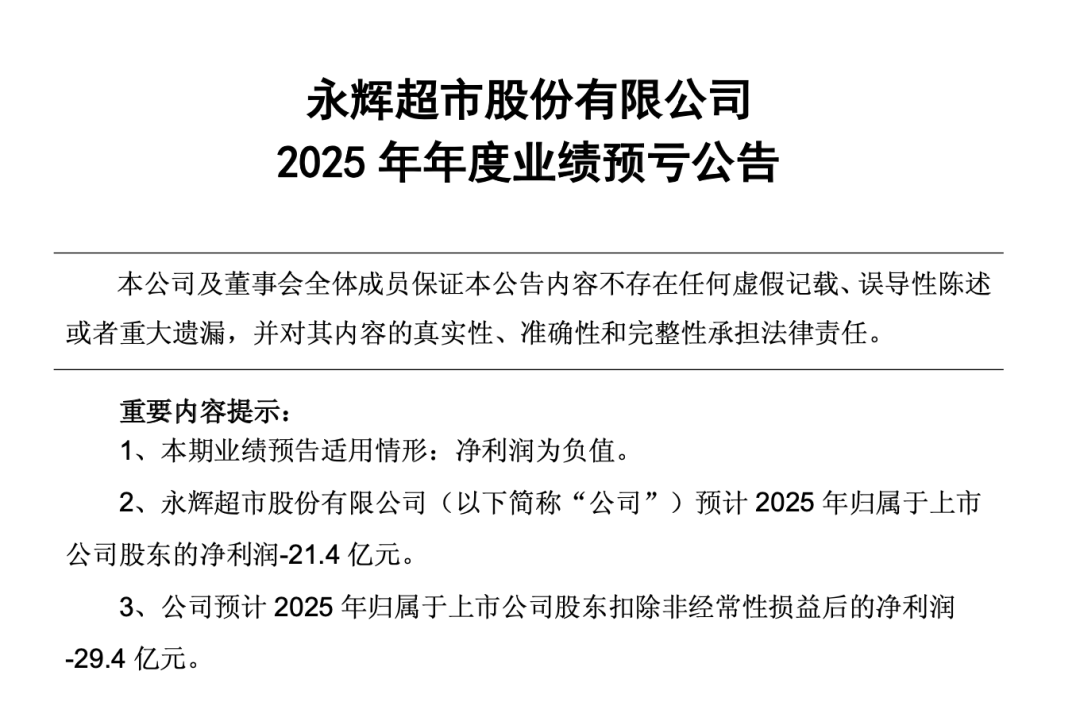
Core Viewpoint - The company, Yonghui Supermarket, is forecasting a net profit loss of 2.14 billion yuan for the year 2025, compared to a loss of 1.47 billion yuan in the previous year, indicating a worsening financial situation [1] Group 1: Financial Performance - The company anticipates a net profit loss of 2.14 billion yuan for 2025, an increase from the previous year's loss of 1.47 billion yuan [1] - The company incurred significant losses due to the closure and adjustment of nearly 700 stores during the reporting period [1] Group 2: Strategic Adjustments - In 2025, the company undertook major operational strategic adjustments, including the deep adjustment of 315 stores and the closure of 381 stores that did not align with the company's future strategic positioning [2] - The adjustments resulted in asset write-off losses and one-time investment costs totaling approximately 910 million yuan, along with an estimated gross profit loss of about 300 million yuan due to store renovations [2] Group 3: Supply Chain Strategy - The company is reforming its supply chain with a focus on "sunshine transparency, quality-driven, and efficiency improvement," addressing traditional supply chain pain points through systematic measures [2] - Short-term challenges include stock shortages and declining gross margins, which have impacted revenue; however, these effects are expected to gradually diminish as the supply chain reforms progress [2]
一年关店381家,知名超市预计去年亏损21亿元
Nan Fang Du Shi Bao· 2026-01-21 06:25
Core Viewpoint - Yonghui Supermarket is projected to incur a net loss of 2.14 billion yuan in 2025, marking the sixth consecutive year of losses since 2021, with a cumulative loss of approximately 11.641 billion yuan [1][4]. Group 1: Financial Performance - The net profit attributable to shareholders for 2025 is estimated at -2.14 billion yuan, while the net profit after excluding non-recurring gains and losses is projected at -2.94 billion yuan [1]. - The cumulative loss since 2021 amounts to approximately 11.641 billion yuan, with the 2025 loss expected to exceed that of 2023 and 2024 [1]. Group 2: Strategic Adjustments - In 2025, the company is shifting its operational strategy from "scale expansion" to "quality growth," rebranding as "New Yonghui, New Quality" [4]. - The company plans to significantly adjust its store layout, with 315 stores undergoing deep modifications and 381 stores being closed due to misalignment with future strategic positioning [4]. Group 3: Impact of Store Adjustments - The adjustments to stores will incur substantial costs, including asset write-off losses and one-time setup costs totaling approximately 910 million yuan, alongside an estimated gross profit loss of about 300 million yuan due to store closures [4]. - The closure of 381 stores will lead to significant losses, including asset write-off losses, employee severance compensation, and lease-related penalties [4]. Group 4: Supply Chain and Investment Challenges - Yonghui is reforming its supply chain with a focus on transparency, quality, and efficiency, which has led to short-term challenges such as stock shortages and declining gross margins [5]. - The company has recognized a fair value loss of 236 million yuan on its overseas equity investment in Advantage Solutions due to a continuous decline in stock prices, and it anticipates a long-term asset impairment of 162 million yuan [5]. Group 5: Store Count and Future Outlook - As of the end of 2024, Yonghui had 775 stores, with 381 closures planned for 2025, leaving at least 400 stores operational, of which 315 have already been modified [7]. - The performance of the modified stores will be crucial in determining whether the company will continue to close a significant number of stores in 2026 [7]. Group 6: Management's Vision - The new CEO has indicated that Yonghui aims to recover customer trust over the next 2 to 3 years and to become a supermarket that customers feel proud of within 5 to 10 years [8]. - Data from the company's recent adjustments show an average customer traffic increase of 80% in modified stores, with over 60% of these stores achieving profitability levels surpassing their highest in the past five years [8].