
保险业

Search documents
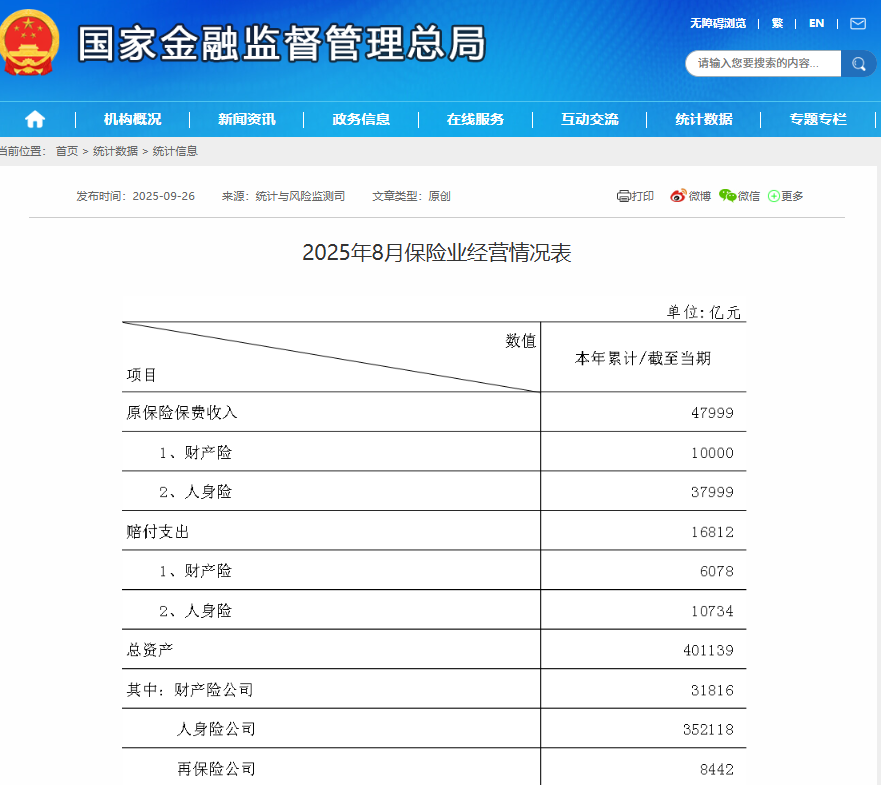
前8月保险业原保险保费收入4.8万亿元,人身险保费增长11.3%
Huan Qiu Wang· 2025-09-28 05:22
Group 1 - The core viewpoint of the article highlights the growth in China's insurance industry, with a total original insurance premium income of 4.8 trillion yuan, representing a year-on-year increase of 9.63% in the first eight months of the year [1][2] - Property insurance premium income reached 1 trillion yuan, showing a year-on-year growth of 3.65%, while life insurance premium income was 3.8 trillion yuan, with a significant year-on-year increase of 11.32% [1][2] - The total assets of the insurance industry amounted to 401.139 billion yuan, with life insurance companies holding 352.118 billion yuan and property insurance companies holding 31.816 billion yuan [2] Group 2 - Life insurance premium income specifically saw a rise of 14.05% year-on-year, totaling 2.97 trillion yuan, while new policyholder investment contributions remained stable at 458.8 billion yuan [2][3] - The insurance product structure is undergoing adjustments, with a notable increase in the proportion of participating insurance products due to the continuous decline in preset interest rates [3] - In the first quarter, over 170 new life insurance products were launched, with nearly 40% being participating and universal life insurance, indicating a shift towards more flexible and potentially higher-yielding products [3]

金融盛会!就在今天
Zhong Guo Zheng Quan Bao· 2025-09-28 00:33
Group 1 - The financial industry in China is experiencing significant growth and achievements, reflecting a robust development trajectory over the decades [1] - The upcoming 2025 Insurance and Trust Industry High-Quality Development Conference will focus on the theme "Long Money, Long Investment, Long Green," emphasizing the importance of these sectors in supporting the real economy and enhancing social welfare [2][4] - The Chinese government is implementing structural reforms in the financial supply side, introducing policies to improve service quality, risk management, and innovation within financial institutions [2] Group 2 - The insurance and trust industries are presented with new development opportunities and challenges, necessitating a strategic alignment with policy directions and an enhancement of core competitiveness [2] - Financial technology is highlighted as a key enabler for innovation in service models, aimed at meeting diverse customer needs [2] - Strengthening risk management is identified as a critical issue for ensuring financial security within the industry [2] Group 3 - The Golden Bull Awards, organized by China Securities Journal, are recognized as one of the most credible and influential awards in China's capital market, promoting healthy development in the asset management industry [3]
万能险结算利率持续下行,超六成产品低于3%
Huan Qiu Wang· 2025-09-27 02:02
Group 1 - The overall settlement rates for universal insurance products are on a downward trend, with the highest rate at 3.5% and the lowest at 0.36% as of August, with 34.53% of products offering rates above 3% [1][3] - In July, 41.83% of universal insurance products had settlement rates above 3%, indicating a decline in higher-yielding options compared to earlier in the year when over 50% of products had rates above 3% [3] - Universal insurance products were previously viewed as alternatives to high-interest deposits, with rates exceeding 4% or even 5%, but the recent decline in rates has reduced their attractiveness to consumers [3] Group 2 - The decline in settlement rates is a necessary response by the insurance industry to the challenges posed by a low-interest-rate environment, although these products still offer better returns compared to current bank deposits [3] - Consumers are advised to exercise caution when selecting universal insurance products, as many are sold in combination with other insurance types, necessitating a match with individual needs [3] - Insurance companies are required to optimize asset allocation and enhance duration management to stabilize investment returns, which supports the reasonableness of settlement rates [3]

以金融“活水”滋润“三农”沃土 浇灌出乡村振兴新气象
Yang Shi Wang· 2025-09-27 01:48
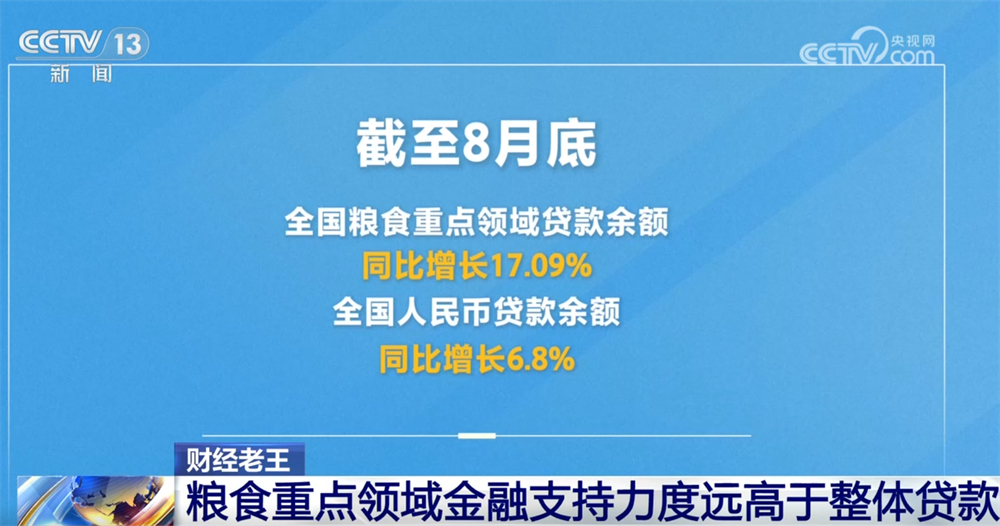
Financial Support for Agriculture - As of the end of August, the loan balance in key agricultural sectors increased by 17.09% year-on-year, significantly higher than the overall growth of 6.8% in RMB loans [1] - Financial support for agriculture includes various tailored loan products such as "Smart Grain Warehouse Loan," "Marine Ranch Loan," and "Fruit Farmer Loan," with over half of the agricultural loans requiring no collateral or guarantees [3][5] Insurance Developments - Comprehensive insurance products for major crops like rice, wheat, and corn are now available nationwide, providing better coverage compared to previous years [5] - The cost of insurance has decreased, with farmers able to secure around 1000 yuan in coverage for a premium of just over 10 yuan, thanks to substantial government subsidies [5][7] Impact on Farmers - Farmers have reported easier access to loans with lower interest rates and better disaster protection, leading to increased confidence in agricultural activities [9]
手里有粮 心里不慌,种粮有钱 丰收有底
Yang Shi Xin Wen· 2025-09-27 00:17
Financial Support for Agriculture - As of the end of August, the loan balance in key agricultural sectors increased by 17.09% year-on-year, significantly higher than the overall growth of 6.8% in RMB loans [4] - Farmers previously faced challenges in obtaining loans due to lack of collateral, but now over half of the operating loans do not require collateral or guarantees, relying solely on credit [7] - Various tailored loan products have emerged, including loans for specific agricultural activities such as "Smart Grain Warehouse Loan," "Marine Ranch Loan," and "Apple Flow E-Loan" [10] Insurance Developments - Agricultural insurance has improved significantly, with comprehensive cost insurance and income insurance for major crops like rice, wheat, and corn now available nationwide [12] - The cost of insurance has become more affordable, with farmers able to secure around 1000 yuan in coverage for a premium of about 10 yuan, largely subsidized by the government [12] - Specialty agricultural insurance products have also been developed to cover various types of farming, ensuring that farmers are protected based on what they grow [15] Policy and Economic Context - The current year is critical for consolidating poverty alleviation achievements, with stable summer grain production and increasing early rice yields [18] - The combination of supportive policies, financial empowerment, and effective insurance has created a robust safety net for farmers, enhancing their confidence in agricultural production [18]

宏观策略周报:LPR连续四月保持不变,数字人民币国际运营中心正式运营-20250926
Yuan Da Xin Xi· 2025-09-26 13:58
Group 1: Key Insights - The Loan Prime Rate (LPR) has remained unchanged for four consecutive months, with the 1-year LPR at 3.0% and the 5-year LPR at 3.5%, aligning with market expectations [10][22]. - The digital RMB international operation center has officially commenced operations, featuring three major business platforms: cross-border digital payment, blockchain service, and digital asset platforms, aimed at enhancing RMB internationalization and cross-border payment efficiency [22][23]. - The Chinese government emphasizes the importance of mutual respect and cooperation in US-China relations, with a focus on creating more opportunities for foreign investment in China [25][26]. Group 2: Market Overview - The domestic securities market showed mixed performance, with the STAR 50 index experiencing the highest increase of 6.47%. The power equipment sector led the industry gains with a 3.86% rise [2][30]. - The LPR's stability suggests a continuation of a loose monetary policy in the short term, although the necessity for further rate cuts appears limited [2][10]. - The market outlook indicates potential growth in the application of digital RMB in cross-border transactions, which could positively influence market dynamics if US-China trade relations stabilize [2][25]. Group 3: Investment Recommendations - Development of new productive forces is a key policy direction, with a focus on sectors such as artificial intelligence, semiconductor chips, robotics, low-altitude economy, deep-sea technology, and controllable nuclear fusion, which are expected to yield excess returns [3][40]. - Consumer spending is anticipated to increase, suggesting investment opportunities in new consumption, home appliances, and automotive sectors [3][40]. - In the context of geopolitical tensions and global economic uncertainty, long-term demand for gold as a safe-haven asset is expected to grow, alongside tight copper supply, presenting investment opportunities in these commodities [3][40].
央行重要会议,关于货币政策
Zhong Guo Zheng Quan Bao· 2025-09-26 13:17
Core Viewpoint - The People's Bank of China emphasizes the need for a moderately loose monetary policy to enhance counter-cyclical adjustments and support economic stability amid a complex external environment [2][5]. Monetary Policy Strategy - The meeting suggests strengthening monetary policy regulation, improving its foresight, targeting, and effectiveness based on domestic and international economic conditions [1][2]. - It aims to maintain ample liquidity and guide financial institutions to increase credit supply, aligning social financing scale and money supply growth with economic growth and price level expectations [3][4]. Economic Analysis - The current external environment is increasingly complex, with weakening global economic growth and rising trade barriers, leading to differentiated economic performances among major economies [2][5]. - Despite challenges such as insufficient domestic demand and low price levels, China's economy is showing steady progress and improved social confidence [2][5]. Financial Market Stability - The meeting highlights the importance of maintaining stability in the capital market and the real estate market, urging large banks to support the real economy while enhancing the capital strength of small and medium-sized banks [4][5]. - It calls for effective implementation of structural monetary policy tools to support key areas such as technological innovation, consumption, small and micro enterprises, and foreign trade [4][5]. Real Estate and Financial Management - There is a focus on revitalizing existing housing and land assets to stabilize the real estate market and improve foundational financial systems [5]. - The meeting stresses the need for high-level financial openness and enhanced economic and financial management capabilities under open conditions [5].
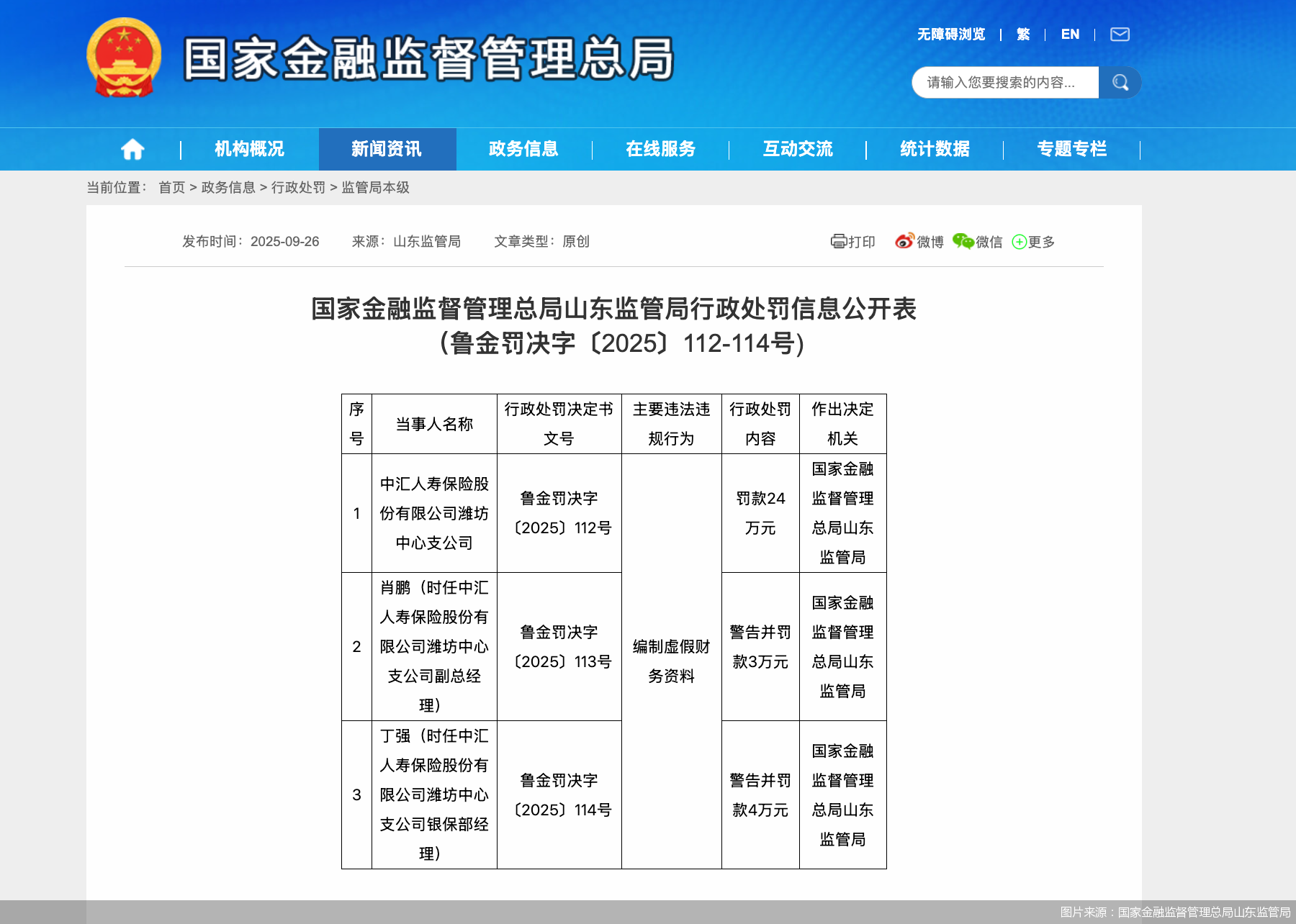
编制虚假财务资料,中汇人寿合计被罚31万元
Bei Jing Shang Bao· 2025-09-26 11:49
北京商报讯(记者 胡永新)9月26日,国家金融监督管理总局山东监管局发布的行政处罚信息显示,中汇人寿保险股份有限公司潍坊中心支公司因编制虚假 财务资料,被罚款24万元。时任该公司副总经理肖鹏被警告并罚款3万元,时任该公司银保部经理丁强被警告并罚款4万元。 | 序 | 当事人名称 | 行政处罚决定书 | 主要违法违 | 行政处罚 | | --- | --- | --- | --- | --- | | 름 | | 文号 | 规行为 | 内容 | | | 中汇人寿保险股 | 鲁金罚决字 | | 罚款24 | | 1 | 份有限公司潍坊 | 〔2025〕 112号 | | 万元 | | | 中心支公司 | | | | | | 肖鹏 (时任中汇 | | | | | | 人寿保险股份有 | 鲁金罚决字 | | 警告并罚 | | 2 | 限公司潍坊中心 | 〔2025〕 113号 | 编制虚假财 | | | | 支公司副总经 | | 务资料 | 款3万元 | | | 理) | | | | | | 丁强(时任中汇 | | | | | | 人寿保险股份有 | | | | | | | 鲁金罚决字 | | 警告并罚 | | 3 | ...
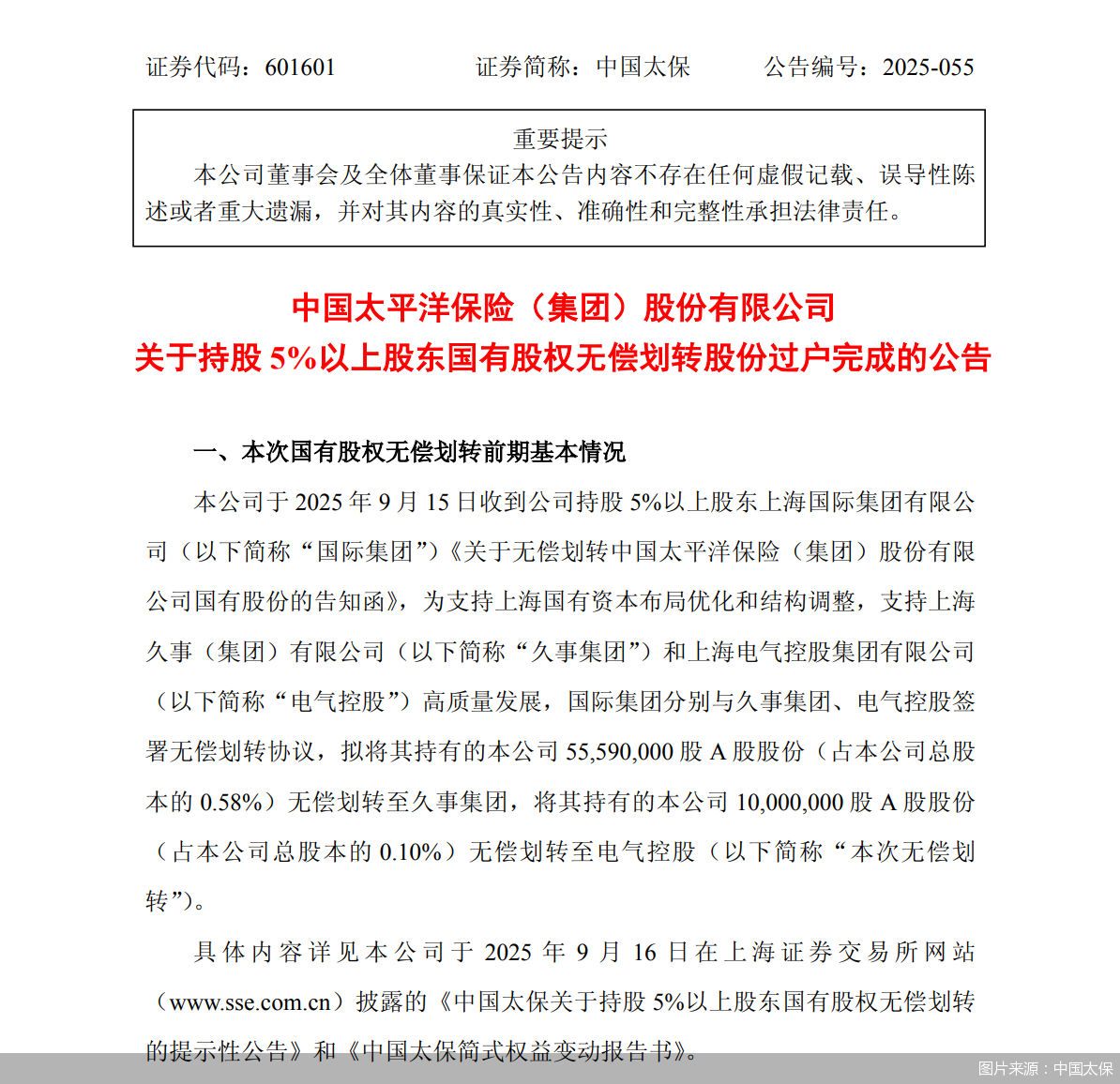
中国太保:上海国际集团所持公司0.68%股权无偿划转实施完毕
Bei Jing Shang Bao· 2025-09-26 11:49
Core Points - China Pacific Insurance (Group) Co., Ltd. announced the completion of the transfer of state-owned shares from its major shareholder, Shanghai International Group, to support the optimization of state-owned capital layout and structural adjustment [1][2] - Shanghai International Group transferred 55.59 million A-shares (0.58% of total share capital) to Jiushi Group and 10 million A-shares (0.1% of total share capital) to Shanghai Electric Holding Group [1][2] - Following the transfer, Shanghai International Group holds 97.1287 million A-shares and 213 million H-shares, totaling 960 million shares, which is 9.97% of the company's total share capital [2] Summary by Sections - **Share Transfer Details** - The transfer involved 55.59 million A-shares to Jiushi Group and 10 million A-shares to Shanghai Electric Holding Group [1] - The transfer was approved by the Shanghai State-owned Assets Supervision and Administration Commission [2] - **Post-Transfer Shareholding Structure** - After the transfer, Shanghai International Group directly holds 97.1287 million A-shares and 213 million H-shares [2] - Jiushi Group directly holds 1.47 million A-shares (1.52% of total share capital) [2] - Shanghai Electric Holding Group directly holds 10 million A-shares (0.1% of total share capital) [2] - The company continues to have no controlling shareholder or actual controller [2]

和泰人寿10%股权将被拍卖 起拍价9196万元
Mei Ri Jing Ji Xin Wen· 2025-09-26 11:24
每经记者|袁园 每经编辑|廖丹 又有保险公司股权将被拍卖! 9月26日,《每日经济新闻》记者从阿里拍卖平台获悉,和泰人寿保险股份有限公司(以下简称和泰人 寿)10%股权将于10月23日被司法拍卖,起拍价约9196万元,持有方为栾川县金兴矿业有限责任公司 (以下简称金兴矿业)。 作为和泰人寿的股东之一,金兴矿业的持股比例为14%,但从和泰人寿二季度偿付能力报告来看,金兴 矿业持有的这部分股权均已被质押、冻结。 公告信息显示,金兴矿业持有的和泰人寿10%股权将于10月份进行拍卖,评估价约9680万元,起拍价 9196万元,保证金1000万元,竞价周期1天。 成立至今,和泰人寿并未进入稳定盈利期,绝大多数年份均处在亏损状态。2024年,该公司实现净利润 1244万元,不过,今年上半年该公司继续陷入亏损。数据显示,上半年和泰人寿保险业务收入为13.33 亿元,同比增长39.90%;净利润由盈转亏,为-1.76亿元,去年同期盈利1.34亿元。 股权方面,除了金兴矿业所持14%股权被质押冻结,和泰人寿其他多家股东也存在质押或冻结股权的情 况。二季度偿付能力报告显示,和泰人寿合计有40%的股权处于质押或者冻结的状态,涉及4 ...