浮动收益型产品

Search documents
2026年1月中英人寿福满佳C款分红险:低利率时代稳健之选
Cai Fu Zai Xian· 2026-01-22 03:41
Core Viewpoint - The article emphasizes the growing demand for safe and profitable financial tools in the savings insurance market, highlighting the unique features of the "Fumanjia C" whole life insurance product launched by Zhongying Life, which combines guaranteed returns with dividends to meet various financial needs [1]. Product Design - The Fumanjia C product features a dual return structure of "guaranteed returns + floating dividends," balancing safety and growth, making it an ideal tool for the current economic cycle [2]. - The guaranteed portion of the policy provides a safety net, ensuring that benefits are secure regardless of market fluctuations, thus safeguarding wealth [2]. - The floating dividends allow policyholders to share in the insurance company's investment success, offering potential returns that exceed inflation, which is crucial in the current low-interest-rate environment [2]. Fund Flexibility - The product offers high flexibility in dividend usage, allowing policyholders to choose how to manage their dividends, breaking away from traditional rigid distribution methods [3]. - There are four options for handling dividends: cash withdrawal, accumulation with interest, premium offset, and additional coverage purchase, catering to different financial needs [4][5]. Value Growth - The Fumanjia C product demonstrates rapid cash value growth, with the cash value exceeding total premiums paid by the fourth year, significantly reducing liquidity concerns [6]. - The internal rate of return (IRR) surpasses 2.0% by the fifth year, indicating strong mid-term growth potential, making it suitable for short to medium-term financial planning [6][7]. Asset Utilization - The product features clear and transparent rules for reducing coverage, allowing for orderly access to funds, which is crucial for liquidity [8]. - The contract stipulates a maximum reduction limit of 20% of the basic coverage, ensuring reliability and legal protection for policyholders [8]. Insurer Strength - Zhongying Life is backed by strong shareholders, including COFCO Group and Aviva, combining local resources with global expertise [9]. - The company boasts robust financials, with total assets exceeding 108.3 billion and a solvency ratio well above regulatory requirements, indicating strong risk resilience [9][10]. - The company has maintained a high risk rating of "AAA," reflecting its financial stability and operational integrity, which supports the long-term viability of its dividend insurance products [10]. Target Audience and Recommendations - The Fumanjia C product is particularly suitable for investors seeking stable mid to long-term returns, families planning for education or retirement, and high-net-worth individuals focused on efficient asset transfer [11]. - It is recommended that investors consider this product as part of a broader financial strategy, especially in a low-interest-rate environment, to build a protective wealth framework [11].
保险业2025年前11个月保费收入同比增长7.6% 人身险公司实现较高增速
Huan Qiu Wang· 2026-01-03 01:41
Group 1 - The insurance industry achieved a total premium income of 57,629 billion yuan in the first 11 months of 2025, representing a year-on-year growth of 7.6% [1] - Life insurance companies generated premium income of 41,472 billion yuan, with a year-on-year increase of 9.1%, while property insurance companies reported premium income of 16,157 billion yuan, growing by 3.9% [1] - The growth in life insurance premium income is attributed to the continuous decline in interest rates and the expiration of bank wealth management products, leading to increased consumer interest in insurance products that offer both guaranteed and floating returns [3] Group 2 - Health insurance and accident insurance within property insurance companies saw significant premium income growth, with health insurance premiums reaching 2,187 billion yuan (up 11.4%) and accident insurance premiums at 546 billion yuan (up 11.3%) [3] - Life insurance companies reported a premium income of 33,874 billion yuan from life insurance (up 11.5%) and 188 billion yuan from unit-linked insurance products (up 16.7%) [3] - The demand for short-term health insurance is strong, and property insurance companies have successfully increased health insurance premium income through participation in public welfare insurance and mid-range medical insurance [4] Group 3 - The growth in life insurance premium income is primarily driven by the sales of savings-type products, while unit-linked insurance products have become more attractive due to favorable settlement interest rates amid a declining interest rate environment [4] - The insurance industry is experiencing a transformation towards floating return products, with a shift from single protection to a model that combines diversified protection and long-term savings [4] - Analysts indicate that floating return products are becoming a trend in the insurance market, as they have lower rigid cost structures and can alleviate pressure from interest rate spreads [4]


保险业前11个月保费收入同比增长7.6%
Zheng Quan Ri Bao· 2025-12-30 15:53
Core Insights - The insurance industry in China achieved a total premium income of 57,629 billion yuan in the first 11 months of the year, representing a year-on-year growth of 7.6% [1] - Life insurance companies generated premium income of 41,472 billion yuan, with a growth rate of 9.1%, while property insurance companies reported 16,157 billion yuan, growing by 3.9% [1][2] Industry Performance - The growth in premium income is attributed to several factors, including the continuous decline in interest rates, optimization of product offerings, and reduced sales expenses [2] - Both life and property insurance companies experienced year-on-year growth in premium income, with life insurance companies maintaining a higher growth rate [2] Segment Analysis - In terms of specific insurance types, health and accident insurance from property insurers saw significant growth, while life insurers reported strong growth in life and investment-linked insurance [3] - Health insurance premium income for property insurers reached 2,187 billion yuan, growing by 11.4%, and accident insurance premium income was 546 billion yuan, growing by 11.3% [3] - Life insurance premium income was 33,874 billion yuan, with an increase of 11.5%, and investment-linked insurance saw a premium income of 188 billion yuan, growing by 16.7% [3] Product Trends - The competitive nature of the settlement rates for universal insurance is influenced by the ongoing decline in interest rates and the transformation of product structures within the industry [4] - The trend in product transformation is moving towards floating income products, which are becoming more popular due to their lower rigid costs and attractive designs for customers [4]
分红险走上“C位”,险企从拼收益转向比服务
Bei Jing Shang Bao· 2025-12-10 11:53
Core Viewpoint - The insurance industry is experiencing a significant shift towards dividend insurance products, which are becoming the dominant market force as companies adapt to a low-interest-rate environment and seek to mitigate risks associated with interest rate spreads [1][2]. Group 1: Market Trends - Major insurance companies such as China Life, Ping An Life, Sunshine Life, and Xinhua Insurance have launched new dividend insurance products, marking a transition from traditional fixed-return savings products to floating-return products [2][3]. - Dividend insurance products, characterized by a dual structure of guaranteed and floating returns, are increasingly favored due to their ability to meet consumer demand for stable long-term returns in a low-interest-rate environment [2][4]. Group 2: Regulatory Environment - Regulatory guidance is pushing the industry towards floating-return products, as highlighted in the State Council's opinions on enhancing regulation and promoting high-quality development in the insurance sector [3][4]. - The recent regulatory framework emphasizes the need for insurance companies to maintain sustainable dividend levels through prudent long-term investment strategies [5]. Group 3: Product Complexity and Competitiveness - The complexity of dividend insurance products requires higher professional standards from insurance agents, as they must effectively communicate the uncertainties associated with dividend payouts to clients [4][5]. - Companies are increasingly focusing on differentiating their products through innovative design and value-added services, creating a competitive landscape that extends beyond mere interest rate comparisons [6][8]. Group 4: Service Integration - Insurance companies are integrating their products with healthcare and elderly care services, enhancing customer value through comprehensive service ecosystems [6][7]. - For instance, Sunshine Life's dividend insurance product offers access to premium medical resources and tailored elderly care services, reflecting a shift towards a more holistic approach to customer needs [7][8]. Group 5: Investment Performance - The performance of dividend insurance products is closely tied to the investment outcomes of the insurance companies, with established firms demonstrating superior long-term investment capabilities [5][6]. - Sunshine Insurance, for example, reported significant growth in net investment income and total investment returns, indicating a strong ability to deliver on dividend promises [5].
破冰!分红型重疾险时隔22年回归 能否重振雄风?
Guo Ji Jin Rong Bao· 2025-10-16 17:16
Core Insights - The return of dividend-type critical illness insurance to the market is supported by regulatory guidance aimed at enhancing the attractiveness of health insurance products and addressing the challenges posed by declining preset interest rates [1][3]. Industry Overview - The Financial Regulatory Authority has issued guidelines to promote high-quality development in health insurance, allowing well-rated insurance companies to offer dividend-type long-term health insurance products [1]. - Dividend-type critical illness insurance was popular in the early 2000s but was phased out due to regulatory concerns over complexity and mis-selling [2]. Market Dynamics - Analysts suggest that the reintroduction of dividend-type critical illness insurance can stimulate industry growth by providing a floating income mechanism that enhances product appeal [1][3]. - The current insurance market faces challenges such as intense competition and the need for product differentiation, which dividend insurance can address by offering dynamic coverage that adjusts for inflation [3]. Challenges Ahead - The successful re-entry of dividend-type critical illness insurance will require balancing protection and dividend features, which poses significant actuarial and risk management challenges for insurance companies [5]. - The higher premiums associated with dividend-type products compared to traditional insurance may complicate sales efforts, necessitating clear communication about the uncertainties of dividends to avoid consumer disputes [5]. Strategic Recommendations - Insurance companies are advised to enhance transparency in dividend mechanisms, improve agent training, and leverage big data for pricing optimization to increase product value [5][6]. - The importance of agent channels is emphasized, as they play a crucial role in educating consumers about complex insurance products and matching them with suitable options [6]. Regulatory Developments - The regulatory body plans to expedite the development of supporting guidelines for floating income health insurance products, encouraging insurance companies to diversify their offerings to meet public demand for quality health coverage [6].
269款万能险产品披露9月结算利率 平均值2.68%同比下降
Cai Jing Wang· 2025-10-13 01:16
Core Insights - The average settlement interest rate for universal life insurance products has decreased to 2.68%, down approximately 18 basis points year-on-year, with the highest rate at 3.50% and the lowest at 0.36% [1][2][3] - A significant 68.4% of the 269 universal life insurance products reported settlement rates below 3% [1][2] Summary by Category Settlement Rates - As of October 12, 269 universal life insurance products disclosed their September settlement rates, with 85 products (31.6%) having rates of 3% or above, a notable decline from approximately 62% in the same period last year [2][3] - The distribution of rates shows that 66.5% of products have rates between 2% and 3%, while 5 products reported rates below 2% [2] Factors Influencing Rate Changes - The decline in settlement rates is attributed to three main factors: pressure on investment returns, regulatory guidance to mitigate interest rate risk, and proactive adjustments by insurance companies to lower liability costs [3][4] - Regulatory changes, particularly the April notification from the National Financial Regulatory Administration, require insurance companies to align settlement rates with actual investment returns, thereby capping the upper limits of these rates [3][5] Market Trends - The universal life insurance market has shown a slight decline in premium income, with new policyholder investment contributions totaling 458.8 billion yuan in the first eight months of the year, nearly unchanged from the previous year [4] - The shift towards guaranteed return products, such as increasing interest in whole life insurance, has diverted savings demand away from universal life insurance [4][6] - The industry is moving towards floating return products, with dividend insurance becoming a mainstream choice, although universal life insurance will continue to meet specific long-term financial needs due to its flexibility [6]

前8月保险业原保险保费收入4.8万亿元,人身险保费增长11.3%
Huan Qiu Wang· 2025-09-28 05:22
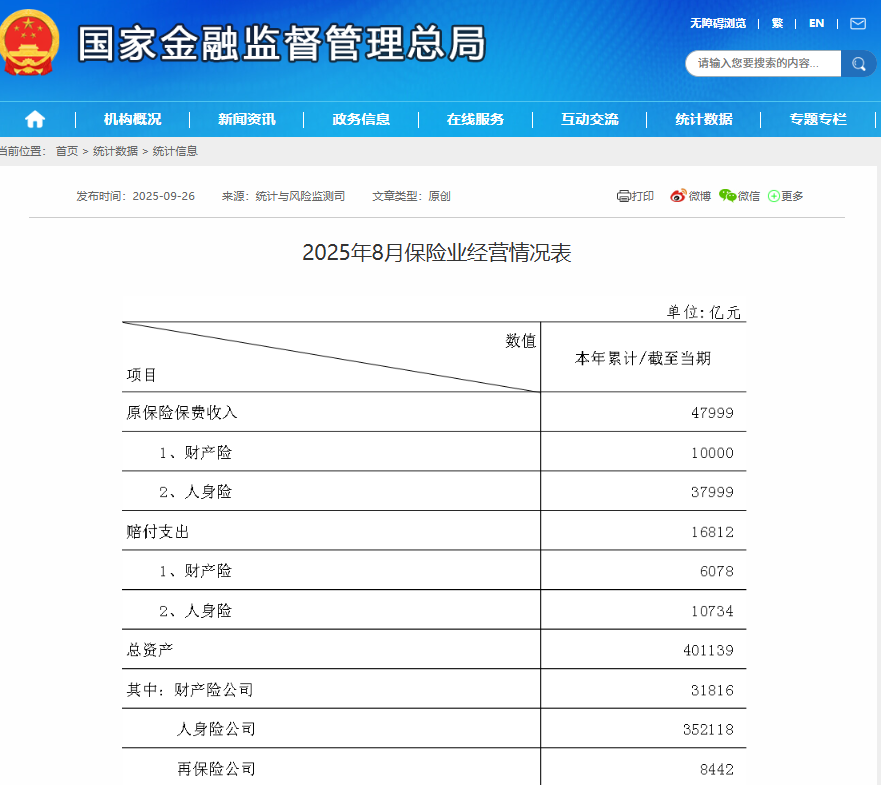
Group 1 - The core viewpoint of the article highlights the growth in China's insurance industry, with a total original insurance premium income of 4.8 trillion yuan, representing a year-on-year increase of 9.63% in the first eight months of the year [1][2] - Property insurance premium income reached 1 trillion yuan, showing a year-on-year growth of 3.65%, while life insurance premium income was 3.8 trillion yuan, with a significant year-on-year increase of 11.32% [1][2] - The total assets of the insurance industry amounted to 401.139 billion yuan, with life insurance companies holding 352.118 billion yuan and property insurance companies holding 31.816 billion yuan [2] Group 2 - Life insurance premium income specifically saw a rise of 14.05% year-on-year, totaling 2.97 trillion yuan, while new policyholder investment contributions remained stable at 458.8 billion yuan [2][3] - The insurance product structure is undergoing adjustments, with a notable increase in the proportion of participating insurance products due to the continuous decline in preset interest rates [3] - In the first quarter, over 170 new life insurance products were launched, with nearly 40% being participating and universal life insurance, indicating a shift towards more flexible and potentially higher-yielding products [3]
人身险 预定利率研究值最新发布
Jin Rong Shi Bao· 2025-08-08 08:01
Core Viewpoint - The adjustment of the predetermined interest rate for life insurance products is a response to the newly established dynamic adjustment mechanism, with the current research value set at 1.99% for the second quarter of 2025, indicating a downward trend in interest rates [1][2]. Group 1: Adjustment Mechanism - The dynamic adjustment mechanism for predetermined interest rates was established in January 2023, linking them to market interest rates such as the 5-year LPR and 10-year government bond rates [2]. - The current maximum predetermined interest rates are 2.5% for ordinary life insurance products, 2.0% for participating products, and 1.5% for universal life products [2]. Group 2: Expected Adjustments - Analysts predict a reduction of 25 basis points in the maximum predetermined interest rate, but some expect a more significant adjustment of 50 basis points to 2.0% due to anticipated further declines in the research value [3][4]. - Major insurance companies, including China Life and Ping An Life, have already announced adjustments to their new insurance products' maximum predetermined interest rates in response to the changes [4]. Group 3: Market Response - Several insurance companies have proactively adjusted their product offerings, with some introducing products with a predetermined interest rate of 1.75% ahead of the official announcement [5]. - The market is witnessing a shift towards participating insurance products, which are expected to become a significant focus for insurance companies, with some firms reporting that over 50% of their total life insurance premiums now come from participating products [6][7]. Group 4: Industry Trends - The insurance industry is increasingly embracing participating insurance products as a strategy to manage liability costs and enhance product competitiveness [6]. - Experts emphasize the need for a transition towards floating yield products, which can help stabilize financial performance and market expectations despite the downward pressure on traditional savings-type products [7].



中宏人寿净利大增343%!综合投资收益率仅1.74%,向浮动收益产品转型?
Sou Hu Cai Jing· 2025-08-07 14:26
Core Viewpoint - Zhonghong Life Insurance Co., Ltd. has shown significant growth in insurance business revenue and net profit in the second quarter, indicating a strong performance despite regulatory challenges and market fluctuations [1][2][4]. Financial Performance - In Q2, Zhonghong Life achieved insurance business revenue of 6.997 billion yuan, a year-on-year increase of 29.81%, and a total of 19.622 billion yuan for the first half of the year, up 4.96% [1]. - The net profit for the first half of the year reached 222 million yuan, a substantial increase of 343.45% compared to the previous year [1]. - The financial and comprehensive investment returns for the first half of the year were 2.15% and 1.74%, respectively, with the financial investment return improving by 0.29 percentage points year-on-year [1][5]. Investment Strategy - Zhonghong Life has significantly increased its investment in floating income products, aligning with industry trends towards risk-adjusted wealth management [2][10]. - The company reported a total investment asset amount of 130.552 billion yuan, a 9.72% increase from the previous quarter and a 29.48% increase year-on-year [6]. - The investment in government bonds and stocks has been notably increased, with government bond holdings rising by 102.59% and stock holdings increasing by 861.72% compared to the previous year [7]. Product Development - The revenue from participating insurance products has rapidly increased, reaching 19.364 billion yuan in 2024, a year-on-year growth of 69.84%, making up 63.66% of total insurance revenue [9]. - The company is focusing on enhancing the transparency and optimization of the dividend mechanism for floating income products, which are expected to drive future growth [2][11]. Regulatory Environment - Zhonghong Life's Shenzhen branch was fined 500,000 yuan for "untrue financial data," highlighting regulatory scrutiny in the industry [2].

保险业前5月保费稳增、赔付高企,变局下如何开启“后半场”
Bei Jing Shang Bao· 2025-06-29 10:46
Core Insights - The insurance industry in China reported a premium income of 3.06 trillion yuan for the first five months of the year, reflecting a year-on-year growth of 3.77% [1][3] - The life insurance sector saw a significant increase in premium income, with a monthly growth rate exceeding 15% in May [1][3] - Non-auto insurance segments, particularly health and accident insurance, experienced rapid growth, with accident insurance premiums rising by 12.55% year-on-year [1][4] Group 1: Premium Income and Growth - The insurance industry achieved a premium income of 3.06 trillion yuan in the first five months, with life insurance contributing 2.45 trillion yuan and property insurance contributing 612.9 billion yuan [3][4] - The growth in premium income for property insurance was 5.22%, while life insurance saw a growth of 3.72% [3][4] - The overall premium income recovery in the first five months is attributed to various factors, including market demand and regulatory changes [1][3] Group 2: Claims and Payouts - The insurance industry reported claims payouts of 1.17 trillion yuan in the first five months, marking a year-on-year increase of 9.91% [3] - The increase in claims payouts indicates a strengthening of the insurance protection function within the industry [3] Group 3: Market Dynamics and Innovations - The property insurance sector is focusing on non-auto insurance products, with health and accident insurance showing significant growth, reflecting increased consumer demand for health and risk management [4][8] - The industry is undergoing continuous transformation, with innovations in new energy vehicle insurance and adjustments in pricing strategies for life insurance products [5][6][7] - Regulatory support is fostering the development of floating income products, which are expected to gain traction in the market [7][8] Group 4: Future Outlook - The insurance market is anticipated to evolve into a more diversified and high-quality development landscape, driven by ongoing reforms and innovation [8] - Recommendations for the property insurance sector include focusing on new energy vehicle insurance innovations and enhancing technology-driven risk management [8] - In the life insurance sector, there is potential for growth in floating income products, necessitating improved asset-liability management and expansion of health and pension insurance services [8]