
软件

Search documents
打造国际开源之都!上海将发布国内首个面向海外的开源平台
Di Yi Cai Jing· 2025-12-25 12:32
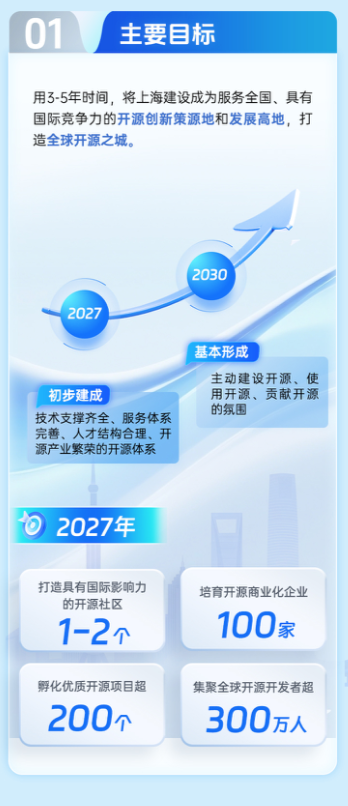
Core Viewpoint - Shanghai aims to establish 1-2 internationally influential open-source communities and incubate over 200 high-quality open-source projects within 3 to 5 years, gathering more than 3 million global developers [1] Group 1: Open Source Strategy - The open-source technology is recognized as a core engine driving global technological innovation, industrial transformation, and ecological collaboration [1] - Shanghai's plan emphasizes leading industrial development through open-source, creating a sustainable innovation ecosystem that integrates technology, talent, and enterprises [1][4] Group 2: Economic Impact - The artificial intelligence industry in Shanghai is projected to exceed 450 billion yuan in 2024, with a year-on-year growth of over 7.8%, achieving its "14th Five-Year Plan" goals ahead of schedule [4] - The open-source initiative is expected to lower costs for enterprises in innovation, testing, certification, standardization, and talent cultivation [5] Group 3: Development Initiatives - Shanghai's plan includes five major enhancement projects: foundational capability building, project cultivation, talent aggregation, cultural promotion, and governance collaboration [8] - The establishment of a domestic open-source platform aimed at connecting global intellectual resources is anticipated to launch next year [9] Group 4: Support for Developers and Enterprises - The open-source MCN (Multi-Channel Network) model will be utilized to incubate open-source projects, providing deep empowerment in technology flow, community operation, and commercial closure [11] - Financial support of up to 20 million yuan will be allocated for key open-source tool development projects starting next year [12]

2026年美股还值得买吗?
Guo Ji Jin Rong Bao· 2025-12-25 11:44
Core Viewpoint - The U.S. stock market is at a threshold where it is no longer solely driven by "rate cut narratives," facing a complex combination of variables as it approaches 2026 [1] Group 1: Market Performance and Trends - In 2025, the S&P 500 index experienced significant volatility, initially dropping near bear market territory due to tariff threats but rebounding due to policy concessions and AI momentum, resulting in a year-to-date total return of approximately 18%-19% by year-end [2] - The S&P 500 index reached its 38th historical high on December 23, reflecting market confidence in the resilience of the U.S. economy and corporate earnings [3] - The VIX index, a measure of market volatility, closed at 14 points on December 23, the lowest since December 2024, indicating reduced market tension [3] Group 2: Economic Outlook and Influencing Factors - Analysts are focused on whether the U.S. stock market will continue its bull run or face systemic risks in 2026, with key determinants being economic stability, Federal Reserve policy direction, and whether current stock prices are supported by economic fundamentals [4] - The U.S. economy showed no signs of significant recession in 2025, with GDP expanding at its fastest pace in two years, reinforcing expectations of a "soft landing" [4] - The OBBBA tax cut legislation is expected to boost economic growth starting in 2026, alongside a gradual decline in inflation, contributing to a favorable macroeconomic environment [5] Group 3: Federal Reserve and Interest Rates - If inflation continues to cool, the Federal Reserve may begin to lower interest rates in 2026, which could help maintain high stock prices despite elevated valuations [6] - Current market sentiment indicates a 19.9% probability of a 25 basis point rate cut in January 2026, with a 47.1% chance of maintaining current rates [6] Group 4: Sector Performance and Investment Focus - Wall Street strategists expect 2026 to be a strong year for the U.S. stock market, with optimistic projections for the S&P 500 index reaching between 7,000 and 8,100 points by year-end [8] - Investment focus is shifting from technology stocks to cyclical stocks, which are closely tied to economic cycles, with notable performance improvements in sectors like real estate, steel, and automotive [9] - Cyclical stocks have outperformed defensive stocks, with a 9.3% increase in a recent month, indicating a growing investor interest in sectors benefiting from economic recovery [9]

上海开源方案落地:最高2000万补助,将打造国内首个海外平台
Xin Lang Cai Jing· 2025-12-25 11:12
Core Insights - The Shanghai government has officially implemented the "Implementation Plan for Strengthening Open Source System Construction," aiming to build a comprehensive open-source ecosystem over the next 3 to 5 years, focusing on technology, talent, and enterprises as the core components [2] Group 1: Open Source Development Initiatives - The open-source initiative has evolved from simple "code sharing" to a core engine for technological innovation, with five major enhancement projects outlined to promote sustainable development of the open-source ecosystem [3] - A foundational capability construction project will lower the barriers to open-source participation, including the establishment of the first domestic open-source platform aimed at overseas collaboration, expected to launch next year [3] Group 2: Financial Support and Incentives - The plan includes financial support for foundational development tools, with up to 20 million yuan allocated for R&D projects starting next year [4] - An annual evaluation mechanism for outstanding open-source projects will be established, offering direct rewards of up to 5 million yuan to encourage open-source contributions [4] Group 3: Talent Development and Collaboration - A talent aggregation project will create an evaluation mechanism based on "open-source contributions," encouraging universities to incorporate open-source achievements into student awards and enterprise evaluations [4] - The implementation of the open-source plan is expected to invigorate the automotive and software sectors, reducing innovation and talent cultivation costs while addressing industry challenges [4][5] Group 4: Industry Impact and Future Goals - The open-source initiative is anticipated to facilitate breakthroughs in core technologies for automotive operating systems, with over 400 Tier 1 manufacturers and 44 vehicle manufacturers already involved in collaborative projects [5] - Shanghai aims to establish 1 to 2 internationally advanced open-source communities, incubate over 200 quality open-source projects, and attract more than 3 million global developers [6]
超700款生成式人工智能大模型产品完成备案
Xin Lang Cai Jing· 2025-12-25 10:11
Core Insights - During the "14th Five-Year Plan" period, significant advancements have been made in fields such as integrated circuits, artificial intelligence, and foundational software, with over 1.19 billion products equipped with the open-source Harmony operating system [1] - More than 700 generative artificial intelligence large model products have completed registration, indicating a rapid development in intelligent applications and innovation [1] Group 1: Information Technology Development - The level of information application in China has significantly improved, with the internet penetration rate increasing from 70.4% to 79.7% [1] - The gap in internet penetration between urban and rural areas has narrowed by 8.2 percentage points compared to the end of the "13th Five-Year Plan" [1] Group 2: Agricultural and Rural Digitalization - The rate of informationization in agricultural production has risen from 22.5% to over 30% [1] - The national rural online retail sales are projected to exceed 2.5 trillion yuan, representing a 43% increase compared to the end of the "13th Five-Year Plan" [1] - Telemedicine services are now available across all cities and counties in the country [1]
多维度“数”说新突破、新跨越、新提升 创新成为信息化发展第一动力
Yang Shi Wang· 2025-12-25 10:09
Core Viewpoint - During the "14th Five-Year Plan" period, China's network information technology innovation has made significant breakthroughs, enhancing innovation capabilities and achieving substantial advancements in information infrastructure and application levels [1][5]. Group 1: Technological Innovations - Key breakthroughs have been achieved in integrated circuits, artificial intelligence, and foundational software, with over 1.19 billion products equipped with the open-source Harmony operating system [3]. - The development of 6G technology is progressing steadily, with the first phase of technical testing completed and over 300 key technologies reserved [5]. Group 2: Digital Economy Growth - The value added by the core industries of the digital economy increased from 7.8% to 10.4% of GDP, maintaining China's position as the second-largest digital economy globally [8]. - By 2024, the revenue of the electronic information manufacturing industry is projected to reach 16.19 trillion yuan, and software business revenue is expected to reach 13.73 trillion yuan, representing increases of 33.8% and 68.2% respectively compared to the end of the "13th Five-Year Plan" [8]. Group 3: Digital Transformation in Manufacturing - The digital transformation of the manufacturing sector is accelerating, with the penetration rate of digital R&D design tools among key industrial enterprises rising from 73% to 85.4%, and the CNC rate of key processes increasing from 52.1% to 68.5% [13]. - The online retail sales in China increased from 11.76 trillion yuan to 15.23 trillion yuan, solidifying its status as the largest online retail market globally [13]. Group 4: Data Resource Development - The annual data production in China grew from 26.83 ZB in 2022 to 41.06 ZB in 2024, accounting for 26.67% of the global total [14][16]. - The establishment of a national public data resource registration platform and the implementation of the "data element ×" initiative have led to the emergence of numerous typical application scenarios and cases [16]. Group 5: E-Government and Digital Literacy - The development of e-government services has progressed steadily, with 92.5% of provincial administrative licensing matters being processed online, enhancing efficiency [18]. - The number of internet users in China increased from 989 million to 1.123 billion, with the internet penetration rate rising from 70.4% to 79.7%, and over 60% of citizens possessing basic digital literacy and skills [18]. Group 6: Rural Digital Development - Significant progress has been made in rural digital development, with the rural online retail sales exceeding 250 billion yuan, a 43% increase compared to the end of the "13th Five-Year Plan" [21]. - The gap in internet penetration rates between urban and rural areas has narrowed by 8.2 percentage points during the "14th Five-Year Plan" period [21].
Notion 创始人年终预测:AI 是新时代的「钢铁」,未来的工作、组织架构会这样演变
Founder Park· 2025-12-25 06:09
Core Insights - The article presents the idea that AI is a "revolutionary material" of the current era, akin to steel in the industrial age and semiconductors in the digital age [2][6] - It emphasizes that those who can master AI will define the future, highlighting the need to rethink personal productivity, organizational structures, and economic models in light of AI advancements [5][6] Group 1: Personal Productivity - AI has already transformed the work of programmers, with examples showing that individuals can achieve 30-40 times greater efficiency by utilizing AI coding agents [15][18] - The current state of knowledge work resembles riding a bicycle on a highway, relying heavily on human effort, while AI can facilitate a transition to a more efficient mode of operation [17][21] - Two main challenges for broader AI adoption in knowledge work are the fragmentation of context across multiple applications and the lack of verifiable outcomes for tasks outside programming [21][22][25] Group 2: Organizational Structure - Companies have evolved from small workshops to large multinational corporations, but their communication infrastructures are struggling under increasing demands [26][27] - AI has the potential to act as the "steel" of organizations, enabling them to scale effectively by maintaining context across workflows and reducing communication noise [32][36] - The current phase of AI application is likened to simply replacing water wheels with steam engines, indicating that true innovation requires rethinking organizational designs rather than merely integrating AI into existing workflows [34][36] Group 3: Economic Transformation - The article draws parallels between historical urban development driven by steel and steam and the anticipated transformation of the knowledge economy through AI [40][41] - As knowledge work increasingly relies on AI, organizations will evolve into more complex structures, akin to modern megacities, allowing for continuous operation and real-time decision-making [41][42] - The shift towards AI will necessitate a departure from traditional work rhythms, leading to new operational dynamics that prioritize speed and scale over familiar processes [41][42]

景顺:看好2026年亚洲股票 AI仍是亚洲市场的结构性增长主题
Zhi Tong Cai Jing· 2025-12-25 06:07
Group 1 - The core view of the report is that Asian stocks are expected to perform robustly in 2025, driven by favorable policies, strong domestic demand, and AI-driven innovations [1] - The report anticipates a continued decline in the US dollar, which historically benefits Asian stocks, and a globally accommodative monetary policy environment that may lead investors to shift from the US market to more attractively valued Asian economies [1] - The outlook for 2026 is positive for Asian stocks due to improved earnings prospects, favorable liquidity conditions, and ongoing structural reforms, presenting attractive investment opportunities for global investors [1] Group 2 - The next phase of growth in Asia will be driven by the real-world application of AI, with accelerated adoption in healthcare, finance, manufacturing, and e-commerce expected to unlock more earnings and boost productivity [2] - Asia's competitive advantage lies in its vast data ecosystem, cost-effective talent pool, and government-supported digital strategies, which will facilitate scalable AI solutions [2] - The report emphasizes a preference for companies with clear monetization paths, proprietary technologies, and integration capabilities that can incorporate AI into their overall business deployment [2] Group 3 - In China, the report maintains an optimistic outlook supported by structural growth drivers and clear policy focus, with domestic consumption expected to contribute approximately 60% to economic growth from 2021 to 2024 [2] - The "14th Five-Year Plan" highlights China's commitment to breakthroughs in core technologies and the development of advanced manufacturing and emerging industries, such as semiconductors and green energy, to reduce reliance on foreign supply chains [2] - The report notes that industry consolidation is alleviating overcapacity issues in manufacturing, allowing leading companies to achieve sustained growth through advanced technologies and resources [2] Group 4 - In India, despite a lag in stock market performance compared to Asia and global peers in 2025, a turning point is expected in 2026, supported by stable consumption and investment trends [3] - Recent government measures, including reductions in the Goods and Services Tax (GST) and personal income tax, are anticipated to ease household tax burdens and stimulate consumption, particularly benefiting sectors like consumer goods [3] - South Korea and Taiwan are expected to benefit from the ongoing technology cycle, especially in high-frequency storage and semiconductors, with long-term capacity growth anticipated due to rising AI application demand [3] Group 5 - ASEAN markets present attractive investment opportunities, although political uncertainties in some countries should be noted [4] - Singapore is highlighted for its stable economic outlook, supported by favorable policies and abundant liquidity, while Malaysia continues to attract global semiconductor and tech hardware companies [4] - The Philippines is expected to benefit from urbanization, a young population, and remittances, contributing to a solid foundation for long-term economic growth [4] - Overall, despite short-term uncertainties, Asia's large domestic market and evolving innovation ecosystem reinforce sustainable growth, with structural drivers continuing to support resilience in the region [4]
从天空到好莱坞,揭秘甲骨文埃里森父子的媒体帝国豪赌
Feng Huang Wang· 2025-12-25 01:52
Core Viewpoint - David Ellison, CEO of Paramount, has initiated a $108.4 billion hostile takeover bid for Warner Bros to compete with Netflix, with significant involvement from his father, Larry Ellison, co-founder of Oracle [1][3]. Group 1: Father-Son Partnership - The relationship between David and Larry Ellison has evolved from distant to a strong business partnership, particularly in pursuing major media acquisitions [3][4]. - Larry Ellison has provided a $40.4 billion guarantee for Paramount's acquisition bid, emphasizing the family's commitment to the venture [4]. - The father-son duo consults frequently on business decisions, with discussions often focusing on their media strategy and interactions with political figures like President Trump [5][11]. Group 2: Media Acquisition Strategy - David Ellison's company, SkyDance, initially faced skepticism from Larry but has gained his father's trust and support in recent years [8]. - The acquisition of Warner Bros could significantly expand the Ellison family's media empire, potentially rivaling that of the Murdoch family [13]. - The Ellison family aims to shift CBS News towards a more conservative platform, aligning with their views and political connections [9][10]. Group 3: Political Connections - Larry Ellison's relationship with Trump has become a strategic asset in their media endeavors, as Trump's influence could impact regulatory approvals for acquisitions [11][13]. - Despite their efforts, the anticipated outcomes of their media strategy have not fully materialized, as indicated by Trump's critical remarks about CBS News [14].


软件ETF(515230)近20日净流入超7.4亿元,AI健康应用“蚂蚁阿福”验证赛道高景气
Mei Ri Jing Ji Xin Wen· 2025-12-24 07:39
(文章来源:每日经济新闻) 长江证券表示,蚂蚁集团的AI健康应用"蚂蚁阿福"月活跃用户已达1500万,显示出强劲的增长势头。该 应用通过支付入口优势、深厚的医疗资源网络以及支付与金融业务带来的信任优势,实现了高留存率和 高转化率。此外,医疗场景因其用户付费意愿强、高频次和高迁移成本,可能成为原生AI垂类应用的 突破口。预计到2026年,随着政策推进,医疗Agent将在多个层面实现广泛应用。 软件ETF(515230)跟踪的是软件指数(H30202),该指数从市场中选取涉及软件开发、销售和服务等 业务的上市公司证券作为指数样本,覆盖操作系统、应用软件、网络安全等领域的代表性企业,以反映 软件行业相关上市公司证券的整体表现。该指数具有显著的成长性和技术导向性,能够较好地体现软件 行业的市场趋势和发展动态。 ...
麦肯锡AI应用现状调研:普及率极高,但变现率极低
Hua Er Jie Jian Wen· 2025-12-24 06:00
Core Insights - There is a significant gap between market hype around AI and actual business implementation, with most companies still in the "pilot purgatory" phase and unable to scale AI deployment effectively [1][2] - Only 39% of surveyed companies reported a substantial impact of AI on their EBIT, with most contributions being less than 5% [1][6] - High-performing companies, representing only 6% of the surveyed, are not merely purchasing software but are fundamentally restructuring workflows and pursuing growth [1][7] Group 1: AI Adoption and Implementation - 88% of companies report regular use of AI in at least one function, up from 78% the previous year, indicating widespread adoption but shallow implementation [2] - 62% of respondents are testing intelligent agents, but only 23% have initiated scaled applications in at least one function [3] - Companies with revenues over $5 billion are closer to scaling AI, with nearly half having entered this phase, compared to only 29% of companies with revenues under $1 million [5] Group 2: Financial Impact and Performance - Despite 64% of respondents believing AI drives innovation, its actual impact on financial performance is minimal [4] - The majority of companies are still in the investment phase, with over 60% experiencing little to no financial benefit from AI initiatives [6] - High-performing companies invest significantly more in AI, with one-third allocating over 20% of their digital budget to AI, compared to nearly 5% for other companies [10] Group 3: Workforce and Management Dynamics - There is a growing expectation of workforce reductions, with 32% of respondents anticipating a decrease in employee numbers over the next year [10] - High-performing companies are three times more likely to fundamentally reshape workflows compared to their peers [10] - The demand for software and data engineers remains strong, indicating a structural talent shortage in the industry [10]