
Gemini系列大模型

Search documents
DeepMind新论文炸锅:AI全自动进化算法,写出专家都想不到的解,网友:这可能就是“王牌”
3 6 Ke· 2026-02-27 09:32
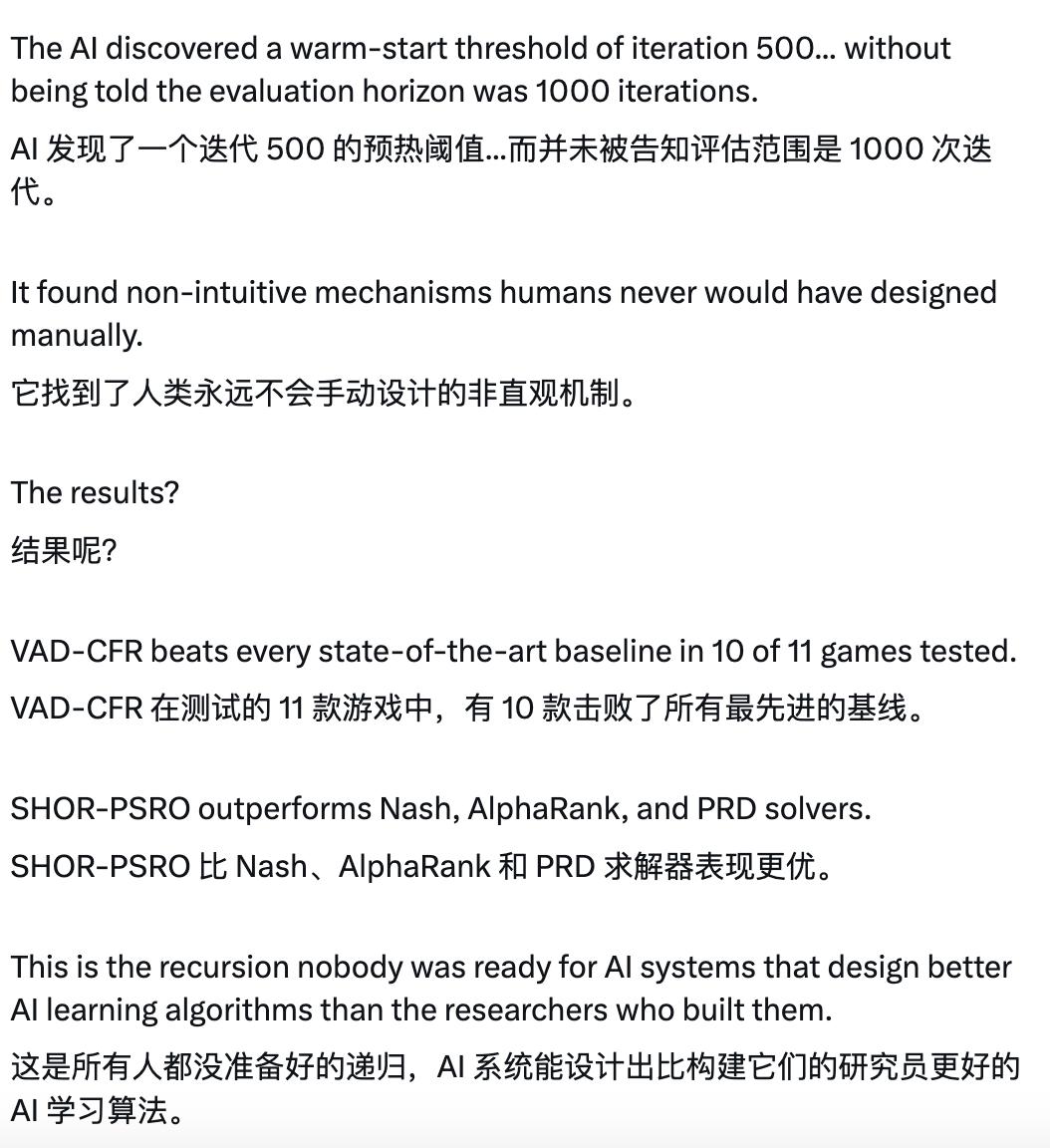
Core Insights - The article discusses the advancements made by Google's DeepMind in AI coding, specifically through a new intelligent agent called AlphaEvolve, which can autonomously rewrite and evolve algorithmic code, surpassing human-designed versions in multiple tests [1][2][4]. Group 1: AlphaEvolve Overview - AlphaEvolve is named following DeepMind's tradition, with "Evolve" indicating its core mechanism of algorithm evolution through a biological-like process [2]. - The research process and findings were published in a 37-page paper titled "Discovering Multiagent Learning Algorithms with Large Language Models," which has generated significant attention in the tech community [4]. Group 2: Evolution Mechanism - The AI operates by selecting two established frameworks, CFR (Counterfactual Regret Minimization) and PSRO (Policy Space Response Oracles), and modifies their core logic rather than starting from scratch [8]. - The process involves generating multiple semantically meaningful versions of the algorithm, which are then compiled, run, and evaluated in a competitive environment, creating a closed-loop system of generation, evaluation, and selection [9]. Group 3: Algorithmic Innovations - AlphaEvolve produced two new algorithms: VAD-CFR and SHOR-PSRO, which demonstrate superior performance compared to traditional human-optimized algorithms [11][13]. - VAD-CFR improves upon the CFR framework by altering core logic elements such as regret accumulation and discounting mechanisms, leading to faster convergence in various game scenarios [11][13]. - SHOR-PSRO innovatively combines multiple update mechanisms into a hybrid meta-solver that dynamically adjusts during training, enhancing its ability to balance exploration and equilibrium approximation [14][16].


DeepMind新论文炸锅:AI全自动进化算法,写出专家都想不到的解,网友:这可能就是“王牌”
AI前线· 2026-02-27 06:00
Core Viewpoint - The article discusses the advancements in AI coding, particularly focusing on DeepMind's AlphaEvolve, which can autonomously evolve algorithms, surpassing human-designed versions in performance [3][5][11]. Group 1: AI Evolution and Algorithm Development - DeepMind's AlphaEvolve utilizes a large language model (LLM) to rewrite and evolve algorithmic code, moving beyond mere parameter tuning to altering algorithm logic itself [3][6]. - The process involves generating, testing, and selecting algorithm variations in a closed loop, allowing AI to autonomously improve without human intervention in the tuning process [20][21]. - AlphaEvolve has successfully created new multi-agent learning algorithms that outperform human-crafted versions in various tests [5][21]. Group 2: Specific Algorithm Innovations - The first new algorithm developed is VAD-CFR, which modifies core logic such as regret value accumulation and discounting mechanisms, leading to superior performance in multiple games compared to traditional CFR variants [22][23]. - The second algorithm, SHOR-PSRO, innovatively combines multiple update mechanisms into a hybrid meta-solver, dynamically adjusting its approach during training to balance exploration and equilibrium [30][33]. - Both algorithms demonstrate significant improvements in convergence speed and effectiveness in complex game environments, indicating a fundamental enhancement in algorithmic structure rather than mere parameter adjustments [27][34].

谷歌官宣2026 I/O开发者大会日程,AI眼镜与Gemini更新成焦点
Huan Qiu Wang Zi Xun· 2026-02-18 03:49
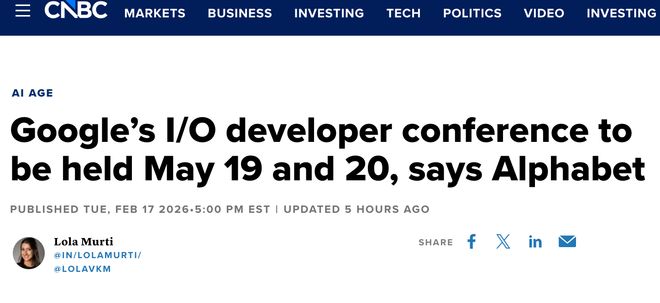
Group 1 - The annual flagship developer conference Google I/O will be held on May 19-20, 2026, at Google's headquarters in Mountain View, California, and will be live-streamed globally [1] - This year's Google I/O is expected to focus on advancements in artificial intelligence, with updates on the Gemini series of large models and demonstrations of AI-integrated hardware and software products [2] - A highly anticipated release is Google's first consumer smart glasses, set to launch in 2026 with AI capabilities, responding to the popularity of Meta's AI glasses, which sold over 7 million units in 2025, a year-on-year increase of over three times [2] Group 2 - Google announced a strategic partnership with the well-known eyewear brand Warby Parker at the 2025 Google I/O to co-develop wearable devices that combine fashionable design with AI functionality [2]
2025云计算:泡沫、焦虑与改变世界的人
3 6 Ke· 2025-12-31 02:11
Core Insights - The article discusses the significant developments in the AI cloud computing market throughout 2025, highlighting the emergence of AI infrastructure as a crucial sector for companies like Baidu Smart Cloud [1][4][19]. Group 1: AI Cloud Market Dynamics - The AI cloud computing market experienced a transformative wave in 2025, characterized by a "price war" in the first half and a surge in demand for AI resources driven by the explosion of AI Agents in the second half [4][9]. - Major tech companies increased their capital expenditures significantly, with Amazon projecting $125 billion for AI and data center infrastructure, while Google raised its spending to between $91 billion and $93 billion [16]. - Baidu Smart Cloud led the market with 95 winning bids and a total bid amount of 710 million yuan, establishing itself as a dominant player in the AI cloud sector [11][14]. Group 2: AI Implementation and Adoption - Over 65% of central enterprises and 100% of systemically important banks in China have adopted large models using Baidu Smart Cloud, indicating a strong trend towards AI implementation across various industries [14]. - The year 2025 has been termed the "Year of the Agent," with numerous AI applications emerging in sectors such as finance, education, and entertainment, showcasing the widespread adoption of AI technologies [8][9]. Group 3: Competitive Landscape and Full-Stack Capabilities - The competition in the AI cloud market has evolved from price and performance comparisons to a focus on full-stack capabilities, where companies are expected to provide comprehensive AI solutions rather than just cloud resources [15][18]. - Baidu Smart Cloud's full-stack capabilities include advanced infrastructure such as Kunlun chips and a comprehensive AI development platform, positioning it as a leader in the AI cloud market [21][23]. - The article emphasizes that only a few players in China can achieve full-stack AI cloud capabilities, with Baidu being the most representative example [19][23].


美股AI突变,OpenAI沦为“股价毒药”,硅谷八巨头一夜蒸发3.8万亿元市值,专家:看好谷歌,其拥有两项致胜“法宝”
3 6 Ke· 2025-12-15 01:28
Core Insights - The "OpenAI concept stocks" have seen a significant decline, with major companies like Oracle and Broadcom experiencing substantial stock price drops due to concerns over the viability of their contracts with OpenAI [1][15] - Oracle's stock fell 27.7%, losing $209.4 billion in market value, while Broadcom's stock dropped 11%, resulting in a $219.2 billion loss in market capitalization [17] - OpenAI's financial commitments and the long return cycles associated with its contracts have raised doubts about its revenue potential and ability to fulfill obligations [8][12] Company Performance - Broadcom reported a Q4 FY2025 earnings per share of $1.95, exceeding analyst expectations, with revenues of $18.02 billion, also above forecasts [4] - Despite having $73 billion in AI product orders, Broadcom's low profit margins on AI revenue compared to non-AI revenue have caused investor disappointment [6][7] - Oracle's total revenue for Q2 FY2026 was $16.06 billion, falling short of expectations, while its remaining performance obligations surged 438% to $523 billion, raising concerns about its future financial health [9][12] Market Reactions - The combined market value of major AI companies dropped by $547 billion (approximately 3.8 trillion RMB) in a single day, reflecting investor anxiety over the sustainability of OpenAI's business model [1][16] - Companies deeply tied to OpenAI, including Oracle, SoftBank, Microsoft, and Nvidia, have collectively seen their stock prices decline significantly since late October [16][17] Competitive Landscape - OpenAI's recent launch of GPT-5.2 is seen as a reactive measure to increasing competition from Google's Gemini 3, which poses a significant threat to OpenAI's market position [3][18] - Analysts suggest that OpenAI's reliance on external partnerships and its high operational costs may hinder its ability to compete effectively against Google's integrated ecosystem [23][25] Financial Viability - HSBC's report indicates that OpenAI may face a cumulative free cash flow deficit of $207 billion by 2030, necessitating additional debt or equity financing to sustain operations [19] - The financial strain on Oracle, with a projected capital expenditure increase to $50 billion, raises concerns about its ability to manage its commitments to OpenAI [12][14]




甲骨文和博通大跌,OpenAI沦为“股价毒药”;泽连斯基主张选举或公投解决“和平计划”分歧;下任美联储主席候选人有变;英伟达下周将就“缺电”问题开会 |...
Mei Ri Jing Ji Xin Wen· 2025-12-13 04:23
Core Insights - OpenAI's association with companies like Oracle and Broadcom has shifted from a growth driver to a source of significant stock price declines, with Oracle's stock dropping 16% and Broadcom's 11% in a short period [4][5][6] - The market is increasingly skeptical about OpenAI's revenue potential and ability to fulfill its contracts, particularly in light of competition from Google [4][5][7] Company Performance - Oracle reported a total revenue of $16.06 billion for Q2 FY2026, which fell short of expectations, while its cloud business revenue of $8 billion grew 34% year-over-year but did not meet analyst forecasts [12][14] - Oracle's remaining performance obligations (RPO) surged 438% to $523 billion, with $300 billion attributed to a five-year computing power procurement agreement with OpenAI, raising concerns about OpenAI's ability to meet its spending commitments [12][14][16] - Broadcom's Q4 FY2025 earnings per share reached $1.95, exceeding analyst expectations, and revenue was $18.02 billion, also above forecasts. However, the stock fell sharply due to concerns over the timing of revenue from its $73 billion AI product backlog [7][9][11] Market Impact - The combined market capitalization of major AI companies, including Oracle and Broadcom, saw a significant decline, with a total loss of approximately $547 billion (around 3.8 trillion yuan) in a single day [5][6] - Companies deeply tied to OpenAI, such as Oracle, SoftBank, Microsoft, and Nvidia, have experienced substantial stock price drops since late October, with Oracle's stock down 27.7% and SoftBank's down 34% [20][21] Competitive Landscape - OpenAI faces increasing pressure from Google's new Gemini 3 model, which is perceived to have a competitive edge in the AI ecosystem, leading to concerns about OpenAI's long-term viability [22][26] - Analysts suggest that OpenAI's ambitious expansion plans may be unrealistic, with estimates indicating that it would require over $1 trillion in investments to fulfill its commitments, raising doubts about its business model sustainability [23][25][26]


西部证券晨会纪要-20251110
Western Securities· 2025-11-10 01:35
Macro Insights - October CPI year-on-year growth turned positive at 0.2%, with a month-on-month increase of 0.2%, significantly higher than the same period last year [6][7] - Food CPI increased month-on-month by 0.3%, with a year-on-year decline of 2.9%, indicating a narrowing drop compared to September [6][7] - Core CPI continued to rise, maintaining a year-on-year growth of 1.2%, matching the highest growth rate in the past four years [6][7] - PPI showed a month-on-month increase of 0.1%, marking the first positive growth this year, while the year-on-year decline narrowed to 2.1% [7] Computer Industry - The configuration ratio for the computer industry in Q3 2025 decreased again, with a heavy stock configuration ratio of 2.6%, down 0.1 percentage points, indicating a low allocation of 2.2 percentage points [2][9] - The top ten holdings in public funds for Q3 2025 included companies like Kingsoft Office and Inspur Information, with Kingsoft Office having the highest market value at 12.6 billion yuan [10][11] - Public funds increased their holdings in AI computing and financial technology sectors, indicating a focus on these areas for future growth [11] Company Insights: Desay SV - Desay SV reported Q3 2025 revenue of 7.692 billion yuan, a year-on-year increase of 5.63%, while net profit attributable to shareholders decreased by 0.57% to 565 million yuan [12][13] - The company launched a low-speed autonomous vehicle brand, marking a new growth curve, with plans to expand its global presence through partnerships with NVIDIA [12][13] - Revenue projections for 2025, 2026, and 2027 are expected to reach 32.7 billion, 39.8 billion, and 49.4 billion yuan, respectively, with net profits projected at 2.53 billion, 3.26 billion, and 4.08 billion yuan [12][13] Company Insights: Guobang Pharmaceutical - Guobang Pharmaceutical achieved revenue of 4.47 billion yuan in the first three quarters of 2025, a year-on-year increase of 1.2%, with net profit rising by 15.8% to 670 million yuan [15][16] - The company is expected to see revenue growth of 8.8%, 13.6%, and 12.2% for 2025, 2026, and 2027, respectively, with net profit growth of 20.6%, 23.2%, and 18.5% [17][16] - The strategic investment from Zhejiang State Capital Operation Co., Ltd. aims to support innovation in pet medicine and new drug research [16] Company Insights: Dongfang Electric - Dongfang Electric reported a revenue of 54.744 billion yuan for the first three quarters of 2025, a year-on-year increase of 16.41%, with net profit rising by 13.02% to 2.966 billion yuan [18][19] - The company secured new orders worth 88.583 billion yuan, with a focus on clean energy equipment and renewable energy sectors [19][20] - Future revenue projections for 2025, 2026, and 2027 are expected to reach 4.081 billion, 4.876 billion, and 5.409 billion yuan, respectively, driven by a strong order backlog [20] Company Insights: Guoxuan High-Tech - Guoxuan High-Tech achieved revenue of 29.508 billion yuan in the first three quarters of 2025, a year-on-year increase of 17.21%, with net profit soaring by 514.35% to 2.533 billion yuan [22][23] - The company’s energy storage output is projected to reach 65 GWh, with significant growth in both power and energy storage segments [23][24] - Guoxuan High-Tech is set to supply batteries for Volkswagen's upcoming electric vehicles, indicating strong market recognition [23] Company Insights: Anta Sports - Anta Sports reported low single-digit growth for its main brand in Q3 2025, with overall revenue guidance for the year adjusted down to low single digits [26][27] - The company launched several new products and maintained a healthy inventory turnover ratio, despite facing challenges from weak consumer demand [26][27] - Other brands under Anta, such as FILA, showed strong growth, with expectations of maintaining over 40% growth for the year [27] Company Insights: Xtep International - Xtep International's main brand showed low single-digit growth in Q3 2025, while its subsidiary Saucony experienced over 20% growth [29][30] - The company is expanding its outlet strategy and plans to open 30-50 new stores in the coming year [29][30] - Revenue projections for 2025, 2026, and 2027 are expected to reach 14.46 billion, 15.56 billion, and 16.78 billion yuan, respectively [30] Company Insights: Yongxin Co. - Yongxin Co. reported revenue of 2.706 billion yuan in the first three quarters of 2025, a year-on-year increase of 6.56%, with net profit rising by 1.43% to 309 million yuan [32][33] - The company is expanding its production capacity with several new projects expected to come online in the next two years [32][33] - Future revenue projections for 2025, 2026, and 2027 are expected to reach 3.788 billion, 4.135 billion, and 4.542 billion yuan, respectively [33] Company Insights: Kesheng Co. - Kesheng Co. reported a revenue of 1.116 billion yuan in the first three quarters of 2025, a year-on-year decline of 39.93%, with net profit dropping by 84.84% [41][42] - The company is focusing on product diversification to mitigate the impact of declining demand in its core sunscreen business [42][43] - Future earnings per share (EPS) projections for 2025, 2026, and 2027 are expected to be 0.25, 0.38, and 0.50 yuan, respectively [43]
欢迎OpenAI重返开源大模型赛道,谈一谈我关注的一些要点
3 6 Ke· 2025-08-06 07:55
Core Viewpoint - OpenAI has released two open-source large models, GPT-OSS 120B and GPT-OSS 20B, marking its return to the open-source arena after a six-year hiatus, driven by competitive pressures and the need to cater to enterprise clients who prioritize data security [1][4][5]. Group 1: OpenAI's Shift to Open Source - OpenAI's name originally signified "openness" and "open source," but it deviated from this path since early 2019, limiting the release of its models due to "safety concerns" [1][2]. - OpenAI is now one of the few leading AI developers without any new open-source models until the recent release, alongside Anthropic, which has also not released open-source models [2][5]. Group 2: Reasons for Open Sourcing - Open-sourcing allows clients to run models locally, enhancing data security by keeping sensitive information off third-party platforms, which is crucial for industries like government and finance [3][4]. - Clients can fine-tune open-source models to meet specific industry needs, making them more attractive for sectors with complex requirements [3][4]. Group 3: Competitive Landscape - The release of GPT-OSS is seen as a response to competitors like Meta's LLaMA series and DeepSeek, which have gained traction in the enterprise market due to their open-source nature [4][5]. - The global landscape now features only two major developers without open-source versions, highlighting a significant shift towards open-source models in the industry [5]. Group 4: Technical Insights - GPT-OSS models are comparable in performance to GPT-4o3 and utilize a mixed expert architecture, which is a common approach among leading models [6][7]. - The training of GPT-OSS utilized significant computational resources, with the 120B parameter version consuming 2.1 million H100 GPU hours, indicating a substantial investment in infrastructure [9][10]. Group 5: Limitations of Open Source - GPT-OSS is described as an "open weight" model rather than a fully open-source model, lacking comprehensive training details and proprietary tools used in its development [8][9]. - The release of GPT-OSS does not include the latest advancements or training methodologies, limiting its impact on the broader AI development landscape [6][10].
OpenAI重返开源大模型赛道,谈一谈我关注的一些要点
Hu Xiu· 2025-08-06 07:03
Core Points - OpenAI has released two open-source large models, GPT-OSS 120B and GPT-OSS 20B, available for download on Hugging Face, marking its first open-source release since November 2019 [1] - OpenAI's shift back to open-source comes after a period of releasing closed models, with competitors like Google and Meta maintaining open-source versions of their models [2][7] - The decision to open-source is driven by the need for data security and customization for clients, particularly in sensitive industries [3][4][5] Summary by Sections OpenAI's Open-Source Models - OpenAI's new models can be modified and used commercially, with major cloud platforms like AWS and Azure offering services based on these models [1] - This release contrasts with OpenAI's previous closed model strategy, which began in early 2019 [1][2] Competitive Landscape - OpenAI and Anthropic are among the few major developers without any new open-source models, while competitors like Google and Meta have been actively releasing open-source versions [2][7] - The open-source trend is seen as beneficial for the industry, promoting collaboration and innovation [3] Client Benefits - Open-source models allow clients to run models locally, enhancing data security by keeping sensitive information off third-party platforms [3] - Clients can fine-tune models to meet specific industry needs, particularly in sectors like healthcare and finance [4] - For budget-conscious clients, running open-source models locally can be more cost-effective than purchasing licenses for closed models [5] Technical Insights - The GPT-OSS models are trained using a hybrid expert architecture, with specific configurations for the 120B and 20B versions [9] - The models utilize a chain of thought (CoT) architecture, implemented during the post-training phase, which is crucial for deep reasoning capabilities [10][12] - OpenAI has not fully disclosed its training data or methodologies, limiting the extent of true open-source capabilities [14][15] Market Implications - The release of GPT-OSS signifies a broader trend towards open-source in 2025, with major players like OpenAI and Meta participating [7] - OpenAI's decision to return to open-source is seen as a strategic move to capture market share in sectors where clients prioritize data security [6][8]