通用设备

Search documents
英特科技获融资买入0.28亿元,近三日累计买入0.67亿元
Jin Rong Jie· 2025-08-08 01:08
融券方面,当日融券卖出0.00万股,净卖出0.00万股。 本文源自:金融界 作者:智投君 8月7日,沪深两融数据显示,英特科技获融资买入额0.28亿元,居两市第1392位,当日融资偿还额0.20 亿元,净买入790.16万元。 最近三个交易日,5日-7日,英特科技分别获融资买入0.11亿元、0.28亿元、0.28亿元。 ...
七部门:推动脑机接口产业创新发展;央行连续9个月增持黄金丨盘前情报
2 1 Shi Ji Jing Ji Bao Dao· 2025-08-08 00:41
Market Overview - On August 7, A-shares showed mixed performance with the Shanghai Composite Index rising by 0.16% to 3639.67 points, while the Shenzhen Component Index fell by 0.18% to 11157.94 points, and the ChiNext Index decreased by 0.68% to 2342.86 points [2][3] - The total trading volume in the Shanghai and Shenzhen markets reached 185.25 billion yuan, an increase of 93.2 billion yuan compared to the previous day, with over 2100 stocks rising [2] Sector Performance - The semiconductor sector showed strength with a 1.9% increase, attracting a net inflow of 4.467 billion yuan, while the medical device sector rose by 1.83% with a net inflow of 1.75 billion yuan [17] - The rare earth permanent magnet sector strengthened in the afternoon, while the CRO (Contract Research Organization) sector weakened [2] International Market - In the U.S. market, the Dow Jones Industrial Average fell by 0.51% to 43968.64 points, and the S&P 500 decreased by 0.08% to 6340.00 points, while the Nasdaq Composite rose by 0.35% to 21242.70 points [4][5] - European markets showed mixed results, with the UK FTSE 100 down by 0.69%, while the French CAC 40 and German DAX indices rose by 0.97% and 1.12%, respectively [4] Central Bank Actions - The People's Bank of China announced a 700 billion yuan reverse repurchase operation scheduled for August 8, aimed at maintaining liquidity in the banking system [6] Industry Developments - A joint initiative by seven departments in China aims to achieve breakthroughs in brain-computer interface technology by 2027, establishing a robust industry ecosystem [7] - China's first manned lunar exploration mission successfully completed a key test for the lunar lander, marking a significant milestone in the country's space program [8] Company News - Huawei is expected to launch a new foldable smartphone supporting eSIM technology, potentially becoming the first commercial eSIM smartphone in China [9] - OpenAI is set to release GPT-5, which is anticipated to significantly enhance AI capabilities and drive a new cycle of computing power demand [10][11] Gold Reserves - The People's Bank of China reported an increase in gold reserves to 7396 million ounces as of the end of July, marking the ninth consecutive month of accumulation [12]


同惠电子(833509):半导体测试设备等新品放量,2025H1归母净利润增长55%
Hua Yuan Zheng Quan· 2025-08-07 14:49
Investment Rating - The investment rating for the company is "Accumulate" (maintained) [5] Core Views - The company has seen a significant increase in net profit attributable to shareholders, with a growth of 55% in H1 2025, driven by the ramp-up of new semiconductor testing equipment [5][9] - The company is expected to continue its growth trajectory, with projected net profits of 0.66 billion, 0.80 billion, and 0.97 billion RMB for 2025-2027, corresponding to EPS of 0.41, 0.50, and 0.60 RMB per share [6] - The company is focusing on expanding its overseas market presence and enhancing its product innovation strategy, particularly in the semiconductor and new energy sectors [9] Financial Performance Summary - In H1 2025, the company achieved revenue of 1.0 billion RMB (up 17% year-on-year) and a net profit of 293.1 million RMB (up 55% year-on-year) [9] - The company’s revenue for Q2 2025 was 0.61 billion RMB (up 13% year-on-year and up 57% quarter-on-quarter), with a net profit of 193.8 million RMB (up 34% year-on-year and up 95% quarter-on-quarter) [9] - The company’s gross margin for semiconductor testing equipment increased significantly, contributing to overall revenue growth [9] Earnings Forecast and Valuation - The company’s projected revenue for 2025 is 236 million RMB, with a year-on-year growth rate of 21.88% [8] - The projected net profit for 2025 is 66 million RMB, with a year-on-year growth rate of 29.90% [8] - The price-to-earnings (P/E) ratios for 2025, 2026, and 2027 are expected to be 65.1, 53.6, and 44.1 respectively [6][8]

日发精机股价小幅回落 低空经济大会临近引关注
Jin Rong Jie· 2025-08-07 13:33
Core Viewpoint - The stock price of Rifa Precision Machinery is currently at 6.88 yuan, reflecting a decline of 0.58% from the previous trading day, with a trading volume of 416 million yuan, indicating active market participation [1] Group 1: Company Overview - Rifa Precision Machinery specializes in the research, development, production, and sales of high-end CNC machine tools and automation equipment, with applications in aerospace and automotive manufacturing [1] - The company operates within the general equipment sector and is involved in concepts related to low-altitude economy and robotic actuators [1] Group 2: Market Activity - On August 7, 2025, the net outflow of main funds was 17.97 million yuan, with a cumulative net outflow of 15.24 million yuan over the past five days [1] - The stock exhibited a volatility of 2.31% and a turnover rate of 8.41%, suggesting a lively trading environment [1] Group 3: Upcoming Events - The 2025 Low Altitude Economy Development Conference is scheduled to take place from September 5 to 7, with related supporting policies being gradually introduced [1] - Rifa Precision Machinery has been identified as a focus stock within the low-altitude economy concept, showing high activity over the past year according to institutional research data [1]

8月7日增减持汇总:东方国信等19家公司减持 暂无A股增持(表)
Xin Lang Zheng Quan· 2025-08-07 13:13
Core Viewpoint - A total of 19 A-share listed companies have disclosed share reduction plans, with no companies announcing share increases on the same day [1]. Group 1: Share Reduction Details - Weilon Co., Ltd. plans to reduce no more than 0.7664% of its shares by the controlling shareholder's concerted action [2]. - Gongchuang Turf's shareholders plan to reduce no more than 0.80% of the total shares [2]. - Yujing Co., Ltd. will see a reduction of 1.12% of shares by its controlling shareholder and actual controller Yang Yuhong [2]. - Xiangxin Technology's controlling shareholder and actual controller will reduce 801,300 shares [2]. - Hengji Daxin's controlling shareholder Zhuhai Shiyou intends to reduce no more than 3% of the company's shares [2]. - Hengli Hydraulic's shareholder Shennuo Technology plans to reduce no more than 3% of the company's shares [2]. - Cangzhou Mingzhu's shareholder Junyue Rixin 17 plans to reduce no more than 1.00% of the company's shares [2]. - Tongfu Microelectronics' major fund reduced 13.1424 million shares, bringing its holding ratio down to 6.91% [2]. - Xianheng International's shareholder Goldman Sachs Asia Strategic plans to reduce no more than 12.3 million shares, accounting for no more than 3% [2]. - Hongsheng Co., Ltd.'s shareholder Changzhou Zhongke plans to reduce no more than 2.8594% of the company's shares [2]. - Dongfang Guoxin's controlling shareholder reduced 1.63% of the company's shares on August 6 [2]. - Linuo Pharmaceutical's shareholder plans to reduce no more than 3% of the company's shares [2]. - Yinlun Co., Ltd.'s directors and executives plan to reduce no more than 964,000 shares [2]. - Sanwei Xinan's Zhongwang Investment plans to reduce no more than 1% of the company's shares [2]. - Xue Neng Technology's shareholder Shanghang Xingyuan plans to reduce no more than 1.9832% of the company's shares [2]. - Zhongyan Co., Ltd.'s shareholder Wang Xiuyun plans to reduce no more than 1% of the company's shares [2]. - Zhongyou Technology's director Zhang Zhanguan plans to reduce no more than 0.0009% of the company's shares [2]. - Ruifeng Bank's Antu Automobile plans to reduce no more than 1.20% of the company's shares [2]. - Aili Home's directors and senior management plan to reduce no more than 0.108% of the company's shares [2].


科新机电:公司将积极参与同公司产品应用领域相关的投标工作
Zheng Quan Ri Bao Wang· 2025-08-07 12:11
证券日报网讯科新机电(300092)8月7日在互动平台回答投资者提问时表示,公司将持续关注国家重大 项目建设情况,若有机会,公司将积极参与同公司产品应用领域相关的投标工作。 ...

港迪技术收盘下跌1.69%,滚动市盈率48.81倍,总市值43.79亿元
Jin Rong Jie· 2025-08-07 10:36
Company Overview - The company, Wuhan Gangdi Technology Co., Ltd., specializes in the research, production, and sales of products in the industrial automation sector, including frequency converters and intelligent control systems for containers and bulk goods [1] - The company has received several honors, including being ranked among the "Top 10 Intelligent Information Enterprises in the Cement Industry" in 2021 and "Top 100 Innovative Building Material Enterprises" in 2022 [1] Financial Performance - As of the latest quarterly report for Q1 2025, the company reported revenue of 60.78 million yuan, a year-on-year decrease of 5.50%, and a net loss of approximately 5.19 million yuan, representing a year-on-year decline of 878.31% [1] - The company's gross profit margin stands at 35.45% [1] Market Position - The company's current price-to-earnings (PE) ratio is 48.81, while the average PE ratio for the general equipment industry is 84.45, and the industry median is 46.54 [2] - The company's total market capitalization is approximately 4.379 billion yuan [2] Capital Flow - On August 7, the company experienced a net outflow of 7.3751 million yuan in principal funds, with a total outflow of 526,900 yuan over the past five days [1]
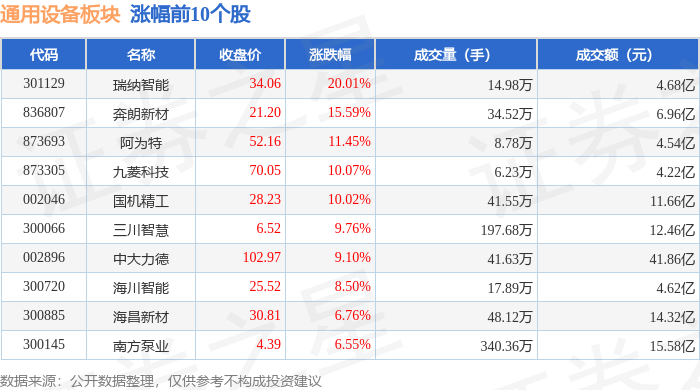
通用设备板块8月7日涨0.11%,瑞纳智能领涨,主力资金净流出24.78亿元
Zheng Xing Xing Ye Ri Bao· 2025-08-07 08:27
从资金流向上来看,当日通用设备板块主力资金净流出24.78亿元,游资资金净流入2831.19万元,散户资 金净流入24.49亿元。通用设备板块个股资金流向见下表: 证券之星消息,8月7日通用设备板块较上一交易日上涨0.11%,瑞纳智能领涨。当日上证指数报收于 3639.67,上涨0.16%。深证成指报收于11157.94,下跌0.18%。通用设备板块个股涨跌见下表: | 代码 | 名称 | 收盘价 | 涨跌幅 | 成交量(手) | 成交额(元) | | | --- | --- | --- | --- | --- | --- | --- | | 301129 | 瑞纳智能 | 34.06 | 20.01% | 14.98万 | | 4.68亿 | | 836807 | 奔朗新材 | 21.20 | 15.59% | 34.52万 | | 6.96亿 | | 873693 | 阿为特 | 52.16 | 11.45% | 8.78万 | | 4.54亿 | | 873305 | 九菱科技 | 70.05 | 10.07% | 6.23万 | | 4.22亿 | | 002046 | 国机精工 | 28.23 | ...


纽威股份(603699):25H1快报点评:Q2归母净利润同比+28%超预期,盈利能力稳健增长
Soochow Securities· 2025-08-07 04:04
Investment Rating - The investment rating for the company is "Buy" (maintained) [1] Core Views - The company's Q2 net profit attributable to shareholders increased by 28% year-on-year, exceeding expectations, indicating robust growth in profitability [2] - The company achieved a total revenue of 3.4 billion yuan in the first half of 2025, a year-on-year increase of 20%, with a net profit of 640 million yuan, up 30% year-on-year [2] - The company maintains a strong profit margin, with a net profit margin of 18.7% in the first half of 2025, an increase of 1.5 percentage points year-on-year [2] - The company is expected to benefit from geopolitical tensions and increased energy independence, leading to higher demand for valve procurement [3] - The company has a solid order backlog from major clients like Saudi Aramco and ADNOC, with ongoing expansion of new products and market share [3] - The 2025 stock incentive plan aims to motivate key employees and reflects the company's long-term confidence in its development [4] Financial Summary - Total revenue forecast for 2023 is 5.544 billion yuan, with a year-on-year growth of 36.59% [1] - Net profit attributable to shareholders is projected to be 721.8 million yuan in 2023, representing a year-on-year increase of 54.85% [1] - The earnings per share (EPS) for 2023 is estimated at 0.94 yuan, with a price-to-earnings (P/E) ratio of 35.39 [1] - The company expects to achieve a net profit of 1.15558 billion yuan in 2024, with a year-on-year growth of 60.10% [1] - The projected net profit for 2025 is 1.4499 billion yuan, with a growth rate of 25.47% [1]

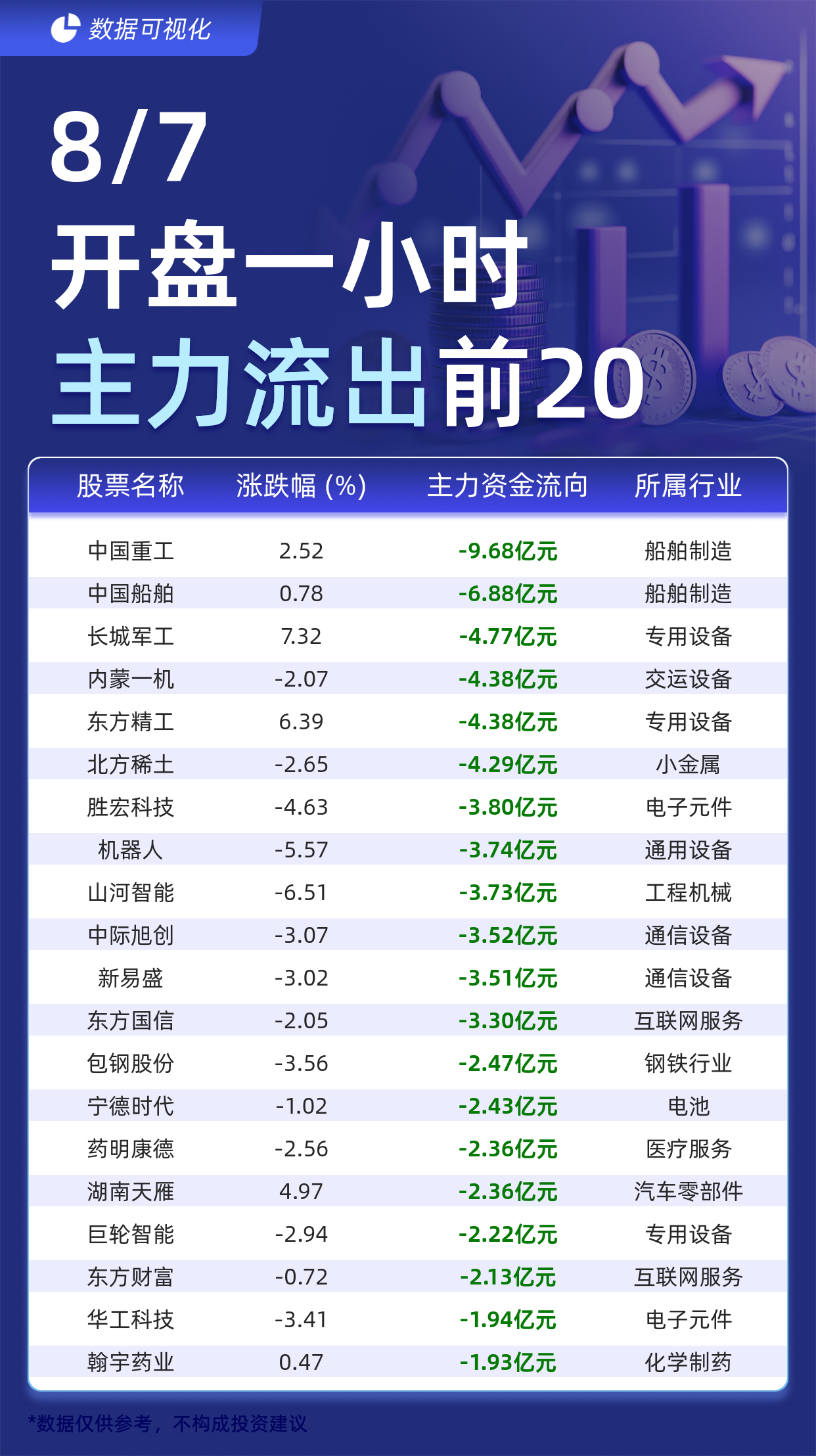
主力个股资金流出前20:中国重工流出9.68亿元、中国船舶流出6.88亿元
Jin Rong Jie· 2025-08-07 03:10
截至8月7日开盘一小时,主力资金流出前20的股票分别为:中国重工(-9.68亿元)、中国船舶(-6.88亿元)、长城军工(-4.77亿元)、内蒙一机(-4.38亿 元)、东方精工(-4.38亿元)、北方稀土(-4.29亿元)、胜宏科技(-3.80亿元)、机器人(-3.74亿元)、山河智能(-3.73亿元)、中际旭创(-3.52亿 元)、新易盛(-3.51亿元)、东方国信(-3.30亿元)、包钢股份(-2.47亿元)、宁德时代(-2.43亿元)、药明康德(-2.36亿元)、湖南天雁(-2.36亿 元)、巨轮智能(-2.22亿元)、东方财富(-2.13亿元)、华工科技(-1.94亿元)、翰宇药业(-1.93亿元)。 | 股票名称 | 涨跌幅 (%) | 主力资金流向 | 所属行) | | --- | --- | --- | --- | | 中国重工 | 2.52 | -9.68亿元 | 船舶制送 | | 中国船舶 | 0.78 | -6.88亿元 | 船舶制送 | | 长城军工 | 7.32 | -4.77亿元 | 专用设备 | | 内蒙一机 | -2.07 | -4.38亿元 | 交运设备 | | 东方精工 | ...