
养殖业

Search documents
我国将重点建设6类国家农业现代化示范区
Jing Ji Guan Cha Wang· 2026-01-16 12:21
Core Viewpoint - The article discusses the implementation of the "National Agricultural Modernization Demonstration Zone Creation Work Plan," which aims to accelerate agricultural modernization in China by establishing demonstration zones that ensure food security and promote new agricultural productivity [1] Group 1: Objectives and Goals - The plan sets a target to create no more than 500 recognized demonstration zones by 2030 [1] - It focuses on six types of demonstration zones: grain industry, animal husbandry, advantageous specialty industries, smart agriculture, urban agriculture, and dry farming [1] - The goal is to enable qualified demonstration zones to achieve basic agricultural modernization ahead of others, creating a phased construction pattern with key breakthroughs [1] Group 2: Implementation Strategy - The demonstration zones are intended to serve as practical models for agricultural modernization, exploring replicable and promotable development modes [1] - The initiative aims to build agricultural industry development hubs and accelerate the cultivation of new agricultural productivity test fields [1] - It also seeks to promote comprehensive green transformation benchmarks in agriculture [1]
三部门部署国家农业现代化示范区创建工作
Xin Lang Cai Jing· 2026-01-16 11:54
Core Viewpoint - The Ministry of Agriculture and Rural Affairs, the Ministry of Finance, and the National Development and Reform Commission have issued the "National Agricultural Modernization Demonstration Zone Creation Work Plan," which outlines the creation of demonstration zones as a key strategy to accelerate agricultural modernization in China [1][2]. Group 1: Overall Requirements - The creation of demonstration zones is guided by Xi Jinping's Thought on Socialism with Chinese Characteristics for a New Era and aims to implement the spirit of the 20th National Congress of the Communist Party of China [1]. - The plan emphasizes the importance of deepening reforms and technological innovation, focusing on enhancing agricultural comprehensive production capacity and quality efficiency [1]. Group 2: Creation Goals - By 2030, the plan aims to establish no more than 500 recognized demonstration zones, focusing on six types: grain industry, animal husbandry, advantageous specialty industries, smart agriculture, urban agriculture, and dry farming [2]. - The goal is to enable qualified demonstration zones to achieve basic agricultural modernization ahead of others, creating a phased construction pattern with key breakthroughs [2]. Group 3: Creation Tasks - The plan specifies the creation positioning, application standards, and goals for each type of demonstration zone, incorporating both "regular tasks + special tasks" to advance the creation work [2]. - Counties applying for demonstration zones must select a type that meets the application standards and strengthen organizational leadership and innovative mechanisms [2]. Group 4: Work Procedures and Measures - The demonstration zones will follow a "create first, recognize later" approach, with annual progress [2]. - Agricultural departments at all levels are required to enhance organizational leadership, policy support, guidance services, and promote effective outcomes in the creation work [2].
农业农村部等三部门:到2030年累计创建认定示范区不超过500个
Xin Lang Cai Jing· 2026-01-16 11:37
Core Viewpoint - The Ministry of Agriculture and Rural Affairs, the Ministry of Finance, and the National Development and Reform Commission have issued a work plan for the creation of national agricultural modernization demonstration zones, aiming to establish a structured approach to agricultural modernization by 2030 [1] Group 1: Overall Requirements and Goals - The plan sets a target to create no more than 500 recognized demonstration zones by 2030 [1] - The focus will be on six types of demonstration zones: grain industry, aquaculture, advantageous and characteristic industries, smart agriculture, urban agriculture, and dryland farming [1] Group 2: Implementation Strategy - The plan emphasizes that demonstration zones with favorable conditions should achieve basic agricultural modernization ahead of others [1] - A phased approach will be adopted to ensure key breakthroughs and gradual advancement in the construction of these zones [1]
养殖业板块1月16日跌2.27%,温氏股份领跌,主力资金净流出7.98亿元
Zheng Xing Xing Ye Ri Bao· 2026-01-16 08:49
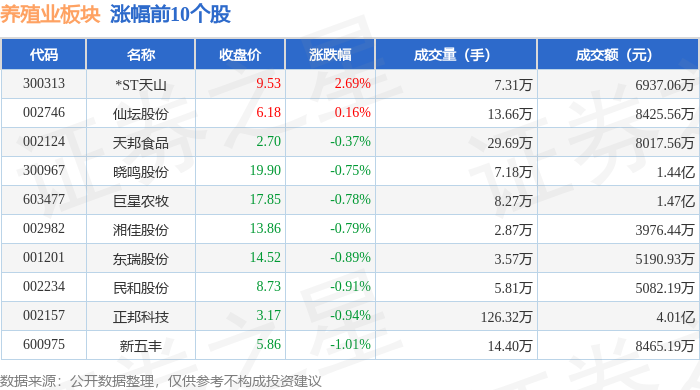
证券之星消息,1月16日养殖业板块较上一交易日下跌2.27%,温氏股份领跌。当日上证指数报收于 4101.91,下跌0.26%。深证成指报收于14281.08,下跌0.18%。养殖业板块个股涨跌见下表: | 代码 | 名称 | 收盘价 | 涨跌幅 | 成交量(手) | 成交额(元) | | --- | --- | --- | --- | --- | --- | | 300313 | *ST天山 | 9.53 | 2.69% | 7.31万 | 6937.06万 | | 002746 | 仙坛股份 | 6.18 | 0.16% | 13.66万 | 8425.56万 | | 002124 | 天邦食品 | 2.70 | -0.37% | 29.69万 | 8017.56万 | | 300967 | 膀ਫ਼股份 | 19.90 | -0.75% | 7.18万 | 1.44亿 | | 603477 | 巨星农牧 | 17.85 | -0.78% | 8.27万 | 1.47亿 | | 002982 | 湘佳股份 | 13.86 | -0.79% | 2.87万 | 3976.44万 | | 001201 | 东瑞 ...


(乡村行·看振兴)广东义容镇:农业强镇促蝶变
Xin Lang Cai Jing· 2026-01-15 14:19
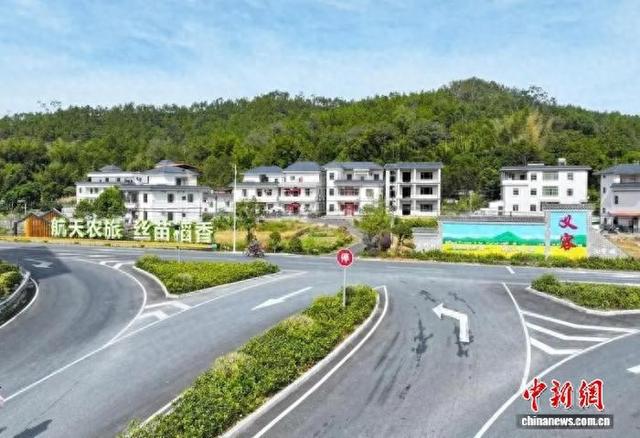
Group 1 - The core viewpoint of the article highlights the development of various industries in Yirong Town, including the establishment of a company to promote local entrepreneurship and the integration of agriculture with processing and sales [1][3] - Yirong Town has implemented the "Hundred Thousand Project" to cultivate specific industries, focusing on the full-chain development of leading industries such as silk rice planting and livestock breeding [3][4] - The town has introduced seven quality projects with a total investment exceeding 3.2 billion, including the China (Heyuan) Aerospace Agricultural Demonstration Park and the Seed Industry Expo Park, which are currently under construction [3][4] Group 2 - The agricultural initiatives include the goal of planting 43,490 acres of rice by 2025, with a total grain output expected to reach 17,509 tons [3] - The establishment of the "Rich Town Strong Village" company aims to foster local entrepreneurial teams and support the development of aquaculture and smart agricultural machinery [3] - Yirong Town is enhancing its infrastructure and aesthetics, with improved roads and vibrant murals depicting local agricultural elements, contributing to a more appealing living and working environment [4]
养殖业板块1月15日跌0.28%,*ST天山领跌,主力资金净流出4.55万元
Zheng Xing Xing Ye Ri Bao· 2026-01-15 08:53
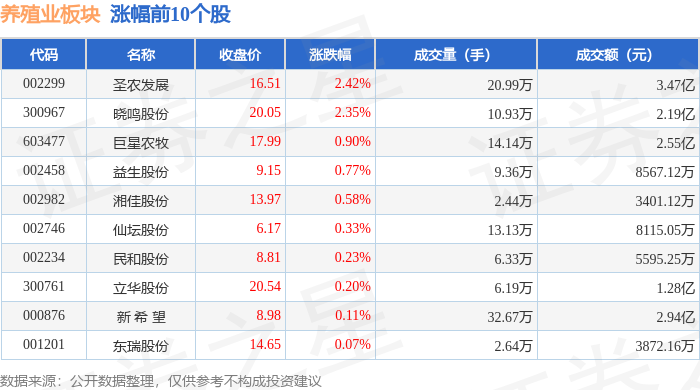
证券之星消息,1月15日养殖业板块较上一交易日下跌0.28%,*ST天山领跌。当日上证指数报收于 4112.6,下跌0.33%。深证成指报收于14306.73,上涨0.41%。养殖业板块个股涨跌见下表: 从资金流向上来看,当日养殖业板块主力资金净流出4.55万元,游资资金净流出4309.47万元,散户资金 净流入4314.02万元。养殖业板块个股资金流向见下表: | 代码 | 名称 | 主力净流入 (元) | 主力净占比 游资净流入(元) | | 游资净占比 散户净流入(元) | | 散户净占比 | | --- | --- | --- | --- | --- | --- | --- | --- | | 002714 | 牧原股份 | -5881.48万 | 3.38% | -1873.42万 | -1.08% | -4008.06万 | -2.31% | | 300498 | 温氏股份 | 2532.99万 | 3.12% | -1954.54万 | -2.41% | -578.46万 | -0.71% | | 300967 | 晓鸣股份 | 2512.54万 | 11.45% | -478.94万 | -2 ...


猪肉价格上涨!银行创新信贷模式赋能养殖业
Zhong Guo Jing Ying Bao· 2026-01-14 12:37
Core Viewpoint - The recent increase in pork prices in China has improved the income of farmers but has also highlighted the financing challenges faced by small and medium-sized livestock farmers, prompting banks to innovate credit services and enhance financial support for the livestock industry [1][2]. Group 1: Price Trends and Impacts - The average price of pork in China's wholesale markets rose to 18.04 yuan per kilogram, marking a 1.2% increase from the previous day [1]. - The rise in pork prices is attributed to a seasonal improvement in supply and demand, with winter consumption and upcoming Spring Festival demand boosting pork consumption [2]. - While higher pork prices increase farmers' sales revenue and profit levels, they also raise costs for piglets and feed, leading to a greater need for working capital [2]. Group 2: Financing Needs and Solutions - Farmers' core financing needs include funds for daily operational expenses, long-term investments in infrastructure, and technology upgrades for environmental and smart farming [2]. - Financial institutions are addressing these needs by providing innovative credit solutions, such as pure credit financing and expedited loan approvals through rural revitalization financial channels [3]. - The use of technology, such as AI for real-time data collection and valuation of livestock, is becoming crucial for improving the accuracy and efficiency of collateral assessments [3][4]. Group 3: Innovative Financing Models - The promotion of livestock collateral financing is encouraged by recent policy initiatives, which aim to establish recognized valuation standards and dynamic monitoring systems for livestock [4][5]. - A proposed "insurance + futures + credit" model suggests that farmers can purchase price insurance, which can then be used as collateral for low-interest loans from banks, thereby sharing risk among stakeholders [5]. - Banks are encouraged to extend their services beyond the farming sector to include financing for upstream suppliers and downstream processing companies, thereby reducing credit barriers for farmers [5].

平原农商银行:精准信贷 助力信鸽养殖
Qi Lu Wan Bao· 2026-01-14 10:33
Core Insights - The traditional pigeon breeding industry in Pingyuan County is experiencing revitalization due to financial support from Pingyuan Rural Commercial Bank, which has been providing tailored loans to local farmers [1][2] - The bank's initiative to implement "village-wide credit" assessments has enabled farmers like Wang Hong'en to secure necessary funding for expansion, leading to increased production and quality in pigeon breeding [1][2] Group 1: Financial Support Initiatives - Pingyuan Rural Commercial Bank has been actively engaging with local farmers to understand their needs, particularly in the pigeon breeding sector, and has introduced tailored financial products such as "Rudang Huinong Loan" and "Family Affection Loan" to alleviate financing challenges [2] - The bank has provided credit support to 527 breeding entities in the county, amounting to a total of 301 million yuan, facilitating the growth of the local pigeon breeding industry [2] Group 2: Impact on Local Industry - The financial assistance has allowed pigeon breeders to expand their operations and improve the quality of their breeds, contributing to the overall economic upliftment of the region [2] - The success stories of local breeders, such as Wang Hong'en, highlight the positive impact of financial support on traditional industries, showcasing a blend of heritage and modern financial solutions [1][2]
养殖业板块1月14日涨0.09%,*ST天山领涨,主力资金净流出2.23亿元
Zheng Xing Xing Ye Ri Bao· 2026-01-14 08:44
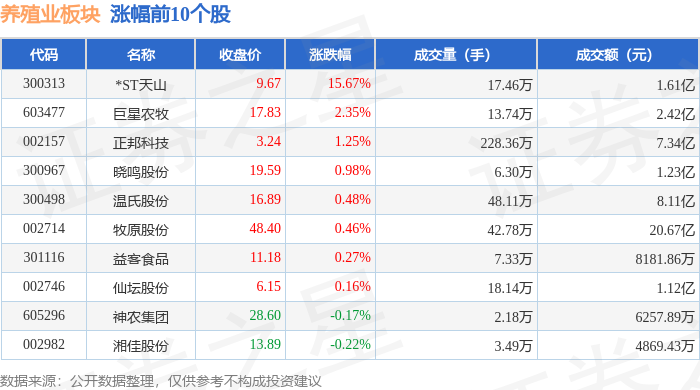
Core Viewpoint - The aquaculture sector experienced a slight increase of 0.09% on January 14, with *ST Tianshan leading the gains, while the overall market showed mixed results with the Shanghai Composite Index down by 0.31% and the Shenzhen Component Index up by 0.56% [1]. Group 1: Stock Performance - *ST Tianshan closed at 9.67, up by 15.67%, with a trading volume of 174,600 shares and a transaction value of 161 million yuan [1]. - Other notable performers included Juxing Agriculture (up 2.35% to 17.83), Zhengbang Technology (up 1.25% to 3.24), and Xiaoming Co. (up 0.98% to 19.59) [1]. - Major stocks like Wens Foodstuff and Muyuan Foods saw minor increases of 0.48% and 0.46%, respectively, with closing prices of 16.89 and 48.40 [1]. Group 2: Capital Flow - The aquaculture sector saw a net outflow of 223 million yuan from institutional investors, while retail investors contributed a net inflow of 77.57 million yuan [2]. - Notable stocks with significant capital flow included Zhengbang Technology, which experienced a net outflow of 37.67 million yuan from institutional investors [3]. - Muyuan Foods had a net inflow of 37.65 million yuan from institutional investors, indicating a positive sentiment towards this stock [3].

京基智农股价连续3天下跌累计跌幅6%,前海开源基金旗下1只基金持136.73万股,浮亏损失129.89万元
Xin Lang Cai Jing· 2026-01-14 07:12
Group 1 - The core point of the news is that Jingji Zhino has experienced a decline in stock price, dropping 1.2% to 14.88 yuan per share, with a total market value of 7.891 billion yuan and a cumulative drop of 6% over three consecutive days [1] - Jingji Zhino's main business includes modern agriculture and real estate, with revenue composition: pig products 79.38%, feed products 11.67%, commercial housing 5.38%, rental income 1.36%, poultry products 1.29%, hotel business 0.83%, and others 0.07% [1] - The company is located in Shenzhen, Guangdong Province, and was established on January 1, 1979, with its listing date on November 1, 1994 [1] Group 2 - The Qianhai Kaiyuan Fund holds a significant position in Jingji Zhino, with its fund, Qianhai Kaiyuan Hong Kong-Shenzhen Agricultural Mixed (LOF) A, reducing its holdings by 10.47 million shares, now holding 1.3673 million shares, which accounts for 6.29% of the fund's net value [2] - The fund has reported a floating loss of approximately 246,100 yuan today and a cumulative floating loss of 1,298,900 yuan during the three-day decline [2] - The fund was established on July 20, 2016, with a current scale of 239 million yuan, and has experienced a loss of 1.65% this year, ranking 8713 out of 8838 in its category [2]
