
加密货币

Search documents
复刻特朗普,英国改革党领袖建议设立50亿英镑比特币储备
Hua Er Jie Jian Wen· 2025-10-15 16:31
Group 1 - The core viewpoint is that UK officials, led by Nigel Farage, are adopting a pro-cryptocurrency stance similar to Donald Trump's to attract voters amid a growing cryptocurrency wave in the UK [1][2]. - Farage's policy proposals include establishing a £5 billion Bitcoin strategic reserve using seized assets, imposing a 10% capital gains tax on cryptocurrencies, terminating the Bank of England's digital pound project, and allowing tax payments in cryptocurrency on a voluntary basis [1][2]. - A recent survey indicates that approximately 12% of UK adults currently hold or have held cryptocurrency, a significant increase from 4% in 2021, highlighting a growing voter base that Farage aims to appeal to [2]. Group 2 - Despite the ambitious nature of Farage's plans, his actual influence in Parliament is limited, with the Reform Party holding only 5 out of 650 seats, making it challenging to convert proposals into policy [3]. - Key institutions such as the Treasury and the Bank of England are not directly influenced by Farage, meaning his proposals may primarily serve to spark discussion rather than lead to actionable policy changes [3]. - However, some aspects of Farage's proposals are already being implemented, as the UK is laying the groundwork for cryptocurrency regulation, particularly in stablecoins and custodial frameworks [3].
Origin奥拉丁生态核心代币LGNS最新数据显示国库资产突破3.45亿
Sou Hu Cai Jing· 2025-10-15 14:42
Core Insights - The article highlights the innovative nature of the LGNS token, which operates as an algorithmic stablecoin with a decentralized issuance mechanism [1][3] - The current treasury assets of $345 million can support the platform's operations for 264 days without risk, providing reassurance to investors [3][4] - The daily asset growth of $9.55 million, with a notable daily growth rate of 2.77%, indicates strong internal growth dynamics within the Origin ecosystem, especially in a generally sluggish crypto market [3][4] Treasury and Asset Management - The total issuance of LGNS has surpassed 373 million tokens, with a daily increase of 4.465 million tokens [4] - The treasury assets have seen a significant daily increase of $9.55 million, reaching a total of $345 million [4] Market Dynamics and Community Engagement - The innovative economic model of the LGNS token is attracting capital inflows, driven by diverse application scenarios that create real demand [5] - Community consensus is playing a crucial role in accumulating value within the ecosystem [5] Operational Stability - The platform's operational safety period is currently estimated at 264 days, indicating a robust risk management framework [3][4]


TACO快不灵了,A股免疫“关税恐吓”
和讯· 2025-10-15 09:47
Core Viewpoint - The article discusses the TACO trading strategy, which capitalizes on the erratic behavior of former President Trump regarding tariffs, allowing investors to profit from market fluctuations caused by his threats and subsequent retreats [4][5][11]. Group 1: What is TACO Trading? - TACO stands for "Trump Always Chickens Out," a term coined by Robert Armstrong to describe Trump's inconsistent approach to tariffs [4]. - The TACO trading strategy involves predicting Trump's behavior, where market downturns occur after tariff threats, followed by rebounds when he retracts those threats [5][6]. - This trading pattern has become a recognized method on Wall Street, allowing traders to buy during panic and sell during recovery [5][8]. Group 2: Recent TACO Trading Examples - On October 10, Trump threatened to impose a 100% tariff on Chinese goods, leading to a significant market drop, with the Nasdaq index falling 3.56% and major tech companies losing approximately $770 billion in market value [6]. - Following a calming statement from Vice President Pence on October 12, the market rebounded, with Bitcoin and Ethereum seeing gains of over 2% and 7%, respectively [6][7]. - A similar pattern was observed on May 23, when Trump announced potential tariffs on the EU, causing a market drop, which was reversed after he postponed the tariffs [9][10]. Group 3: Market Immunity to TACO Trading - Analysts suggest that the market is becoming increasingly immune to Trump's tariff threats, as repeated instances have led to diminished effects of such announcements [11][13]. - The current geopolitical environment indicates that while tensions exist, the market's reaction to Trump's threats is becoming more rational and less panic-driven [11][12]. - The effectiveness of the TACO trading strategy may decline as investors grow skeptical of the credibility of Trump's threats, potentially leading to prolonged economic conflicts [13].

美股加密货币概念股盘前普涨,IREN涨4.5%
Mei Ri Jing Ji Xin Wen· 2025-10-15 08:39
每经AI快讯,10月15日,美股加密货币概念股盘前普涨。IREN涨4.5%,Hut 8涨超3%,Circle涨超2%, Coinbase涨超1%。 ...
加密货币市场风声鹤唳 巨鲸集体加码做空比特币与主流山寨币
智通财经网· 2025-10-15 07:44
Group 1 - Major cryptocurrency whales are increasing their short positions on Bitcoin and mainstream altcoins, with a notable entity known as Trump Insider Whale taking an aggressive bearish stance [1] - Trump Insider Whale recently added $150 million to its short position, bringing its total short exposure to $485 million, and has realized approximately $22 million in unrealized profits due to the current market downturn [1] - Prior reports indicated that Trump Insider Whale had established a $340 million short position in Bitcoin, and before the recent cryptocurrency market crash, it had shorted $700 million in Bitcoin and $350 million in Ethereum, netting $200 million in profits [1] Group 2 - Other whales are also actively positioning themselves in short positions on mainstream altcoins, with one wallet reportedly holding $98 million in short positions across Dogecoin, Ethereum, Pepe, Ripple, and Aster, realizing $31.8 million in profits [1] - Another whale has established $84 million in short positions in Solana and Bitcoin, with profits of $13.2 million [1] - Additionally, BlackRock has transferred 704 Bitcoins to Coinbase Prime, valued at approximately $77.67 million, further dampening market sentiment [1] Group 3 - As of the latest update, Bitcoin's price has decreased by 0.5% to $112,550.35, while Ethereum's price has fallen by 0.38% to $4,115.18 [2]
ATH Silver Flips Bitcoin: Has the Age of Digital Gold Finally Ended?
Yahoo Finance· 2025-10-15 01:41
Core Insights - The digital asset market is experiencing a significant shift as silver reaches its highest price in nearly 50 years, indicating a potential transition from "digital gold" to traditional assets [1][2] - Silver's market capitalization has surpassed that of Bitcoin, highlighting a divergence in the performance of these asset classes [2][3] - The current trend suggests a bear market for cryptocurrencies, particularly Bitcoin and Ethereum, as they decline while traditional assets like gold and silver rally [3][5] Group 1: Market Performance - Silver has achieved a historic peak, marking its highest level in approximately 45 years, with unprecedented demand for physical silver [1] - Bitcoin and Ethereum have seen sharp declines following the recent "Crypto Black Friday," contrasting with the rising prices of silver and gold [2][3] - The Bitcoin/silver ratio has been in decline since its peak four years ago, indicating a significant shift in market dynamics [4] Group 2: Investor Sentiment - Prominent economist Peter Schiff suggests that crypto investors may face significant losses, with many young investors likely to experience a steep learning curve [3] - Some traders have reported substantial losses, with one individual losing 80% of their portfolio value during the recent market downturn [6] - The cyclical rotation between physical and digital assets is becoming evident as investors seek traditional safe havens amid economic uncertainty [7]
多头血流成河,稳定币脱锚,10·11爆仓日发生了什么?
Hu Xiu· 2025-10-15 01:02
Core Viewpoint - The cryptocurrency market experienced a significant crash on October 11, leading to substantial financial losses for many investors, highlighting the extreme volatility and emotional nature of the market [1] Group 1 - The event is described as a "day of liquidation" in the cryptocurrency sector, indicating widespread sell-offs and financial distress among investors [1] - The contrasting reactions of individuals in the market are noted, with some losing everything while others continue to engage in speculative behavior, illustrating the duality of human nature in the face of financial turmoil [1] - The cryptocurrency market is characterized as a magnifier of human emotions, where greed and panic are ever-present, affecting investor behavior and market dynamics [1]
史上最大爆仓,币圈血洗之夜,160万人惨遭清算
3 6 Ke· 2025-10-15 00:33
Core Viewpoint - The cryptocurrency market experienced a significant crash following Trump's threat to impose a 100% tariff on China, leading to massive losses for investors and a dramatic decline in asset values [1][5][27]. Group 1: Market Impact - Bitcoin plummeted from $122,000 to $103,900, a decrease of nearly 15%, while Ethereum fell from $4,363 to $3,468, a drop of 20% [1]. - The total forced liquidation of long positions in the cryptocurrency market reached approximately $19 billion within 24 hours, affecting over 1.6 million accounts [5][27]. - The stablecoin USDe, which was originally pegged to $1, dropped to as low as $0.65 during the crash, indicating a severe loss of stability [3][35]. Group 2: Investor Reactions - A tragic incident involved a Ukrainian cryptocurrency trader, who reportedly lost around $30 million and subsequently took his own life [6][8]. - Social media platforms were flooded with despair from over 2,000 cryptocurrency traders expressing suicidal thoughts after the market collapse [8]. - Many traders shared their experiences of shock and devastation, with some losing their entire life savings and expressing feelings of hopelessness [13][24]. Group 3: Trading Mechanisms - The use of high leverage in trading exacerbated losses, with some traders using up to 10x leverage, leading to total asset liquidation upon a 10% market drop [28][30]. - The Auto-Deleveraging (ADL) mechanism automatically liquidated positions when collateral values fell below borrowed amounts, resulting in widespread forced sell-offs [30][41]. - The crash highlighted the risks associated with perpetual contracts and high leverage, which can lead to rapid and catastrophic losses in volatile markets [31][43]. Group 4: Market Recovery - Following the initial crash, USDe quickly regained its peg to $1, and Bitcoin rebounded to $115,000, indicating a volatile recovery phase [27]. - Despite the losses, some investors viewed the situation as a buying opportunity, demonstrating the cyclical nature of market sentiment in the cryptocurrency space [52].
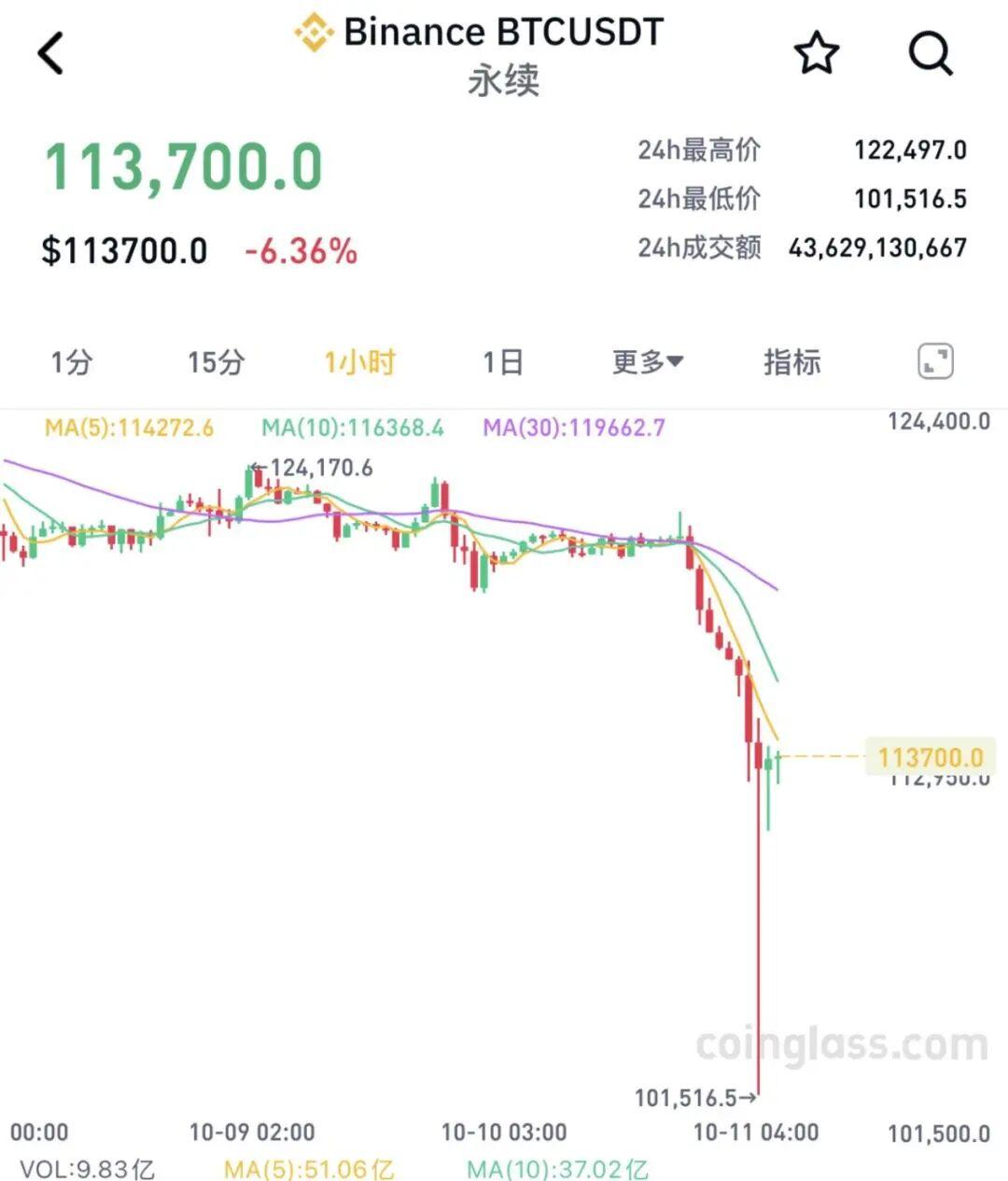
加密货币再度集体跳水,超20万人爆仓
Zhong Guo Ji Jin Bao· 2025-10-14 22:57
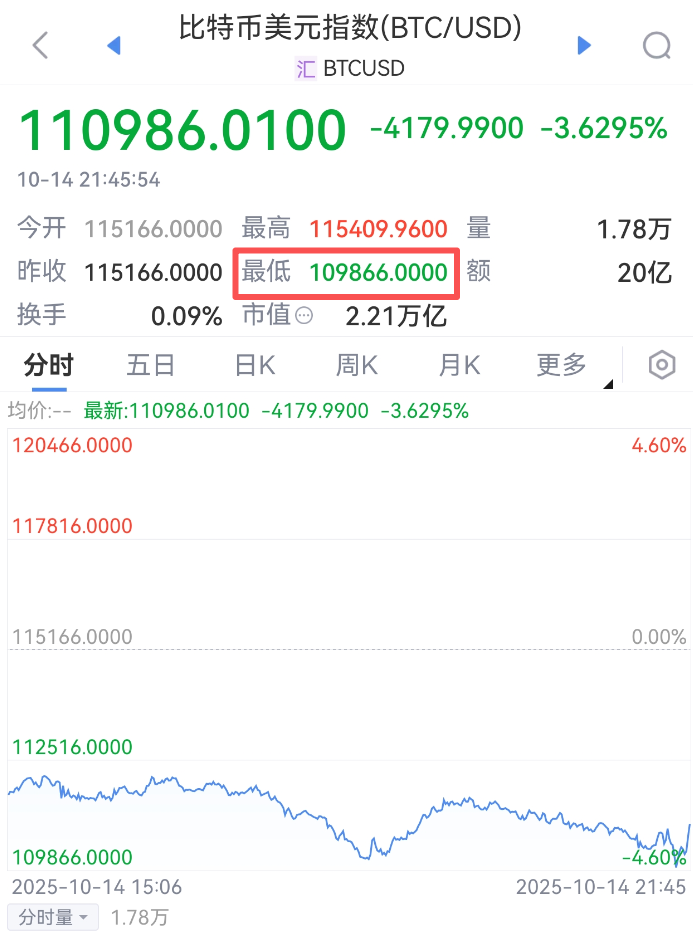
Core Points - The cryptocurrency market experienced a significant downturn on October 14, with Bitcoin dropping below $110,000, marking a decline of 4.6% [1] - Ethereum fell below $3,900, with a decline exceeding 8% [3] - Major cryptocurrencies, including Dogecoin, Binance Coin, and Cardano, also saw substantial decreases [4] Market Performance - Bitcoin (BTC) price: $111,173.90, down 3.47% with a trading volume of $2 billion [5] - Ethereum (ETH) price: $3,956.26, down 6.71% with a trading volume of $2 billion [5] - Binance Coin (BNB) price: $1,167.76, down 9.79% with a trading volume of $998 million [5] - Dogecoin (DOGE) price: $0.19778, down 7.49% with a trading volume of $370 million [5] - Total liquidations in the last 24 hours reached $656 million, with long positions accounting for $475 million [5][6] Regulatory and Legal Developments - The U.S. seeks to confiscate 127,271 Bitcoins (approximately $12 billion) linked to a scam operated by a Chinese national [7] - Delays in the passage of cryptocurrency market structure legislation in the U.S. may extend until after the midterm elections [10] Quantum Threats - Approximately 25% of Bitcoin may be exposed to quantum attack risks, potentially leading to losses in the hundreds of billions to trillions of dollars if not addressed by 2026 [8] Market Sentiment and Historical Context - The recent sell-off was not solely driven by tariff news but also reflects deeper structural issues, including excessive leverage and concentrated long positions [9] - The previous week's liquidation amounted to over $19.1 billion, marking a historical high [9]
BRIC 与 Tether 达成 2.995 亿美元和解,用于偿付 Celsius 破产财产
Xin Lang Cai Jing· 2025-10-14 20:24
(来源:吴说) 吴说获悉,Blockchain Recovery Investment Consortium(BRIC)宣布与 Tether 达成 2.995 亿美元和解协 议,用于向 Celsius Network 的破产财产(bankruptcy estate)支付款项。该协议源于 BRIC 于 2024 年 8 月在美国纽约南区破产法院提起的一项对抗性诉讼(adversary proceeding),指控 Tether 在 Celsius 于 2022 年申请破产前,通过转移与清算抵押资产,违反破产法及相关法定义务。 来源:市场资讯 ...