
电池制造

Search documents
国轩高科:2025年前三季度净利润约25.33亿元
Mei Ri Jing Ji Xin Wen· 2025-10-24 14:59
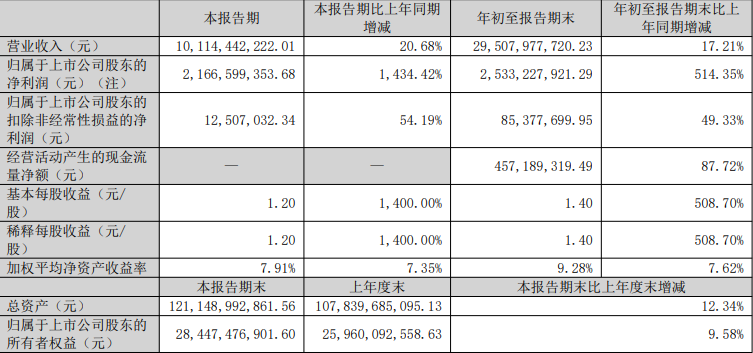
Group 1 - The core viewpoint of the article highlights the significant growth in Guoxuan High-Tech's third-quarter performance, with a notable increase in revenue and net profit compared to the previous year [1] - For the first three quarters of 2025, Guoxuan High-Tech reported revenue of approximately 29.508 billion yuan, representing a year-on-year increase of 17.21% [1] - The net profit attributable to shareholders reached approximately 2.533 billion yuan, showing a substantial year-on-year increase of 514.35% [1] - The basic earnings per share for the company was reported at 1.4 yuan, which is an increase of 508.7% year-on-year [1] - As of the report date, Guoxuan High-Tech's market capitalization stands at 76.5 billion yuan [1]

骆驼股份第三季度营收增长近9% 低压锂电池销量继续高增长
Zheng Quan Shi Bao Wang· 2025-10-24 14:41
Core Viewpoint - Camel Group (骆驼股份) reported a revenue increase in Q3 but faced a significant decline in net profit, indicating challenges in operational performance despite growth in sales [1][2] Group 1: Financial Performance - In Q3, Camel Group achieved a revenue of 4.147 billion yuan, a year-on-year increase of 8.95%, with a cumulative revenue of 12.142 billion yuan, up 7.14% year-on-year [1] - The net profit attributable to shareholders in Q3 was 87 million yuan, down 49.81% year-on-year, while the cumulative net profit reached 619 million yuan, an increase of 26.95% [1] - The decline in Q3 net profit was attributed to both operational and non-operational losses, including reduced exchange gains due to currency fluctuations and a decrease in gross margin for the recycled lead business [1] Group 2: Product Performance - Camel Group's main products, low-voltage lead-acid batteries and lithium batteries, saw an increase in gross margins year-on-year, with stable growth in lead-acid battery sales [2] - The sales of low-voltage lithium batteries doubled by the end of Q3, reflecting a strong growth trend [2] - The company experienced explosive growth in the sales of lithium batteries for parking air conditioning, with a nearly 50-fold increase in demand for commercial vehicle lithium battery products [2]

金力集团(03919.HK)拟折价13%向韩卫宁配股 筹资640万港元扩充电动快充电池业务
Ge Long Hui· 2025-10-24 13:38
Core Viewpoint - Kingli Group (03919.HK) has entered into a subscription agreement with Electronica Capital Limited to issue 6,480,000 shares at a subscription price of HKD 1.00 per share, representing a discount of approximately 13.0% from the market price of HKD 1.15 on the date of the agreement [1] Group 1 - The total amount raised from the subscription is approximately HKD 6.48 million, with a net amount of about HKD 6.4 million [1] - The net proceeds will be used for expanding the company's battery business into the electric vehicle fast charging market, repaying outstanding bank financing, and for general working capital [1] - Electronica Capital Limited is a company registered in the British Virgin Islands, fully owned by Han Weining [1]
国轩高科前三季度营收295亿同比增长超17% 将向大众汽车交付电池
Zheng Quan Shi Bao Wang· 2025-10-24 13:13
Financial Performance - Company achieved total revenue of 29.508 billion yuan in Q3, a 17.21% increase from 25.175 billion yuan in the same period last year [1] - Net profit reached 2.533 billion yuan, a significant increase of 514.35% year-on-year [1] - Non-recurring profit was 853.777 million yuan, up 49.33% year-on-year [1] - In Q3 alone, revenue was 10.114 billion yuan, with a year-on-year growth of 20.68% [1] Non-Recurring Gains - The substantial increase in net profit was primarily due to the fair value changes of shares held in Chery Automobile, which listed on the Hong Kong Stock Exchange [1] - Non-operating income totaled 2.448 billion yuan, with 2.436 billion yuan attributed to fair value changes and disposal gains from financial assets and liabilities [1] Cost Management - Sales expenses, management expenses, and R&D expenses were 341 million yuan, 1.358 billion yuan, and 1.605 billion yuan respectively, reflecting increases of 30.86%, 18.75%, and 17.10% year-on-year [2] - Financial expenses rose by 37.31% due to increased interest costs [2] Inventory and Cash Flow - Inventory balance was 11.746 billion yuan, up 64.94% from the beginning of the period, driven by increased sales [2] - Cash flow from operating activities generated a net amount of 457 million yuan, an increase of 87.72% year-on-year [2] - Investment activities resulted in a net cash outflow of 5.771 billion yuan, a decrease of 52.30% year-on-year [2] Market Position and Growth - Company’s cumulative battery installation volume reached 26.27 GWh in the first nine months, a year-on-year increase of 84.7%, capturing a market share of 5.33% [3] - In September, the monthly installation volume was 4.42 GWh, with a market share of 5.83% [3] - Company will supply batteries to Volkswagen for their new electric vehicle model, indicating a strategic partnership [3]
国轩高科Q3净利暴增1434.42%,奇瑞IPO推升账面利润
Hua Er Jie Jian Wen· 2025-10-24 12:56
Core Viewpoint - Guoxuan High-Tech reported a significant increase in net profit for Q3, primarily driven by the fair value changes from its early investment in Chery Automobile's Hong Kong listing, resulting in a non-recurring gain of 2.154 billion yuan [1][3]. Financial Performance - Q3 revenue reached 10.114 billion yuan, a year-on-year increase of 20.68%, while total revenue for the first three quarters was 29.508 billion yuan, up 17.21% [2]. - The net profit attributable to shareholders for Q3 was 2.167 billion yuan, a staggering increase of 1434% year-on-year, largely due to the fair value changes from Chery's listing [1][2]. - The net profit for the first three quarters was 2.533 billion yuan, reflecting a 514.35% increase year-on-year [2]. - The net profit excluding non-recurring items for Q3 was only 12.51 million yuan, a 54% increase year-on-year, indicating reliance on non-recurring gains [1][3]. Inventory and Cash Flow - Inventory increased by 64.94% year-on-year to 11.746 billion yuan, suggesting a significant buildup in stock compared to revenue growth [3]. - Operating cash flow for the first three quarters was 457 million yuan, an 87.72% increase year-on-year, but still low relative to revenue [5]. - Cash flow from financing activities was 24.912 billion yuan, with a net cash inflow of 3.809 billion yuan after debt repayments [5]. Asset and Investment - The company has ongoing construction projects amounting to 21.04 billion yuan, a 42.16% increase from the beginning of the year, indicating continued investment in capacity expansion [3][4]. - Total assets at the end of the reporting period were approximately 121.149 billion yuan, a 12.34% increase from the previous year [2]. Debt and Financial Health - The company has a total interest-bearing debt exceeding 39 billion yuan, with a debt-to-asset ratio of 71.72%, indicating significant financial pressure [5]. - Financial expenses increased by 37.31% year-on-year, primarily due to rising interest costs [5].

骆驼股份:10月24日召开董事会会议
Mei Ri Jing Ji Xin Wen· 2025-10-24 12:38
Group 1 - The core point of the article is that Camel Group Co., Ltd. announced the convening of its 10th Board of Directors meeting to review the third quarter report for 2025 [1] - For the year 2024, the revenue composition of Camel Group is as follows: lead-acid batteries account for 79.86%, recycled lead for 15.75%, lithium batteries for 2.59%, and others for 1.79% [1] - As of the report date, Camel Group's market capitalization is 12.7 billion yuan [1]
国轩高科Q3净利暴增1434.42%,奇瑞IPO推升账面利润 | 财报见闻
Hua Er Jie Jian Wen· 2025-10-24 12:14
Core Viewpoint - Guoxuan High-Tech reported a significant increase in net profit for Q3, primarily driven by the fair value changes from its early investment in Chery Automobile, following its Hong Kong listing, resulting in a net profit of 2.167 billion yuan, a year-on-year increase of 1434% [1][6]. Financial Performance - Q3 revenue reached 10.114 billion yuan, a year-on-year growth of 20.68%, while total revenue for the first three quarters was 29.508 billion yuan, up 17.21% [2][6]. - Net profit attributable to shareholders for Q3 was 2.167 billion yuan, a staggering increase of 1434%, with a total of 2.533 billion yuan for the first three quarters, reflecting a 514.35% rise [2][6]. - Non-recurring gains amounted to 2.154 billion yuan, with fair value changes contributing 2.326 billion yuan, indicating that the adjusted net profit was only 12.51 million yuan for Q3, a 54.19% increase year-on-year [3][6]. Inventory and Receivables - Inventory surged to 11.746 billion yuan by the end of Q3, a 64.94% increase from the beginning of the year, indicating a significant buildup in stock [4][6]. - Accounts receivable stood at 18.8 billion yuan, reflecting a 14.24% increase, which is slightly lower than the revenue growth rate, suggesting effective credit control [4][6]. Capital Expenditure and Debt - The company is actively expanding its production capacity, with construction in progress reaching 21.040 billion yuan, a 42% increase from the start of the year, including two new 20GWh battery projects [7][8]. - Cash flow from operating activities was 4.571 billion yuan, an 87.72% increase, but only 1.55% of total revenue, indicating limited cash generation capacity [9]. - Total interest-bearing debt exceeded 39 billion yuan, with a debt-to-asset ratio of 71.72%, highlighting significant financial pressure [9]. Shareholder Structure - Volkswagen remains the largest shareholder with a 24.29% stake, followed by Nanjing Guoxuan with 10.59%, and the founder and his son holding a combined 7.26% [9].
宁德时代(300750):业绩符合预期 海外产能扩张支撑业绩增长
Xin Lang Cai Jing· 2025-10-24 10:39
Core Insights - The company achieved a revenue of 283.072 billion yuan in Q1-Q3 2025, representing a year-on-year growth of 9.28%, and a net profit attributable to shareholders of 49.034 billion yuan, up 36.2% year-on-year [1] - In Q3 2025, the company reported a revenue of 104.186 billion yuan, with a year-on-year increase of 12.9% and a quarter-on-quarter increase of 10.6%, alongside a net profit of 18.549 billion yuan, reflecting a year-on-year growth of 41.2% [1] - The company maintains strong cash flow, with a net operating cash flow of 80.66 billion yuan in Q1-Q3 2025, a 19.6% increase year-on-year, and a continuous improvement in profit margins, with a net profit margin of 18.5% in Q1-Q3 2025 [1] Financial Performance - The company’s Q3 2025 sales/management/R&D expense ratios were 0.76%/2.98%/4.77%, with management expenses increasing due to higher sales volume in Q3 [1] - The sales net profit margin has shown consistent improvement, with figures of 14.92% in 2024, 17.6% in Q1 2025, 18.1% in H1 2025, and 18.5% in Q1-Q3 2025 [1] Market Demand and Product Development - There is strong demand for electric commercial vehicles, with an estimated lithium battery shipment of around 180 GWh in Q3, of which 20% is for energy storage batteries [2] - The company is enhancing its product offerings with new battery technologies, including sodium batteries, which are being piloted in some commercial vehicles due to their cost-effectiveness and fast charging capabilities [2] Capacity Expansion and Innovation - The company is accelerating overseas production capacity, with factories in Germany, Hungary, and Spain progressing well, and new products being launched to strengthen its market position [2] - Innovative products such as the Tianheng energy storage system and various advanced battery types are expected to further enhance the company's competitive edge [2] Earnings Forecast and Investment Recommendation - The projected EPS for 2025-2027 is 15.33 yuan, 18.03 yuan, and 21.69 yuan, with corresponding PE ratios of 24x, 21x, and 17x [2] - The company is expected to maintain a leading position in the industry with stable overseas capacity release and continuous product innovation, leading to a "buy" rating [2]

国轩高科:第三季度净利润同比增长1434.42% 主要系本期销售规模增加所致
Mei Ri Jing Ji Xin Wen· 2025-10-24 10:36
每经AI快讯,10月24日,国轩高科(002074)(002074.SZ)公告称,第三季度营收为101.14亿元,同比增 长20.68%;净利润为21.67亿元,同比增长1434.42%。前三季度营收为295.08亿元,同比增长17.21%; 净利润为25.33亿元,同比增长514.35%。报告期内,主要系本期销售规模增加所致。公司归属于上市公 司股东的净利润本报告期比上年同期大幅上涨,除受公司业务规模进一步扩大影响外,主要系公司早期 持有的奇瑞汽车(股票代码:HK.9973)股份因其港股上市以至公允价值大幅变动影响。 ...
亿纬锂能:2026年的商用车产品线需求预计有同比超过50%以上增长
Ge Long Hui A P P· 2025-10-24 10:35
Core Viewpoint - The company is focused on expanding its production capacity and optimizing its gross margin, with positive outlooks for both energy storage and commercial vehicle product lines in the coming years [1] Construction and Production Capacity - The company's ongoing construction projects are primarily located in Jingmen's Factory 60, Shenyang Factory, and overseas factories, with expectations for these to be operational by 2026 [1] - The production capacity is projected to reach approximately 30 GWh if fully utilized next year, with an estimated contribution of 10-12 GWh for the current year due to the late acquisition of some external factories [1] Market Demand and Sales Outlook - Energy storage is expected to maintain full production and sales, with a projected quarter-on-quarter increase in shipment volumes [1] - The commercial vehicle product line is showing optimistic feedback, with demand expected to grow by over 50% year-on-year by 2026 [1] Gross Margin and Business Optimization - The company is actively working on optimizing its business operations, with expectations for gross margin improvements to be reflected in the fourth quarter [1] - The goal for overseas shipments of energy storage batteries is to exceed 25% next year, up from less than 20% this year [1]
