库存积压

Search documents
多晶硅:高库存积压,价格趋势下行
Guo Tou Qi Huo· 2026-03-06 10:48
Report Industry Investment Rating - Not provided Core View of the Report - After the anti - monopoly regulatory signal, the previous sharp rise in the polysilicon market gradually declined, and the market returned to being dominated by fundamentals. The current prominent over - capacity and continuously high inventory levels jointly drive the polysilicon price to continue to decline, and the price may approach the cash cost in the short term. A trend reversal still requires fundamental improvement [3] Summary by Related Contents Price Trend - After the holiday, the polysilicon futures price continued to weaken, showing a downward trend. As of March 6, the main contract of polysilicon futures closed at 41,115 yuan/ton, and the intraday price touched the 40,000 yuan/ton mark [1] - The N - type dense material's lowest quotation dropped to 43,000 yuan/ton, a decrease of 4,500 yuan/ton compared with the last trading day before the holiday [2] Influencing Factors - Polysilicon price fluctuations are deeply affected by industry policies. The ban on market coordination by relevant regulatory authorities in January this year was a key factor in the price decline [1] - The over - capacity problem is prominent. In 2025, the domestic polysilicon production capacity is about 3.35 million tons, which can support about 1,450GW of photovoltaic installation demand, while the global actual photovoltaic installation volume in 2025 is less than 600GW. In 2026, the over - capacity contradiction persists [1] - Both polysilicon and its downstream sectors are in a state of cyclical over - supply, with large monthly production elasticities. The uncertainty of cell production scheduling increases due to silver price fluctuations [2] - The inventory level is high. At the end of February, the polysilicon inventory reached 480,000 tons, which can meet nearly 5 months of demand. The silicon wafer inventory increased by about 5.2GW month - on - month, which indirectly affected the upstream polysilicon market [2] - The recovery of downstream photovoltaic demand after the holiday was less than expected, and the silicon wafer procurement demand was weak, which increased the inventory pressure and suppressed the price [2] - The exchange expanded the scope of delivery brand enterprises to avoid the risk of cornering, and the price on the futures market decreased for secondary pricing [2]
斥资约2.51亿港元回购,拉布布感受到“天冷了”
Yang Zi Wan Bao Wang· 2026-01-21 06:17
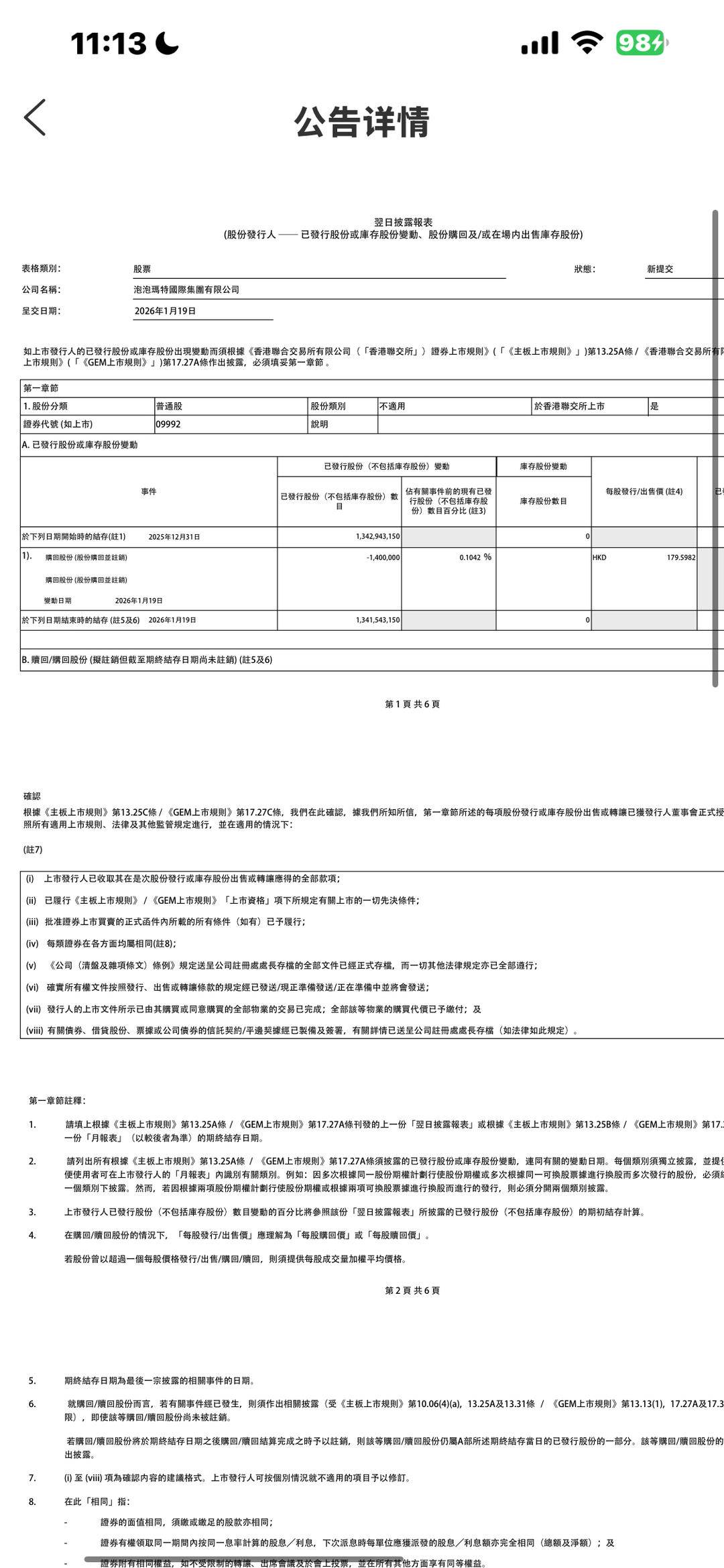
Core Viewpoint - Pop Mart, a leading player in the trendy toy market, has repurchased approximately 1.4 million shares for about HKD 251 million, indicating a strategic move to stabilize its stock price amid recent declines [1][5]. Group 1: Share Buyback Details - The share buyback occurred on January 19, 2026, with a total expenditure of approximately HKD 251 million [1]. - Following the buyback, Pop Mart's market capitalization stands at HKD 257.04 billion [1]. - The total number of issued shares decreased from 1,342,943,150 to 1,341,543,150 after the buyback [2]. Group 2: Market Performance and Concerns - Pop Mart's stock price has been on a downward trend since reaching a peak of HKD 339.8 in late August 2025 [5]. - There are concerns regarding a potential slowdown in domestic revenue growth in Q4 2025, with some products experiencing inventory buildup in specific retail locations [5]. - The market has shown reduced interest in older product lines, leading to significant price drops for certain items, reflecting consumer behavior trends [21].


迎最惨淡年报 口子窖缘何业绩滑铁卢
Bei Jing Shang Bao· 2026-01-13 15:08
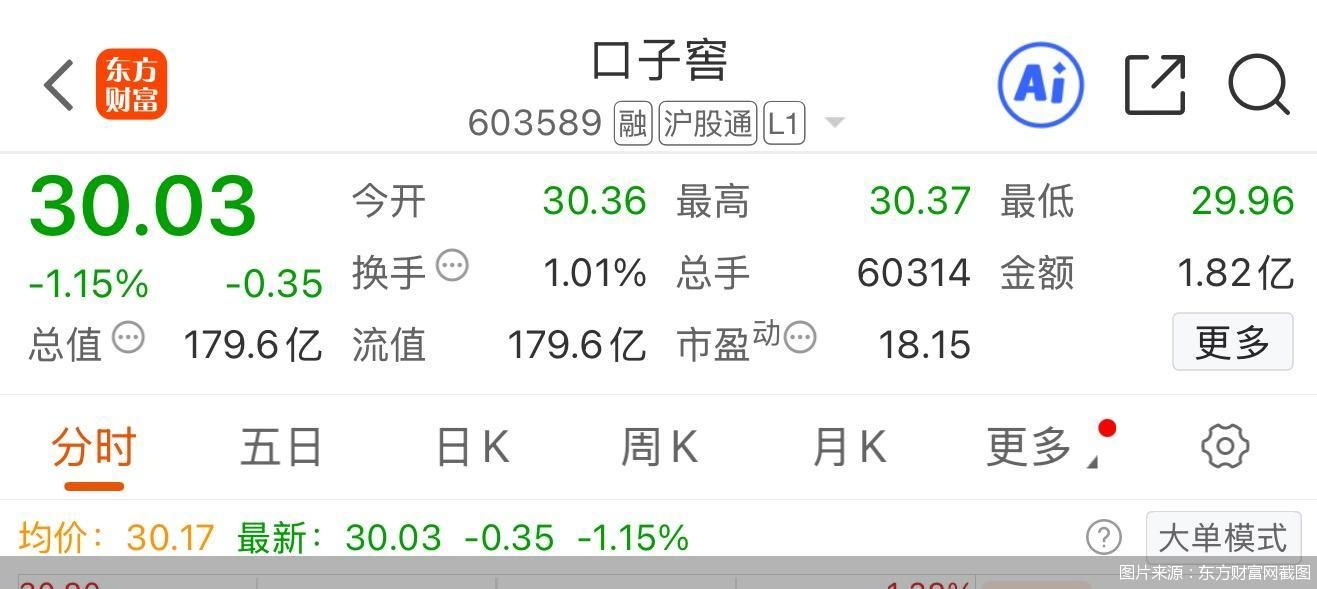
Core Viewpoint - Kuozi Jiao's net profit is expected to decline by over 50% in 2025, reflecting significant challenges in the white liquor industry and the company's operational difficulties [1][3][4] Financial Performance - Kuozi Jiao's 2025 net profit forecast is between 662 million to 828 million yuan, a decrease of 50% to 60% year-on-year [3][4] - The company's revenue for the first three quarters of 2025 shows a decline of 27.24%, with net profit down 43.39% [4] - The fourth quarter of 2025 is projected to be the worst since 2017, with net profit potentially falling into negative territory [4] Industry Context - The white liquor industry is undergoing a deep adjustment phase, with overall market demand weak and increased competition in Anhui province [5][6] - The "Matthew Effect" in the industry is squeezing the survival space for regional liquor companies as leading firms penetrate mid-range markets [5][6] Product and Market Challenges - Kuozi Jiao's high-end product sales have significantly underperformed, with high-end liquor revenue dropping by 27.98% year-on-year [6] - The introduction of the "Jian Series" products has not led to improved performance, as the company struggles with product structure optimization [5][6][7] Inventory and Operational Strategy - Kuozi Jiao's inventory reached 6.218 billion yuan by the end of Q3 2025, the highest in five years, indicating a pressing need to manage stock levels [8] - The company is exploring new sales channels, including opening a "Kuozi Wine Workshop" for bulk sales, to alleviate inventory pressure [9][10] Future Outlook - Kuozi Jiao aims for a revenue target of 10 billion yuan, but current performance indicates a significant gap, necessitating immediate action to manage inventory and improve sales [8][10]

What to Know Before Buying Celsius Stock
The Motley Fool· 2025-11-23 15:35
Core Insights - Celsius stock has experienced a significant decline of 58% from its peak in March 2024, despite a remarkable 7,330% increase over the previous five years [1][2] Financial Performance - In Q3 2023, Celsius reported a year-over-year revenue growth of 173%, reaching $725 million, largely due to the acquisition of Alani Nu [3] - The Celsius brand itself achieved a sales growth of 44% in the same quarter [3] Market Dynamics - The stock's decline may be attributed to slower revenue growth compared to previous years, with a 25-fold increase from 2018 to 2023, and a notable slowdown in scanner growth at just 13% [4] - There are concerns about potential inventory accumulation despite the revenue increase [4] Growth Opportunities - Celsius has significant potential for international expansion, as international revenue currently represents a small portion of total sales [5] - Analysts project a compound annual revenue growth rate of 21% for Celsius from 2025 to 2027 [5] Competitive Landscape - Celsius faces strong competition from established brands like Monster Beverage and Red Bull, which have greater brand recognition and loyalty [8] - The lack of a strong economic moat raises concerns about Celsius's long-term growth potential [8][9]


一瓶亏1500元、库存压1500万:白酒行业到底怎么了?
Sou Hu Cai Jing· 2025-11-19 20:37
Core Insights - The Chinese liquor industry is facing a severe downturn characterized by inventory backlog, price inversion, and tight cash flow [1][3][18] Group 1: Price Inversion - The key issue in the liquor industry this year is price inversion, where the market retail price is lower than the manufacturer's ex-factory price, leading to guaranteed losses for distributors [3][6] - Distributors are experiencing significant financial strain, with some opting not to make payments for new stock due to anticipated losses [3][6] Group 2: Manufacturer-Distributor Relationship Shift - The relationship between manufacturers and distributors has shifted from a competitive "grab stock" mentality to a more passive "let it be" approach due to high inventory levels [5][6] - Distributors are now focused on cost-cutting measures, reducing operational expenses significantly, such as downsizing office space and staff [7][6] Group 3: County Market Challenges - Distributors in county markets are under even greater pressure, with estimates suggesting that 20% of local liquor stores may close next year due to unsustainable pricing and inventory issues [9][10] Group 4: High-End Liquor Struggles - Distributors of high-end liquor are facing severe losses, with some reporting potential losses of over 30 million yuan this year due to decreased orders and high inventory costs [12][14] Group 5: Declining Consumption - The foundation of liquor consumption is weakening, as evidenced by reduced demand for liquor at events such as weddings, indicating a broader decline in consumer interest and spending power [16][20] - The overall consumption capacity is decreasing, impacting both high-end and general liquor sales [18][20]

棉花期货日报-20251110
Guo Jin Qi Huo· 2025-11-10 08:41
Report Summary 1. Report Industry Investment Rating - Not provided in the content 2. Core Viewpoints - In the short - term, against the backdrop of a slight decline in spot prices, the price of the cotton CF2601 contract is likely to show a weak and oscillating trend [15] 3. Summary by Directory 3.1 Futures Market - **Contract行情**: On November 6, 2025, the main contract CF2601 of Zhengzhou Commodity Exchange's cotton futures opened at 13,600 yuan/ton, with an intraday high of 13,630 yuan/ton and a low of 13,555 yuan/ton, closing at 13,605 yuan/ton, up 70 yuan/ton or 0.52% from the previous trading day. The trading volume was 178,288 lots, and the open interest decreased by 1,553 lots to 579,138 lots [2] - **Variety price**: All 6 cotton futures contracts closed higher, and the variety's open interest was 944,677 lots, an increase of 1,307 lots from the previous trading day [5] - **Associated行情**: On the same day, the trading volume of cotton options reached 92,555 lots, and the total open interest was 497,857 lots, an increase of 4,327 lots from the previous trading day [7] 3.2 Spot Market - **Spot price tracking**: On November 6, the average arrival price of imported cotton was 74.07 cents/pound, unchanged from November 5. After conversion, the import cost was 12,763 yuan/ton under 1% tariff and 13,748 yuan/ton under sliding - scale duty [10] - **Registered warehouse receipts**: The cotton warehouse receipts on the Zhengzhou Commodity Exchange totaled 2,769 on the day, an increase of 17 from the previous trading day [11] 3.3 Influencing Factors - **Important events**: According to China Cotton Net, about one - third of textile and clothing exporters in India reported a more than 50% plunge in their turnover in the US market due to tariff policies. Around 85% of enterprises faced inventory overstock, and over 80% encountered a 3 - 6 - month extension of the credit cycle, resulting in "severe pressure on liquidity." Two - thirds of exporters had to offer up to 25% discounts to remain competitive in the US market [12] - **Industry information**: The domestic CC Index 3128B closed at 14,795 yuan/ton, down 7 yuan/ton from November 5. The arrival price of Xinjiang cotton at Shandong warehouses (grade 3128B) was 14,890 yuan/ton, down 15 yuan/ton from November 5. The National Cotton Basis Index CNCottonJ (CF2601) was reported at 960 yuan/ton, up 5 yuan/ton from November 5 [13]
供应端压力显著 PVC向下测试支撑
Qi Huo Ri Bao· 2025-11-07 00:12
Core Viewpoint - The PVC market is currently facing significant pressure due to high social inventory and weak demand, leading to a potential test of historical low price support levels [1] Group 1: Social Inventory - PVC social inventory remains high, with a slight month-on-month decrease of 0.5% to 1.03 million tons by the end of October, but a year-on-year increase of 25.09% [3] - The East China region holds 0.9716 million tons of inventory, down 0.57% month-on-month but up 25.95% year-on-year, while South China shows an increase of 0.54% month-on-month to 0.0584 million tons, with a year-on-year rise of 12.30% [3] - High inventory levels are a key factor suppressing PVC prices, with the accumulation occurring even during the traditional consumption peak season [2][5] Group 2: Demand Side - The real estate sector, a major downstream market for PVC, remains sluggish, with significant year-on-year declines in investment, new construction, completion, and sales areas [4] - Although there has been a slight increase in operating rates for pipe and profile manufacturers due to promotions, the overall demand growth potential is limited, failing to provide effective support for PVC prices [4] - Despite challenges, PVC exports have surged, with a cumulative export volume of 3.3941 million tons from January to September, marking a year-on-year increase of 47.78% [4] Group 3: Production and Pricing - Domestic PVC production remains high, with an operating load of 78.26% as of October 31, consistent with levels from 2023 and 2024 [2] - The unit loss for calcium carbide-based PVC producers has reached 770 yuan per ton, while ethylene-based PVC losses have narrowed to approximately 475 yuan per ton [2] - The overall weak market for PVC is expected to persist, with supply pressures and high social inventory continuing to dominate, despite some cost support from stable calcium carbide prices [5]
国轩高科Q3净利暴增1434.42%,奇瑞IPO推升账面利润 | 财报见闻
Hua Er Jie Jian Wen· 2025-10-24 12:14
Core Viewpoint - Guoxuan High-Tech reported a significant increase in net profit for Q3, primarily driven by the fair value changes from its early investment in Chery Automobile, following its Hong Kong listing, resulting in a net profit of 2.167 billion yuan, a year-on-year increase of 1434% [1][6]. Financial Performance - Q3 revenue reached 10.114 billion yuan, a year-on-year growth of 20.68%, while total revenue for the first three quarters was 29.508 billion yuan, up 17.21% [2][6]. - Net profit attributable to shareholders for Q3 was 2.167 billion yuan, a staggering increase of 1434%, with a total of 2.533 billion yuan for the first three quarters, reflecting a 514.35% rise [2][6]. - Non-recurring gains amounted to 2.154 billion yuan, with fair value changes contributing 2.326 billion yuan, indicating that the adjusted net profit was only 12.51 million yuan for Q3, a 54.19% increase year-on-year [3][6]. Inventory and Receivables - Inventory surged to 11.746 billion yuan by the end of Q3, a 64.94% increase from the beginning of the year, indicating a significant buildup in stock [4][6]. - Accounts receivable stood at 18.8 billion yuan, reflecting a 14.24% increase, which is slightly lower than the revenue growth rate, suggesting effective credit control [4][6]. Capital Expenditure and Debt - The company is actively expanding its production capacity, with construction in progress reaching 21.040 billion yuan, a 42% increase from the start of the year, including two new 20GWh battery projects [7][8]. - Cash flow from operating activities was 4.571 billion yuan, an 87.72% increase, but only 1.55% of total revenue, indicating limited cash generation capacity [9]. - Total interest-bearing debt exceeded 39 billion yuan, with a debt-to-asset ratio of 71.72%, highlighting significant financial pressure [9]. Shareholder Structure - Volkswagen remains the largest shareholder with a 24.29% stake, followed by Nanjing Guoxuan with 10.59%, and the founder and his son holding a combined 7.26% [9].

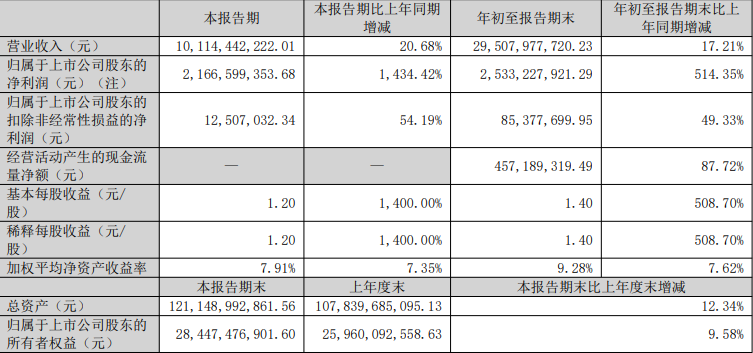
57亿元vs500亿元!太极集团“四面楚歌”:明星大单品失灵,卖房补血自救
Hua Xia Shi Bao· 2025-08-28 14:28
Core Insights - Taiji Group, once a leading player in the traditional Chinese medicine industry, is facing unprecedented operational challenges, with a significant decline in revenue and profit margins in the first half of 2025 [1][2][4] Financial Performance - In the first half of 2025, Taiji Group reported revenue of 5.66 billion yuan, a year-on-year decrease of 27.63%, and a net profit attributable to shareholders of 139 million yuan, down 71.94% [2][6] - The company's net profit margin has deteriorated significantly, with a non-recurring net profit of 120 million yuan, reflecting a 74.52% decline compared to the previous year [2][6] - The decline in performance is attributed to policy impacts and ongoing inventory digestion of certain products, which has been consistent with previous years' explanations [2][4] Industry Context - The pharmaceutical industry is experiencing pressures from policies such as volume-based procurement and medical insurance cost control, but Taiji Group's revenue decline of 27.63% and nearly 70% drop in net profit exceeds the industry average [2][4] - The company's previous high-growth strategy, which relied on heavy inventory stocking, has backfired, leading to high social inventory levels that are now being liquidated [2][4] Product Performance - Taiji Group's main revenue sources are heavily reliant on its pharmaceutical industrial and commercial sectors, with key products like Huoxiang Zhengqi Oral Liquid and Jizhi Syrup facing significant sales declines [8][9] - In 2024, the pharmaceutical industrial sector's revenue fell by 32.25%, with a further decline of 44.03% in the first half of 2025, indicating severe pressure on core products [8][9] Strategic Challenges - The company had set an ambitious revenue target of 50 billion yuan for 2025, but with only 5.66 billion yuan achieved in the first half, meeting this target appears highly unlikely [10] - Taiji Group's high inventory levels and ineffective marketing strategies have been likened to "running with sandbags," continuously dragging down profits [4][5] Financial Pressures - Taiji Group has faced additional financial strain with the freezing of bank accounts totaling 62.92 million yuan, which represents 1.73% of the company's audited net assets [12][13] - The company is taking steps to address its financial situation by selling idle assets, including properties in Chongqing and Chengdu, to improve liquidity [13]

美国物价飙升倒计时?专家预警:通胀压力暂隐库存环节,假日旺季或成爆发点
智通财经网· 2025-08-15 07:38
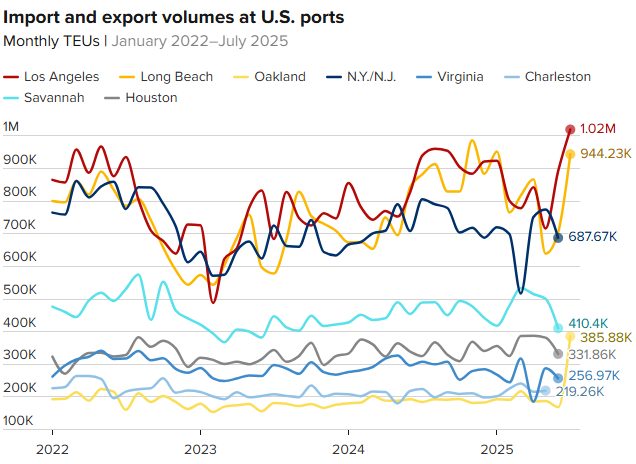
Core Insights - Despite rising CPI and PPI in the US, significant price increases for various goods have not yet been observed, with higher costs currently hidden in the "mid-transport" phase, such as warehouses and distribution centers [1] - The increase in inventory is attributed to the uncertainty surrounding tariffs, leading importers to stockpile goods to mitigate costs, which has resulted in a backlog in warehouses [1][2] - Retailers are experiencing a mixed seasonal demand, with some categories like children's clothing and toys seeing price increases, but overall sales volume is weaker compared to last year [1][2] Inventory and Supply Chain Dynamics - Retailers typically see inventory peak around mid-October, but this year, due to early stocking, warehouse capacity has expanded, leading to price increases [1] - Companies are facing rising warehousing costs, which may or may not be passed on to consumers, depending on various factors including tariffs and overall supply chain costs [2] - The demand for flexible warehousing solutions has increased among importers and distributors to manage inventory effectively in light of ongoing tariff uncertainties [2] Shipping and Port Operations - The operational status at major US ports, such as the Port of Los Angeles, reflects the inventory buildup, with a notable number of ships docked in August [5] - Although the number of ships is lower than in July and August of the previous year, the increase in inventory is causing a temporary stabilization in shipping operations [5] Tariff Implications and Consumer Sentiment - The evolving tariff landscape is impacting supply chains, with increased shipping costs to countries like Vietnam and India, highlighting the volatility of the current business environment [5] - Consumer confidence remains low, influenced by past price surges in 2021 and 2022, leading to concerns about further cost increases due to tariffs [6]