
信贷

Search documents
华尔街的下一个雷?美国私募信贷市场违约警告激增
Hua Er Jie Jian Wen· 2025-08-22 08:18
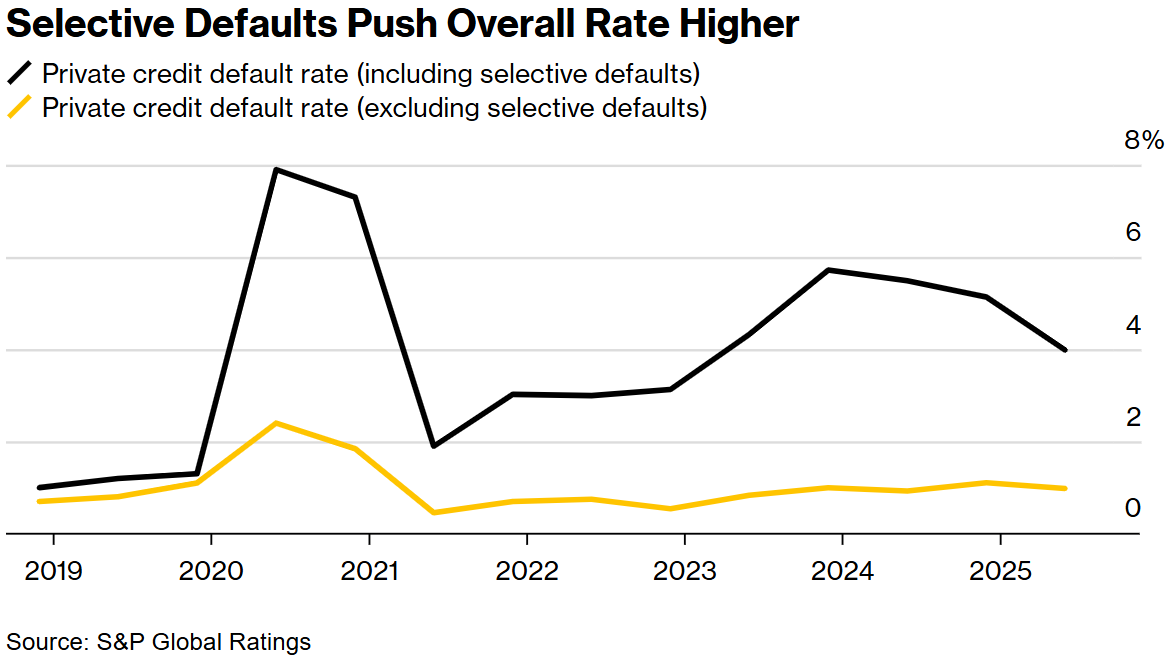
Group 1 - The private credit market, valued at $1.7 trillion, is facing a surge in default warnings, with analysts concerned that the actual default rate may be significantly underestimated [1][2] - According to a report by JPMorgan, if non-accrual loans are included, the default rate in the private credit market has risen to 5.4%, comparable to the broader syndicated loan market [1][2] - Analysts warn that years of rapid fundraising in private credit funds have led to relaxed underwriting standards, which could result in excessive losses during an economic downturn [1][3] Group 2 - The definition of default in the private credit market is inconsistent, with current reported default rates ranging from 2% to 3%. However, including non-accrual loans raises the rate to 5.4% [2] - The "shadow default rate," which considers "bad" in-kind payments as part of total investments, reached 6% in Q2, significantly higher than 2% in 2021 [2] - Analysts agree on the upward trend in defaults, despite differences in specific data, indicating a growing concern in the market [3] Group 3 - The influx of capital into the private credit asset class has led to a rapid allocation of funds, resulting in compromised underwriting processes, which may lead to greater losses in a downturn [3] - Private companies and lenders are using in-kind payment arrangements to avoid cash defaults, allowing borrowers to defer cash interest payments until maturity, ultimately leading to larger liabilities [3] - The ability of private credit funds to attract capital is diminishing, as they are no longer the strong magnet for investment they once were, despite still offering returns above 8% [3]

私募信贷市场警报频传:官方低违约率背后,影子违约率已飙升至6%
智通财经网· 2025-08-22 03:37
Core Viewpoint - The private credit market, valued at $1.7 trillion, is facing increasing default warnings, raising concerns among analysts about the underestimated risks in one of Wall Street's most profitable businesses [1] Group 1: Default Rates and Market Conditions - The current default rate in the private credit market is between 2% and 3%, but when including "non-accrual loans," the rate rises to 5.4%, which is comparable to the syndicated loan market [1] - The official default rate for private credit increased from 2.9% to 3.4% in the second quarter, while the "shadow default rate" reached 6%, significantly higher than 2% in 2021 [4] - Analysts from various firms note that the concentration of low credit rating borrowers and rising recent default rates indicate ongoing challenges in the market [5] Group 2: Investment Trends and Fundraising - Despite a slowdown in fundraising, private credit funds still attract investors with returns exceeding 8%, although the amount raised this year is only $70 billion, the smallest share of alternative asset inflows since at least 2015 [1] - Analysts express concerns that rapid capital commitments may lead to lower underwriting standards, which could amplify losses during economic downturns [1] Group 3: Borrower Behavior and Risk Management - Borrowers are utilizing arrangements that allow them to defer cash interest payments until debt maturity, which can mask default risks [4] - The reputation of private credit for low default rates is based on narrow definitions of default, and if broader definitions are applied, the actual rate of non-compliance would be significantly higher [4] - Different credit rating agencies and consulting firms monitor borrower groups differently, complicating the overall market assessment [4] Group 4: Market Sentiment - Some market participants remain optimistic, citing that declining interest rates alleviate pressure on highly leveraged companies, and the interest coverage ratio within loan portfolios remains healthy [8] - The sentiment suggests that robust companies with strong cash flows can withstand current interest rate levels [8]

日本中年返贫史
投资界· 2025-08-21 08:18
Core Viewpoint - The article discusses the economic struggles faced by Japan's 60s generation, highlighting their transition from being the "luckiest generation" to experiencing significant debt and unemployment issues during their middle age [2][3]. Debt Crisis of the 60s Generation - The 60s generation faced severe debt issues, with average household debt reaching nearly 20 million yen, the highest among all generations at the time [3]. - This debt crisis was largely due to their home purchases coinciding with the peak of the real estate bubble in the 1980s, where land prices surged over 150% [3][4]. - By 1995, over half of the 60s generation households owned homes, but the anticipated rebound in property values never materialized, leading to a 20-year decline in housing prices [5][4]. Employment and Income Challenges - Following the bubble burst, companies struggled with high labor costs, leading to a significant drop in employee salaries starting in 1995, with disposable income for the 60s generation decreasing by nearly 25% [8][9]. - The unemployment rate for middle-aged individuals rose from 1.5% to 3% between the early 1990s and 1998, with many older workers losing their jobs and facing difficulties re-entering the workforce [9][10]. Credit Loan Crisis - The rise of unsecured credit loans became prevalent, with the market growing from 4.5 trillion yen in 1994 to over 10 trillion yen by 2000, primarily used to service existing debts [10][11]. - High-interest rates on these loans, often exceeding 30%, led many families into a cycle of debt, exacerbated by aggressive collection practices [11]. Family and Social Dynamics - The 60s generation also faced a significant increase in divorce rates, with over 2.77 million families divorcing in the decade following 1995, largely due to economic pressures and changing family roles [13][14]. - The traditional family structure, where the husband was the sole breadwinner, became unsustainable, leading to increased tensions and breakdowns in family relationships [14]. Long-term Consequences - By 2022, the average debt for the 60s generation remained around 6 million yen, double that of the previous generation, indicating a lasting impact of the economic turmoil [20]. - The societal perception of this generation shifted from being the "warm spring generation" to the "bubble generation," reflecting their once prosperous lives that turned into prolonged hardship [20].

区块链信贷公司Figure冲刺纳斯达克IPO 估值曾高达32亿美元!
Zhi Tong Cai Jing· 2025-08-19 01:08
Group 1 - Figure Technology Solutions Inc. has filed for an IPO, joining the trend of crypto-related companies seeking to go public [1] - For the six months ending June 30, the company reported revenue of $43.8 million and a net profit of $29.1 million, compared to revenue of $12.5 million and a net loss of $15.6 million in the same period last year [1] - The company was valued at $3.2 billion during a funding round in 2021 [1] Group 2 - Figure was co-founded by Mike Cagney in 2018, who previously was part of the founding team of SoFi Technologies Inc. [1] - The company initially offered home equity lines of credit and has since expanded to include crypto asset-backed loans and a digital asset exchange [1] - The total loan issuance based on blockchain technology has exceeded $16 billion [1] Group 3 - Major investors in Figure include Apollo Global Management, 10T Holdings LLC, and Ribbit Capital [2] - After the IPO, Cagney is expected to retain majority voting rights in the company [2] - The IPO is being underwritten by Goldman Sachs, Jefferies Financial Group, and Bank of America, with plans to list on the NASDAQ under the ticker symbol FIGR [2]
港股异动 | 新鸿基公司(00086)涨近6% 预计中期溢利同比增至不少于8亿港元
Zhi Tong Cai Jing· 2025-08-07 01:44
Group 1 - The core viewpoint of the article is that Sun Hung Kai Properties (00086) has experienced a nearly 6% increase in stock price due to a positive earnings forecast, expecting a significant rise in interim profits [1] - The company anticipates that the profit attributable to shareholders for the six months ending June 30, 2025, will not be less than HKD 800 million, compared to HKD 75.4 million for the same period ending June 30, 2024, indicating a substantial growth [1] - The primary driver of this notable increase in profits is attributed to enhanced investment returns from the company's investment management business, although this is partially offset by a decrease in profits from the company's credit business [1]

Blackstone Secured Lending Fund(BXSL) - 2025 Q2 - Earnings Call Transcript
2025-08-06 14:32
Financial Data and Key Metrics Changes - BXSL reported net investment income (NII) of $0.77 per share, representing an 11.2% annualized return on equity, primarily from interest income [9][27] - Net asset value (NAV) per share decreased slightly to $27.33 from $27.39 in the previous quarter [9][28] - The distribution of $0.77 per share was fully covered by NII, yielding an annualized distribution yield of 11.3% [9][20] Business Line Data and Key Metrics Changes - BXSL's total portfolio investments at fair value increased to $13.3 billion, up from $11.3 billion year over year [14][28] - The weighted average yield on performing debt investments remained stable at 10.2% [16][29] - 98% of investments are in first lien senior secured loans, with a low non-accrual rate of 0.3% at cost [16][18] Market Data and Key Metrics Changes - The company experienced a nearly 50% increase in new Blackstone credit insurance (BXCI) global private credit deal screenings compared to the fourth quarter of the previous year [8][9] - The average EBITDA of the portfolio companies is approximately $219 million, with year-over-year EBITDA growth of nearly 11% [17][78] Company Strategy and Development Direction - BXSL is focusing on maximizing operational efficiency and maintaining a disciplined approach to investment quality, avoiding unnecessary risks [11][12] - The company aims to lead the market with lower fees and expenses compared to peers, which is seen as a priority for creating a stronger portfolio over time [11][12] - BXCI's scale and expertise are leveraged to enhance revenue and lower costs for portfolio companies, indicating a commitment to value creation [14][25] Management's Comments on Operating Environment and Future Outlook - Management noted a shift in market conditions with improved investor sentiment and a return to open markets, leading to increased deal activity [7][8] - There is cautious optimism regarding the economic outlook, with management emphasizing the importance of quality over risk in investment decisions [11][44] - The company is preparing for heightened deal activity, particularly within existing portfolio companies, while remaining vigilant about market risks [10][11] Other Important Information - The company maintained its dividend distribution at $0.77 per share, reflecting a commitment to delivering high-quality yield to shareholders [20][27] - Total liquidity was reported at nearly $3 billion, providing ample cash and undrawn debt available for future investments [31] Q&A Session Summary Question: Sustainability of the dividend - Management indicated that the dividend is regularly assessed and is currently 15% higher than the average BDC, with long-term signals being prioritized over short-term deal activity [35][38] Question: Deal activity and spread expectations - Management acknowledged the potential for increased deal activity to impact spreads but emphasized the importance of supply and demand dynamics in the market [41][43] Question: Types of deals being seen - Management noted a mix of M&A activity within existing portfolio companies and some refinancing deals, with a focus on both lower middle market and large-cap spaces [48][49] Question: Repayment activity expectations - Management expects repayment activity to normalize higher as M&A activity picks up, following a low base in Q2 [56][58] Question: Concerns about net investment losses - Management reassured that the marks on assets reflect a robust valuation process, with a long track record of managing through various market conditions [75][78]

环球信贷集团(01669)附属授出总金额为3058.3万港元的有抵押贷款
智通财经网· 2025-08-01 09:32
Core Viewpoint - The company, Global Credit Group, has announced the signing of twelve renewal loan agreements with borrowers A, B, and C, involving a total secured loan amount of HKD 30.583 million, effective from August 1, 2025 [1] Group 1 - The total amount of the secured loans is HKD 30.583 million [1] - The agreements involve three borrowers identified as Client A, Client B, and Client C [1] - The loans are set to be effective from August 1, 2025 [1]
环球信贷集团附属授出总金额为3058.3万港元的有抵押贷款
Zhi Tong Cai Jing· 2025-08-01 09:32
Core Viewpoint - Global Credit Group (01669) announced the signing of twelve renewal loan agreements with clients A, B, and C, involving a total secured loan amount of HKD 30.583 million, effective from August 1, 2025 [1] Group 1 - The company’s indirect wholly-owned subsidiary, Global Credit, will act as the lender in these agreements [1] - The total amount of the secured loans is HKD 30.583 million [1] - The agreements are part of a broader strategy to maintain lending relationships with existing clients [1]
夯实顶层!凯雷(CG.US)CEO设立三位联席总裁
智通财经网· 2025-07-28 12:35
Core Insights - Carlyle Group's CEO Harvey Schwartz has promoted three executives to co-presidents, reinforcing his core management team in the restructuring of the private equity giant [1][2] - The appointments highlight the central role of private equity and credit businesses in Carlyle's strategic framework, with the private equity division contributing nearly half of the management fee revenue in Q1 [1][2] Management Changes - John Redett, a top corporate strategy expert, will transition from CFO to global private equity head, overseeing flagship acquisition and infrastructure sectors [1][2] - Mark Jenkins will continue to lead the credit business, which manages $453 billion in assets, and will also take on insurance business responsibilities [1][2] - Jeff Nedelman will enhance cross-strategy client service collaboration, avoiding internal resource competition [1][2] Strategic Goals - Schwartz's leadership aims to boost stock prices and reposition the company for growth, with a focus on understanding clients and aligning the management team with strategic goals [2] - The timing of the leadership announcement coincides with Carlyle's stock reaching historical highs and outperforming most peers over the past year [2] Challenges Ahead - Redett will face the challenge of integrating diverse businesses, particularly as Carlyle prepares for a retail fund across private equity strategies [3] - The company has also made leadership changes in the EMEA region, appointing Michael Wand to oversee investment business in Europe, the Middle East, and Africa [4] Broader Context - Carlyle's adjustments reflect a strategic response to market conditions, including the need for leadership in the post-Russia-Ukraine conflict European market and the emerging capital opportunities in the Middle East [4]

摩根士丹利:关税对经济数据的影响
摩根· 2025-07-19 14:02
Investment Rating - The report indicates a significant impact of tariffs on the economy, with a focus on the retail sector and credit market dynamics, suggesting a cautious approach to investments in these areas. Core Insights - Tariff revenues exceeded 26 billion USD in June, annualized at about 1% of GDP, marking a significant increase compared to three months prior, indicating that the effects of tariffs are becoming more pronounced [1][2] - The retail sector is particularly vulnerable due to preemptive inventory purchases made in anticipation of high tariffs, which have now been sold out, leading to higher costs for new orders expected in the third quarter of 2025 [3][4] - Core inflation data is rising, reflecting increased cost pressures across industries affected by tariffs, with the retail sector expected to feel the impact more acutely in the third quarter of 2025 [3][4] Summary by Sections Tariff Impact - The rapid increase in tariff rates, now reaching historical highs of 9%, with potential future increases to 15-20%, is a key factor in the delayed impact of tariffs on the market [2] - Companies had stocked up on inventory before tariffs took effect, but by the third quarter, these inventories will be depleted, leading to higher costs for new products [2] Retail Sector - The retail industry is especially affected as it faces higher costs for new goods after selling off pre-purchased inventory, with core inflation pressures compounding the situation [3] Credit Market - The credit market is advised to focus on quality, particularly in August and September, as the retail sector's challenges may lead to increased scrutiny on credit quality due to rising costs and inflation [4]