软件

Search documents

美股异动|财捷夜盘跌4.7%,今财年营收及调整后EPS指引逊于预期
Ge Long Hui A P P· 2026-02-27 01:53
展望第三财季,公司预计营收同比增长10%,达到85.3亿美元,略高于市场预期的85.2亿美元;调整后 每股盈利将介于12.45至12.51美元之间,则低于市场预期的12.97美元。公司重申全财年业绩指引,预计 营收将介于210亿至211.9亿美元之间,调整后每股收益将介于22.98至23.18美元之间,市场预期分别为 212.5亿美元和23.19美元。(格隆汇) 格隆汇2月27日|税务软件制造商财捷(INTU.US)夜盘跌4.7%,报376美元。 消息面上,财捷(Intuit)公布,第二财季营收同比增长17.4%至46.5亿美元,高于市场预期的45.3亿美元; 调整后每股盈利4.15美元,亦高于市场预期的3.68美元。公司维持季度股息为每股1.2美元不变。 ...
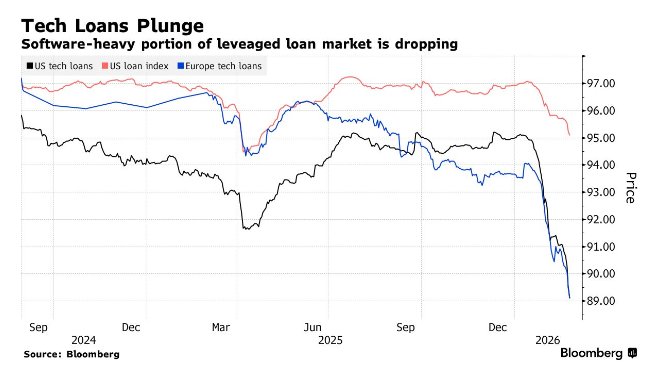
债务高峰遇上AI变革 贝恩资本警告:软件业违约潮山雨欲来
智通财经网· 2026-02-27 00:15
Group 1 - Bain Capital warns that the software industry faces a risk of loan default rates soaring to double digits due to the disruptive impact of AI technology and an approaching debt repayment peak [1] - Angelo Rufino predicts that the software industry default rate could rise to the high single digits to low double digits, compared to an expected overall leveraged loan default rate in the U.S. of only 5% this year [1] - Wall Street has raised alarms that AI productivity tools will not only impact the software industry but may also reshape the financial services and asset management sectors [1] Group 2 - Despite recent debt pressures on Rocket Software Inc., Bain Capital's special situations business has a risk exposure to the software industry of less than 5% [2] - Rufino believes that while many software service companies have stable subscription revenues, the rise of AI will limit their pricing power, affecting enterprise valuation multiples and making debt refinancing more challenging [4] - Rufino asserts that the current credit market crisis is unlikely to escalate into a widespread credit market issue, as the software industry's crisis is expected to be confined to specific sectors [4] Group 3 - Rufino notes that the current credit spread levels are too narrow, with high-yield bonds offering a premium of about 300 basis points over U.S. Treasuries, which is not attractive from a risk-return perspective [4]

英伟达,重挫5.46%!
Zhong Guo Ji Jin Bao· 2026-02-27 00:13
【导读】道指微涨,标普500、纳指下跌;英伟达股价重挫 中国基金报记者 赵刚 综合整理 美东时间2月26日周四,美国三大股指涨跌不一,科技巨头英伟达和软件巨头Salesforce业绩未能提振市 场,英伟达股价下跌超5%。 三大股指收盘涨跌不一 道指涨17.05点,涨幅为0.03%,报49499.20点;纳指跌273.70点,跌幅为1.18%,报22878.38点;标普 500指数跌37.27点,跌幅为0.54%,报6908.86点。 国际金融协会发布的报告显示,全球债务规模在去年底攀升到创纪录的348万亿美元,增长了近29万亿 美元。创下自2020年新冠疫情暴发初期以来最快增速,一改以往由家庭或企业主导的结构。其中,美 国、欧元区等国家政府债务占10万亿美元以上。 英伟达财报后股价下挫超5% 英伟达第四财季盈利超预期且上调指引,但市场仍未完全放心,周四开盘后,英伟达股价大幅跳水,一 度跌近6%,收跌5.46%。 有分析人士指出,英伟达的财报未能打消市场对"AI泡沫"的忧虑,投资者一直担心人工智能支出的可持 续性。 周四,大型科技股多数下跌,特斯拉跌逾2%,谷歌跌超1%,亚马逊跌逾1%,苹果跌0.47%,微软涨 ...


AI轮番冲击各个行业,华尔街转向“花式”防守
Hua Er Jie Jian Wen· 2026-02-27 00:02
Group 1 - The core viewpoint of the articles highlights the significant impact of AI-related developments on individual stocks in the U.S. market, leading to a shift in Wall Street's focus towards more complex options and hedging strategies to navigate the unpredictable sell-off waves [1][2] - The S&P 500 index has only risen about 1% year-to-date, with a trading range narrowing to 2.7%, marking one of the narrowest ranges in nearly a century, while individual stock volatility has reached its highest divergence since the 2009 financial crisis [2][3] - The trend of "dispersion trading" is gaining traction among institutional investors, as it allows them to capitalize on the significant volatility of individual stocks compared to the relative stability of indices [2][3] Group 2 - The scale of funds pursuing dispersion trading is reportedly larger than ever, with participation from hedge funds, asset management companies, and pension funds increasing significantly [3] - The price ratio of short-term individual stock options to index options has risen sharply, indicating expectations of a highly dispersed market environment [3] - Institutional demand for overall portfolio protection is rising, with clients accelerating purchases of put options on ETFs that include several software companies, reflecting a defensive strategy against negative market catalysts [4][5] Group 3 - Morgan Stanley's wealth management division has noted a trend where traders are shorting non-essential consumer stocks while going long on industrial stocks, indicating a strategy to avoid potential weaknesses in consumer spending while betting on beneficiaries of AI infrastructure [5] - Despite the popularity of dispersion trading, there are warnings about potential systemic risks that could undermine its effectiveness, particularly in the event of broader market shocks [6] - The effectiveness of current defensive strategies ultimately depends on whether the impacts of AI can maintain structural differentiation rather than lead to systemic collapse [6]
新浪财经隔夜要闻大事汇总:2026年2月27日
Sou Hu Cai Jing· 2026-02-26 22:42
●2月27日美股成交额前20:英伟达跌逾5%,投资者担心AI支出可持续性 周四美股成交额前20中,多只股票有重要表现。英伟达收跌5.46%,虽营收和业绩指引超预期,但投资 者担忧人工智能支出可持续性。特斯拉收跌2.12%,其Cybercab项目经理离职。闪迪收高3.09%,香橼研 究发布做空报告。美光、博通、AMD等收跌。奈飞收高2.29%,其CEO将访问白宫。台积电收跌。赛富 时收高4.03%,因财报超预期、巨额回购及乐观指引,公司提高股息,推出500亿美元股票回购计划, 发布乐观业绩指引,重申长期营收目标,虽目标价下调,分析师仍维持积极评级。 [2] ●2月27日热门中概股多数下跌 百度跌5.65%,小马智行涨4.64% 2月27日,热门中概股多数下跌,纳斯达克中国金龙指数收跌1.78%。上涨股包括腾讯音乐、富途控股 等,其中小马智行涨幅达4.64%;下跌股有台积电、阿里巴巴等,百度跌5.65%,贝壳跌5.53%,万国数 据跌7.11%,慧荣科技跌8.34%。美股周四收盘涨跌不一,科技巨头英伟达和软件巨头Salesforce业绩未 提振大盘,美国上周初请失业金人数低于预期。道指涨0.03%,纳指跌1.18 ...
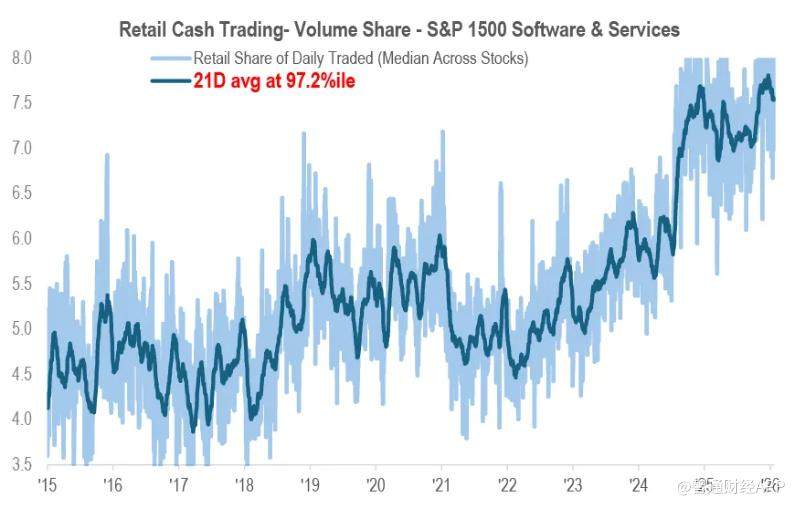
AI冲击吓退机构?“YOLO”散户高调进场 大举加仓软件股 最爱微软(MSFT.US)
智通财经网· 2026-02-26 22:24
Group 1 - Retail investors are increasing their positions in the software sector despite a nearly 20% decline in the S&P Composite 1500 Software and Services Index since the beginning of the year, indicating a surge in retail trading activity close to historical highs [1][3] - Microsoft (MSFT.US) has emerged as the most favored stock among retail investors, with ServiceNow (NOW.US) and AppLovin (APP.US) also attracting significant attention [3] - Concerns over AI potentially replacing traditional software services have led to heavy selling in the software sector, with warnings from analysts about possible economic disruptions and a wave of bankruptcies in the industry [3][4] Group 2 - Some analysts believe the recent sell-off in software stocks has been excessive, with current valuations becoming attractive for investors [3][4] - Retail investors are not deterred by AI concerns, as evidenced by a record high in buying activity during Nvidia's (NVDA.US) largest drop in three months, along with significant buying in Broadcom (AVGO.US) and various tech ETFs [3][4] - There is a sentiment among analysts that the indiscriminate nature of recent sell-offs may present opportunities for value investing, with potential for a technical rebound in the software sector [4]

英伟达(NVDA.US)重挫拖累大盘 纳指跌逾1% AI热潮下市场分化加剧
智通财经网· 2026-02-26 22:20
Group 1: Nvidia Performance and Market Impact - Nvidia experienced its worst single-day performance since last spring, dropping nearly 5.5%, which significantly impacted the overall U.S. stock market [1] - Despite Nvidia's quarterly earnings exceeding market expectations and strong profit growth, investor concerns are rising regarding the sustainability of its high growth due to potential cuts in high-end chip purchases by clients [2] - Nvidia's single-day decline contributed to over 80% of the drop in the S&P 500 index, highlighting its significant weight in the index [2] Group 2: Salesforce and Market Dynamics - Salesforce's stock rose over 4% after reporting quarterly profits that also exceeded analyst expectations, alongside a $50 billion stock buyback announcement and an increase in dividends [3] - Despite the short-term rebound, Salesforce's year-to-date decline remains close to 25%, driven by concerns over emerging AI competitors impacting its core customer management business [4] - The software sector has faced significant volatility, with a widely followed software ETF up 2.1% on the day but still down over 22% year-to-date [4] Group 3: Oil Market and Geopolitical Factors - The oil market experienced significant fluctuations due to indirect negotiations between the U.S. and Iran regarding nuclear plans, which could potentially ease war risks and stabilize global oil supply [5] - U.S. benchmark crude oil prices fluctuated, reaching a low of $63.60 before rebounding to close at $65.21, reflecting a 0.3% increase [5] - Brent crude oil settled at $70.75 per barrel, showing a slight decline of 0.1% [5] Group 4: Bond Market and Economic Indicators - The U.S. bond market showed stability with a slight decline in the 10-year Treasury yield from 4.05% to 4.01% [6] - Initial jobless claims in the U.S. rose slightly but remained in line with economist expectations and at historically low levels [6] - Global markets displayed mixed results, with European stocks generally rising and the Asian markets showing varied performance, indicating ongoing reassessment of high-valuation tech leaders amid the AI revolution [6]
欧洲股市持稳 英伟达下跌引发板块轮动
Xin Lang Cai Jing· 2026-02-26 18:16
Group 1 - European stock markets remained largely flat on Thursday, with the Stoxx Europe 600 index closing unchanged after reaching a record high on Wednesday [1] - ASML Holding was the biggest drag on the index, with its stock price falling by 4.3% following Nvidia's disappointing earnings report [1] - UBS's EU AI Risk Basket Index rose by 3.8%, indicating a recovery in software stocks like SAP AG, advertising companies like WPP Group, and professional publishers like Wiley [1] Group 2 - The London Stock Exchange announced a £3 billion ($4.1 billion) share buyback plan, leading to a 9.1% increase in its stock price [1] - Indra Sistemas saw its stock price soar by 21% after Morgan Stanley highlighted that the IT company's fourth-quarter performance "significantly exceeded expectations" [1] - European stock markets are poised for an eighth consecutive month of gains, driven by strong performance in traditional economic sectors, which have shielded them from the worst impacts of AI disruptions [1]
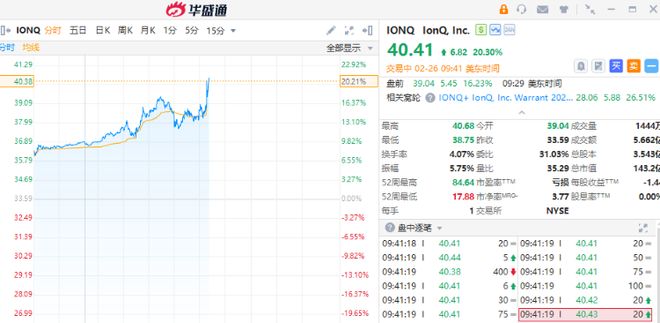
美股异动 | IonQ绩后暴涨20%带飞量子计算股!英伟达绩后跌超2%,博通跌超3%
Xin Lang Cai Jing· 2026-02-26 15:09
Market Overview - The U.S. stock market indices experienced a decline in early trading, with investors awaiting the resumption of the third round of negotiations regarding the U.S.-China trade talks, scheduled to resume later in the evening (Beijing time 23:30) [1] Company Performance - Nvidia's stock fell over 2% following its earnings report, contributing to a broader weakness in the semiconductor sector, with Broadcom down over 3%, AMD down over 2%, and both TSMC and ASML down over 1% [1] - IonQ's stock surged by 20% post-earnings, positively impacting quantum computing stocks, with RGTI and QUBT both rising over 4% [1] - Software stocks showed resilience, with Now Services up over 3%, and both ServiceTitan and CrowdStrike increasing by over 2% [1]