
国防军工

Search documents
10月28日上证央企(000042)指数跌0.18%,成份股中金黄金(600489)领跌
Sou Hu Cai Jing· 2025-10-28 10:01
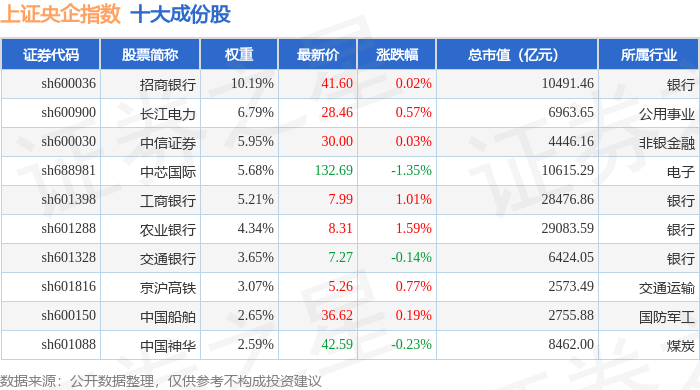
Market Overview - The Shanghai Central Enterprise Index (000042) closed at 1852.7 points, down 0.18%, with a trading volume of 79.123 billion yuan and a turnover rate of 0.33% [1] - Among the index constituents, 16 stocks rose while 33 fell, with AVIC Shenyang Aircraft (中航沈飞) leading the gainers at 1.92% and Zhongjin Gold (中金黄金) leading the decliners at 3.49% [1] Key Constituents - The top ten constituents of the Shanghai Central Enterprise Index are as follows: - China Merchants Bank (招商银行): 10.19% weight, latest price 41.60 yuan, market cap 1,049.146 billion yuan [1] - Yangtze Power (长江电力): 6.79% weight, latest price 28.46 yuan, market cap 696.365 billion yuan [1] - CITIC Securities (中信证券): 5.95% weight, latest price 30.00 yuan, market cap 444.616 billion yuan [1] - SMIC (中芯国际): 5.68% weight, latest price 132.69 yuan, market cap 1,061.529 billion yuan [1] - Industrial and Commercial Bank of China (工商银行): 5.21% weight, latest price 7.99 yuan, market cap 28,476.86 billion yuan [1] - Agricultural Bank of China (农业银行): 4.34% weight, latest price 8.31 yuan, market cap 29,083.59 billion yuan [1] - Bank of Communications (交通银行): 3.65% weight, latest price 7.27 yuan, market cap 6,424.05 billion yuan [1] - Beijing-Shanghai High-Speed Railway (京沪高铁): 3.07% weight, latest price 5.26 yuan, market cap 257.349 billion yuan [1] - China Shipbuilding Industry (中国船舶): 2.65% weight, latest price 36.62 yuan, market cap 275.588 billion yuan [1] - China Shenhua Energy (中国神华): 2.59% weight, latest price 42.59 yuan, market cap 846.200 billion yuan [1] Capital Flow - The net outflow of main funds from the index constituents totaled 3.92 billion yuan, while retail investors saw a net inflow of 2.021 billion yuan [1] - The detailed capital flow for key stocks includes: - AVIC Shenyang Aircraft: Main funds net inflow of 284 million yuan [2] - Yangtze Power: Main funds net inflow of 231 million yuan [2] - Agricultural Bank of China: Main funds net inflow of 127 million yuan [2] - Industrial and Commercial Bank of China: Main funds net inflow of 86 million yuan [2] - China Petroleum (中国石油): Main funds net inflow of 6.5195 million yuan [2] ETF Information - The Gold Stock ETF (product code: 159562) tracks the CSI Hong Kong-Shanghai Gold Industry Index, with a recent five-day change of -0.55% and a P/E ratio of 24.55 times [4] - The latest share count is 1.26 billion, a decrease of 32 million shares, with a net inflow of main funds amounting to 7.874 million yuan [4]






今日21.38亿元主力资金潜入国防军工业
Zheng Quan Shi Bao Wang· 2025-10-28 09:10
Core Insights - The defense and military industry saw the largest net inflow of capital today, amounting to 2.138 billion yuan, with a price change of 1.07% and a turnover rate of 3.47% [1] - The electronics industry experienced the largest net outflow of capital, totaling 12.127 billion yuan, with a price change of -0.37% and a turnover rate of 3.61% [2] Industry Summary - **Defense and Military**: - Trading volume: 3.070 billion shares - Change in trading volume: +26.98% - Turnover rate: 3.47% - Price change: +1.07% - Net capital inflow: 2.138 billion yuan [1] - **Electronics**: - Trading volume: 10.058 billion shares - Change in trading volume: -6.08% - Turnover rate: 3.61% - Price change: -0.37% - Net capital outflow: -12.127 billion yuan [2] - **Other Notable Industries**: - **Construction Materials**: - Net inflow: 0.286 billion yuan, price change: +0.01% [1] - **Banking**: - Net outflow: -1.074 billion yuan, price change: -0.17% [2] - **Healthcare**: - Net outflow: -1.898 billion yuan, price change: -0.72% [2] - **Utilities**: - Net outflow: -3.948 billion yuan, price change: -0.34% [2]
10月28日主力资金流向日报
Zheng Quan Shi Bao Wang· 2025-10-28 08:47
Market Overview - The Shanghai Composite Index fell by 0.22%, the Shenzhen Component Index decreased by 0.44%, the ChiNext Index dropped by 0.15%, and the CSI 300 Index declined by 0.51% [1] - Among the tradable A-shares, 2,362 stocks rose, accounting for 43.52%, while 2,908 stocks fell [1] Capital Flow - The main capital experienced a net outflow of 48.369 billion yuan throughout the day [1] - The ChiNext saw a net outflow of 8.319 billion yuan, while the STAR Market had a net outflow of 3.603 billion yuan [1] - The CSI 300 constituent stocks faced a net outflow of 20.911 billion yuan [1] Industry Performance - Out of the 28 first-level industries classified by Shenwan, 10 industries saw an increase, with the top gainers being the comprehensive sector and defense industry, rising by 2.06% and 1.07% respectively [1] - The industries with the largest declines were non-ferrous metals and beauty care, which fell by 2.72% and 1.51% respectively [1] Industry Capital Inflow and Outflow - The defense industry led in net capital inflow, with a total of 2.138 billion yuan, while it also increased by 1.07% [1] - The building materials sector had a slight increase of 0.01% with a net inflow of 0.286 billion yuan [1] - The electronics industry experienced the largest net outflow, totaling 12.127 billion yuan, with a decline of 0.37% [1] - Other significant outflows were seen in the non-ferrous metals sector, which fell by 2.72% with a net outflow of 10.828 billion yuan [1] Individual Stock Performance - A total of 1,809 stocks had a net inflow of funds, with 685 stocks seeing inflows exceeding 10 million yuan [3] - The stock with the highest net inflow was C He Yuan-U, with 1.776 billion yuan, followed by C Yi Cai-U and Sanhua Intelligent Control with net inflows of 1.295 billion yuan and 1.228 billion yuan respectively [3] - Conversely, 201 stocks experienced net outflows exceeding 100 million yuan, with Northern Rare Earth, ZTE Corporation, and Huayou Cobalt seeing the largest outflows of 2.242 billion yuan, 1.359 billion yuan, and 1.235 billion yuan respectively [3]




国防军工行业今日涨1.07%,主力资金净流入21.38亿元
Zheng Quan Shi Bao Wang· 2025-10-28 08:40
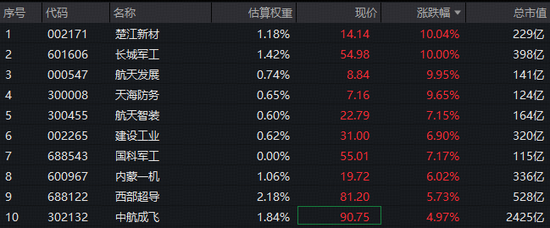
Core Viewpoint - The defense and military industry showed a positive performance on October 28, with a 1.07% increase, while the overall Shanghai Composite Index fell by 0.22% [1]. Industry Performance - Among the industries tracked, 10 sectors experienced gains, with the defense and military sector ranking second in terms of growth, following the comprehensive sector [1]. - The defense and military industry saw a net inflow of 2.138 billion yuan, with 100 out of 138 stocks in the sector rising, and 4 hitting the daily limit [1]. Fund Flow Analysis - The top three stocks with the highest net inflow in the defense and military sector were: - Changcheng Military Industry: 1.187 billion yuan [1] - Aerospace Development: 555 million yuan [1] - Jianglong Shipbuilding: 319 million yuan [1] - Conversely, the stocks with the highest net outflow included: - Western Superconducting: 326 million yuan [2] - Huafeng Technology: 258 million yuan [2] - Zhenhua Technology: 228 million yuan [2]. Stock Performance - Notable gainers in the defense and military sector included: - Changcheng Military Industry: +10.00% [1] - Aerospace Development: +9.95% [1] - Jianglong Shipbuilding: +19.98% [1] - Stocks with significant losses included: - Huafeng Technology: -9.17% [2] - Zhenhua Technology: -0.88% [2] - Gaode Infrared: -1.12% [2].





振华科技(000733):Q3单季度同比环比明显增长,前瞻指标持续向好
Orient Securities· 2025-10-28 07:10
Investment Rating - The report maintains a "Buy" rating for the company, with a target price of 67.55 CNY based on a 35x PE ratio for 2025 [3][5]. Core Insights - The company reported a revenue of 39.26 billion CNY for the first three quarters of 2025, reflecting a year-on-year increase of 4.98%, while the net profit attributable to the parent company was 6.23 billion CNY, down 3.31% [2]. - In Q3 alone, the company achieved a revenue of 15.16 billion CNY, marking a 15.78% increase, and a net profit of 3.11 billion CNY, which is up 38.68% compared to the previous quarter [2]. - The defense market has shown signs of recovery since Q1 2025, with a notable improvement in demand for military electronics, leading to a significant increase in new orders [10]. - The company's gross margin and net margin improved in Q3, reaching 47.26% and 20.52% respectively, indicating a recovery in profitability [10]. - The company's contract liabilities doubled compared to the beginning of the year, and inventory levels have been increasing, suggesting a positive outlook for future performance [10]. Financial Summary - The company’s projected earnings per share (EPS) for 2025, 2026, and 2027 are 1.93 CNY, 2.82 CNY, and 3.37 CNY respectively [3]. - The revenue forecast for 2025 is 66 billion CNY, with a projected growth rate of 26.5% [4]. - The company’s net profit is expected to reach 1.072 billion CNY in 2025, with a growth rate of 10.4% [4]. - The gross margin is projected to be 46.9% in 2025, with a gradual recovery expected in subsequent years [4].
收评:沪指4000点得而复失 军工、福建板块爆发
Xin Lang Cai Jing· 2025-10-28 07:08
Core Viewpoint - The stock market experienced fluctuations throughout the day, with all three major indices closing lower, and the Shanghai Composite Index losing the 4000-point mark again [1] Market Performance - The Shanghai Composite Index closed at 3988.22 points, down 0.22% - The Shenzhen Component Index closed at 13430.10 points, down 0.44% - The ChiNext Index closed at 3229.58 points, down 0.15% [1] Sector Performance - The Fujian sector showed strong performance, with stocks like Luqiao Information and Haixia Innovation hitting the daily limit up of 30% and 20% respectively - The military industry sector saw gains in the afternoon, with Jianglong Shipbuilding and Great Wall Military Industry both hitting the daily limit up of 20% - The battery sector was active, with Jinfeng Technology also reaching the daily limit up of 20% [1] Declining Sectors - The non-ferrous metals sector declined, with industrial metals leading the drop, notably Tongling Nonferrous Metals hitting the daily limit down - The wind power equipment sector weakened, with Dajin Heavy Industry experiencing significant losses - The rare earth permanent magnet sector adjusted, with Xiangming Intelligent showing notable declines [1] Overall Market Sentiment - Overall, there were more declining stocks than gaining ones, with over 2900 stocks falling [1]
【盘中播报】9只A股跌停 有色金属行业跌幅最大
Zheng Quan Shi Bao Wang· 2025-10-28 06:39
Market Overview - The Shanghai Composite Index decreased by 0.19% as of 13:58, with a trading volume of 1,035.35 million shares and a transaction amount of 1,791.19 billion yuan, representing a 7.10% decrease compared to the previous trading day [1]. Industry Performance - The top-performing sectors included: - Comprehensive sector increased by 2.03% with a transaction amount of 56.26 billion yuan, led by Nanjing Public Utilities which rose by 10.06% [1]. - Defense and military industry rose by 1.34%, with a transaction amount of 715.45 billion yuan, led by Jianglong Shipbuilding which surged by 19.98% [1]. - Banking sector saw a modest increase of 0.47%, with a transaction amount of 275.92 billion yuan, led by Xiamen Bank which increased by 5.31% [1]. - The sectors with the largest declines included: - Non-ferrous metals sector fell by 2.47%, with a transaction amount of 1,179.53 billion yuan, led by Tongling Nonferrous Metals which dropped by 9.56% [2]. - Steel sector decreased by 1.64%, with a transaction amount of 119.04 billion yuan, led by Wujin Stainless Steel which fell by 5.21% [2]. - Beauty and personal care sector declined by 1.44%, with a transaction amount of 50.31 billion yuan, led by Zhongshun Jierou which decreased by 9.65% [2]. Summary of Key Stocks - Leading stocks in the comprehensive sector included Nanjing Public Utilities with a significant rise of 10.06% [1]. - Jianglong Shipbuilding in the defense sector showed a remarkable increase of 19.98% [1]. - Xiamen Bank in the banking sector increased by 5.31% [1]. - Conversely, notable declines were seen in: - Tongling Nonferrous Metals with a drop of 9.56% [2]. - Wujin Stainless Steel which fell by 5.21% [2]. - Zhongshun Jierou with a decrease of 9.65% [2].
80亿主力资金猛攻,多股涨停!国防军工ETF(512810)溢价上探1.85%冲击三连阳!
Xin Lang Ji Jin· 2025-10-28 05:47
Group 1 - The defense and military industry sector continues to rise, with stocks like Chuanjiang New Materials and Great Wall Military Technology hitting the daily limit [1] - The defense military sector (Shenwan) saw a net inflow of over 8.185 billion yuan, leading among 31 Shenwan primary industries [5] - The "14th Five-Year Plan" suggests enhancing national security and emphasizes the development of emerging industries, including low-altitude economy, commercial aerospace, and deep-sea technology [2][6] Group 2 - As of now, 27 out of 32 disclosed stocks in the defense military ETF (512810) reported profits, with several companies showing significant year-on-year growth, such as Chuanjiang New Materials and Gaode Infrared [3][6] - The defense military ETF (512810) experienced a peak increase of 1.85% in the afternoon session, indicating strong bullish sentiment [4] - Analysts from Dongfang Securities and Huafu Securities highlight the strong demand recovery expected in the defense military sector for 2025-2026, suggesting high allocation significance at this time [6]
国防ETF(512670)涨超2%位列ETF榜第一,已连续4日获资金净申购
Xin Lang Cai Jing· 2025-10-28 05:42
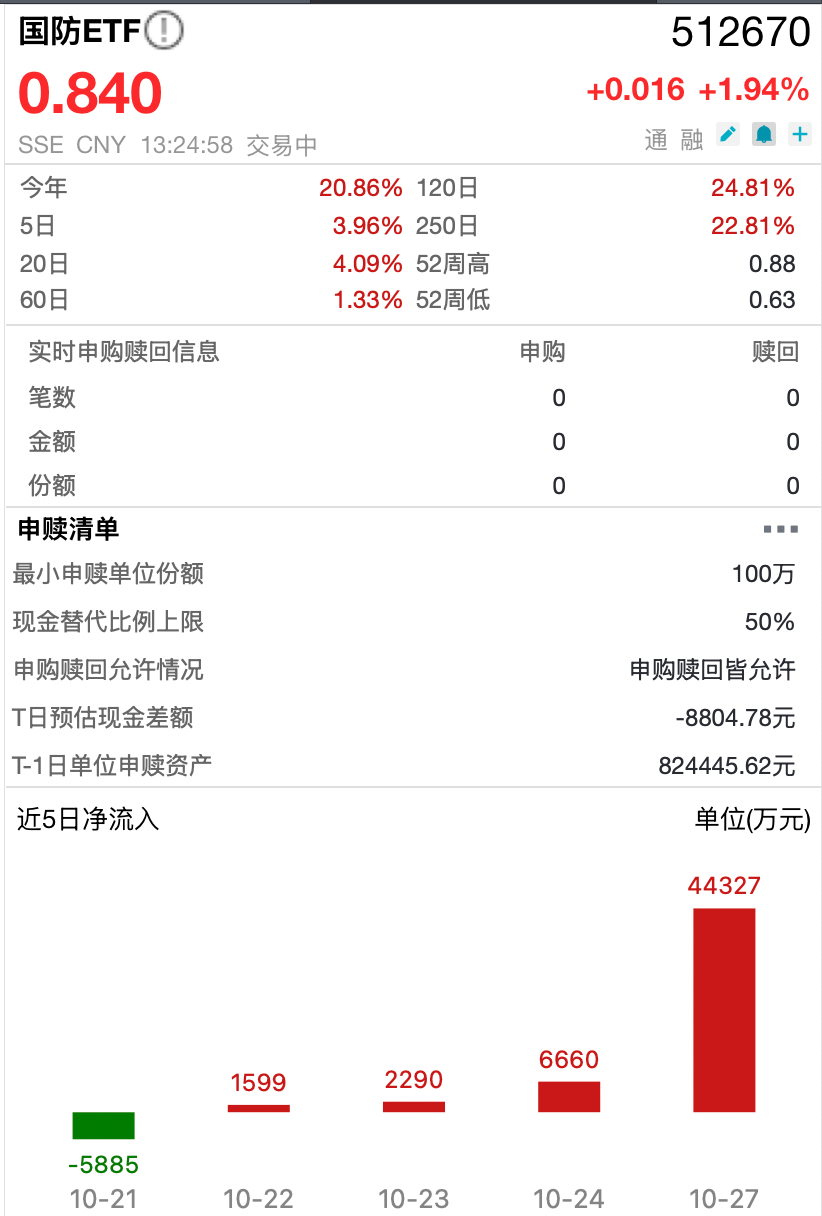
Group 1 - The core viewpoint of the news highlights the increasing importance of commercial aerospace in China's strategic development, with a focus on technological breakthroughs and capital acceleration in the industry [1][2]. - The Fourth Plenary Session of the Central Committee added the term "aerospace power," indicating a renewed emphasis on commercial aerospace following the mention of "new growth engines" [1]. - The 14th Five-Year Plan suggests accelerating the development of strategic emerging industries, including new energy, new materials, aerospace, and low-altitude economy, which is expected to create several trillion-yuan markets [1]. Group 2 - The commercial aerospace sector is entering a high-density launch period, with significant advancements in satellite deployment and launch frequency, closely approaching the launch density of SpaceX's Starlink system [2]. - The recent successful launch of the Tianlong-3 large liquid carrier rocket, achieving the simultaneous separation of 36 satellites, marks a significant milestone in China's commercial aerospace capabilities [2]. - The procurement announcement from Yuanxin in July indicates plans for multiple rocket launches, with a total of 94 satellites to be deployed by 2026, further accelerating the launch schedule [2]. Group 3 - According to Xinda Securities, the military industry sector is becoming more attractive in terms of valuation, with recommendations to overweight the military industry, focusing on new combat systems, unmanned equipment, satellite internet, and commercial aerospace [3]. - The National Defense ETF closely tracks the CSI National Defense Index, which includes listed companies under major military groups and those providing equipment to the armed forces, reflecting the overall performance of the defense industry [3]. - The management and custody fees for the National Defense ETF are the lowest among similar ETFs, at only 0.40% [3]. Group 4 - As of September 30, 2025, the top ten weighted stocks in the CSI National Defense Index include companies like AVIC Shenyang Aircraft (600760) and Aero Engine Corporation of China (600893), collectively accounting for 45.45% of the index [6].
【盘中播报】6只A股跌停 建筑装饰行业跌幅最大
Zheng Quan Shi Bao Wang· 2025-10-28 04:40
Market Overview - The Shanghai Composite Index decreased by 0.01% as of 10:29 AM, with a trading volume of 573.04 million shares and a turnover of 98.09 billion yuan, representing a 22.22% decrease compared to the previous trading day [1] Industry Performance - The top-performing sectors included: - Comprehensive: +1.18% with a turnover of 32.57 billion yuan, led by Nanjing Public Utilities (+10.06%) [1] - National Defense and Military Industry: +0.94% with a turnover of 345.74 billion yuan, led by Aerospace Development (+9.95%) [1] - Computer: +0.83% with a turnover of 751.00 billion yuan, led by Haixia Innovation (+19.97%) [1] - The sectors with the largest declines included: - Building Decoration: -0.78% with a turnover of 178.24 billion yuan, led by Huajian Group (-7.74%) [2] - Non-ferrous Metals: -0.77% with a turnover of 646.48 billion yuan, led by Tongling Nonferrous Metals (-7.68%) [2] - Steel: -0.72% with a turnover of 68.55 billion yuan, led by Wujin Stainless Steel (-2.69%) [2] Summary of Trading Data - A total of 2,520 stocks rose, with 49 hitting the daily limit, while 2,689 stocks fell, including 6 hitting the lower limit [1] - The sectors with the highest trading volumes included: - Electronics: 2,084.44 billion yuan, down 0.02% [1] - Power Equipment: 962.16 billion yuan, down 0.06% [1] - Banking: 160.14 billion yuan, down 0.06% [1]