Funds

Search documents
首批10只科创债ETF获批 债市指数化投资加速
Guang Zhou Ri Bao· 2025-07-02 16:39
Group 1 - The first batch of 10 Science and Technology Innovation Bond ETFs has been approved, injecting new vitality into the bond ETF market and enriching investor choices [1][2] - The issuance of science and technology innovation bonds has accelerated since the pilot program began in 2021, with funds primarily directed towards cutting-edge fields such as semiconductors, artificial intelligence, new energy, and high-end manufacturing [1] - As of mid-June, there are 1,273 science and technology innovation bonds in the exchange market, with a total balance exceeding 1.3 trillion yuan [1] Group 2 - Ten fund companies have submitted products tracking three categories of science and technology innovation bond indices, including the China Securities AAA Technology Innovation Company Bond Index and the Shanghai Stock Exchange AAA Technology Innovation Company Bond Index [2] - The launch of these ETFs is seen as a significant tool for capital markets to support financing for technology innovation enterprises, providing stable investment options for investors [2] - The introduction of these ETFs is expected to attract social capital efficiently into key areas of technology innovation, supporting the high-quality development of technology innovation enterprises [2]
ETF市场快速扩容下如何防内卷,陆家嘴金融沙龙热议破局之道
Di Yi Cai Jing· 2025-07-02 12:42
中国ETF渗透率(ETF规模/上市公司总市值)较成熟市场仍有1~2倍提升空间,未来增长潜力显著。 近年来,我国ETF市场乘着政策支持的东风,伴着中长期资金的持续流入,随着产品种类的不断创新, 呈现出加速增长的态势。 ETF作为可交易的指数基金,规模在一年内接连突破2万亿元、3万亿元大关,目前已迈上4万亿元新台 阶。在业内看来,这不仅是资本市场的一个新的里程碑,也彰显了ETF正日益受到机构和个人投资者的 青睐。 "陆家嘴金融沙龙"在上海浦东举办,会聚了来自证券、基金、指数编制、保险资管以及金融信息服务等 相关领域的资深专家,围绕ETF的发展现状、产品创新、指数编制优化、中长期资金布局等维度展开了 深入而全面的探讨,为ETF市场从"规模增长"向"质量跃升"的转型发展提供了全新的思路与方向。 华泰柏瑞基金副总经理、指数投资部总监柳军认为,未来中国ETF市场需在产品创新、投资者教育、风 险管控等方面持续发力,真正实现"让ETF走进更多投资者视野,在资产配置中少走弯路"的目标。随着 市场有效性提升与投资者认知深化,ETF有望在普惠金融领域开辟新蓝海,成为居民财富保值增值 的"国民级"投资工具。 ETF市场快速扩张,指数 ...

首批十只科创债ETF获批!债券ETF半年净流入1720亿
Sou Hu Cai Jing· 2025-07-02 11:50
Group 1 - The first batch of 10 Science and Technology Innovation Bond ETFs (科创债ETF) has been approved after being submitted for approval on June 18, 2025, during the Lujiazui Forum [2][4] - The approval was announced by the Chairman of the China Securities Regulatory Commission (CSRC), indicating a strong push for the development of Science and Technology Innovation Bonds [2][4] - The ETFs are designed to meet the growing demand for stable investment products, with bond ETFs seeing significant inflows, totaling 1.72 trillion yuan in the first half of 2025 [4] Group 2 - Science and Technology Innovation Bonds are issued by financial institutions, technology companies, and equity investment institutions, with funds raised directed towards supporting technological innovation [5] - As of mid-June 2025, there are 1,273 Science and Technology Innovation Bonds in the market, with a total balance exceeding 1.3 trillion yuan [5] - The introduction of Science and Technology Innovation Bond ETFs is expected to provide investors with stable investment tools and attract social capital into key technological innovation sectors [6] Group 3 - The ETFs will track various indices, including the China Securities AAA Science and Technology Innovation Bond Index and the Shanghai Securities AAA Science and Technology Innovation Bond Index, among others [4] - The China Securities AAA Science and Technology Innovation Bond Index has 810 sample bonds, with an average credit rating of AAA for about 70% of the bonds [6] - The performance of the three indices over the past year shows a return of approximately 3.85% to 4.52%, with low annual volatility rates [6]

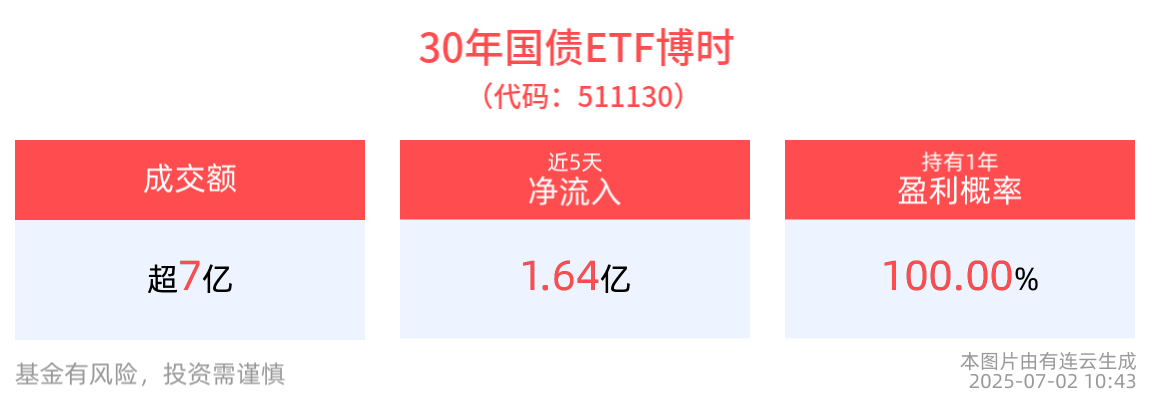
30年国债ETF博时(511130)盘中涨幅不断扩大,最新单日“吸金”2.47亿元,机构:下半年债券市场或将延续宽幅震荡走势
Sou Hu Cai Jing· 2025-07-02 03:15
流动性方面,30年国债ETF博时盘中换手9.88%,成交7.47亿元。拉长时间看,截至7月1日,30年国债ETF博时近1周日均成交25.15亿元。 中信建投固收分析师认为,下半年债券市场或将延续宽幅震荡走势。预计下半年利率债供给强度居中,估算下半年利率债净融资规模为6.88万亿元,月均净 融资1.15万亿元,与2023年水平接近。"不过,下半年或有新型政策性金融工具落地,或将带来政策性金融债的增量供应。" 规模方面,30年国债ETF博时最新规模达75.41亿元。 截至2025年7月2日 10:43,30年国债ETF博时(511130)上涨0.33%,最新价报112.82元。拉长时间看,截至2025年7月1日,30年国债ETF博时近1月累计上涨 1.38%。 回撤方面,截至2025年7月1日,30年国债ETF博时成立以来最大回撤6.89%,相对基准回撤1.28%。 费率方面,30年国债ETF博时管理费率为0.15%,托管费率为0.05%。 跟踪精度方面,截至2025年7月1日,30年国债ETF博时近1月跟踪误差为0.047%。 30年国债ETF博时紧密跟踪上证30年期国债指数,上证30年期国债指数从上海证券交易 ...
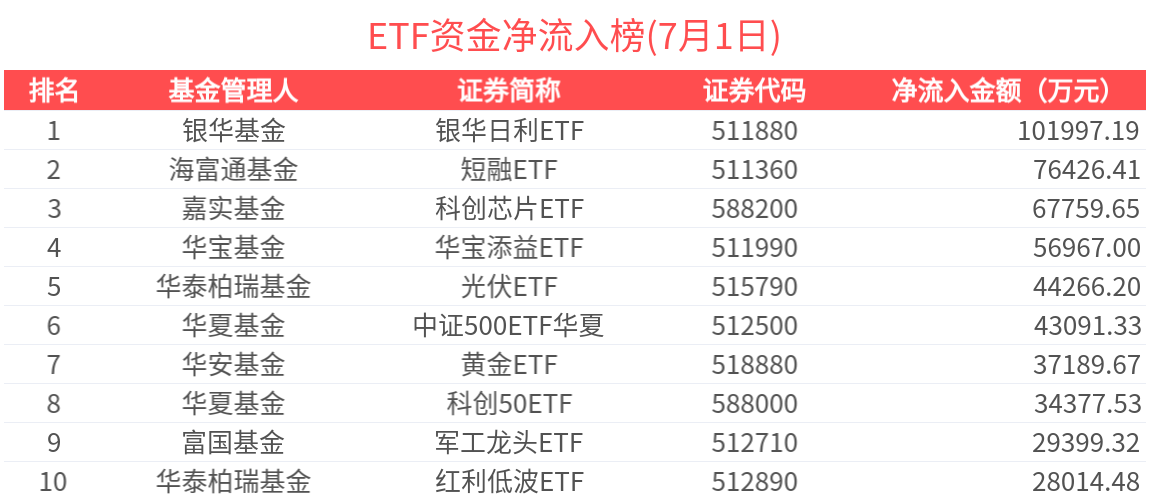
ETF资金榜 | 十年国债ETF(511260)近20天连续净流入,货基吸金能力强-20250701
Sou Hu Cai Jing· 2025-07-02 02:40
Core Insights - On July 1, 2025, a total of 167 ETFs experienced net inflows, while 461 ETFs saw net outflows, indicating a significant disparity in investor sentiment towards different funds [1] - The top five ETFs with substantial net inflows included Yin Hua Ri Li ETF, Short-term Bond ETF, Sci-Tech Chip ETF, Hua Bao Tian Yi ETF, and Photovoltaic ETF, with net inflows of 1.02 billion, 764 million, 678 million, 570 million, and 443 million respectively [1][3] - Conversely, 32 ETFs had net outflows exceeding 1 billion, with the China A500 ETF, CSI 300 ETF, and others leading the outflows, totaling 2.282 billion, 1.465 billion, and 990 million respectively [1][5] Inflow and Outflow Analysis - The ETFs with the highest net inflows were led by Yin Hua Ri Li ETF and Short-term Bond ETF, which attracted significant capital, reflecting investor confidence in these funds [1][3] - A total of 86 ETFs have seen consecutive net inflows, with the Ten-Year Treasury ETF and Corporate Bond ETF leading the pack, accumulating inflows of 10.134 billion and 9.405 billion respectively [5] - In contrast, 290 ETFs have experienced consecutive net outflows, with the Xin Chuang ETF and CSI 300 Enhanced ETF being the most affected, with outflows of 411 million and 301 million respectively [6][8] Recent Trends - Over the past five days, 89 ETFs recorded net inflows exceeding 1 billion, with the China A500 ETF leading with an inflow of 8.278 billion, indicating a strong recovery in investor interest [6][9] - On the other hand, 115 ETFs saw net outflows surpassing 1 billion in the same period, with Yin Hua Ri Li ETF experiencing the largest outflow of 10.055 billion, suggesting a shift in investor preference [9]
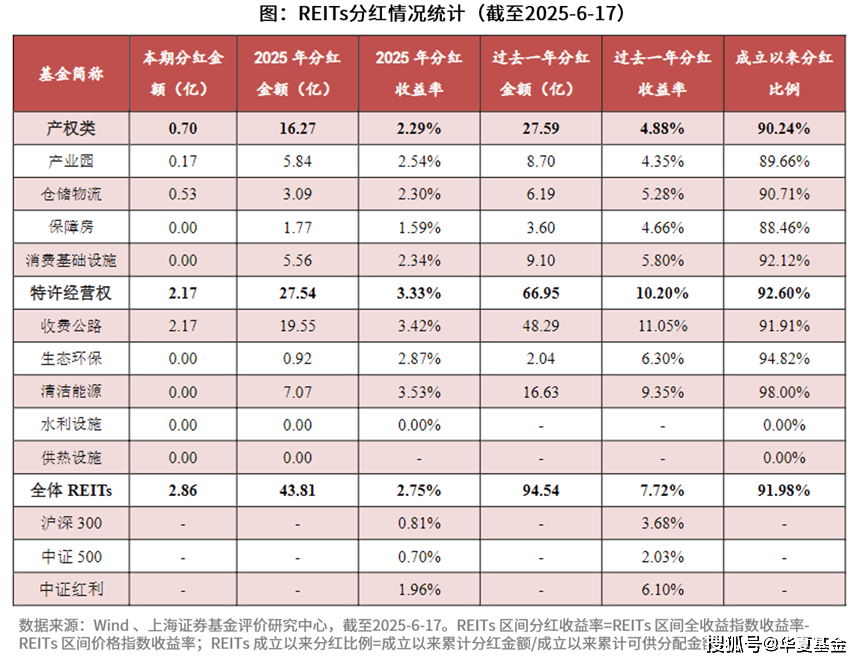
创新、温度与获得感|公募基金上半年现象级产品盘点
Sou Hu Cai Jing· 2025-07-02 02:12
Group 1: Public Fund Market Overview - The public fund market has experienced significant changes in the first half of 2025, focusing on enhancing investor satisfaction and addressing real concerns [1] - Innovative public fund products that genuinely respond to investor needs are emerging, characterized by sincerity and warmth rather than flashy marketing [1] Group 2: Public REITs Development - Public REITs have become deeply integrated into China's capital market, with the Wind REITs Index reaching a historical high, up 22.7% in the first half of 2025, and a total market value exceeding 200 billion yuan [3] - The overall dividend yield for REITs has surpassed 7%, providing investors with a new income-generating option that is less correlated with traditional stocks and bonds [3] Group 3: New Floating Rate Funds - The introduction of the first batch of new floating rate funds in May 2025 marks a significant shift in aligning the interests of fund managers and investors, moving away from fixed management fees [9] - This innovation represents a return to the essence of fiduciary responsibility, allowing investors to directly influence management fees based on performance [9] Group 4: ETF Market Growth - The total scale of ETFs in the market has surpassed 4 trillion yuan, indicating a strong consensus on the growing importance of index funds [10] - The launch of the Sci-Tech Innovation Index ETF has attracted over 30 public fund managers, reflecting a collective trust in China's technological advancements [10] Group 5: Free Cash Flow ETFs - The issuance of the first free cash flow ETFs in February 2025 introduces a new perspective focused on companies' ability to generate real cash after necessary expenditures [12] - This strategy aims to identify companies that can generate, save, and distribute cash effectively, enhancing investor confidence in returns [12] Group 6: Credit Bond ETFs - The credit bond ETF market has rapidly grown, with total assets exceeding 210 billion yuan, reflecting a strong demand for stable and low-risk investment options [19] - These ETFs simplify the investment process in credit bonds, allowing for efficient trading and better liquidity compared to traditional methods [21]
港股、医药“霸屏”收益榜,上半年最赚钱基金榜单出炉
Hua Xia Shi Bao· 2025-07-02 01:45
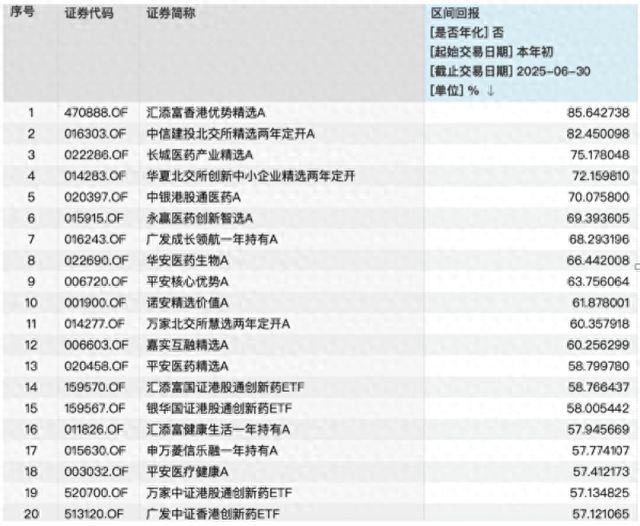
Core Insights - The core investment theme for the first half of 2025 revolves around opportunities in the Hong Kong stock market and the recovery of the pharmaceutical sector [1][2][3] Fund Performance - The top-performing fund for the first half of 2025 is the Huatai-PineBridge Hong Kong Advantage Select A, achieving a return of 85.64% [2][3] - Other notable funds include CITIC Construction Investment North Exchange Select Two-Year Open A with a return of 82.45% and Great Wall Pharmaceutical Industry Select A with a return of 75.18% [2][3] - Among the top ten funds, six are from CITIC Construction Investment, Huaxia, and Great Wall, focusing on the North Exchange or pharmaceutical sectors, all exceeding a 66% return [3] Pharmaceutical Sector Highlights - The pharmaceutical and biotechnology sectors have shown strong performance, with various funds achieving significant returns, such as the Bank of China Hong Kong Stock Connect Pharmaceutical A at 70.08% and Ping An Pharmaceutical Select A at 58.80% [4][5] - The overall pharmaceutical index has risen by 26.74% year-to-date, with the innovative drug sector outperforming, showing a year-to-date increase of 24.83% [5][6] Market Dynamics - The Hong Kong stock market, particularly in the innovative drug sector, has become a focal point for investors, with the Hong Kong Stock Connect Innovative Drug Index showing a year-to-date increase of over 60% [7][9] - The innovative drug sector is expected to continue attracting investment due to favorable policies and commercial acceleration, with significant transactions in the sector reaching $45.5 billion in the first five months of the year [6][9] Future Outlook - The investment strategy for the second half of 2025 is anticipated to focus on growth sectors, particularly innovative drugs, with three main investment themes identified: commercialization in the domestic medical insurance market, international licensing of domestic innovative drugs, and capitalizing on industry cycles and valuation opportunities [4][5] - The overall valuation of the innovative drug sector remains reasonable, providing potential opportunities for investment despite previous market corrections [5][9]

增超183%
Zhong Guo Ji Jin Bao· 2025-07-01 13:11
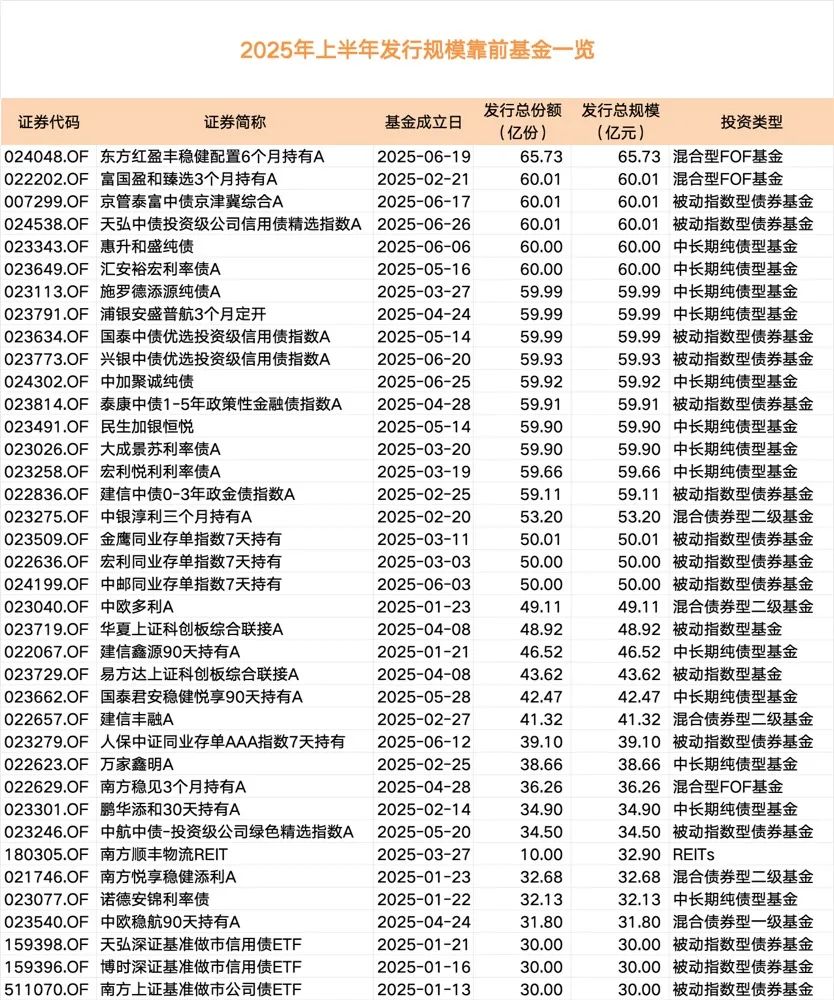
Core Insights - The total issuance scale of new funds in the first half of 2025 reached 540.85 billion yuan, a nearly 20% decline compared to the same period last year, despite an increase in the number of new funds established [2][3] - Stock funds saw a significant increase, with issuance reaching 188.06 billion yuan, representing a growth of over 183% year-on-year, marking a historical high in both issuance quantity and share [3][4] - Bond funds remained the mainstay of new fund issuance but experienced a substantial decline, with 126 new bond funds established, raising 247.85 billion yuan, a decrease of nearly 54% compared to last year [2][4] Fund Issuance Overview - A total of 672 new funds were established by the end of June, with a combined issuance of 5,303.47 million units, raising a total of 540.85 billion yuan [2] - The share of bond funds in the total issuance fell below 50% for the first time since 2022, accounting for 46.73% of the total new fund issuance [2][3] - Mixed funds also saw growth, with 111 new mixed funds established, raising 52.35 billion yuan, achieving a share of 9.87% [3] Market Highlights - The first half of 2025 saw a notable performance in the FOF (Fund of Funds) category, with 30 new FOF funds established, raising 32.75 billion yuan, marking a significant recovery in this segment [4] - Bond index funds emerged as a highlight, with 27 new bond index funds established, accounting for over 20% of the total new bond funds [4] - The REITs market also showed strong performance, with 10 new public REITs issued, raising a total of 15.3 billion yuan, all of which were sold out on the first day [5]
兴证全球基金完成工商变更,庄园芳正式接任董事长
Sou Hu Cai Jing· 2025-07-01 11:21
根据国家企业信用信息公示系统记录,此次工商变更登记于7月1日正式生效。变更后,庄园芳成为公司法定代表人与董事长,同时公司主要人员备案信息也 相应更新。 7月1日,天眼查App最新信息显示,兴证全球基金管理有限公司(以下简称"兴证全球基金")完成工商变更登记,庄园芳正式接任公司法定代表人、董事长 职务,此前担任该职的杨华辉已卸任相关职位。 南都·湾财社记者注意到,在6月22日原董事长杨华辉因年龄离任后,由总经理庄园芳代行职责仅过去数日,该公司迅速完成了法定交接程序。 工商变更落地,兴证全球基金完成权力交接 据悉,此次人事调整已在公司第七届董事会第十次会议上审议通过,并依法履行了备案程序。 杨华辉因年龄卸任,任职期间规模倍增 | 风险等级 | 动态类型 | 动态内容 | | --- | --- | --- | | | 主要人员变更 | 任职企业:兴证全球基金管理有限公司 | | 提示 | | 变更前职务:董事兼总经理 | | | | 变更后职务:董事长,总经理 | | 提示 | 法定代表人变更 | 担任兴证全球基金管理有限公司的法定代表人 | 来源:天眼查 兴证全球基金成立于2003年9月,注册资本1.5亿元人民 ...

基金半年考放榜:医药、北交所主题基金“霸榜”,前海开源人工智能半年亏20%垫底
Sou Hu Cai Jing· 2025-07-01 10:03
Core Viewpoint - The performance of the fund industry in the first half of 2025 has been strong, with significant returns driven by sectors such as pharmaceuticals and the North Exchange, despite challenges from tariff policies [2][4][7]. Fund Performance - The average return of all market fund products was 4.28%, with the best-performing fund achieving over 85% return and the worst losing more than 20%, resulting in a performance spread of over 106% [2]. - Notable funds include: - Huatai-PineBridge Hong Kong Advantage Selection A: 85.64% - CITIC Construction North Exchange Selection Two-Year Open A: 82.45% - Great Wall Pharmaceutical Industry Selection A: 75.18% - Huaxia North Exchange Innovative SMEs Selection Two-Year Open: 72.16% - Bank of China Hong Kong Stock Connect Pharmaceutical A: 70.08% [6][16]. Sector Highlights - The pharmaceutical sector has shown remarkable performance, with the core driver being the explosive growth of the Hong Kong innovative pharmaceutical sector [4][7]. - The North Exchange theme funds have also performed well, benefiting from ongoing reforms and the growth of specialized and innovative enterprises [7][19]. Fund Manager Insights - Fund managers have noted that the pharmaceutical industry is expected to continue demonstrating resilience and technological attributes over the next 2-3 years, with supportive policies for innovative drugs likely to improve conditions across various sectors [7][14]. - The performance of passive funds is increasingly challenging that of actively managed funds, with notable examples being: - Huaan Pharmaceutical Biotechnology A: 66.44% - Huatai-PineBridge National Index Hong Kong Stock Connect Innovative Drug ETF: 58.77% [3][11]. Market Outlook - The market is expected to shift from a risk-averse mindset to one focused on opportunities, with a broader range of sectors showing potential for growth, including technology and cyclical industries [18][19]. - Analysts predict a "dumbbell" structure for market opportunities in the second half of the year, highlighting both high-growth technology stocks and stable dividend-paying blue-chip stocks [19].