
造纸

Search documents
博汇纸业2025年中报简析:增收不增利,应收账款上升
Zheng Quan Zhi Xing· 2025-08-30 23:27
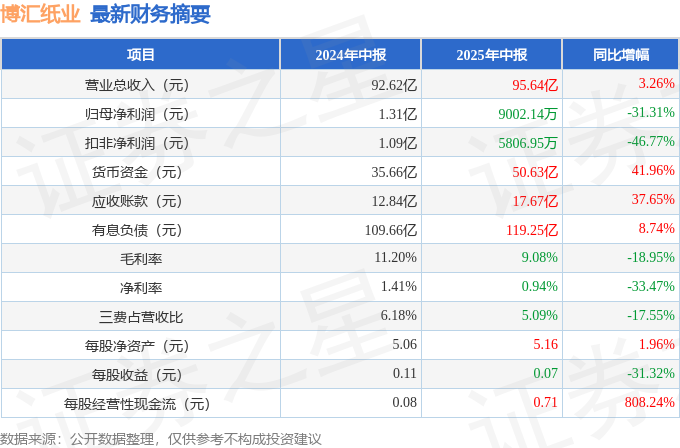
Core Viewpoint - 博汇纸业's 2025 mid-year report shows mixed financial performance, with revenue growth but a significant decline in net profit, indicating potential challenges in profitability and operational efficiency [1] Financial Performance - The total revenue for the first half of 2025 reached 9.564 billion yuan, a year-on-year increase of 3.26% compared to 9.262 billion yuan in 2024 [1] - The net profit attributable to shareholders was 90.0214 million yuan, down 31.31% from 131 million yuan in the previous year [1] - The gross margin decreased to 9.08%, a decline of 18.95% year-on-year, while the net margin fell to 0.94%, down 33.47% [1] - The company reported an increase in accounts receivable, which rose by 37.65% year-on-year, reaching 1.767 billion yuan [1] Cash Flow and Debt Analysis - The company has a healthy cash position, with cash assets amounting to 5.063 billion yuan, a 41.96% increase from the previous year [2][3] - The debt situation shows an interest-bearing debt ratio of 43.87%, indicating a significant level of leverage [3] - The liquidity ratio is low at 0.68, suggesting potential challenges in meeting short-term obligations [3] Market Expectations - Analysts project the company's performance for 2025 to reach a net profit of 229 million yuan, with an average earnings per share of 0.17 yuan [4] Shareholder Information - The largest fund holding in 博汇纸业 is 大成丰享回报混合A, which holds 164,000 shares, with a current scale of 0.26 billion yuan [5]


华泰股份2025年中报简析:净利润同比下降63.13%,公司应收账款体量较大
Zheng Quan Zhi Xing· 2025-08-30 23:27
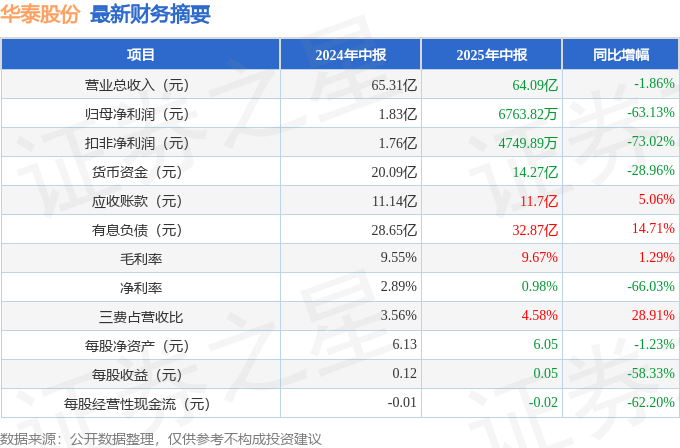
Financial Performance - The company's total revenue for the first half of 2025 was 6.409 billion yuan, a decrease of 1.86% year-on-year [1] - The net profit attributable to shareholders was 67.6382 million yuan, down 63.13% year-on-year [1] - In Q2 2025, total revenue was 3.323 billion yuan, an increase of 7.32% year-on-year, while net profit attributable to shareholders was 7.8087 million yuan, a decline of 88.92% year-on-year [1] - The gross margin was 9.67%, an increase of 1.29% year-on-year, while the net margin was 0.98%, a decrease of 66.03% year-on-year [1] Financial Ratios and Metrics - The company's return on invested capital (ROIC) for the previous year was 0.79%, indicating weak capital returns [3] - The net profit margin for the previous year was 0.14%, suggesting low added value for products or services [3] - The ratio of selling, administrative, and financial expenses to revenue was 4.58%, an increase of 28.91% year-on-year [1] Cash Flow and Debt Situation - The company's cash flow situation is concerning, with cash and cash equivalents amounting to 1.427 billion yuan, a decrease of 28.96% year-on-year [1] - The ratio of cash and cash equivalents to current liabilities was only 44.85%, indicating potential liquidity issues [3] - The company’s interest-bearing debt increased by 14.71% year-on-year to 3.287 billion yuan [1] Accounts Receivable - The accounts receivable stood at 1.17 billion yuan, a 5.06% increase year-on-year, with accounts receivable to profit ratio reaching 3235.46% [1][3] - The company needs to closely monitor its accounts receivable situation due to the high ratio compared to net profit [3]

荣晟环保2025年中报简析:净利润同比下降34.57%,公司应收账款体量较大
Zheng Quan Zhi Xing· 2025-08-30 23:26
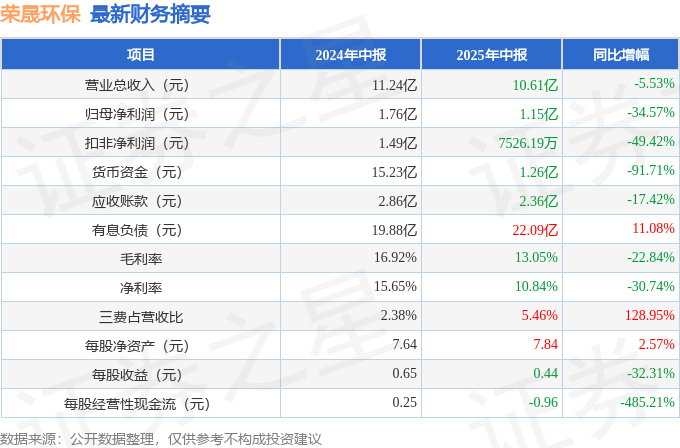
Financial Performance - The company reported total revenue of 1.061 billion yuan for the first half of 2025, a decrease of 5.53% year-on-year [1] - The net profit attributable to shareholders was 115 million yuan, down 34.57% compared to the previous year [1] - In Q2 2025, total revenue was 528 million yuan, reflecting an 8.39% decline year-on-year, while net profit for the quarter was 44.43 million yuan, a decrease of 47.47% [1] - The gross margin was 13.05%, down 22.84% year-on-year, and the net margin was 10.84%, a decline of 30.74% [1] - Total operating expenses (selling, administrative, and financial) amounted to 57.91 million yuan, representing 5.46% of revenue, an increase of 128.95% year-on-year [1] Cash Flow and Debt - The company reported a significant decrease in cash and cash equivalents, with 126 million yuan, down 91.71% year-on-year [1] - The company's interest-bearing debt increased to 2.209 billion yuan, up 11.08% from the previous year [1] - The operating cash flow per share was -0.96 yuan, a decline of 485.21% year-on-year [1] Shareholder Returns - The company has consistently implemented cash dividends since its listing, distributing 5.00 yuan per 10 shares in May 2025, totaling approximately 131 million yuan [4] - The company emphasizes a long-term, stable, and sustainable profit distribution policy, with undistributed profits amounting to 1.478 billion yuan as of Q1 2025 [4] Operational Metrics - The company's return on invested capital (ROIC) was 8.09% last year, indicating average capital returns [3] - The average cash flow from operations over the past three years is only 11.13% of current liabilities, suggesting potential liquidity concerns [3] - The ratio of accounts receivable to profit reached 82.49%, indicating a high level of receivables relative to net profit [3]

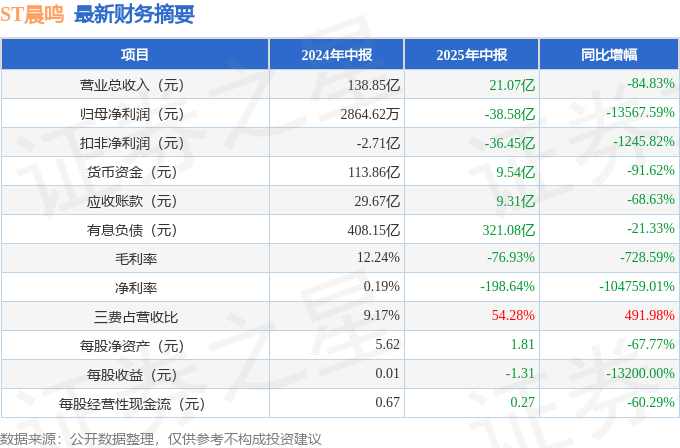
ST晨鸣2025年中报简析:净利润同比下降13567.6%,三费占比上升明显
Zheng Quan Zhi Xing· 2025-08-30 23:24
Core Viewpoint - ST晨鸣 reported significant declines in revenue and net profit for the first half of 2025, indicating severe operational challenges and financial distress [1] Financial Performance - Total revenue for the first half of 2025 was 2.107 billion yuan, a decrease of 84.83% year-on-year [1] - Net profit attributable to shareholders was -3.858 billion yuan, a decline of 13,567.59% year-on-year [1] - Gross margin was -76.93%, down 728.59% year-on-year, while net margin was -198.64%, a drop of 104,759.01% year-on-year [1] - Total expenses (selling, administrative, and financial) accounted for 54.28% of revenue, an increase of 491.98% year-on-year [1] Cash Flow and Assets - Cash and cash equivalents decreased by 91.62% to 0.954 billion yuan, attributed to reduced guarantees [3] - Accounts receivable fell by 68.63% to 0.931 billion yuan due to decreased customer payments [3] - Operating cash flow decreased by 60.59%, primarily due to reduced sales volume and revenue [9] Liabilities and Debt - Interest-bearing liabilities decreased by 21.33% to 32.108 billion yuan [1] - Long-term payables increased by 228.40%, reflecting reclassification of certain liabilities [4] Operational Challenges - Revenue decline was attributed to production halts and reduced sales of paper products [4] - Research and development expenses dropped by 94.02%, indicating a significant cutback in investment [4] - The company faced increased litigation expenses and asset write-offs, contributing to a 2,484.82% rise in non-operating expenses [8] Business Model and Historical Performance - The company's historical return on invested capital (ROIC) has been weak, with a median of 4.12% over the past decade [11] - The business model relies heavily on research and marketing, necessitating a thorough examination of underlying drivers [12]
每周股票复盘:山鹰国际(600567)Q2扣非净利同比增76.85%
Sou Hu Cai Jing· 2025-08-30 23:21
Core Points - The stock price of Shanying International (600567) closed at 1.87 yuan as of August 29, 2025, down 2.09% from the previous week [1] - The company has a total market capitalization of 10.231 billion yuan, ranking 3rd in the paper industry and 1834th among A-shares [1] Trading Information - On August 26, 2025, Shanying International recorded a block trade with a transaction amount of 1.225 million yuan [2] Shareholder Changes - As of June 30, 2025, the number of shareholders was 189,100, a decrease of 11,700 (5.84%) from March 31, 2025 [3] - The average number of shares held per shareholder increased from 27,200 to 28,900, with an average holding value of 55,000 yuan [3] Performance Disclosure - For the first half of 2025, Shanying International reported a main revenue of 13.842 billion yuan, a year-on-year decrease of 2.89% [4] - The net profit attributable to shareholders was 41.8154 million yuan, down 63.17% year-on-year [4] - The non-recurring net profit was -65.7799 million yuan, an increase of 39.16% year-on-year [4] - In Q2 2025, the main revenue was 7.076 billion yuan, down 6.72% year-on-year [4] - The net profit attributable to shareholders in Q2 was 9.0009 million yuan, down 87.92% year-on-year [4] - The non-recurring net profit for Q2 was -21.4494 million yuan, an increase of 76.85% year-on-year [4] - The company's debt ratio stood at 68.99%, with investment income of 347.435 million yuan and financial expenses of 450 million yuan [4]

岳阳林纸(600963.SH)上半年净利润1.41亿元,同比下降7.13%
Ge Long Hui A P P· 2025-08-30 16:47
格隆汇8月29日丨岳阳林纸(600963.SH)发布中报,2025上半年实现营业总收入44.84亿元,同比下降 6.01%;归属母公司股东净利润1.41亿元,同比下降7.13%;基本每股收益为0.08元。 ...

中国人民银行广东省分行行长张奎:强化金融支持”创新湾区”建设
Zheng Quan Shi Bao Wang· 2025-08-30 15:03
Core Viewpoint - The People's Bank of China Guangdong Branch emphasizes the importance of financial support in building the "Innovation Bay Area" to enhance high-quality development and modern industrial construction in the Greater Bay Area [1] Group 1: Financial Support for Innovation - Financial institutions are encouraged to issue technology innovation bonds, with a total of 486 billion yuan issued in the interbank market as of August 26, 2025 [1] - The loan balance for Guangdong's science and technology service industry reached 213.7 billion yuan, showing a year-on-year growth of 22% as of July 2025 [1] - The financial sector will focus on "four focuses and four reinforcements" to support the development of a modern industrial system with Bay Area characteristics [2] Group 2: Support for Industrial Development - Financial support will be directed towards urban renewal projects, integrating technology innovation and industrial structure optimization into the process [3] - The use of policy tools such as mortgage supplementary loans and special loans will be encouraged to attract social capital for urban renewal [3] - The financial sector aims to enhance the resilience of industrial supply chains and support the growth of traditional and emerging industries [3] Group 3: Optimizing Layout for Connectivity - Increased financial support for major cooperation platforms like Hengqin, Qianhai, and Nansha to promote high-quality development of the Greater Bay Area [4] - The financial sector will facilitate the integration of Hong Kong and Macau into the global innovation network [4] - New financial service measures will be implemented to optimize cross-border trade and investment [4] Group 4: Innovation in Development Methods - The financial sector will utilize carbon reduction support tools and promote green bonds in international markets [5] - Financial institutions are encouraged to adopt international standards for sustainable finance and support enterprises in disclosing sustainability information [5] - The aim is to position the Greater Bay Area as a leader in green trade and sustainable development [5]
美元迎来巨大噩耗,人民币连涨6天,单日大涨320点,汇率即将破7
Sou Hu Cai Jing· 2025-08-30 13:40
Core Viewpoint - The recent appreciation of the Chinese yuan is attributed to a combination of a weakening US dollar and proactive measures by the People's Bank of China, leading to discussions about a potential new strong cycle for the yuan [1][3][15] Group 1: Factors Influencing Yuan Appreciation - The immediate trigger for the yuan's rise was the dovish signal from Federal Reserve Chairman Jerome Powell, which led to a decline in the US dollar index [3] - The People's Bank of China has been actively adjusting the yuan's central parity rate, signaling a commitment to stabilize the exchange rate [3][7] - Positive domestic economic data, including a GDP growth of 5.3% in the first half of 2025, has bolstered confidence in the yuan [5][7] Group 2: Market Reactions and Trends - The onshore yuan appreciated by 600 basis points in August, marking the largest increase in three months and pushing the exchange rate below 7.10 [5] - There is a growing trend among international sovereign funds and large asset management institutions to increase their allocation to yuan-denominated assets, driving demand for the currency [9] - The global trend of "de-dollarization" is gaining momentum, with some countries shifting their foreign exchange reserves to include more yuan, providing long-term support for its value [9] Group 3: Implications of Yuan Strength - A stronger yuan reduces import costs for companies reliant on imported raw materials, benefiting sectors like aviation and paper manufacturing [10] - However, the appreciation may weaken the price competitiveness of export products, posing challenges for small and medium-sized enterprises [10][11] - The strength of the yuan reflects China's increasing international financial standing and the need for careful management of its financial responsibilities [13][15] Group 4: Future Considerations - The continuation of the yuan's strong position will depend on several factors, including potential interest rate cuts by the Federal Reserve, China's economic policies, and the stability of US-China trade relations [13][15]
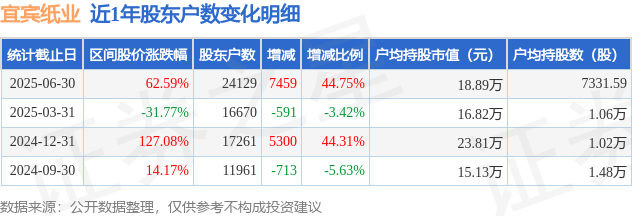
宜宾纸业6月30日股东户数2.41万户,较上期增加44.75%
Zheng Quan Zhi Xing· 2025-08-30 10:05
Core Insights - Yibin Paper's shareholder count increased to 24,129 as of June 30, 2025, representing a growth of 7,459 shareholders or 44.75% compared to March 31, 2025 [1][2] - The average shareholding value per shareholder is 188,900 yuan, which is above the industry average of 139,700 yuan [1][2] - The stock price of Yibin Paper rose by 62.59% from March 31, 2025, to June 30, 2025, coinciding with the increase in shareholder count [1][2] Shareholder Statistics - As of June 30, 2025, the average number of shares held per shareholder decreased to 7,332 shares from 10,600 shares as of March 31, 2025 [1][2] - The total number of shareholders in the paper industry averages 48,100, indicating that Yibin Paper's shareholder count is below this average [1][2] Financial Flows - During the period from March 31, 2025, to June 30, 2025, the net outflow of funds from major investors was 854 million yuan, while retail investors saw a net inflow of 1.157 billion yuan [2]

长三角国家技术创新中心范霁红:工业供热零碳转型是长三角实现碳中和的关键
Di Yi Cai Jing· 2025-08-30 06:09
Core Insights - The industrial sector is responsible for 68% to 69% of China's total carbon dioxide emissions, making it crucial for achieving carbon neutrality goals [2] - The direct emissions from the industrial sector account for approximately 62%, while indirect emissions from purchased heat and electricity make up 38% [2] - Industrial heating contributes to about 50% of the total national emissions, highlighting the urgent need for low-carbon transformation in industrial heating systems [2] Group 1: Industrial Emissions Overview - In 2022, carbon emissions from obtaining heat and electricity reached 6.62 billion tons, accounting for 83% of total industrial emissions, with direct combustion contributing 4.97 billion tons [2] - If the low-carbon transformation of regional heating systems is achieved, it is estimated that carbon emissions in the Yangtze River Delta could be reduced by approximately 12 million tons per year by 2030 [3] Group 2: Technological Pathways for Transformation - Current coal-fired boiler heating has a carbon emission intensity 1.6 to 1.8 times higher than that of combined heat and power (CHP) systems, while gas boilers are slightly lower than coal CHP [4] - Low-temperature industrial heat pumps currently outperform coal CHP under existing electricity carbon intensity, and high-temperature heat pumps will show better emission reduction benefits as the proportion of green electricity increases [4] Group 3: Strategies for Achieving Zero Carbon Goals - To achieve comprehensive zero-carbon goals in industrial heating, multiple technological pathways must be pursued simultaneously, including increasing the proportion of electricity in terminal energy consumption from 28%-29% to over 50% [5] - The total scale of industrial boilers in China is 3.52 billion kilowatts, equivalent to the total installed capacity of the national power grid, indicating a need for a gradual transition strategy [5] - The dual approach of increasing the proportion of green electricity and developing green fuel alternatives is essential for achieving zero-carbon targets in industrial heating systems [5][6]