
军工

Search documents
9月30日A股市场投资情绪:解套率创新高
Di Yi Cai Jing· 2025-09-30 09:28
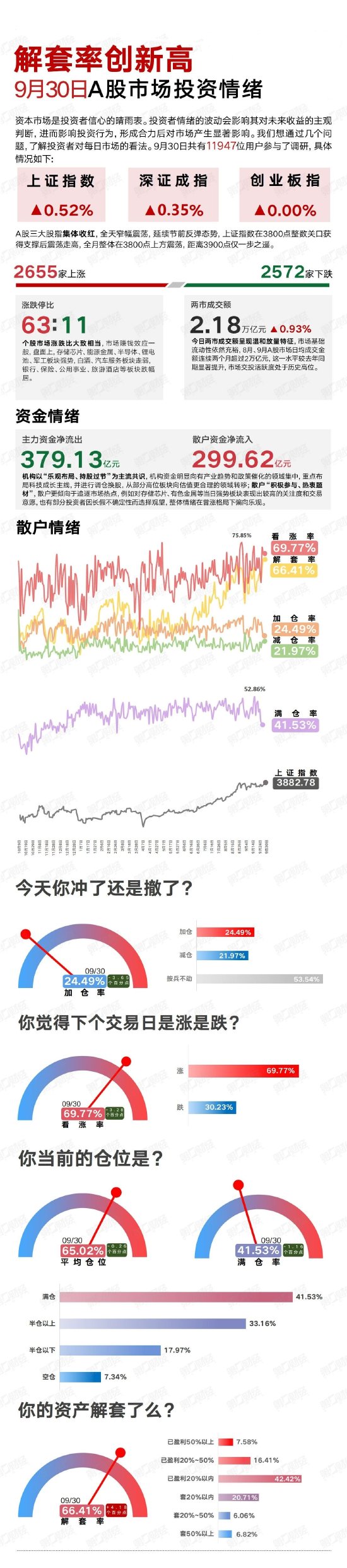
Core Viewpoint - The A-share market shows a significant rebound in investor sentiment as of September 30, with a high level of participation and optimism among both institutional and retail investors, despite some caution due to the upcoming holiday [1][5]. Market Performance - All three major A-share indices closed in the green, with the Shanghai Composite Index supported at the 3800-point level, indicating a continued upward trend [3]. - The market saw 2,655 stocks rise, reflecting a balanced gain-loss ratio, and the average daily trading volume in August and September reached 2 trillion yuan, marking a historical high in trading activity [3]. Investor Sentiment - Institutional investors are adopting a "optimistic layout, holding stocks through the holiday" strategy, reallocating funds towards sectors with reasonable valuations, while retail investors are actively chasing market hotspots like storage chips and energy metals [5]. - A survey indicated that 52.86% of investors are fully invested, with 24.49% increasing their positions, while 53.54% chose to hold their positions [7][9]. Trading Behavior - Retail investors displayed a strong inclination towards active trading, with 69.77% predicting a market decline in the next trading day, while 30.23% anticipated a rise [11].

ETF收评 | 有色+军工板块领涨,稀有金属ETF基金涨近5%,军工龙头ETF涨超4%
Ge Long Hui· 2025-09-30 07:46
Market Performance - On the last trading day before the holiday, the Shanghai Composite Index rose by 0.52%, while the Shenzhen Component increased by 0.35%. The ChiNext Index remained flat, and the Beijing Stock Exchange 50 fell by 0.70% [1] - The total trading volume across Shanghai, Shenzhen, and Beijing reached 21,972 billion yuan, an increase of 191 billion yuan compared to the previous day [1] - More than 2,600 stocks in the market experienced gains [1] Sector Performance - The semiconductor, energy metals, and storage chip sectors saw significant gains, while the large financial sector underwent adjustments [1] - In the ETF market, the rare metals sector led the gains, with Huafu Fund's Rare Metals ETF, GF Fund's Rare Metals ETF, and ICBC Credit Suisse Fund's Rare Metals ETF rising by 4.99%, 4.38%, and 4.35% respectively [1] - The military industry sector also surged, with the Fortune Fund's Military Leaders ETF and Huaxia Fund's Aerospace ETF increasing by 4.3% and 3.94% respectively [1] - The semiconductor sector continued its upward trend, with the Guotai Fund's Integrated Circuit ETF rising by 3.81% [1] Declines - Overnight crude oil prices fell, leading to a 2.67% drop in the S&P Oil & Gas ETF [1] - The AI hardware sector declined, with the Communication ETF and Communication Equipment ETF falling by 2.05% and 1.82% respectively [1] - The brokerage sector experienced a pullback, with the leading Securities ETF dropping by 1.5% [1]
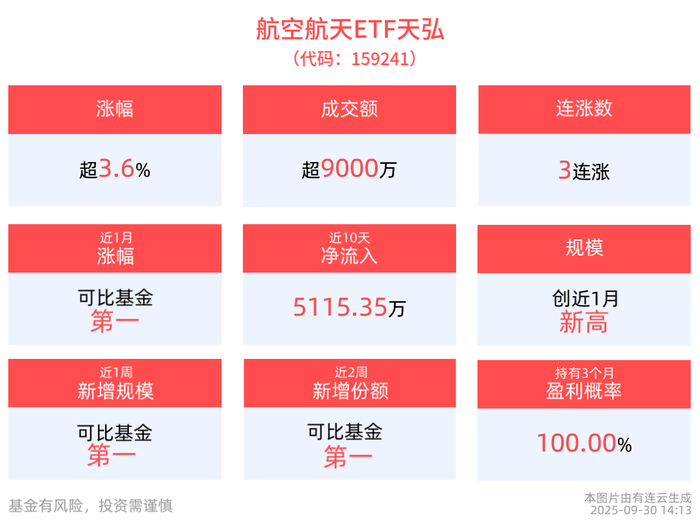
航天军工行情起飞!航空航天ETF天弘(159241)涨超3.6%冲击3连涨,近10日净流入超5100万元
Xin Lang Cai Jing· 2025-09-30 06:31
Group 1 - Aerospace ETF Tianhong (159241) has risen by 3.62%, marking a three-day consecutive increase, with a trading volume of 95.95 million yuan and a turnover rate of 18.86% [3] - The latest scale of Aerospace ETF Tianhong reached 498 million yuan, a new high in nearly a month, with a significant increase of 39 million shares in the past two weeks, ranking first among comparable funds [3] - The net inflow of funds into Aerospace ETF Tianhong was 4.61 million yuan, with a total net inflow of 51.15 million yuan over the last ten trading days [3] Group 2 - The military industry achieved a net profit attributable to shareholders of 17.27 billion yuan in the first half of 2025, a year-on-year increase of 6.43%, with operating revenue of 287.11 billion yuan, up 12.65% year-on-year [5] - The military sector's contract liabilities reached 66.32 billion yuan in the second quarter of 2025, a significant increase of 38.65% compared to the beginning of the period, indicating a positive outlook for future performance [5] Group 3 - The Chinese commercial aircraft engine sector is expected to see further deepening of independent innovation processes, driven by the urgency for self-sufficiency in domestic aircraft engines [6] - The development of a complete industrial system in the aviation engine field over the past five years has fostered numerous excellent suppliers, indicating a robust market for domestic replacements [6]
港股军工股普遍上扬 中航科工涨超4%
Mei Ri Jing Ji Xin Wen· 2025-09-30 06:17
Core Viewpoint - The Hong Kong military industry stocks experienced a general rise on September 30, with notable increases in share prices for several companies [1] Group 1: Company Performance - AVIC Aircraft (02357.HK) saw a price increase of 4.58%, reaching HKD 4.34 [1] - China Shipbuilding Defense (00317.HK) rose by 3.38%, with shares priced at HKD 16.23 [1] - Mainland Aviation Technology Holdings (00232.HK) increased by 2.24%, trading at HKD 0.137 [1]
军工股普遍上扬 中航科工涨超4% 中船防务涨超3%
Zhi Tong Cai Jing· 2025-09-30 06:09
Core Viewpoint - The military stocks have generally risen, with notable increases in companies such as AVIC (4.58% increase), China Shipbuilding Defense (3.38% increase), and Continental Aerospace Technology (2.24% increase) [1] Group 1: Market Performance - AVIC (02357) rose by 4.58%, trading at 4.34 HKD [1] - China Shipbuilding Defense (600685) (00317) increased by 3.38%, trading at 16.23 HKD [1] - Continental Aerospace Technology (00232) saw a rise of 2.24%, trading at 0.137 HKD [1] Group 2: Industry Developments - Dongfang Securities' report highlights that three types of carrier-based aircraft have completed their first catapult takeoff and landing training, marking a milestone in China's naval strength [1] - The influence of weaponry and equipment is continuously expanding [1] Group 3: Strategic Insights - The U.S. Treasury Secretary indicated that engines may become a significant bargaining chip in Sino-U.S. negotiations, emphasizing the urgency for self-sufficiency in domestic large aircraft engines [1] - The military industry has stabilized in recent weeks, with a new phase of equipment construction expected to commence as the 14th Five-Year Plan approaches [1] - Focus on domestic demand recovery and military trade progress is essential for the second half of the year, highlighting the sector's investment value [1]
港股异动 | 军工股普遍上扬 中航科工(02357)涨超4% 中船防务(00317)涨超3%
智通财经网· 2025-09-30 06:09
Core Viewpoint - Military stocks have generally risen, indicating a positive sentiment in the defense sector, driven by recent developments in naval capabilities and the urgency for domestic aircraft engine independence [1] Group 1: Stock Performance - Companies such as AVIC (02357) saw a rise of 4.58%, trading at HKD 4.34; China Shipbuilding Defense (00317) increased by 3.38%, trading at HKD 16.23; and Continental Aerospace Technology Holdings (00232) rose by 2.24%, trading at HKD 0.137 [1] Group 2: Industry Developments - A report from Dongfang Securities highlighted that three types of carrier-based aircraft have completed their first catapult takeoff and landing training, marking a milestone in China's naval strength and expanding the influence of military equipment [1] - The U.S. Treasury Secretary indicated that engines could become a significant bargaining chip in U.S.-China negotiations, emphasizing the urgent need for self-sufficiency in domestic aircraft engines [1] Group 3: Future Outlook - The military industry has stabilized in recent weeks, with the upcoming "14th Five-Year Plan" signaling the start of a new phase in equipment construction, focusing on domestic demand and military trade [1] - The second half of the year will require attention to the upward trend in domestic demand and positive developments in military trade, highlighting the sector's investment value [1]
国防ETF(512670)涨超3.6%,军贸预期再起军工板块强势拉升
Xin Lang Cai Jing· 2025-09-30 05:48
Group 1 - The military industry sector is experiencing a resurgence ahead of the National Day, with expectations that China may quickly capture a significant share of the global military trade market [1] - The aerospace equipment segment is particularly active, with China's mid-to-high-end equipment becoming a popular choice in the global military trade market, focusing on products such as aircraft, ships, armored vehicles, and missiles [1] - Short-term prospects indicate that equipment with prior export experience or already in service domestically will likely see orders materialize first, while long-term expectations include increased defense technology exchanges between China and friendly nations [1] Group 2 - The Defense ETF closely tracks the CSI Defense Index, which includes listed companies under the ten major military groups and those providing weaponry and equipment to the armed forces, reflecting the overall performance of defense industry listed companies [2] - Among the 13 ETFs tracking defense and military sectors, the Defense ETF has the lowest management and custody fees at 0.40%, making it unique in its category [2] - As of August 29, 2025, the top ten weighted stocks in the CSI Defense Index account for 43.88% of the index, with key companies including AVIC Shenyang Aircraft (600760) and AVIC Xi'an Aircraft (000768) [2]
超2900只个股上涨
Di Yi Cai Jing· 2025-09-30 03:57
Market Overview - The Shanghai Composite Index rose by 0.4%, approaching the 3900-point mark, while the Shenzhen Component increased by 0.31% and the ChiNext Index saw a slight rise of 0.06% [2][3] - The total trading volume in the Shanghai and Shenzhen markets reached 1.36 trillion CNY, an increase of 763 billion CNY compared to the previous trading day, with over 2900 stocks rising [2][3] Sector Performance - The energy metals, military industry, and AI PC concepts sectors showed significant gains, while the liquor sector remained sluggish [2] - The semiconductor industry chain continued to perform strongly, with companies like Huahong Semiconductor and Guolin Technology hitting their daily price limits, and Huahong's stock price increasing by over 15% to reach a new high [2][3] Notable Stocks - Huahong Semiconductor's A-shares rose by over 14%, while its H-shares increased by more than 10% [3] - Zijin Mining International opened high and saw its stock price increase by 65% [5] - The military sector experienced a surge, with AVIC Shenyang Aircraft Corporation rising over 7% to reach a new high, alongside gains in China Shipbuilding Industry Corporation and AVIC Chengfei [4] Trading Dynamics - The market saw fluctuations with the ChiNext Index briefly rising over 1% before turning negative, while the Shanghai Composite Index and Shenzhen Component showed minor increases [7] - The steel sector also experienced upward movement, with Hebei Steel Resources rising over 7% and other related stocks following suit [8][9] Economic Indicators - The People's Bank of China conducted a 242.2 billion CNY reverse repurchase operation with a rate of 1.40%, while 276.1 billion CNY of reverse repos were set to mature today [16] - The RMB/USD central parity rate was reported at 7.1055, an increase of 34 basis points from the previous day [16] Summary of Key Events - The market opened with all three major indices showing gains, particularly in sectors like energy metals and semiconductors, while financial sectors lagged [14][15] - The gold price reached a new historical high of 3850 USD per ounce, reflecting a daily increase of 0.43% [12] - The battery concept stocks saw renewed interest, with companies like Fengshan Group and Tianji Shares experiencing consecutive price increases [11]


A股军工股集体强势,中航沈飞涨超8%
Ge Long Hui A P P· 2025-09-30 03:50
Group 1 - The A-share market saw a strong performance in the military industry stocks, with several companies hitting their daily price limits [1] - Notable performers included Xinle Energy, which reached a 20% increase, and Hezhuan Intelligent and Zhongdian Xinlong, both achieving a 10% increase [2] - Other companies such as Huayin Technology and Aerospace South Lake also showed significant gains, with increases exceeding 8% [1][2] Group 2 - The total market capitalization of Xinle Energy is 12.2 billion, with a year-to-date increase of 100.36% [2] - Hezhuan Intelligent has a market cap of 9.715 billion and a year-to-date increase of 186.86% [2] - Zhongdian Xinlong's market cap stands at 9.762 billion, with a year-to-date increase of 147.93% [2]




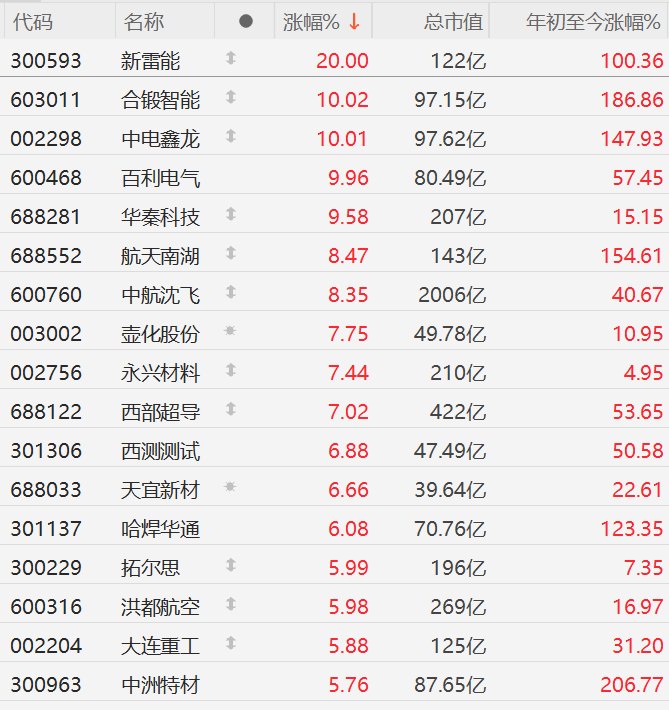
军工概念持续走强,合锻智能、新雷能等多股涨停
Mei Ri Jing Ji Xin Wen· 2025-09-30 03:26
Group 1 - The military industry concept continues to strengthen, with stocks such as Hezhan Intelligent, Xinle Energy, Fulian Precision, and *ST Aowei reaching the daily limit [1] - Other companies like Huaqin Technology, AVIC Shenyang Aircraft, Western Superconducting, Aerospace Nanhai, Chengfei Integration, and West Testing also experienced gains [1]

