金融科技

Search documents
民建北京市委金融委主任李平:上合组织国家虽数字金融水平差异显著,但互补空间广阔
Sou Hu Cai Jing· 2025-10-31 06:48
Core Viewpoint - The 2025 Financial Street Forum in Beijing will focus on digital financial cooperation among Shanghai Cooperation Organization (SCO) countries, highlighting Beijing's advantages in technology, policy, and international collaboration to lead this initiative [1][3]. Group 1: Digital Financial Landscape - The global financial sector is rapidly digitizing, with technologies like AI, cloud computing, and blockchain becoming core drivers of economic growth. The global digital economy is approximately $57 trillion, accounting for over 55% of global GDP [4]. - In 2024, global fintech investment is expected to exceed $170 billion, marking a nearly 60% increase since 2020 [4]. - SCO member countries show significant disparities in digital financial inclusion, with an average of 20% of GDP from the digital economy, while China (41%), Russia (28%), and Kazakhstan (25%) lead, and other Central Asian countries fall below 15% [4]. Group 2: Beijing's Role and Advantages - Beijing is positioned to become a core player in promoting digital financial cooperation within the SCO due to three main advantages: a strong digital economy and fintech ecosystem, favorable policies, and international cooperation capabilities [6]. - The city has a robust digital industry and financial innovation that aligns with the needs of SCO countries, housing leading tech firms and advanced technologies [6]. - As a demonstration city for financial management and digital economy, Beijing can implement pilot projects for central bank digital currencies and cross-border payments [6]. Group 3: Cooperation Directions - Four key cooperation directions have been identified: 1. Digital currency and cross-border settlement, exploring applications of digital currencies among member countries [7]. 2. Interconnection of digital infrastructure, involving Beijing enterprises in communication upgrades and establishing computing hubs [7]. 3. Collaboration in inclusive and green finance, developing digital credit products for countries with lower financial inclusion [7]. 4. Joint efforts in data security and regulatory frameworks, including the establishment of a digital financial risk monitoring center [7]. Group 4: Building a Digital Financial Ecosystem - To construct a digital financial cooperation ecosystem, Beijing can focus on: 1. Deepening energy finance cooperation and establishing a service platform for energy trade [8]. 2. Promoting green finance development and creating a standard system for green finance [8]. 3. Creating an "open-secure-interconnected" ecosystem by deploying 5G+ financial networks and establishing a financial data sharing platform [8]. 4. Forming innovation alliances and joint laboratories to foster collaboration among financial institutions and tech companies [8]. Group 5: Continuous Efforts from Beijing - Beijing can enhance its role by leveraging policy advantages, such as tax incentives and funding subsidies, and organizing forums to align national policies with SCO regulations [9]. - The city can also export technological solutions like AI risk control and blockchain to assist member countries in improving their financial systems [9]. - Establishing a Beijing-SCO digital financial service platform and a green digital finance fund can help promote the "Beijing model" internationally [9].

聚焦金融服务新质生产力 建言法治保障与规则建立
Qi Huo Ri Bao Wang· 2025-10-31 06:32
期货日报网讯(记者 杨美)10月30日下午,由北京金融法院承办的2025金融科技大会金融科技法治平 行论坛在北京成功举办。 金融科技大会作为金融街论坛年会特定版块,与金融街论坛同期举行。2025金融科技大会以"数智时代 下的金融科技"为主题,整体架构为"1场开幕式+5场主论坛+5场平行论坛"。本场平行论坛的主题是"金 融服务新质生产力的法治保障与规则建立"。来自法律、金融、科技等领域的领导、专家、学者齐聚一 堂,展开深入研讨和交流。 北京国际大数据交易所有限责任公司副总经理温天宁介绍了北数所通过制度创新,制定数据交易、资产 化、匿名化等一系列标准规范,用司法规则和标准体系护航。 主题演讲环节由北京金融法院副院长薛峰主持。 教育部哲学社会科学实验室—中国政法大学数据法治实验室主任、中国政法大学数据法治研究院院长时 建中,首都经济贸易大学北京数字经济发展研究院二级教授、常务副院长李平,国家数据发展研究院数 据资源研究部主任、研究员王威,中证数据有限责任公司副总经理汪洵,中国国际金融股份有限公司合 规总监、法律合规部负责人周佳兴,北京四象爱数科技有限公司创始人、CEO郗晓菲,北京字节跳动法 律研究总监王洁等嘉宾,围 ...
“未来20”调研解码中小市值成长力:制造业升级与创新韧性成突围关键
Di Yi Cai Jing· 2025-10-31 04:41
Core Insights - China's small and medium-sized enterprises (SMEs) are demonstrating strong resilience through innovation and adaptability, forming new models and trends that warrant market attention [1][42] - The "Future 20" growth research project, initiated by First Financial, Ernst & Young (China), and Xiya Asset Management, is the first systematic evaluation of small and medium-sized listed companies in the A-share market [1][5] Group 1: Research and Evaluation Process - The second year of the "Future 20" research concluded with a final evaluation meeting on October 28, where 18 companies were selected based on initial scores and field research [5][20] - The final list will be officially announced at the "Future 20·China A-share Listed Companies Growth Conference" in December after compliance checks [5][20] - The research aims to provide a macro perspective on China's economic and industrial development through the growth trajectories of selected companies [5][20] Group 2: Industry Trends and Insights - The manufacturing sector's share is increasing, and the extension of industrial chains is becoming a new trend among SMEs, which are crucial for economic resilience and innovation [9][20] - Companies are actively engaging in digital transformation and developing a "1+5+X" industrial innovation system, focusing on smart, low-carbon, and health-related industries [12][20] - The research indicates a significant rise in the number of SMEs, with 57 million registered by 2024, despite a backdrop of intense market competition and consolidation [16][19] Group 3: Company Performance and Challenges - Among the 3,878 small-cap listed companies, 1,385 reported losses, highlighting a stark performance divide within this segment [19][20] - Many SMEs are transitioning from general products to scenario-based strategies, enhancing customer loyalty in niche markets [22][34] - The research emphasizes the importance of understanding the unique characteristics and industry connections of SMEs to inform investment decisions [24][27] Group 4: Future Directions and Recommendations - The evaluation process is being refined to enhance risk assessment and focus on core operational challenges faced by companies [27][51] - The research highlights the need for SMEs to balance R&D investments with short-term performance, ensuring sustainable growth [51][52] - Future evaluations should incorporate a broader range of indicators to identify potential high-growth companies that may currently be overlooked [52][41]

金融壹账通:2.25万份购股权失效
Zhi Tong Cai Jing· 2025-10-31 04:12
Group 1 - Financial One Account (06638) announced the termination of employee contracts, resulting in 22,500 stock options expiring on October 30, 2025 [1]
蚂蚁数科余滨:金融AI的升级远不是开发个智能体
Cai Jing Wang· 2025-10-31 03:13
Core Insights - Ant Group's AI business is actively supporting local commercial banks in China to adopt financial large models and intelligent agent technologies to enhance performance amidst challenges like narrowing net interest margins and intensified competition [1][3] - The implementation of AI has shifted from a trial phase to a necessity, transforming from a cost center to a core element of service, marketing, and value creation [1] Group 1: AI Adoption and Impact - Local commercial banks are experiencing significant improvements in employee efficiency, marketing conversion rates, and revenue scale through AI applications [1] - For instance, a pilot bank reported that the use of digital avatars for financial advisors increased the average number of clients served per advisor from 200 to 2000, leading to a revenue growth of approximately 20% [1] - The AI mobile banking solution developed for Shanghai Bank allows users to perform over ten high-frequency tasks through natural language interaction, resulting in a 10% increase in business conversion rates [2] Group 2: Strategic Approaches to AI Implementation - Different financial institutions should choose AI evolution paths that suit their resources and development stages, with regional banks advised to start with application scenarios and gradually increase investment [3] - Some banks are prioritizing the upgrade of existing mobile apps to AI mobile banking to enhance user experience and engagement [3] - The ideal model involves establishing a dedicated team to create a comprehensive knowledge base and data set, leveraging Ant Group's financial reasoning large model to drive end-to-end business process reengineering and organizational upgrades [3] Group 3: Market Coverage - Ant Group's financial digital services have reached 100% of state-owned joint-stock banks, over 60% of local commercial banks, and hundreds of financial institutions [3]
一天蒸发300亿美元,美国金融科技史上罕见“血案”是怎么酿成的
3 6 Ke· 2025-10-31 02:54
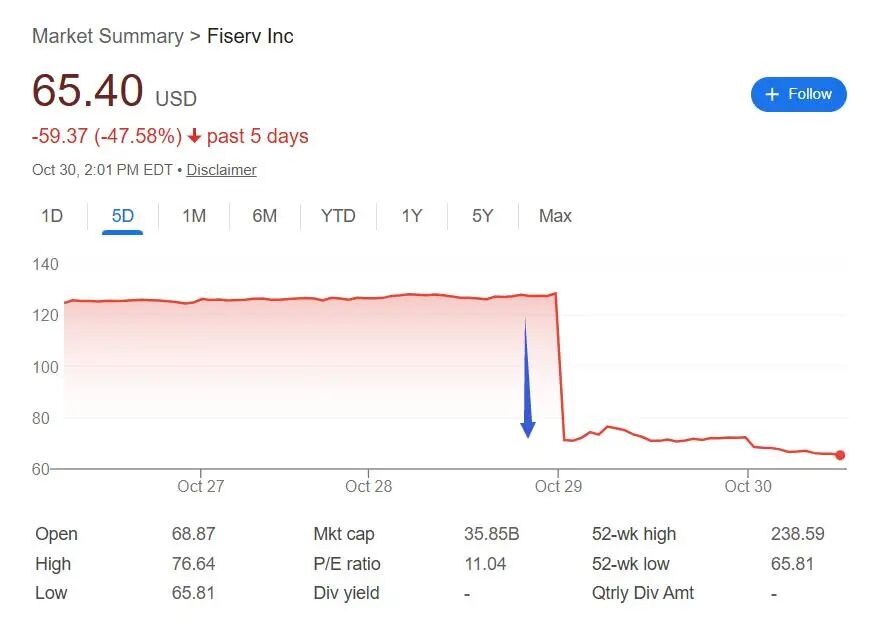
Core Viewpoint - The recent stock crash of Fiserv, a major player in the fintech industry, highlights significant management failures, including poor pricing strategies and a lack of responsiveness to customer needs, leading to a drastic reduction in earnings guidance and revenue expectations [3][4]. Group 1: Stock Performance and Market Reaction - Fiserv's stock plummeted approximately 44%, marking the largest single-day drop in nearly 40 years, resulting in a market capitalization loss of about $30 billion [1][3]. - As of the latest reports, Fiserv's stock has declined nearly 66% year-to-date, potentially making it the worst-performing stock in the S&P 500 index this year [4]. Group 2: Management and Strategic Failures - New CEO Mike Lyons retracted previous earnings guidance, lowering the adjusted EPS forecast from $10.15-$10.30 to $8.50-$8.60, a reduction exceeding 16%, and slashed revenue growth expectations from 10% to 3.5%-4% [3]. - The company's third-quarter revenue growth was only about 1% year-over-year, significantly below Wall Street's expectations of $53.6 billion, and the adjusted EPS was $2.04, nearly 23% lower than anticipated [3][4]. - The previous CEO, Frank Bisignano, set overly aggressive growth targets and implemented pricing strategies that led to significant customer attrition, particularly with the Clover product [3][5]. Group 3: Customer Issues and Competitive Landscape - Customers expressed dissatisfaction with high fees associated with Clover's point-of-sale system, prompting many to switch to cheaper alternatives like Square or Toast [5][6]. - Analysts raised concerns about the sustainability of Clover's revenue growth, noting a disconnect between Clover's revenue growth and the payment volume processed, which typically should align [6]. Group 4: Analyst Reactions and Future Outlook - Analysts reacted sharply to Fiserv's poor performance, with BTIG describing the financial results as "astonishingly bad" and other firms expressing disbelief at the magnitude of the earnings guidance cut [8][9]. - Fiserv announced several remedial measures, including reversing pricing changes for Clover, launching a new technology strategy, and making significant leadership changes [9]. - The company appointed a new COO and CFO, along with new board members, indicating a strategic shift in response to the crisis [9].
DigiFT将启动大洋集团股份代币化——首个受新加坡监管的港股代币化项目
Zhi Tong Cai Jing· 2025-10-31 02:18
Core Insights - DigiFT, a regulated platform for tokenizing Real-World Assets (RWA) in Singapore, plans to tokenize shares of Ocean Group Holdings Limited, marking the first instance of tokenization of a Hong Kong-listed company through a regulated platform in Singapore [1][2] - This initiative highlights DigiFT's role in bridging traditional capital markets with regulated on-chain finance, facilitating institutional investors' compliant participation in tokenized asset investments [1] - Ocean Group's leadership supports this innovation, emphasizing the trend of integration between global capital markets and on-chain finance, which aligns with their commitment to transparency and shareholder value [1] Group 1 - DigiFT is one of the first on-chain exchanges licensed by the Monetary Authority of Singapore (MAS) and has also obtained licenses from the Hong Kong Securities and Futures Commission (SFC) [2] - The platform offers comprehensive digital asset services for RWA, including tokenization, issuance, distribution, trading, and instant liquidity allocation [2] - DigiFT has established partnerships with leading asset management firms such as Invesco, UBS Asset Management, DBS, CMB International, and Wellington Management [2] Group 2 - Ocean Group Holdings Limited, listed on the Hong Kong Stock Exchange since 2007, operates in various sectors including online marketing solutions, silicone rubber products, retail services, healthcare, and hospitality [2] - The company is actively transforming towards AI digital personas and RWA, exploring innovative measures to enhance competitiveness and shareholder value [2]
DigiFT将启动大洋集团(01991)股份代币化——首个受新加坡监管的港股代币化项目
智通财经网· 2025-10-31 01:40
Core Insights - DigiFT, a regulated platform for tokenizing real-world assets (RWA) in Singapore, announced plans to tokenize shares of Ocean Group Holdings Limited, marking the first instance of such a project for a Hong Kong-listed company through a regulated framework in Singapore [1][2] - This initiative highlights DigiFT's role in bridging traditional capital markets with regulated on-chain finance, facilitating institutional investors' compliant participation in tokenized asset investments [1] - Ocean Group's leadership supports the tokenization project, emphasizing the trend of integrating global capital markets with on-chain finance, which aligns with the company's commitment to transparency and shareholder value [1] Company Overview - DigiFT is a next-generation capital market platform focused on the issuance and trading of RWA, and is one of the first licensed by the Monetary Authority of Singapore (MAS) [2] - The platform offers comprehensive digital asset services for RWA, including tokenization, issuance, distribution, trading, and instant liquidity allocation, and is trusted by major financial institutions such as Invesco, UBS Asset Management, and DBS [2] - Ocean Group Holdings Limited, established in 1991 and listed in 2007, operates in various sectors including online marketing solutions, design and manufacturing of silicone and rubber products, retail services, and healthcare [2]
美股异动丨Strategy夜盘涨超7%,Q3营收超预期,净利同比扭亏为盈
Ge Long Hui· 2025-10-31 01:36
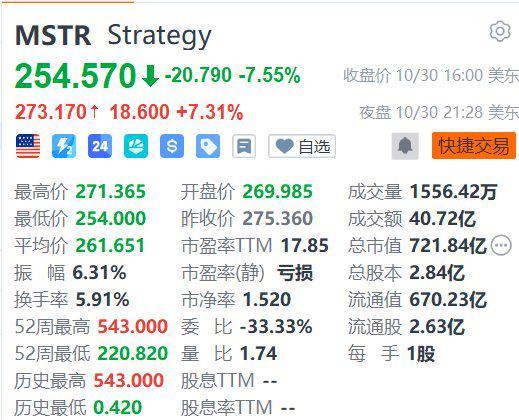
Core Insights - Company reported Q3 2025 revenue of $128.7 million, exceeding market expectations of $116.8 million [1] - Net profit reached $2.65 billion, marking a return to profitability for the second consecutive quarter [1] - Company holds 640,808 bitcoins with a total cost of $47.44 billion, averaging $74,032 per bitcoin [1] Financial Performance - Q3 2025 cash and cash equivalents stood at $54.3 million [1] - Projected net profit for FY 2025 is approximately $24 billion [1] - Earnings guidance assumes a bitcoin price of $150,000 by the end of 2025 [1] Stock Performance - Stock price increased over 7% in after-hours trading, reaching $272.87 [1] - Closing price on October 30 was $254.57, reflecting a decrease of 7.55% [2] - Trading volume was 15.5642 million shares with a market capitalization of $72.184 billion [2]

一天蒸发300亿美元!美国金融科技史上罕见“血案”是怎么酿成的
华尔街见闻· 2025-10-31 01:24
Core Viewpoint - Fiserv's stock price collapse is primarily attributed to management failures, including poor pricing strategies, overpromising growth, and a sluggish corporate culture in responding to customer needs [2][3][4]. Financial Performance - The new CEO Mike Lyons revised the adjusted EPS forecast for the year from $10.15-$10.30 to $8.50-$8.60, a reduction of over 16%. Revenue growth expectations were cut by more than half, from 10% to 3.5%-4% [2]. - In Q3, Fiserv's revenue grew only about 1% year-over-year to $4.92 billion, falling short of the expected $5.36 billion by over 8%. The adjusted EPS was $2.04, nearly 23% below the anticipated $2.64 [2]. Management Issues - The crisis reflects a failure of management rather than a technical failure, with the previous CEO setting overly aggressive growth targets and implementing a pricing strategy that led to significant customer attrition [3][9]. - Lyons acknowledged that the challenges faced were largely self-inflicted, stemming from short-term focused initiatives that compromised the company's ability to deliver products to customers [9][10]. Customer Reactions - Customers expressed dissatisfaction with the high fees associated with Clover's payment terminal system, leading many to switch to cheaper alternatives like Square or Toast [7][8]. - Analysts raised concerns about the sustainability of Clover's revenue growth, noting that its revenue growth was outpacing the growth in payment volume, which typically should align [8]. Analyst Reactions - Analysts reacted swiftly to Fiserv's poor performance, with BTIG describing the financial results as "astonishingly bad" and other analysts expressing disbelief at the magnitude of the earnings miss and guidance cut [11]. - Mizuho's analyst maintained a cautiously optimistic outlook, comparing the situation to a medical emergency that could lead to recovery if managed properly [11]. Strategic Changes - Fiserv announced several remedial measures, including reversing pricing changes for Clover, launching a new technology strategy, and making significant leadership adjustments [11][13]. - The company appointed a new CFO and introduced new board members to help steer the organization through this crisis [12][13]. Market Implications - The situation serves as a warning that even entrenched companies in the digital economy can collapse due to management missteps, especially in a competitive landscape with decreasing investor tolerance [4][13].