即时零售

Search documents
创造百万以上新就业 淘宝闪购持续投入下,物流规模、时效与体验已行业领先
Zhong Guo Jing Ji Wang· 2025-12-01 12:57
Core Insights - Alibaba's latest financial report indicates significant improvements in the unit economics of its instant retail business, driven by enhanced logistics efficiency, high customer retention rates, and increased average order value since September [1] - The logistics capabilities of Taobao Flash Purchase have become industry-leading in terms of scale, efficiency, and customer experience due to ongoing investments and support for delivery riders [2] Group 1: Logistics and Operational Efficiency - Taobao Flash Purchase has achieved a substantial increase in the number of active delivery riders, with a year-on-year growth exceeding 200% by Q3 2025, creating over a million new jobs [1] - The logistics efficiency has been significantly enhanced through advanced computational capabilities and coordinated logistics solutions, which include pressure regulation, time estimation, and intelligent scheduling [2] - The introduction of the "1-to-1 Urgent Delivery" and "Accelerated Card" products has improved delivery experiences for high-value users, resulting in faster delivery times, with reductions of over 5 minutes in the "1-to-1 Urgent Delivery" scenario [2] Group 2: Rider Support and Incentives - Taobao Flash Purchase has implemented a comprehensive rider incentive and support system, including free uniform updates for a million riders and full coverage of pension and medical insurance [2] - The company has introduced the industry's first AI assistant for riders, providing voice interaction and intelligent responses to assist millions of riders across the country [3] - The rider's route optimization has reached a 90% success rate for combined orders, allowing riders to earn more on the same journey [3] Group 3: Future Plans - Taobao Flash Purchase plans to continue increasing investments in logistics infrastructure and refine operations to meet consumer demands for product diversity and timely delivery [3]
外卖大战,下半场拼什么?
3 6 Ke· 2025-12-01 12:09
Core Insights - The intense competition in the food delivery sector has led to significant financial losses for major players, with Meituan reporting its largest loss since its IPO in 2018 [2][5][33]. Summary by Company Alibaba - Alibaba's operating profit plummeted 85% year-on-year to 5.4 billion yuan, while net profit fell 53% to 20.6 billion yuan, marking a 51% decline quarter-on-quarter [2][8]. - The decline in profits is attributed to increased investments in instant retail and user experience, with sales and marketing expenses soaring from 32.7 billion yuan in Q2 to 66.5 billion yuan in Q3, a 105% year-on-year increase [11][10]. - Instant retail revenue grew significantly, with Q3 revenue reaching 22.9 billion yuan, a 55% increase from Q2, reflecting the success of the "Taobao Flash Purchase" initiative [13][14]. JD.com - JD.com reported an operating loss of 1.05 billion yuan in Q3, a stark contrast to a profit of 12 billion yuan in the same period last year [2][17]. - The company has adopted a more restrained approach to spending, with marketing expenses at 21.1 billion yuan, a decrease from 27 billion yuan in Q2, although this still represents a 111% year-on-year increase [19][22]. - JD's new business segment, which includes food delivery, generated 15.6 billion yuan in revenue, reflecting a 214% year-on-year increase [22][25]. Meituan - Meituan's operating loss reached 19.8 billion yuan in Q3, with net losses of 18.6 billion yuan, marking a significant downturn from previous profits [2][33]. - The company's core local business, which includes food delivery and instant retail, saw a dramatic decline in operating profit, dropping from a profit of 3.7 billion yuan in Q2 to a loss of 14.1 billion yuan in Q3 [34]. - Despite the losses, Meituan's management indicated that the competitive landscape is beginning to stabilize, with a rebound in market share for higher-value orders [36].


净亏损160亿!美团的护城河,被淘宝闪购“挖穿”
商业洞察· 2025-12-01 09:23
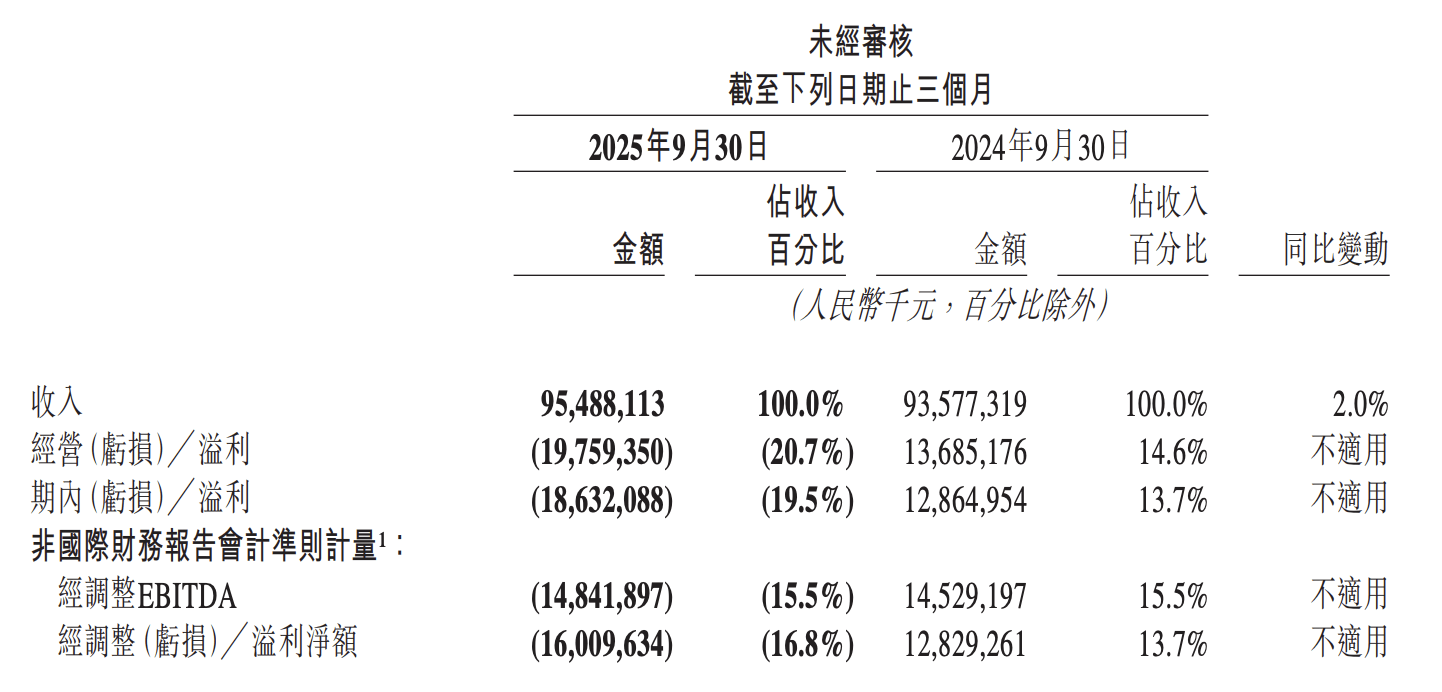
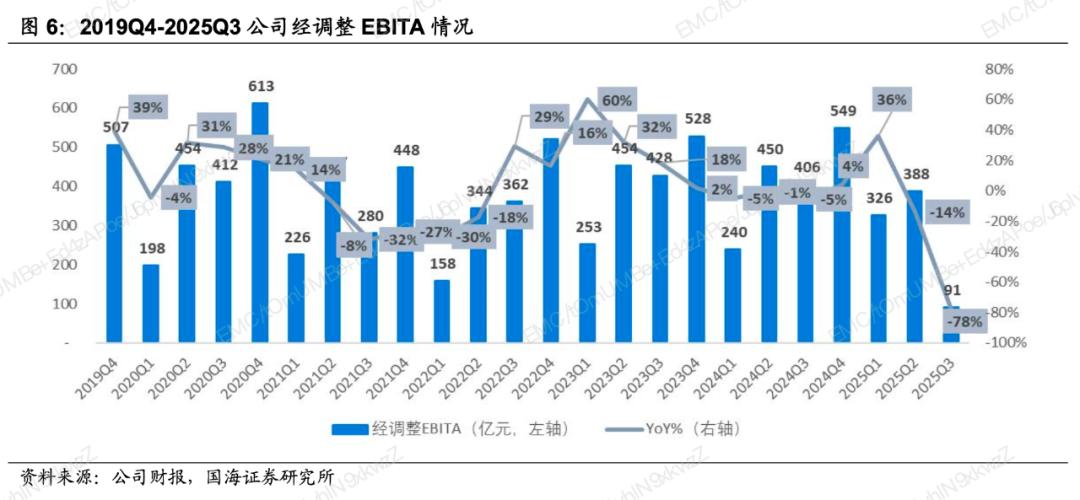
Core Viewpoint - Meituan's Q3 2025 earnings report shows a revenue of 95.5 billion RMB, a 2% year-on-year increase, but below Bloomberg's expected 4% growth. The adjusted net loss was 16.01 billion RMB, exceeding the expected 13.8 billion RMB loss [3][4]. Financial Performance - In Q3 2025, Meituan's revenue was 95,488 million RMB, with a gross loss of 19,759 million RMB, representing a 20.7% loss margin. The adjusted EBITDA was -14,841 million RMB, also reflecting a significant loss [4][9]. - The adjusted net profit in the same quarter last year was 12.8 billion RMB, indicating a nearly 30 billion RMB impact on net profit year-on-year [4][5]. Cost and Investment Analysis - The increase in sales costs and marketing expenses in Q3 2025 amounted to over 29.8 billion RMB, which corresponds closely to the 30 billion RMB decrease in profit, indicating heavy investment in the "takeaway war" to maintain market share [5][14]. - Meituan's core local business revenue decreased by 2.8% to 67.4 billion RMB, with a significant operating loss of 141 million RMB, resulting in a 20.9% loss margin [9][10]. Market Share and Competition - Meituan's market share in the takeaway segment has dropped from over 75% at the beginning of the year to approximately 50% as of November, according to estimates from JPMorgan [5][15]. - The competition has intensified, with Alibaba's market share rising to 42%, while Meituan's share is projected to decline further in the coming years [15][19]. Management's Outlook - CEO Wang Xing expressed optimism about the long-term value creation despite the current losses, stating that the price war in the takeaway sector is unsustainable. However, he acknowledged that losses would continue into Q4 [6][19]. - Meituan plans to invest an additional 2.8 billion RMB to support merchants and enhance service quality, while avoiding participation in price wars [18][19]. Industry Trends - The competition in the takeaway and instant retail markets is expected to persist, with analysts predicting that the market structure may not revert to a scenario where Meituan dominates alone [19][20]. - The industry is transitioning from capital-driven growth to efficiency and innovation-driven models, indicating a shift in competitive dynamics [19].

美团Q3:亏损不是答案,战损比才是——外卖这一仗值不值?
Ge Long Hui· 2025-12-01 07:21
Core Insights - The article discusses the intense competition in the food delivery and instant retail sectors, highlighting Meituan's financial performance in Q3, which shows a revenue of 95.5 billion yuan, a 2% year-on-year increase, but a significant adjusted net loss of 16 billion yuan, with core local business shifting from profit to a loss of 14.1 billion yuan [1][3][5] Financial Performance - Meituan's total revenue increased from 93.6 billion yuan to 95.5 billion yuan year-on-year, while core local business revenue slightly declined from 69.4 billion yuan to 67.4 billion yuan [3] - The cost of sales surged from 56.8 billion yuan to 70.3 billion yuan, accounting for 73.6% of revenue, while sales and marketing expenses nearly doubled from 18 billion yuan to 34.3 billion yuan, representing 35.9% of revenue [1][3] Competitive Landscape - Meituan's significant losses reflect the fierce competition, with competitors reportedly investing hundreds of billions in subsidies [1] - Despite the losses, Meituan managed to maintain approximately 60% of the industry order GTV share, showcasing a high "battle loss ratio" compared to competitors [3][4] User Engagement and Market Position - Meituan's app daily active users (DAU) grew over 20% year-on-year, with transaction users exceeding 800 million, indicating increased user engagement despite financial losses [3] - The company holds over two-thirds of the market share for orders above 15 yuan and over 70% for orders above 30 yuan, indicating a focus on high-value transactions rather than low-price promotions [4] Long-term Strategy and Investments - Meituan is investing in long-term initiatives such as rider benefits and tools for merchants to enhance operational efficiency, which may compress short-term profits but strengthen the business model [2][7] - The company is also focusing on efficiency optimization, with R&D spending increasing by 31% to 6.9 billion yuan, representing 7.3% of revenue [7] New Business Growth - New business revenue grew by 15.9% year-on-year to 28 billion yuan, with operating losses narrowing to 1.3 billion yuan, indicating improved operational efficiency in grocery retail and international expansion [12] - The instant retail segment, particularly Meituan's flash purchase service, is evolving towards brand-focused and structural upgrades, enhancing its commercial value [12][13] International Expansion - Meituan's international arm, Keeta, is expanding into the Middle East and Latin America, with operations in Qatar, Kuwait, UAE, and Brazil, indicating a strategic move towards global market penetration [13] Conclusion - The Q3 report reflects a challenging yet strategic phase for Meituan, balancing short-term losses with long-term investments in user retention, operational efficiency, and international growth, positioning itself for future profitability in a low-margin industry [16][17]

外卖大战转向生态持久战,阿里美团京东三季度烧钱超千亿
Sou Hu Cai Jing· 2025-12-01 01:35
Core Insights - The competition in the food delivery sector is not over; it has merely shifted in strategy, moving from a subsidy and volume battle to an ecological and systemic competition [2][3][8] - Major players like Alibaba, Meituan, and JD.com have collectively burned over 100 billion yuan in the food delivery business within a short period, indicating the high stakes involved [4][6] - Meituan reported its largest loss since going public, with a core local business segment loss of 14.1 billion yuan, while Alibaba and JD.com also faced significant profit declines [6][7] Financial Performance - Meituan's Q3 revenue fluctuated, resulting in a significant operating loss of 16 billion yuan, with sales and marketing expenses reaching 34.3 billion yuan, up 183% year-on-year [6][7] - Alibaba's operating profit dropped from 35.2 billion yuan to 5.4 billion yuan, with sales and marketing expenses increasing by 340 billion yuan [6][7] - JD.com reported a loss of 15.7 billion yuan in new businesses, including food delivery, with marketing expenses rising by 110.5% to 21.1 billion yuan [6][7] Strategic Shifts - The competition is transitioning to a more sustainable and rational phase, focusing on long-term ecological strategies rather than aggressive price wars [8][17] - Alibaba's management indicated a focus on optimizing order structures and logistics costs, leading to improved unit economics in its food delivery segment [9][11] - Meituan is increasing direct subsidies in the restaurant sector while also expanding its overseas operations [13][14] Market Dynamics - The competitive landscape is evolving, with Alibaba gaining a strategic advantage in the food delivery market, while Meituan is under pressure due to its reliance on food delivery as a primary traffic source [19][21] - The long-term implications of this competition may lead to a more integrated ecosystem that encompasses food delivery, e-commerce, and other online travel agency (OTA) services [21][22] - The entry of competitors like Douyin and Pinduoduo into the market adds further complexity to the competitive dynamics, as they seek to capture a share of the growing instant retail market [21][22]

2025Q3美团-W业绩会纪要
2025-12-01 00:49
Key Points Summary of Meituan Q3 2025 Earnings Call Company Overview - **Company**: Meituan-W - **Industry**: Local services and food delivery Core Insights and Arguments 1. **User Growth and Engagement**: - Monthly active users grew over 20% year-on-year, with high-frequency usage among premium users [1][2] - Daily transactions by high-end users indicate strong engagement [1] 2. **Local Business Strategy**: - Focus on upgrading products and services to enhance user retention and competitive advantage [1] - Effective sales activities through Meituan membership, increasing user stickiness [1] 3. **Merchant Support and AI Integration**: - Merchants benefit significantly from Meituan's technological support, integrating AI to enhance operational efficiency [1][2] - Initiatives to support small and medium-sized merchants with funding and operational tools [3] 4. **Food Safety and Merchant Empowerment**: - Collaboration with industry partners to ensure food safety through initiatives like "Raccoon Canteen" [3] - Over 20 locations launched in high-tier cities, improving merchant visibility and order volume [3] 5. **Instant Retail Growth**: - Meituan's instant retail platform, Meituan Flash Purchase, continues to lead in growth and service upgrades [3] - User growth and transaction frequency have increased, with a focus on expanding supply [3] 6. **New Business Performance**: - New business revenue grew 15.9% year-on-year to 28 billion yuan, with operating losses increasing by 24.5% to 1.3 billion yuan [6] - Strong growth in grocery retail businesses like Xiaoxiang Supermarket and Kuailv [6] 7. **Membership and AI as Key Tools**: - Enhanced membership system has improved user engagement and transaction frequency [7] - AI tools tailored for restaurant merchants are being developed to improve operational efficiency [8] 8. **Market Position and Competition**: - Meituan maintains a leading position in the food delivery market, focusing on high average order value (AOV) [11] - The company aims to capture over 70% market share in orders exceeding 30 yuan [11] 9. **Financial Outlook**: - Despite anticipated losses in Q4 2025, the company is committed to maintaining its market position without engaging in price wars [13] - Long-term profitability is expected to stabilize as the competitive landscape matures [14] 10. **International Expansion**: - KEETA's operations in Hong Kong and Saudi Arabia are performing well, with plans for further expansion in the Middle East and Brazil [21][23] - The company sees significant potential in the food delivery market in the Middle East and Brazil, with a focus on localizing operations [23][25] Additional Important Insights 1. **Consumer Behavior**: - High-frequency consumers prioritize delivery experience and service reliability over low prices [12] - The membership program offers exclusive benefits to loyal users, enhancing engagement [12] 2. **AI Development**: - Continuous improvement of AI capabilities to enhance service personalization and operational efficiency [20] - AI tools are being integrated into both merchant operations and consumer-facing applications [20] 3. **Sustainability and Industry Health**: - Emphasis on supporting small merchants and creating a sustainable ecosystem for long-term growth [10] - The company is focused on creating value for consumers, merchants, and the overall ecosystem [10] 4. **Operational Efficiency**: - Investments in supply chain and operational capabilities are crucial for maintaining competitive advantages [16] - The company is committed to enhancing user experience through improved service delivery and product offerings [16] This summary encapsulates the key points from Meituan's Q3 2025 earnings call, highlighting the company's growth strategies, market position, and future outlook.

美团没有被彻底拖住
36氪· 2025-11-30 23:53
Core Insights - The article discusses the intense competition in the food delivery market, highlighting that there are no clear winners in the ongoing battle, particularly in Q3 2025, where both Alibaba and Meituan faced significant losses [4][10]. - Meituan's core local business segment reported a revenue decline of 2.8% year-on-year, resulting in an operating loss of 14.1 billion yuan, marking its first loss since Q4 2022 [4][9]. - Alibaba's aggressive strategy led to a profit drop of approximately 30 billion yuan, with significant investments in subsidies that have nearly exhausted their planned 50 billion yuan budget [10]. Meituan's Performance - Meituan's operating profit for its core local business was 14.6 billion yuan in Q3 2024, contrasting sharply with a loss of 14.1 billion yuan in the same period this year, indicating a significant shift in financial performance [9]. - The increase in sales and marketing expenses by 90.9% to 35.9% of revenue reflects the high cost of maintaining market share amid fierce competition [9][10]. - Despite the losses, Meituan's average order value (AOV) remains significantly higher than competitors, with over 70% market share in orders above 30 yuan [10]. Competitive Landscape - The competition has intensified with new entrants and existing players like Alibaba and JD.com increasing their efforts in the food delivery and local services market [13]. - Douyin (TikTok) is emerging as a formidable competitor, with its life services projected to exceed 800 billion yuan in GTV by 2025, narrowing the gap with Meituan [13]. - The article notes that both Alibaba and Meituan are still in the process of optimizing their user experience (UE) and expanding their instant retail offerings [11][12]. New Business Developments - Meituan's new business segment saw a revenue increase of 15.9% year-on-year to 28 billion yuan, although operating losses increased by 24.5% to 1.3 billion yuan [17]. - The company is expanding its offline retail efforts, with initiatives like the "Happy Monkey" discount supermarket and "Little Elephant" supermarket gaining traction [18]. - Meituan's overseas business, particularly in Brazil, is set to launch in December, with significant investments aimed at capturing market share in a competitive landscape dominated by iFood [19][20]. Future Outlook - Meituan's management expresses confidence in maintaining efficiency and market share despite ongoing losses, emphasizing the importance of patience and strategic focus [7][15]. - The company aims to leverage its strengths in high-value orders and continue exploring new opportunities in both domestic and international markets [10][20].
毛利不到10%,1.5折转让,闪电仓迎来半年生死线
凤凰网财经· 2025-11-29 12:09
Core Viewpoint - The rapid expansion of "flash warehouses" in China has led to a saturated market, with many operators struggling to maintain profitability and facing high turnover rates [4][10][11]. Group 1: Market Dynamics - Flash warehouses emerged to meet consumer demand for ultra-fast delivery, with major platforms like Meituan and Alibaba rapidly increasing their numbers [4][10]. - Meituan reported over 50,000 flash warehouses by Q2 2023, up from 30,000 in October 2022, indicating a growth rate of nearly 2,500 new warehouses per month [10]. - The average gross margin for flash warehouses has plummeted to around 10%, significantly lower than previous years, making profitability increasingly difficult [12]. Group 2: Operational Challenges - Many flash warehouse operators are caught in a "order-chasing" cycle, relying on low-priced fast-moving consumer goods to attract customers, which leads to losses [11][12]. - The operational model often results in a high turnover of warehouse owners, with some locations changing hands multiple times within a year due to unsustainable business practices [5][9]. - A significant number of flash warehouses are unable to achieve the necessary sales volume to remain viable, with many closing within months of opening [9][19]. Group 3: Future Outlook - Despite the challenges, the market for flash warehouses is projected to grow, with Meituan aiming for over 100,000 warehouses by 2027 and a market size of 200 billion yuan [15]. - The recent surge in instant retail sales during events like the "Double 11" shopping festival, which saw a 138.4% year-on-year increase, provides some optimism for operators [15][16]. - Operators are exploring smaller warehouse models to reduce costs and improve profitability, indicating a shift in strategy within the industry [17][18].

阿里美团即时零售都打不动了
3 6 Ke· 2025-11-29 07:35
Core Insights - The article discusses the intense competition between Meituan and Alibaba in the instant retail market, highlighting the strategic decisions made by both companies in response to each other's actions [1][2][3][4][5][6][7][8]. Financial Performance - Meituan's Q3 financial report shows a significant loss of 14.1 billion yuan in its core local business, indicating a shift from being a cash cow to a loss-making entity as it invests heavily in defending its market share against Alibaba [3][4][5]. - Alibaba's Q3 results reveal a 53% drop in net profit despite revenue growth, reflecting the challenges it faces in maintaining investor confidence while pursuing market share in the face of Meituan's aggressive strategies [10][11][12]. Strategic Decisions - Meituan's CEO Wang Xing has adopted a "defensive suicide" strategy, willing to incur massive losses to maintain market share, signaling to competitors that it is prepared to engage in a price war [5][6][7]. - Alibaba's management expresses a willingness to sacrifice short-term profits for long-term market share, yet faces pressure from investors who prefer immediate profitability [10][12][14]. Market Dynamics - The competition is characterized as a "fatigue war," where both companies are testing each other's limits without a clear path to victory, reflecting a shift in the internet landscape where the cost of competition extends beyond financial resources [2][24]. - The article suggests that both companies are in a stalemate, unable to decisively defeat each other, leading to a scenario where neither can afford to escalate the conflict further without risking significant damage to their operations [24][26]. Organizational Challenges - The intense competition has led to organizational strain, with employees at both companies feeling overworked and exhausted, which could hinder their ability to sustain aggressive strategies [18][20][22]. - The article emphasizes that the future of this competition will depend on which company can better manage its resources and maintain employee morale amidst ongoing pressures [26].
净损160亿!美团的护城河,被淘宝闪购“挖穿”
Sou Hu Cai Jing· 2025-11-29 06:07
Core Viewpoint - Meituan's competitive moat has been severely eroded, as evidenced by its disappointing Q3 2025 earnings report, which showed a revenue of 95.5 billion RMB, a 2% year-on-year increase, falling short of Bloomberg's expected 4% growth, and an adjusted net loss of 16.01 billion RMB, exceeding the expected 13.8 billion RMB loss [1][2][3] Financial Performance - In Q3 2025, Meituan reported a revenue of 95.5 billion RMB, with a year-on-year increase of 2% [2] - The adjusted net loss for the quarter was 16.01 billion RMB, significantly higher than the previous year's adjusted net profit of 12.8 billion RMB, indicating a nearly 30 billion RMB impact on net profit [2][3] - Operating loss for the core local business segment reached 14.1 billion RMB, with an operating loss margin of 20.9% [8] Cost and Investment Analysis - Meituan's sales costs and marketing expenses increased by 29.8 billion RMB compared to the same quarter last year, aligning closely with the 30 billion RMB decrease in profit [3] - The core local business segment's revenue decreased by 2.8%, indicating challenges in maintaining market share despite increased spending [8] Market Share and Competition - Meituan's market share in food delivery has dropped from over 75% at the beginning of the year to approximately 50% as of November, according to estimates from JPMorgan [3][12] - The competitive landscape has intensified, with Alibaba's market share rising to 42%, while Meituan's share has declined [12] Strategic Responses - Meituan's CEO expressed optimism about the long-term sustainability of the business model, despite acknowledging ongoing losses due to competition [4][19] - The company plans to invest an additional 2.8 billion RMB to support merchant development and enhance service quality [18] Market Sentiment - The market has reacted negatively to Meituan's Q3 results, with the company's stock price under pressure, reflecting a year-to-date decline of over 32% [6][16] - Analysts predict that Meituan's stock will continue to face downward pressure following the earnings report [7][16]