天然气

Search documents
邓正红能源软实力:全球能源价值升级深层挑战 规则重构、需求驱动和系统协同
Sou Hu Cai Jing· 2025-11-10 12:34
Core Insights - Wood Mackenzie warns that global oil demand will continue to rise at least until 2032, indicating a deviation from the Paris Agreement goals [1] - The primary drivers of oil demand are transportation and petrochemical needs, despite significant investments in energy transition [1] - Fossil fuels still account for approximately 80% of global primary energy demand, highlighting the challenges in transitioning to renewable energy [1] Group 1: Energy Demand Dynamics - The report emphasizes that fossil fuels remain widely available and cost-competitive, deeply embedded in the energy system [1] - Coal demand reached a historical high last year and is expected to break records again this year, indicating persistent reliance on fossil fuels [1] - The surge in electricity consumption by data centers has led to a rush in building baseload power sources, underscoring the limitations of renewable energy to meet incremental demand [1] Group 2: Structural Challenges in Energy Transition - The findings align with Deng Zhenghong's soft power theory, which highlights the need for rule reconstruction, demand drivers, and system collaboration in energy value upgrades [2] - The report indicates that despite trillions invested in energy transition, fossil fuels still dominate due to the structural contradictions in the energy market [2] - The shift in market dominance is characterized by OPEC transitioning from a traditional production controller to a technology standard setter [2] Group 3: Demand-Driven Growth - Deng Zhenghong's demand-driven economic growth paradigm aligns with the report's conclusion on the continuous rise in oil demand [3] - Key factors include the growing global vehicle ownership, recovery in the aviation sector, and strong demand for petrochemical products in developing countries [3] - The industrialization processes in emerging markets, particularly in Asia and the Middle East, are driving rigid energy demand growth [3] Group 4: Energy System Imbalances - Deng Zhenghong's "soft-hard synergy" philosophy provides a framework for understanding the "energy overlay" phenomenon [4] - The report highlights the hard power of sufficient fossil fuel capacity and the soft power challenge of fragmented technology standard-setting [4] - Issues such as the weather dependency of renewable energy and the higher comprehensive costs (including storage) compared to thermal power reflect deep-seated imbalances in the energy system [4] Group 5: Pathways for Collaborative Development - Deng Zhenghong argues that energy transition is a false proposition, advocating for the clean transformation of fossil energy rather than a complete exit [5] - The report suggests that future competition will hinge on rule dominance, technology standards, and value innovation [5] - Key strategies include recognizing long-term energy demand curves, designing rules that balance emission reduction and energy security, and fostering dialogue between oil-producing and consuming countries [5]

受供应稳定和北亚需求低迷影响 欧洲天然气价格下跌
Xin Lang Cai Jing· 2025-11-10 12:33
Core Insights - European natural gas prices have decreased, with the benchmark Dutch TTF contract falling by 0.3% to €31.07 per megawatt hour [1] - Continuous supply of liquefied natural gas and Norwegian pipeline gas has enabled Europe to manage seasonal transitions effectively [1] - Lower liquefied natural gas prices in Northeast Asia are attributed to above-average winter temperatures in most parts of China, which have suppressed demand [1] - Current storage levels in the EU stand at 82.6%, according to data from the European Gas Infrastructure industry organization [1]
A股公告精选 | 尚太科技(001301.SZ)拟斥资超40亿投建锂电池负极材料项目
智通财经网· 2025-11-10 11:53
Group 1 - Shangtai Technology plans to invest approximately 4.07 billion RMB to establish a project for producing 200,000 tons of lithium-ion battery anode materials annually in Shanxi Province [1] - Chaoying Electronics' wholly-owned subsidiary intends to invest 1.468 billion RMB in Thailand to expand production of high-end printed circuit boards for AI computing power [1] - Zhongbei Communication signed a framework agreement worth 1 billion RMB with Hongxin Electronics for comprehensive computing power services over a period of 60 months [2] Group 2 - Hesheng Silicon Industry's shareholder, Fuda Industrial, plans to reduce its stake by up to 2.29%, amounting to a maximum of 27.07 million shares [3] - Victory Shares intends to acquire gas-related assets controlled by its major shareholder, with the stock resuming trading on November 11, 2025 [4] - Fangzhi Technology plans to acquire 100% of AI education company Zhixiang Technology for 116 million RMB, constituting a related party transaction [5] Group 3 - Ganfeng Lithium's PPGS lithium salt lake project has received an environmental impact assessment report, with approximately 15.07 million tons of LCE resources identified [6] - Puran Shares' shareholder is transferring 3.77% of the company's shares at a price of 106.66 RMB per share, which is a 38% discount compared to the closing price [7] - Shandong Gold's subsidiary needs to pay 738 million RMB in taxes, which is expected to impact the company's net profit for 2025 by 230 million RMB [8] Group 4 - Lingzhi Software is planning to acquire 100% of Kaimiride's shares, with the stock resuming trading on November 11, 2025 [8] - Maiwei Biotech's innovative drug 9MW3811 for pathological scars has received approval for a Phase II clinical trial, with significant global potential [8] - *ST Yuancheng received a notice of potential delisting due to its market capitalization falling below 500 million RMB for 20 consecutive trading days, with trading suspension starting November 11, 2025 [9]

新天绿色能源(00956):售气量年内首次转正,单季业绩实现触底反弹
Changjiang Securities· 2025-11-10 11:19
Investment Rating - The investment rating for the company is "Buy" and is maintained [9]. Core Views - The company has experienced a rebound in sales volume for the first time this year, with a quarterly performance showing signs of recovery [2][6]. - The company's installed capacity has expanded, leading to a 9.2% year-on-year increase in controlled power generation, reaching 2.518 billion kWh in the third quarter [6]. - Despite a 3.03% year-on-year decrease in revenue to 3.541 billion yuan, the net profit attributable to shareholders surged by 122.97% to 147 million yuan due to cost control and increased investment income [2][6]. Summary by Sections Revenue and Sales Volume - The company reported a total sales volume of 944 million cubic meters in the third quarter, marking a 0.94% year-on-year increase, reversing the downward trend observed since the end of last year [6]. - The wholesale gas volume increased by 27.66% to 334 million cubic meters, while retail gas volume decreased by 21.99% to 308 million cubic meters [6]. Cost Management and Profitability - The company effectively controlled costs, resulting in a gross profit of 425 million yuan, a decline of 7.77% year-on-year, while financial expenses decreased by 15.70% to 255 million yuan [6]. - Investment income rose by 130.13% to 57 million yuan, contributing to the significant increase in net profit [6]. Future Outlook - The La Niña phenomenon is expected to lead to a colder winter, which may increase heating demand and positively impact gas sales and wind power generation [6]. - The company has adjusted its earnings forecast for 2025-2027, expecting profits of 2.038 billion yuan, 2.248 billion yuan, and 2.480 billion yuan, with corresponding EPS of 0.48 yuan, 0.53 yuan, and 0.59 yuan [6].
胜利股份:公司股票将于2025年11月11日(星期二)开市起复牌
Mei Ri Jing Ji Xin Wen· 2025-11-10 11:01
Company Information - Victory Co., Ltd. (SZ 000407) announced that its stock will resume trading on November 11, 2025 [1] - As of the latest report, the market capitalization of Victory Co., Ltd. is 3.3 billion yuan [1] Revenue Composition - For the first half of 2025, the revenue composition of Victory Co., Ltd. is as follows: natural gas and value-added services account for 76.33%, while other plastic manufacturing accounts for 23.67% [1]

乌克兰绝境逆转!美国3亿方天然气与波兰信贷,过冬危机迎新转机
Sou Hu Cai Jing· 2025-11-10 09:44
Core Points - The article discusses Ukraine's critical energy assistance amid ongoing conflict, highlighting the geopolitical implications of transatlantic energy cooperation [1][8] - The urgency of Ukraine's energy needs is underscored by the destruction of approximately 60% of its natural gas production facilities due to Russian airstrikes [1][4] - The collaboration between the U.S. and Poland to provide 300 million cubic meters of LNG to Ukraine is a significant step in addressing the country's energy crisis [4][6] Energy Supply Situation - Ukraine requires over 4 billion cubic meters of natural gas to ensure winter heating and industrial production, necessitating an investment of $1.9 billion [2] - The ongoing conflict has led to a 30% increase in natural gas imports to compensate for domestic production losses [1][4] International Support and Financial Arrangements - Poland's financial support through export credit institutions alleviates immediate payment pressures for Ukraine, enhancing the feasibility of the LNG deal [6][11] - The total reconstruction cost for Ukraine is estimated at $524 billion, exacerbating the energy funding gap amid severe fiscal challenges [4] Strategic Implications - The LNG deal reflects a broader strategy of the "vertical gas corridor" concept, facilitating U.S. LNG access to Eastern Europe and reducing reliance on single supply sources [8][12] - This cooperation not only addresses Ukraine's immediate energy needs but also strengthens Poland's role as a regional energy hub and enhances U.S. influence in the European energy market [12] Humanitarian Impact - The energy assistance is crucial for maintaining heating and industrial operations in Ukraine, potentially preventing a large-scale humanitarian crisis [8][9] - The support sends a message of solidarity to the Ukrainian people, indicating that they are not abandoned in their time of need [9][11]
首单保税液化天然气顺利加注 厦门港加速推进“绿色港口”建设
Ren Min Wang· 2025-11-10 09:36
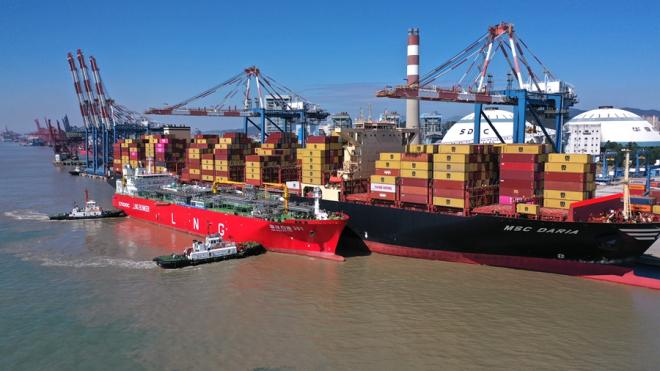
Core Viewpoint - Xiamen Port has made significant progress in its transition to a green port by successfully completing its first international ship-to-ship LNG bunkering operation, enhancing its clean energy supply capabilities with both biofuel and LNG [1][2][4] Group 1: LNG Bunkering Operation - The operation involved the bunkering of approximately 2,000 cubic meters of bonded LNG, taking around seven to eight hours to complete [2] - LNG is recognized as a mature and feasible clean fuel for ships, with its global adoption accelerating [2] - The successful implementation of the bonded LNG bunkering is a key achievement for Xiamen Port, contributing to its green port development and enhancing its attractiveness to international shipping [2][3] Group 2: Environmental Impact - Utilizing LNG as a ship fuel significantly reduces emissions of carbon dioxide and sulfur oxides, playing a crucial role in the shipping industry's efforts to achieve carbon neutrality and accelerate the green transition [2] - The port's capabilities in bonded biofuels and LNG will better meet the clean fuel needs of international vessels, further strengthening its service capacity [2][3] Group 3: Future Development Plans - Xiamen Port aims to enhance its infrastructure for LNG bunkering, optimize operational processes, and expand its clean energy offerings to include green methanol and ammonia [4][5] - The ongoing "14th Five-Year Plan" for Xiamen Port emphasizes green port development as a key focus area, aiming to establish a world-class, green, smart, and efficient port [5]
欧洲在全球AI竞赛中的致命短板——能源!
Hua Er Jie Jian Wen· 2025-11-10 09:33
Core Insights - Goldman Sachs warns that despite the European energy crisis potentially ending by 2027, Europe faces significant energy security vulnerabilities in the AI era, which could hinder its global competitiveness in AI [1] Group 1: Fossil Fuel Dependency - The report indicates that Europe's energy dependency is being reshuffled rather than reduced, with nearly half of its energy still imported, contrasting sharply with the U.S., which has become a net energy exporter [2] - Future energy imports will shift from Russia to the U.S. and Qatar, which are projected to account for 55% of global LNG exports by 2030, introducing geopolitical risks [2] Group 2: Low-Carbon Supply Chain Vulnerabilities - Europe is highly dependent on external sources for critical materials like rare earths and magnets, essential for wind turbines, electric vehicles, semiconductors, and AI systems, with its market share in rare earths being only about 2% [3] - The nuclear energy sector is entirely reliant on imported uranium, with 11% of the EU's energy consumption coming from nuclear power, and 75% of the uranium sourced from Canada, Kazakhstan, and Russia [3] Group 3: Weak Electrical Infrastructure - The aging electrical grid in Europe, averaging 50 years old, poses a significant challenge, as it is nearing the end of its design life and is fragmented, leading to large price discrepancies and vulnerability to outages and cyberattacks [5] - The rise of AI places additional pressure on the already strained electrical grid, with over 90% of data center operators citing power availability as their top concern, indicating that the weak infrastructure is a physical bottleneck for embracing the AI revolution [6]

乌克兰成“北溪”爆炸案被告,西方援乌联盟现裂痕
Jin Shi Shu Ju· 2025-11-10 09:08
Core Viewpoint - The investigation into the Nord Stream gas pipeline explosion, which is considered one of the largest sabotage actions in modern history, is threatening the foundation of support for Ukraine, with Germany identifying Ukraine as the mastermind behind the attack [1] Group 1: Investigation Details - A specialized detective team in Potsdam has been investigating the Nord Stream pipeline explosion for three years, focusing on the involvement of a Ukrainian special forces unit [1][2] - The pipeline, which was crucial for transporting Russian gas to Germany and other European countries, became a focal point of Western strategy following the outbreak of the Russia-Ukraine conflict in February 2022 [2] - The explosion in September 2022 led to accusations against Russia, while investigations have pointed towards a Ukrainian operation aimed at disrupting Russian oil revenue and its economic ties with Germany [2][3] Group 2: Evidence and Arrests - Key evidence includes a blurry black-and-white photo captured by German highway cameras, which identified a Ukrainian diver involved in the operation [3] - The investigation has led to arrest warrants for three Ukrainian special forces soldiers and four senior divers, with the operation being directed by a commander under the Ukrainian military [2][3] - A significant breakthrough occurred when a suspect was tracked to Italy, where he was arrested after crossing the EU border, with the German police having set up alerts for his movements [4] Group 3: Political Implications - The investigation and potential legal proceedings could escalate tensions between Ukraine and Germany, which is Ukraine's largest financial supporter and supplier of advanced weaponry [5] - Despite political pressure within Germany to reduce support for Ukraine, government officials believe they can manage domestic reactions, especially as public acceptance of Ukraine's involvement grows [5] - The outcome of the legal proceedings, expected in December, could have significant diplomatic repercussions for both countries [4][5]
欧洲冬天将烧柴取暖?俄警告:欧盟禁运俄天然气将导致价格暴涨
Sou Hu Cai Jing· 2025-11-10 08:43
Core Points - The ongoing gas dispute between the EU and Russia has intensified, with the EU planning to completely stop importing Russian energy by 2027 while simultaneously imposing sanctions [1][3] - Russia's Novatek chairman has warned that a ban on Russian gas could lead to unprecedented global gas price surges, ultimately affecting ordinary European citizens [1][5] - The EU's sanctions appear contradictory as it continues to rely heavily on Russian energy, spending €5.8 billion on Russian energy in Q1 2025, primarily on gas [1][5] Group 1: Sanctions and Energy Dependency - The EU has imposed multiple rounds of sanctions against Russia since the Ukraine conflict began, yet it remains dependent on Russian energy supplies [1][3] - In Q1 2025, the EU was still the largest buyer of Russian liquefied natural gas, highlighting the contradiction in its sanctions policy [1][3] Group 2: Impact on European Citizens - The rising energy prices have significantly burdened ordinary citizens in Europe, with German households potentially facing an additional €6,000 in energy costs since 2022 if prices had remained stable [5][7] - The comparison to the 2021 energy crisis indicates that a ban on Russian gas could exacerbate the current situation, leading to even higher costs for consumers [5][7] Group 3: Internal EU Disagreements - There are significant divisions within the EU regarding the energy sanctions, with countries like Slovakia and Hungary expressing strong opposition to the 2027 ban due to concerns over energy security and economic stability [9][11] - The varying levels of energy dependency among EU member states complicate the implementation of a unified sanctions strategy [9][11] Group 4: Future Energy Landscape - If the situation escalates to a complete ban on Russian gas, it could reshape the global energy landscape, with Russia redirecting its gas exports to emerging markets in Asia [13][15] - The EU is accelerating the development of renewable energy sources, but challenges such as technology, costs, and grid integration remain significant hurdles [13][15] Group 5: Long-term Solutions - The energy standoff between the EU and Russia lacks a clear resolution, necessitating a search for a balance, possibly through third-party energy transit or short-term supply agreements [15][17] - Long-term solutions may involve diversifying energy sources and enhancing international energy cooperation to address the intertwined issues of energy security, geopolitics, and consumer costs [15][17]