储能

Search documents
20cm速递|创业板新能源ETF国泰(159387)盘中微涨,锂钴稀土供需格局改善引关注
Mei Ri Jing Ji Xin Wen· 2026-01-08 06:52
Core Viewpoint - The lithium industry has undergone a three-year adjustment period, with supply and demand fundamentals improving rapidly, leading to a price recovery from a low of 60,000 yuan/ton to over 130,000 yuan/ton [1] Group 1: Lithium Industry - Supply-side disruptions in Yichun lithium mica mines due to permit issues are causing a gradual exit from extensive mining practices [1] - Demand for lithium is primarily driven by the power battery sector, while energy storage is emerging as a new growth driver due to its economic viability [1] Group 2: Cobalt Market - The Democratic Republic of Congo is implementing an export quota system, with a 2025 quota of only 96,600 tons, a year-on-year decrease of 56%, which may lead to a tight balance in supply and demand in the medium to long term [1] - Limited incremental supply from Indonesia is also contributing to the potential increase in cobalt prices [1] Group 3: Rare Earth Market - The supply side of the rare earth permanent magnet sector is being optimized through the "Rare Earth Management Regulations" and the integration of northern and southern groups [1] - The demand for rare earths is increasing, with the proportion of new energy vehicles reaching 42%, and new applications such as humanoid robots and energy-saving motors opening up long-term growth opportunities [1] Group 4: Energy Storage Batteries - Energy storage batteries are becoming a new engine for lithium demand, with domestic shipments in the first three quarters of 2025 expected to increase by 67% year-on-year, driven by policy support and improving economic viability [1] Group 5: ETF Performance - The Guotai New Energy ETF (159387) tracks the Innovation Energy Index (399266), which has a daily fluctuation of 20%, focusing on technology innovation companies in clean energy, new energy vehicles, and energy storage technology [1]

【大佬持仓跟踪】数据中心+液冷+储能,公司布局涵盖HVDC、液冷CDU等智算中心产品,细分电源产品全球份额第五
财联社· 2026-01-08 04:22
Core Viewpoint - The article emphasizes the importance of timely and professional information interpretation in investment decision-making, focusing on the investment value of significant events, analysis of industry chain companies, and key points of major policies [1] Group 1: Company Overview - The company specializes in data centers, liquid cooling, and energy storage, covering products such as HVDC and liquid cooling CDU [1] - It ranks fifth globally in market share for segmented power products and has successfully delivered energy storage products in multiple countries and regions [1] - The company's overseas market share has consistently been around 50% [1]


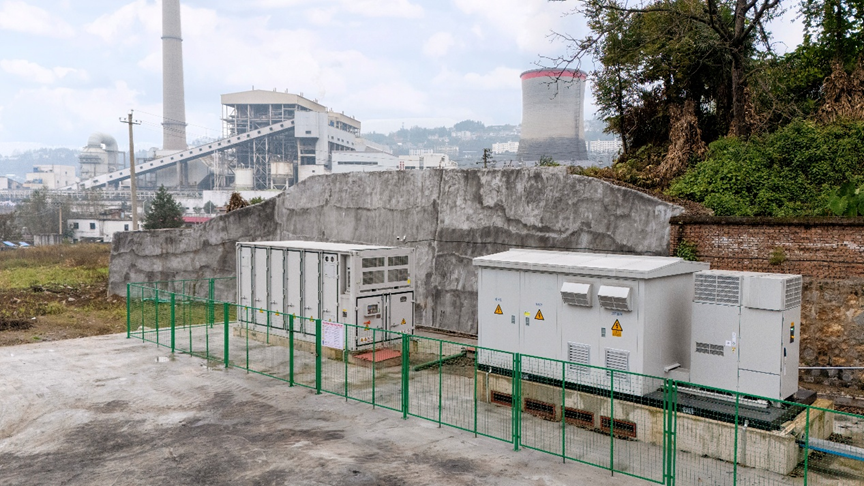
守护矿山安全 海博思创煤矿储能应急电源项目正式投运
Zheng Quan Shi Bao Wang· 2026-01-08 03:51
Core Insights - The article highlights the critical issue of power supply safety in China's coal mining industry, particularly in the complex geological conditions of Guizhou province [1] - A new emergency power storage project has been successfully implemented in a coal mine in Guizhou, showcasing advanced technology and addressing safety concerns [1][3] Group 1: Project Overview - The emergency power storage project, developed by Haibosi and Suzhou Inovance Technology Co., Ltd., features a 2.5MW/3.343MWh capacity and is designed to operate under harsh mining conditions [1] - The project utilizes an advanced liquid cooling energy storage system that is cost-effective, adaptable, highly integrated, and safe [1] Group 2: Safety and Economic Benefits - The project is tailored to meet coal mine safety standards and can quickly switch to emergency mode during power grid failures, ensuring continuous power supply to critical systems [3] - The Guizhou Provincial Energy Bureau plans to provide financial subsidies for coal mines that build emergency energy storage systems, enhancing power supply reliability and reducing gas risk [3] - The energy storage project not only ensures safety but also allows clients to leverage peak and off-peak electricity pricing for economic benefits, maximizing project value [3] Group 3: Future Directions - Haibosi aims to deepen its "Energy Storage + X" strategy, focusing on technological innovation to create a safer, more efficient, and intelligent energy ecosystem [3]
碳酸锂大涨,逼近15万元/吨
2 1 Shi Ji Jing Ji Bao Dao· 2026-01-08 03:36
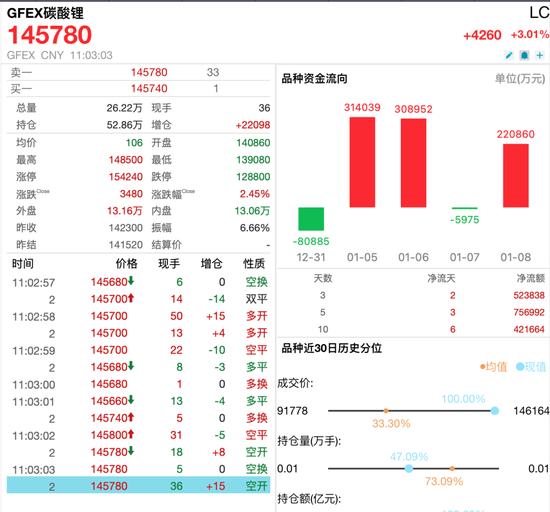
碳酸锂市场持续火热。1月8日,碳酸锂主力合约跳空上涨,涨幅最高触及近5%,一度站上146000万元/ 吨,截至11:00涨幅回落至3.01%。 更有乐观的期货机构预测,2026年全球锂资源供应增长至203万吨LCE,同期需求则可能升至214万吨 LCE,从而产生11万吨的需求缺口。(详情) 据工信部消息,1月7日,工业和信息化部、国家发展改革委、市场监管总局、国家能源局联合召开动力 和储能电池行业座谈会,研究部署进一步规范动力和储能电池产业竞争秩序工作。 会议指出,受多种因素影响,行业内存在盲目建设情况,出现低价竞争等非理性竞争行为,扰乱正常市 场秩序,削弱行业可持续发展能力,必须予以规范治理。 (声明:文章内容仅供参考,不构成投资建议。投资者据此操作,风险自担。)新浪声明:此消息系转 载自新浪合作媒体,新浪网登载此文出于传递更多信息之目的,并不意味着赞同其观点或证实其描述。 文章内容仅供参考,不构成投资建议。投资者据此操作,风险自担。 责任编辑:宋雅芳 截至目前,2026年开年以来,碳酸锂主力合约已连续多个交易日飘红,年内累计涨幅超21%,成为大宗 商品市场中表现最亮眼的品种之一。 A股方面,锂电、锂矿等指 ...
市场那些事丨岁末年初,春季行情抢跑在即?
Sou Hu Cai Jing· 2026-01-08 03:19
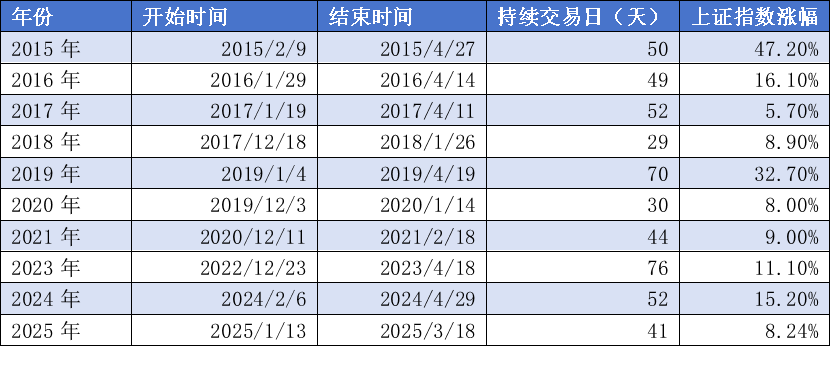
Group 1: Spring Market Dynamics - The spring market is characterized by a combination of policy expectations, liquidity easing, and an earnings vacuum period, creating a stage for market opportunities rather than being solely driven by seasonal factors [1] - The initiation of the spring market has been occurring earlier, with data showing that in the last five years, three instances saw the spring market start in December of the previous year, indicating a new market trend of "year-end sprint" [2] Group 2: Historical Performance - Historical data indicates that the spring market has varied in duration and performance, with the Shanghai Composite Index showing significant gains in various years, such as a 47.20% increase in 2015 and a projected 15.20% increase in 2024 [3] Group 3: External and Domestic Support - On the international front, reduced uncertainties, such as the U.S. Federal Reserve's interest rate cuts and a weaker dollar, are expected to enhance liquidity and attract foreign capital into the A-share market [4] - Domestically, a series of policy measures and early issuance of local government bonds are expected to provide strong support for economic recovery and market growth, with significant inflows into A-share ETFs indicating a favorable liquidity environment [5] Group 4: Investment Strategies - Investors are advised to focus on three main sectors: - The technology sector, which is expected to benefit from policy support in areas like artificial intelligence and semiconductor industries [6] - The cyclical sector, particularly in renewable energy and high-end manufacturing, which is anticipated to gain from global economic recovery and domestic policy initiatives [6]
2025年储能中标价格分析——CNESA年终盘点
中关村储能产业技术联盟· 2026-01-08 02:41
Core Insights - The energy storage industry is entering a critical period of value reshaping driven by technological iteration and market expansion by 2025 [2] - There is a significant structural differentiation and rational regression trend in bidding prices across various dimensions of energy storage systems [3][4] Bidding Price Overview - The average bidding prices for different energy storage systems in 2025 are as follows: - 1h energy storage system: 714.76 CNY/kWh, down 32.89% from 2024 - 2h energy storage system: 553.94 CNY/kWh, down 16.9% from 2024 - 4h energy storage system: 478.69 CNY/kWh, down 26.07% from 2024 - 2h EPC: 1043.82 CNY/kWh, down 13.04% from 2024 [5][10][11] Price Range and Structural Differences - The bidding price range for energy storage systems in 2025 is between 391.14 CNY/kWh and 913.00 CNY/kWh, with significant price differences based on duration [9] - The price drop for 0.25C energy storage systems is nearly double that of 0.5C systems, highlighting the impact of technological cost structures and scale effects [9] Collective Procurement Pricing - Collective procurement prices are approaching cost lines, with average prices for 2h and 4h systems significantly lower than individual project bids, averaging 464.45 CNY/kWh and 421.52 CNY/kWh respectively [14] - The price difference between collective procurement and individual project bids is around 12%-15% [14] Network-type Energy Storage Systems - The bidding prices for network-type energy storage systems show a trend of initial decline followed by stabilization, with 2h and 4h systems averaging 597.70 CNY/kWh and 622.90 CNY/kWh respectively [16] - The average bidding price for 2h network-type systems decreased by 3.06% compared to 2024, while 4h systems saw a decline of 24.98% [16] EPC Bidding Prices - The bidding prices for energy storage EPC projects vary significantly, ranging from 449.20 CNY/kWh to 2082.70 CNY/kWh, influenced by duration, technical requirements, and other factors [18] - The average bidding price for 1h EPC projects is 1280.15 CNY/kWh, down 55.91% from 2024, while 2h and 4h EPC projects average 1043.82 CNY/kWh and 935.40 CNY/kWh, down 13.04% and 8.19% respectively [19][20]
海博思创&汇川技术携手打造煤矿储能应用标杆案例
中关村储能产业技术联盟· 2026-01-08 02:41
Core Viewpoint - The article emphasizes the critical importance of power supply safety in coal mining, particularly in complex environments like Guizhou, where geological conditions pose significant challenges [2][3]. Group 1: Industry Challenges - Guizhou's coal mines face heightened risks due to complex geological conditions, high gas content, and the potential for external power grid failures, which can severely impact essential systems like ventilation and drainage [3]. - The need for reliable emergency responses in such environments is paramount, as any power outage can exacerbate safety risks [3]. Group 2: Project Implementation - A 2.5MW/3.343MWh emergency power storage project was successfully implemented in a Guizhou coal mine, developed in collaboration with Suzhou Inovance Technology Co., serving as a benchmark for energy storage applications in coal mining [4]. - The project utilizes an advanced liquid cooling energy storage system designed to operate reliably in harsh conditions, ensuring stable performance under high temperature, humidity, and dust [5]. Group 3: Safety and Efficiency - The project features a product design and EMS control strategy tailored to coal mine safety standards, enabling rapid switching to emergency mode during power grid failures, thus maintaining power supply to critical loads [7]. - This approach effectively mitigates safety risks associated with power outages, ensuring continuous operation of essential systems [7]. Group 4: Economic Benefits - The Guizhou Provincial Energy Bureau announced funding incentives for coal mines that establish emergency energy storage systems, aiming to enhance power supply reliability and reduce gas exceedance risks [8]. - The energy storage project not only ensures safety but also allows clients to leverage peak and off-peak electricity pricing, creating significant economic benefits through market operations [8]. Group 5: Future Directions - The company plans to deepen its "Energy Storage + X" strategy, focusing on technological innovation to build a safer, more efficient, and intelligent energy ecosystem [10]. - The company will participate in the 14th International Energy Storage Summit and Exhibition in 2026, highlighting its commitment to exploring future opportunities in the energy storage sector [10].


科力远20260107
2026-01-08 02:07
Summary of Kolyuan's Conference Call Company Overview - Kolyuan operates four lithium mines with a total reserve of approximately 12 million tons of raw ore, equivalent to about 400,000 tons of lithium carbonate [2][3][5] - The company is currently constructing a lithium carbonate production line with a capacity of 30,000 tons, of which 10,000 tons have already reached production [2][3] Key Points on Lithium Production - The mining license for the Tong'an mine has been expanded to 400,000 tons per year, expected to be operational by the end of 2026 or early 2027 to meet the demand for 10,000 tons of lithium carbonate [2][4][12] - Kolyuan's production cost for lithium carbonate is relatively low, with direct mining costs around 10,000 RMB per ton of raw ore and total costs approximately 60,000 RMB per ton of lithium carbonate [2][5][6] - The company uses a mica extraction method, eliminating the need for a beneficiation process, which provides a cost advantage over competitors [2][6] Future Production and Supply Plans - By 2027, Kolyuan's own mines are expected to support a lithium carbonate production capacity of 4,500 to 6,000 tons, depending on operational days and regulatory factors [11][17] - The Dantian mine is projected to start production between June and September 2027, providing 400,000 tons of raw materials, equivalent to over 10,000 tons of lithium carbonate, thus supporting a total supply capacity of 20,000 tons [12][17] Sales and Market Strategy - Approximately 46% of Kolyuan's lithium carbonate production is sold externally, as external sales offer better pricing and payment terms compared to internal consumption [10][19] - The pricing mechanism for externally sourced mica is based on the lithium carbonate sales price, resulting in thin margins for processing plants [16] Energy Storage Business - Kolyuan is actively expanding its energy storage business, with a focus on markets in Hebei, Inner Mongolia, Ningxia, and Shandong, aiming for a total of 10 GWh of projects by 2027 [19][22] - The company has completed 4 GWh of orders and plans to construct an additional 10 GWh of energy storage projects across various regions [20][21] Technological Developments - Kolyuan is exploring new lithium extraction technologies to reduce waste and improve efficiency, with pilot tests completed in Hunan [9][23] - The company is also developing solid oxide fuel cell (SOFC) materials and is working to expand its presence in the North American market [23][24] Conclusion - Kolyuan is positioned to capitalize on the growing lithium market with its low-cost production methods and strategic expansion into energy storage and advanced battery technologies. The company's focus on operational efficiency and market responsiveness will be critical in navigating future challenges and opportunities in the lithium industry.

内蒙古全区电力总装机在全国率先突破3亿千瓦 外送电量3500亿千瓦时
Zhong Guo Dian Li Bao· 2026-01-08 00:32
Core Insights - Inner Mongolia is expected to complete investments exceeding 300 billion yuan in major energy projects by 2025, with energy industrial investment accounting for approximately 35% of the region's fixed asset investment [2] Group 1: Energy Supply and Capacity - The energy supply security capability has significantly improved, with Inner Mongolia set to fulfill a coal supply task of 795 million tons by 2025, adding 13 new coal production capacity reserve projects totaling 23.6 million tons [2] - The total installed power capacity in Inner Mongolia is projected to exceed 300 million kilowatts, leading the nation, with an external electricity delivery of 3.5 trillion kilowatt-hours, maintaining the top position for 21 consecutive years [2] Group 2: Power System Enhancements - The power system's support and regulation capabilities will be further enhanced, with the completion of the 500 kV main grid construction for both the eastern and western power grids by 2025 [2] - The State Grid's eastern power market will initiate continuous settlement trial operations, while the western power market will transition to formal operations [2] Group 3: Renewable Energy Development - Wind power installed capacity in Inner Mongolia has surpassed 10 million kilowatts, with an annual addition of 35 million kilowatts, bringing the cumulative installed capacity to over 170 million kilowatts and generating 270 billion kilowatt-hours, ranking first in the nation for ten consecutive years [2] - The region has delivered 90 billion kilowatt-hours of green electricity externally, marking a year-on-year growth of over 40% [2] Group 4: Energy Storage and Hydrogen Production - Inner Mongolia has accelerated energy storage development through policy support, implementing a "discharge compensation" mechanism with compensation rates set at 0.35 yuan/kWh for 2025 and 0.28 yuan/kWh for 2026, with a cumulative new energy storage capacity exceeding 17 million kilowatts [3] - The green hydrogen production in Inner Mongolia is expected to exceed 10,000 tons by 2025, quadrupling the output from 2024, leading the nation in this sector [4] Group 5: Technological Innovation - By 2025, the proportion of green and intelligent coal mines in production will reach 61% and 74%, respectively, with ten technological equipment in hydrogen energy, energy storage, and new power systems recognized as major national first sets [4] - Seven projects have been selected as national pilot projects in the hydrogen energy sector, the highest number in the country [4]
拆解华为储能帝国的隐秘版图|深度
24潮· 2026-01-07 23:06
Core Viewpoint - Huawei's entry into the energy storage sector has positioned it as a significant player, leveraging its ICT technology and extensive industry experience to reshape the market landscape and achieve global recognition [2][9][19]. Group 1: Huawei's Strategic Moves - In 2021, Huawei established a digital energy subsidiary with an investment of 3 billion yuan, marking a significant commitment to the digital energy sector [4]. - Huawei's organizational restructuring included the formation of various "legion" teams targeting emerging markets, emphasizing the importance of the digital energy segment as a business engine [5]. - The digital energy business has become Huawei's third-largest revenue source, contributing 8% to the total revenue of 862.1 billion yuan in 2024 [5]. Group 2: Market Position and Achievements - Huawei has become a dominant player in the photovoltaic inverter market, achieving the top position globally in 2015 and maintaining a strong presence since then [6][19]. - In the energy storage sector, Huawei ranked as the fifth-largest company globally by shipment volume in the first three quarters of 2025, with a year-on-year growth of 84.7% [10]. - Huawei's significant project in Saudi Arabia, the 1,300 MWh energy storage project, is the largest off-grid storage project globally, showcasing its capabilities in large-scale energy solutions [9][10]. Group 3: Technological Innovations - Huawei's advancements in inverter technology, particularly the string inverter, have set industry standards, with a market share exceeding 50% in key projects [20]. - The company has introduced a grid-forming energy storage technology that enhances system stability and efficiency, positioning itself as a leader in the integration of AI and energy management systems [24][29]. - Huawei's focus on software and system integration, rather than manufacturing core components like battery cells, differentiates it from competitors and allows for a unique market approach [38]. Group 4: Global Expansion and Partnerships - Huawei has established strategic partnerships in various regions, including Europe and Southeast Asia, to enhance its market presence and adapt to local energy structures [36][37]. - The company has secured multiple international contracts, including a 132 MWh project in Denmark and a 12 MWh project in Cambodia, demonstrating its commitment to global expansion [31][32]. - Huawei's approach combines technology, localization, and collaboration with local contractors to efficiently penetrate new markets [36]. Group 5: Industry Challenges and Competitive Landscape - The energy storage industry is facing intense competition, with major players like Tesla and BYD rapidly advancing, posing challenges for Huawei [39]. - Supply chain dependencies, particularly regarding battery cells, present risks that could impact Huawei's operational reliability and cost management [40]. - Regulatory challenges and geopolitical tensions may affect Huawei's ability to compete in international markets, especially in light of restrictions imposed by the U.S. and other countries [41].