
外卖

Search documents
中国股市复苏之路探析
Zheng Quan Shi Bao Wang· 2025-08-01 10:50
Group 1 - The core viewpoint is that the recovery of the Chinese stock market is worth close attention due to factors such as easing trade agreements, domestic policy stimulus, improved risk-reward dynamics, and support from global investor allocations [1] - Early signs of economic improvement are emerging, with retail sales growth rate reaching 6.4% year-on-year in May, exceeding expectations [1] - The rising household savings rate, which accelerated from 44% in 2023 to 55% in 2024, reflects a cautious consumer sentiment amid a challenging global environment [1] Group 2 - More stimulus measures are expected to be introduced to further boost consumption, with previous initiatives like the "trade-in" program contributing to strong retail sales in the first half of the year [2] - The government is accelerating the improvement of the childbirth support policy system, recently announcing a cash subsidy of 3,600 yuan per child per year for children under three years old [2] - Recent official meetings have enhanced optimism regarding China's policy outlook, with measures aimed at promoting rational competition and addressing price pressures in various sectors [2] Group 3 - The company maintains a positive outlook on Asian (excluding Japan) stocks, believing that Chinese stocks will generate excess returns due to targeted policy measures aimed at growth, capacity optimization, and overcoming price pressures [3] - Emphasis is placed on the importance of diversified asset allocation, including high-quality bonds, gold, and alternative investments, to achieve optimal returns and protect wealth from market volatility [3]
抵制“内卷”竞争,美团、京东、饿了么集体发声!
Guo Ji Jin Rong Bao· 2025-08-01 10:46
8月1日,三家外卖平台集体发声,对"内卷式"竞争说"不"。 美团表示,"近日,外卖平台补贴引发社会高度关注,美团对此高度重视,将坚决规范促销行为,杜绝不正当竞争行为,推动建立公平有序行业秩序,促进 各方互利共赢。" 对此,美团承诺从自身做起,并积极呼吁行业共同构建良好生态,促进餐饮服务行业规范健康持续发展。 一是开展补贴活动严格遵守《反垄断法》、《反不正当竞争法》、《电子商务法》、《价格法》、《反食品浪费法》等法律法规,不以显著低于成本的价格 销售商品和服务,严重扭曲价格信号,扰乱市场竞争秩序,造成浪费。 二是开展补贴活动依法向商家和消费者公示补贴信息,不对补贴总额进行夸大宣传。 三是不强制或变相强制商家参加补贴活动,切实保障商家自主定价权。 美团表示,外卖市场联系着广大消费者,也关系广大商户和骑手,非理性竞争带来的畸形发展,无论是对消费者,对商户,对骑手都不可能带来可持续的利 益。 午间,"京东黑板报"发布《践行主体责任和社会责任共建外卖行业健康生态》文章表示,外卖行业补贴引发社会广泛关注,不少行业协会、商家发声,希望 停止"0元购"等内卷式补贴促销行为,构建良好行业生态,实现多方互利共赢良性发展。 三、提 ...



新华财经晚报:多家外卖平台发文表示抵制恶性竞争
Xin Hua Cai Jing· 2025-08-01 10:18
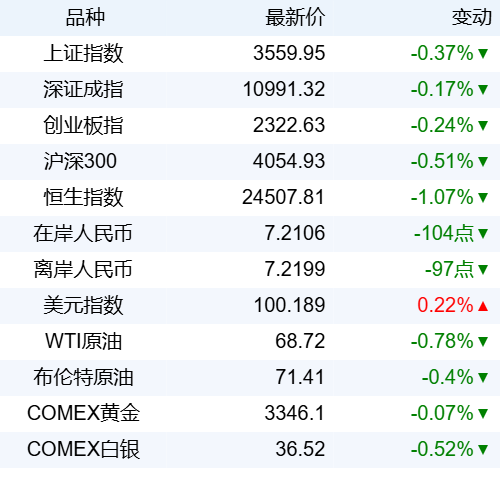
Key Points - The National Development and Reform Commission (NDRC) will allocate the fourth batch of 69 billion yuan for the old-for-new consumption subsidy in October, completing the annual target of 300 billion yuan [1][2] - In the first half of 2025, domestic residents are expected to make 3.285 billion trips, a year-on-year increase of 20.6% [2] - Major companies like Meituan, Taobao, Ele.me, and JD.com have publicly committed to resisting malicious competition and promoting healthy market practices [2] - The software industry in China reported a revenue of 70.585 billion yuan in the first half of the year, with a year-on-year growth of 11.9% [2] - The average price of new residential properties in 100 cities increased by 0.18% month-on-month and 2.64% year-on-year, while second-hand residential prices decreased by 0.77% month-on-month and 7.32% year-on-year [3] - Goldman Sachs has warned investors to hedge risks due to the recent trade agreements between the U.S. and its partners, despite a controlled recession risk [4] - The U.S. non-farm payrolls are expected to increase by 110,000 in July, the smallest gain in five months, with an anticipated rise in the unemployment rate to 4.2% [4] - The Eurozone's July CPI showed a month-on-month change of 0% and a year-on-year change of 2% [5] - In Japan, over 1,000 food items are expected to see price increases in August, with an average rise of 11% [6]
美团、京东、饿了么,同日发文
盐财经· 2025-08-01 10:11
Core Viewpoint - The article discusses the recent price competition and subsidy practices in the food delivery industry, highlighting the responses from major players like Meituan, Alibaba, and JD.com to promote fair competition and sustainable business practices [4][6][7]. Group 1: Company Responses - Meituan emphasizes the need to regulate promotional activities and eliminate unfair competition, advocating for a fair and orderly industry environment [5][6]. - Ele.me (part of Alibaba) commits to resisting irrational promotional activities like "0 yuan purchase" and focuses on enhancing service quality and consumer experience [6][7]. - JD.com also pledges to reject unhealthy competition and promote a transparent subsidy mechanism, aiming to shift the focus from price competition to quality and service [7][9]. Group 2: Industry Challenges - The article highlights the widespread concern regarding irrational competition and excessive subsidies, which distort market signals and disrupt the competitive order [5][6]. - There is a call from industry associations and merchants to halt practices like "0 yuan purchase" to foster a healthier industry ecosystem [7][9]. Group 3: Future Directions - Companies are encouraged to build a multi-win ecosystem involving consumers, merchants, and delivery personnel, focusing on quality and service rather than just price [5][6][9]. - The emphasis is placed on listening to merchant feedback, reducing operational costs, and ensuring fair treatment for all stakeholders in the delivery ecosystem [6][9].
美团、饿了么、京东,最新发声!
证券时报· 2025-08-01 10:11
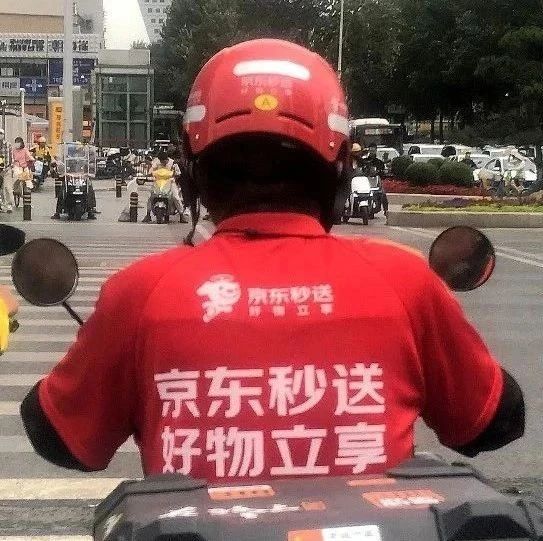
Core Viewpoint - The article discusses the recent announcements from major food delivery platforms in China, including Meituan, Ele.me, and JD, to resist "involution" style competition and promote a healthier industry ecosystem following intense subsidy wars and regulatory scrutiny [1][2][5]. Group 1: Industry Response to Competition - On August 1, Meituan, Ele.me, and JD jointly announced their commitment to resist excessive competition and maintain a healthy industry ecosystem [2]. - The platforms emphasized the need to standardize subsidy behaviors, oppose involution, and enhance service quality, aligning with previous regulatory requirements [5]. - The State Administration for Market Regulation had previously urged these companies to comply with various laws and regulations, including the E-commerce Law and the Anti-Unfair Competition Law, to foster a win-win ecosystem for consumers, merchants, delivery riders, and platforms [5]. Group 2: Specific Stances on Subsidies - JD stated its position against "0 yuan purchase" and other harmful subsidies, aiming to create a transparent subsidy mechanism and ensure fair competition [8]. - Meituan outlined four specific guidelines for subsidy activities, including compliance with laws, transparency in subsidy information, respect for merchants' pricing autonomy, and non-discriminatory practices [9][10][11][12]. - Ele.me committed to avoiding large-scale irrational promotional activities like "0 yuan purchase," focusing instead on reasonable subsidy distribution and protecting merchants' rights [13][14]. Group 3: Enhancing Service Quality and Cooperation - JD aims to improve service quality by promoting responsible consumption and providing various incentives to merchants, while also enhancing rider welfare [17][20]. - Ele.me plans to enhance service quality through diversified consumer experiences and ongoing communication with merchants to optimize operations [18][19]. - Meituan emphasizes the importance of building a cooperative ecosystem that benefits consumers, merchants, and riders, while advocating for sustainable business practices [21].

美团、饿了么、京东,最新发声!
Zheng Quan Shi Bao· 2025-08-01 10:10
Core Viewpoint - The major food delivery platforms in China, including Meituan, Ele.me, and JD, have announced a joint effort to resist "involution" competition and promote a healthier industry ecosystem following intense subsidy wars and regulatory scrutiny [1][4]. Group 1: Industry Response to Competition - The three platforms have expressed a commitment to standardizing subsidy practices, opposing involution, and enhancing service quality, aligning with previous regulatory requirements [4]. - The State Administration for Market Regulation recently urged these platforms to comply with various laws, including the E-commerce Law and the Anti-Unfair Competition Law, to foster a win-win ecosystem for consumers, merchants, delivery riders, and platform companies [4]. Group 2: Specific Stances on Subsidies - JD has stated its position against "0 yuan purchase" and other harmful subsidies, emphasizing the need for a transparent subsidy mechanism and the importance of not inflating market status through order volume [6]. - Meituan has outlined four specific guidelines for subsidy activities, including compliance with laws, not selling below cost, ensuring fair participation for merchants, and maintaining transparency in subsidy information [7][8][9]. - Ele.me has committed to avoiding large-scale "0 yuan purchase" promotions and will focus on reasonable subsidy distribution while respecting merchants' rights [10]. Group 3: Enhancing Service Quality and Cooperation - JD aims to improve service quality by promoting food safety and encouraging responsible consumption, while also providing various incentives to merchants and enhancing rider welfare [12][13]. - Ele.me plans to enhance service quality through diversified consumer experiences and ongoing communication with merchants to optimize operations [14][15]. - Meituan emphasizes the importance of a balanced ecosystem among consumers, merchants, and riders, aiming to improve rider income stability and reduce operational costs for merchants [16][17].

上海交大安泰EMBA“E堂大课”,聚焦单身经济新赛道
Sou Hu Cai Jing· 2025-08-01 10:02
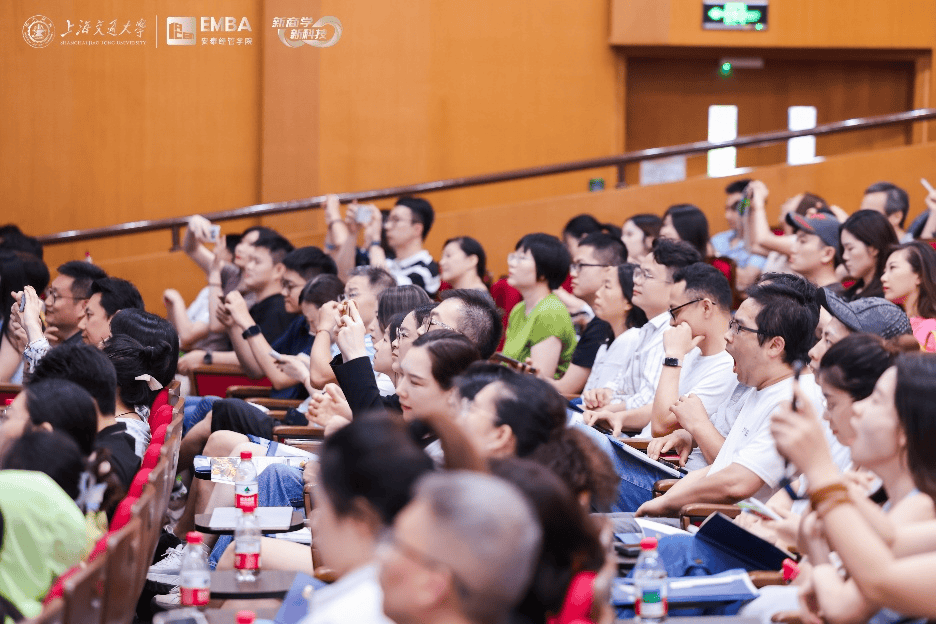
Core Insights - The event hosted by Shanghai Jiao Tong University focused on the emerging "single economy," highlighting its potential to reshape consumption patterns and create a trillion-level economic ecosystem [1][3]. Group 1: Single Economy Overview - The single population in China has exceeded 240 million, significantly impacting consumption behaviors and driving the growth of a trillion-level economy [3]. - The "eight one" industry map includes: one-person meals (takeout and small portion prepared dishes), one-person usage (mini home appliances), one-pet companionship (pet economy), one-person entertainment (short dramas and concerts), one-person living (demand for small apartments), one-person travel, one-person beauty (rapid growth in light medical beauty and cosmetics), and one-person companionship (rise of AI and virtual companionship), with an overall market size reaching 8 trillion [3]. Group 2: Emotional Consumption Trends - The short drama market is particularly notable, with a market size exceeding 50 billion in 2024, surpassing China's film box office, and expected to exceed 100 billion by 2027 [5]. - The proportion of paying users for short dramas increased from 40.5% in January 2024 to 48% in February 2025, indicating a strong trend towards emotional value in consumption [5]. - A new marketing strategy for the single economy, SEE (Scene, Emotion, Engagement), emphasizes creating single scenarios, conveying emotional resonance, and enhancing interactive experiences [5]. Group 3: Pet Economy Insights - The pet economy is becoming increasingly significant within the single economy, transitioning from a "guard dog" role to being viewed as family members [6]. - The number of dogs and cats in China has surpassed 120 million, with over 10 million new pets born in 2023 [6]. - The pet economy is valued at 350 billion, with an annual growth rate exceeding 20%, and pet food accounting for 48% of this market [6]. Group 4: Future Trends in Pet Economy - Five future trends in the pet economy include: premiumization and segmentation, smart and emotional products, health ecosystem formation, personalization and experiential offerings, and digital media dominance [8]. Group 5: EMBA Program Insights - The EMBA program at Shanghai Jiao Tong University emphasizes global vision and innovation capabilities, providing comprehensive support and resource connections for entrepreneurs [9]. - The continuous growth of the single population and changing social attitudes are expected to drive rapid growth in the single economy over the next five years, making it a crucial engine for domestic demand [11].
美团、京东、淘宝闪购、饿了么齐发文:抵制恶性竞争 促进生态共赢
Jing Ji Guan Cha Wang· 2025-08-01 09:31
Core Viewpoint - The recent focus on subsidies in the food delivery industry has prompted major players like Meituan, Taobao, and JD to advocate for a fair and orderly market environment, emphasizing the need to eliminate unhealthy competition and promote mutual benefits among all stakeholders [2][6][7]. Group 1: Company Responses - Meituan has committed to regulating promotional activities and eliminating unfair competition, aiming to establish a fair industry order that benefits all parties involved [2]. - Taobao and Ele.me have jointly declared their stance against malicious competition and pledged to foster a collaborative ecosystem for mutual benefits [4]. - JD's external communication emphasizes the importance of stopping "0 yuan purchase" promotions and other aggressive subsidy practices to build a healthy industry ecosystem [6][7]. Group 2: Key Initiatives - Companies are focusing on standardizing subsidy practices, ensuring transparency in marketing activities, and allowing merchants to independently manage promotional efforts [7]. - There is a strong emphasis on resisting unhealthy competition by enhancing product quality and service, shifting the focus from subsidies to quality and service excellence [7][8]. - Initiatives to improve service quality include maintaining food safety standards, promoting responsible consumption, and enhancing the overall consumer experience [8]. Group 3: Mutual Benefits - Companies are committed to providing various incentives for merchants, such as commission rewards, advertising support, and delivery fee subsidies, to help them operate more effectively [8]. - Efforts are being made to improve the working conditions and dignity of delivery personnel, fostering a positive cycle among consumers, merchants, delivery workers, and platforms [8].

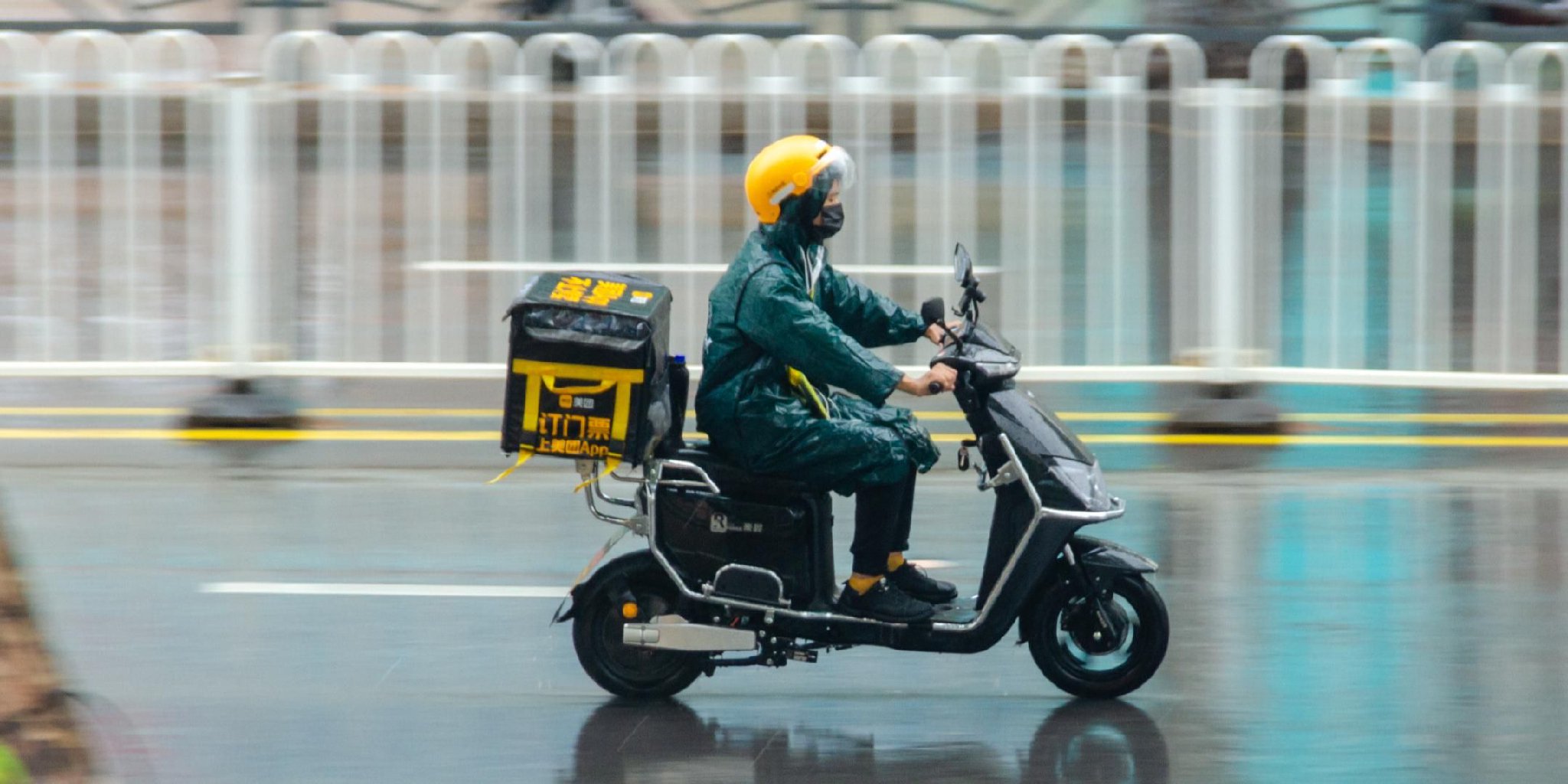
多家外卖平台发文“抵制无序恶性竞争”
Zhong Guo Qing Nian Bao· 2025-08-01 09:31
Core Viewpoint - Major food delivery platforms in China, including Meituan, Taobao Flash Sale, Ele.me, and JD.com, have issued statements calling for the cessation of disorderly and malicious competition in the industry, particularly regarding subsidy practices that distort market dynamics [1][9]. Group 1: Meituan's Commitment - Meituan emphasizes the need to regulate promotional activities and eliminate unfair competition, aiming to establish a fair and orderly industry environment [1]. - The company pledges to comply with laws and regulations, ensuring that subsidies are not significantly below cost, which distorts price signals and disrupts market order [1]. - Meituan will not force merchants to participate in subsidy activities, ensuring merchants' autonomy in pricing and promoting a balanced development between takeout and dine-in services [2]. Group 2: Taobao Flash Sale and Ele.me's Initiatives - Taobao Flash Sale and Ele.me have made four commitments focused on enhancing service quality and promoting healthy competition, including planning subsidies based on consumer and merchant needs [4][5]. - Both platforms will respect merchants' rights to information, choice, and pricing, actively working to eliminate unfair competition and stimulate market consumption potential [5]. - They will implement a strict mechanism for subsidy distribution and provide clear promotional information to consumers, ensuring transparency and protecting consumer rights [5]. Group 3: JD.com's Stance - JD.com has reiterated its commitment to resisting unfair competition and will not engage in irrational promotional activities like "0 yuan purchase" schemes [6]. - The company aims to create a simple and transparent subsidy mechanism, ensuring that merchants can operate independently and participate in promotions voluntarily [6]. - JD.com is focused on enhancing food safety, promoting responsible consumption, and improving the dignity and benefits of delivery riders [6]. Group 4: Industry Context - The recent surge in subsidies within the food delivery industry has drawn significant public attention, prompting calls from industry associations and merchants to halt practices that lead to excessive competition [9]. - The State Administration for Market Regulation has urged major platforms to adhere to relevant laws and regulations, emphasizing the need for responsible competition and a collaborative ecosystem among consumers, merchants, delivery riders, and platforms [9].
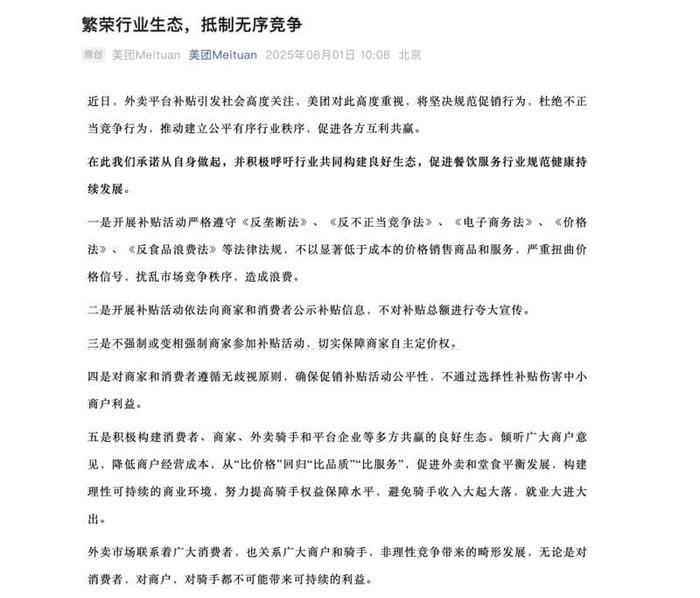
美团、淘宝闪购、饿了么、京东集体发文:立即停止“内卷式”竞争
Jing Ji Guan Cha Wang· 2025-08-01 09:27
Core Viewpoint - The recent subsidy wars in the food delivery industry have raised widespread social concern, prompting industry associations and businesses to call for an end to irrational promotional practices like "0 yuan purchase" to foster a healthy industry ecosystem and achieve mutual benefits [1][2]. Group 1: Industry Response - On August 1, major players including Meituan, Taobao Flash Sale, Ele.me, and JD collectively issued a statement advocating for industry regulation of promotions and the elimination of unfair competition [1]. - Meituan committed to adhering to relevant laws and regulations during subsidy activities, ensuring that prices do not significantly undercut costs and that subsidy information is transparently communicated to merchants and consumers [1]. - Taobao Flash Sale and Ele.me pledged to plan subsidies rationally based on consumer and merchant needs, actively avoiding irrational promotional activities and enhancing service experiences [1]. - JD emphasized its stance against irrational competition and committed to resisting "0 yuan purchase" practices, focusing on quality and differentiation through service improvements and supply chain innovation [1]. Group 2: Market Dynamics - The latest round of competition in the food delivery sector began in February when JD entered the market with a "0 commission + 10 billion subsidy" strategy, disrupting the long-standing dominance of Meituan and Ele.me [2]. - Following JD's entry, Ele.me and Taobao Flash Sale launched a counter-offensive with a 500 billion yuan subsidy, leading to a "historic subsidy war" characterized by extremely low prices for consumers [2]. - The surge in orders reached unprecedented levels, with Meituan surpassing 150 million daily orders and Taobao Flash Sale achieving 80 million [2]. - However, the burden of these subsidies primarily fell on merchants, with over 70% of the subsidy costs being absorbed by them, leading to significant financial strain [2]. Group 3: Regulatory Environment - On July 18, the State Administration for Market Regulation held talks with Ele.me, Meituan, and JD, urging them to comply with the E-commerce Law and to engage in rational competition to foster a healthy ecosystem [3]. - This regulatory intervention follows earlier discussions in May, indicating a strong commitment to governance during the peak of the subsidy war [3]. - A report from Goldman Sachs predicts a deep restructuring of the food delivery industry, with extreme discounts likely to diminish and a shift towards efficiency-driven competition focusing on service quality and food safety [3]. - Long-term market share projections suggest that by the end of 2025, Meituan could hold 50%-55% of the market, Ele.me 15%-18%, and JD 12%-15%, while smaller regional players may face consolidation or exit [3].