
装备制造

Search documents
成都都市圈上半年GDP超1.5万亿元
Xin Hua Cai Jing· 2025-07-27 10:38
Group 1 - The core viewpoint of the news is that the Chengdu metropolitan area has achieved significant economic growth in the first half of the year, with a total GDP of 15,171.78 billion yuan, driven primarily by Chengdu's dominance in the region [1][2] - Chengdu's GDP accounts for 79.8% of the total GDP of the metropolitan area, highlighting its central role in the economic landscape [1] - The metropolitan area has identified nine key industrial chains, with a total output value exceeding one trillion yuan, focusing on sectors such as new displays, rail transit, aerospace equipment, new energy vehicles, green food, and medical beauty services [1] Group 2 - The production output of key industrial products has seen robust growth, with Chengdu's new energy vehicles, smartwatches, and lithium-ion batteries increasing by 352.2%, 119.2%, and 45.8% respectively [1] - The third industry in Chengdu, which includes services, has shown a significant increase, with a value of 8,654.2 billion yuan, representing 71.5% of the regional GDP [2] - Deyang continues to leverage its strengths in equipment manufacturing, with a reported revenue of 1,799.0 billion yuan from large-scale industrial enterprises, reflecting a year-on-year growth of 10.8% [2]
68.1%、40.9%、72.8%,利润增长!“AI+”“数字+”助推传统产业改造提升“加速跑”
Yang Shi Wang· 2025-07-27 06:30
Core Insights - In June, the revenue of industrial enterprises above designated size in China increased by 1.0% year-on-year, maintaining the same growth rate as in May [3] - The total profit for these enterprises reached 715.58 billion yuan, with a year-on-year decline narrowing by 4.8 percentage points compared to May [3] - The equipment manufacturing sector showed significant growth, with revenue increasing by 7.0% year-on-year and profits turning from a decline of 2.9% in May to a growth of 9.6% in June, contributing to a 3.8 percentage point increase in overall industrial profits [6][13] Revenue and Profit Trends - For the first half of 2023, industrial enterprises achieved a total revenue of 6.678 trillion yuan, reflecting a year-on-year growth of 2.5% [10] - The manufacturing sector's total profit for the same period was 2.590 trillion yuan, marking a year-on-year increase of 4.5% [10] Sector Performance - Notable profit growth was observed in specific industries, including: - Electronic special materials manufacturing: 68.1% increase [5] - Smart consumer equipment manufacturing: 40.9% increase [5] - Lithium-ion battery manufacturing: 72.8% increase [5] - The automotive industry experienced a remarkable profit increase of 96.8% year-on-year [13] - The smart unmanned aerial vehicle manufacturing and computer assembly industries saw profits rise by 160% and 97.2%, respectively, in June [15] Economic Drivers - The development of new production capacities and the emergence of new technologies, industries, and business models are accelerating the transformation of traditional industries [8] - The integration of AI and digital technologies is driving price increases for products related to new growth drivers, leading to an optimization of profit structures [8]

解读海南上市公司品牌价值:“封关”也是海南本地企业的“品牌大考”
Mei Ri Jing Ji Xin Wen· 2025-07-27 05:52
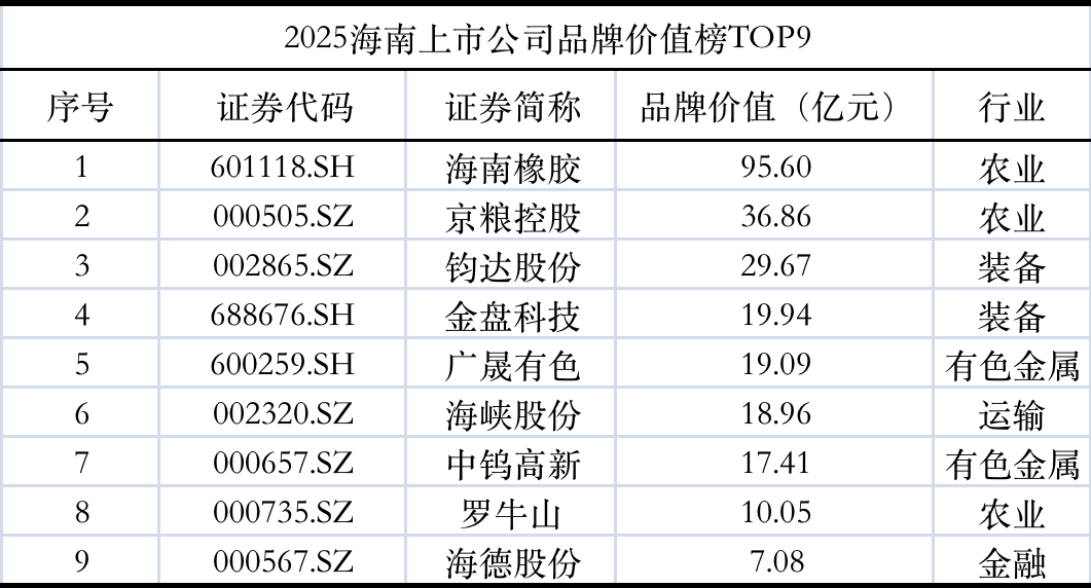
Group 1 - The Hainan Free Trade Port will officially start its full island closure operation on December 18, 2025, as approved by the Central Committee [1] - The capital market reacted quickly, with the Hainan Free Trade Zone index rising by 9.11% on July 24, reaching 1504.21 points [1] - The index opened at 1533.24 points on July 25 but eventually fell to 1447.47 points [1] Group 2 - The "2025 Brand Value Ranking of Hainan Listed Companies" indicates that Hainan has nine listed companies in the top 3000 brand values in China, but others did not make the list due to low brand values [2] - Hainan Rubber (601118.SH) leads the ranking with a brand value of 95.60 billion yuan, significantly higher than the second to fourth ranked companies combined [3][5] - The total brand value of Hainan listed companies is approximately 255 billion yuan, ranking 30th among provincial administrative regions in China [7] Group 3 - The agricultural sector has the highest combined brand value in Hainan, exceeding 14 billion yuan [5] - Hainan's unique tropical climate presents significant potential for agriculture, particularly in marine fisheries [5] - The local listed companies need to enhance competitiveness and address talent shortages to capitalize on the advantages brought by the Free Trade Port [7]

上半年海南经济稳中向好、质效提升
Sou Hu Cai Jing· 2025-07-27 01:43
Economic Overview - The economy of Hainan Province showed a stable and progressive development trend in the first half of 2025, with a GDP growth of 4.2% year-on-year at constant prices [1] - The value added of primary, secondary, and tertiary industries grew by 4.7%, 5.1%, and 3.7% respectively [1] Agricultural Sector - The total output value of agriculture, forestry, animal husbandry, and fishery reached 129.185 billion yuan, marking a year-on-year increase of 5.1% [1] Industrial Sector - Industrial production accelerated, with the equipment manufacturing sector experiencing a significant increase of 72.4%, outpacing the overall industrial value added growth by 61 percentage points [1] - The processing value added in the free trade port policy showed positive effects, with petroleum, coal, and other fuel processing increasing by 35.2%, and oil and gas extraction growing by 52.8% [1] - The agricultural and sideline food processing industry saw a growth of 53.5% [1] Service Sector - The value added of the service industry (tertiary sector) increased by 3.7% year-on-year [1] - The total import and export value of services reached 34.710 billion yuan, reflecting a rapid growth of 24.7% [1] Investment and Consumption - Equipment investment grew by 5.9% due to the promotion of large-scale equipment renewal policies [2] - Infrastructure investment (excluding electricity, gas, and water supply) increased by 17.9%, exceeding the overall investment growth rate by 25.5 percentage points [2] - The total retail sales of social consumer goods reached 132.989 billion yuan, with a year-on-year growth of 11.2%, accelerating by 7 percentage points compared to the first quarter [2] Environmental and Energy Development - The air quality in Hainan was rated as good 96.8% of the time, with a 100% compliance rate for water quality in urban water sources [2] - Clean energy generation, particularly wind and hydropower, saw significant growth, with wind power increasing by 3.3 times and hydropower by 12.7% year-on-year [2] Future Outlook - The overall economic recovery trend is strengthening, with positive factors for economic transformation and high-quality development continuing to accumulate [2] - Future efforts will focus on effective investment, stabilizing foreign trade, and improving service quality [2]
拓外贸出口动能向优向新 引外资中国市场磁吸力强
Zhong Guo Fa Zhan Wang· 2025-07-26 09:07
Group 1: Trade Performance - Since the launch of the China-Europe Railway Express in 2013, the Manzhouli railway port has seen a cumulative traffic of over 30,000 trains, sending nearly 3 million TEUs, accounting for about 30% of the national total [1] - In the first half of this year, China's total import and export trade reached 21.79 trillion yuan, a year-on-year increase of 2.9%, with exports at 13 trillion yuan, growing by 7.2% [1] - The export of electromechanical products reached 7.8 trillion yuan, a year-on-year increase of 9.5%, making up 60% of total exports [1] Group 2: Foreign Investment - In the first half of 2025, 30,014 new foreign-invested enterprises were established in China, a year-on-year increase of 11.7% [2] - Direct investment net inflow from equity nature reached 31.1 billion USD, a year-on-year increase of 16% [2] - Foreign enterprises contributed significantly to China's economic growth, with foreign-invested enterprises' import and export volume reaching 6.32 trillion yuan, a year-on-year increase of 2.4% [5] Group 3: Private Enterprises - Private enterprises are the main force in exports, with their import and export volume reaching 12.48 trillion yuan, a year-on-year increase of 7.3%, accounting for 57.3% of China's foreign trade [3] - The equipment manufacturing sector, particularly in shipbuilding, automobiles, and specialized equipment, has seen double-digit growth in exports [3] Group 4: Market Dynamics - The "export rush" phenomenon has contributed to the growth in trade, with exports to non-U.S. countries maintaining rapid growth, particularly to ASEAN and the EU, with year-on-year increases of 13.0% and 6.6% respectively [4] - The net export of goods and services contributed 1.7 percentage points to China's economic growth, which is 1.0 percentage points higher than the previous year [4] Group 5: Future Outlook - Experts indicate that while the first half of the year showed resilience in foreign trade, the second half will face multiple uncertainties, including global unilateralism and protectionism [7] - The "export rush" effect may continue to drive export growth, but uncertainties in U.S. tariff policies could impact future trade dynamics [7] - The Chinese market remains an attractive option for foreign investment, with significant projects being launched, indicating a strong commitment from foreign enterprises [6]

山东部署十大重点改革事项,推动各项改革措施形成协同效应
Da Zhong Ri Bao· 2025-07-26 00:29
Group 1 - Shandong Heavy Industry Group has launched the first AI smart bulldozer in the engineering machinery industry, aiming to fully apply core AI functions within three years and create a collaborative ecosystem of "AI smart assistants + construction machinery groups" [2] - In the first half of the year, Shandong Heavy Industry Group achieved a profit of 14.97 billion yuan, a year-on-year increase of 6.9%, leading the equipment manufacturing industry and ranking first among Shandong state-owned enterprises [2] - Shandong's GDP surpassed 5 trillion yuan in the first half of the year, with a year-on-year growth of 5.6%, which is 0.3 percentage points higher than the national average, reflecting the continuous enhancement of reform vitality [3] Group 2 - The province has launched 144 new energy storage power stations that delivered a maximum discharge power of 8.0359 million kilowatts, setting a new record for provincial power grids in China [3] - Shandong's government has emphasized the importance of improving the new energy consumption and regulation mechanism, detailing an action plan with eight major actions to address the challenges of new energy consumption [3] - The establishment of a new private school in Dezhou benefited from a "credit + deficiency" approval model, allowing it to obtain a license despite some incomplete facilities, showcasing the effectiveness of reform in the education sector [3][4] Group 3 - Shandong has implemented a series of reforms to optimize the business environment, which is crucial for boosting social confidence and market vitality, contributing to the province's successful achievement of its economic targets [4] - The province has introduced 100 scenarios for "efficiently completing one task" and launched platforms such as "Lu Law Enforcement" and "Lu Enterprise Assistance" to enhance regulatory efficiency and support market entities [4] - The establishment of a new durian processing factory in Qingdao is leveraging the policy benefits of the Shandong Free Trade Zone, aiming to deliver fresh tropical products nationwide [4] Group 4 - Shandong's technology market has seen significant activity, with 1,327 technology achievements transacted, amounting to over 1.3 billion yuan, indicating a robust performance in technology innovation [5] - The reform and innovation initiatives are expected to unlock broader avenues for high-quality development in Shandong, enhancing the effectiveness of the technology innovation system [5]
财政部: 加快出台提振消费增量政策举措 地方隐性债务置换政策实施效果已逐步显现
Shang Hai Zheng Quan Bao· 2025-07-25 18:25
Core Viewpoint - The overall fiscal operation in China remains stable in 2023, with a slight decline in public budget revenue and an increase in expenditure, indicating a proactive fiscal policy aimed at supporting economic recovery [1][2]. Fiscal Revenue and Expenditure - In the first half of the year, the national general public budget revenue reached 11.56 trillion yuan, a year-on-year decrease of 0.3%, with the decline narrowing by 0.8 percentage points compared to the first quarter [1]. - National general public budget expenditure was 14.13 trillion yuan, showing a year-on-year growth of 3.4% [2]. - Tax revenue showed signs of recovery, with total tax revenue at 9.29 trillion yuan, down 1.2% year-on-year, but monthly tax revenue has been increasing for three consecutive months since April [2]. Key Tax Categories - Major tax categories such as domestic VAT, domestic consumption tax, and personal income tax grew by 2.8%, 1.7%, and 8% respectively [2]. - Export tax rebates amounted to 1.27 trillion yuan, an increase of 132.2 billion yuan compared to the same period last year, supporting foreign trade exports [2]. Social Welfare and Public Services - The fiscal policy has focused on increasing investment in social welfare, particularly in employment, pension insurance, and healthcare, including the establishment of a childcare subsidy system [2][3]. Local Government Debt Management - The implementation of local government debt replacement policies has shown gradual effects, with 20 trillion yuan allocated annually from 2024 to 2026 to support local governments in replacing hidden debts [4][5]. - By mid-2025, 90% of the 2025 debt replacement bonds had been issued, significantly reducing the scale of hidden debts and releasing funds for local economic development [5]. Consumption Promotion Initiatives - The "old-for-new" consumption initiative has been a key measure to boost consumption, with sales in various sectors reaching 1.6 trillion yuan, contributing to a 5% year-on-year increase in total retail sales of consumer goods [6]. - The Ministry of Finance plans to continue promoting consumption through new policies and support for key cities to enhance consumer experiences [6]. National Debt Issuance - The issuance of national bonds has increased significantly, with 7.88 trillion yuan issued in the first half of the year, a 35.28% increase year-on-year [7]. - The average issuance rate was 1.52%, down 43 basis points from the previous year, indicating strong investor interest [7]. Future Plans for Debt Management - The Ministry of Finance aims to complete the issuance of 1.3 trillion yuan in long-term special bonds as planned, ensuring the implementation of key projects [8][9]. - There will be a focus on enhancing market monitoring and improving the experience for retail bond purchasers [9].
苏锡常三座“万亿之城”外贸成绩单均创新高!
Zheng Quan Shi Bao Wang· 2025-07-25 11:48
Group 1: Suzhou's Foreign Trade Performance - Suzhou's total import and export value reached 1.3 trillion yuan in the first half of the year, a year-on-year increase of 5.7%, marking a historical high for the same period [1] - Exports amounted to 818.7 billion yuan, growing by 7.7%, while imports were 477.2 billion yuan, increasing by 2.5% [1] - Foreign-invested enterprises contributed 741.3 billion yuan to Suzhou's trade, growing by 4.4%, accounting for 57.2% of the total [1] Group 2: Wuxi's Foreign Trade Growth - Wuxi achieved a total import and export value of 388.6 billion yuan, with a year-on-year growth of 7.1%, surpassing the provincial average by 1.9 percentage points [2] - Integrated circuit products saw a significant increase in trade, with a total value of 76.4 billion yuan, up 27.2% year-on-year [2] - High-tech enterprises in Wuxi experienced a 22.2% increase in export value, representing 40.8% of the total export value [2] Group 3: Changzhou's Foreign Trade Development - Changzhou's total import and export value reached 179.0 billion yuan, with a year-on-year growth of 13.4%, ranking third in the province [3] - Private enterprises in Changzhou reported a continuous increase in trade for nine months, with an import and export value of 113.2 billion yuan, growing by 24.7% [3]
上海湛信科技(鑫高度)获多孔中空纤维膜喷丝装置等2项专利
Zhong Guo Chan Ye Jing Ji Xin Xi Wang· 2025-07-25 10:32
Core Viewpoint - Technological innovation is the core for companies in the hollow fiber membrane equipment manufacturing sector, with Shanghai Zhanxin Technology Development Co., Ltd. leading the industry through its patented technologies [1] Group 1: Patent Technology - The "Multi-porous Hollow Fiber Membrane Spinning Device" patent features a "multi-porous combination" structure, which overcomes inefficiencies of traditional single-hole spinning heads and addresses uneven flow issues in early multi-porous equipment [2] - The device's "uniformity design" ensures that the feed liquid and core liquid enter the independent spinning heads at the same pressure, improving consistency by over 80% compared to traditional equipment, with thickness deviation controlled within 0.003mm [2] - The detachable design of independent spinning heads allows for quick replacement in just 10 minutes, reducing maintenance time by 96% and costs by 70%, while supporting the expansion of spinning hole numbers to 1536, enhancing efficiency nearly 50 times compared to traditional 32-hole devices [2] Group 2: Technology Extension - The "Insert Tube Type Multi-porous Spinning Head" patent integrates a first liquid guiding chamber and a cooling liquid chamber, achieving rapid cooling and preventing contamination, thus enhancing product purity [3] - The adjustable component design allows for spacing adjustments to prevent fiber entanglement, while the threaded connection of the spinning head facilitates maintenance and reduces fiber friction damage, further improving production stability [3] Group 3: Technological Iteration - The two patents represent significant technological advancements for Shanghai Xinda Height, with the "Multi-porous Hollow Fiber Membrane Spinning Device" enabling the company to become the first in China to mass-produce medical dialysis membrane spinning heads, breaking the import monopoly [4] - The company has achieved over 90% market share in the domestic high-end market by continuously launching upgraded technologies from the 6th to the 9th generation, allowing for independent control of feed liquids and non-stop spinning head changes [4] - As the chief editor of the group standard "Hollow Fiber Membrane Spinning Plate," Shanghai Zhanxin Technology is driving the industry towards precision manufacturing, with products exported to 39 countries and regions, serving 634 clients in critical sectors like environmental water purification and medical dialysis [4]
国家发改委署名文章:动态优化消费品以旧换新政策结构 加快资金拨付形成更多实物工作量
Zheng Quan Shi Bao Wang· 2025-07-25 06:02
Core Viewpoint - The National Development and Reform Commission emphasizes the importance of promoting large-scale equipment updates and the replacement of old consumer goods to expand domestic demand and accelerate economic and social development towards a green transition [1][2]. Group 1: Policy Implementation - The "Two New" policy aims to enhance the implementation mechanism, strengthen coordination, focus on key areas, and improve support measures while ensuring strict supervision and management [1][2]. - As of June 30, 2023, the sales driven by the replacement of old consumer goods in five categories (automobiles, home appliances, digital products, home decoration, and electric bicycles) exceeded 1.6 trillion yuan, surpassing the expected sales for 2024 [1]. Group 2: Financial Support - The implementation of the "Two New" policy will involve utilizing special long-term government bond funds to support equipment update projects, ensuring timely project construction and fund disbursement [2][3]. - The policy will focus on key products and equipment, leveraging policy incentives and financial support to enhance energy-saving and carbon reduction efforts [2]. Group 3: Risk Management and Compliance - The National Development and Reform Commission will enforce strict supervision and management to prevent project and fund risks, ensuring accountability throughout the project lifecycle [3]. - Measures will be taken to combat fraudulent activities related to national subsidies and ensure compliance with financial regulations, including the cancellation of participation for entities engaging in price violations or subsidy fraud [3].