资本市场

Search documents
看2026|田轩:应加快构建与新质生产力发展相适配的资本市场生态
Xin Jing Bao· 2025-12-26 08:16
开栏语 当时间的刻度指向2026,一个崭新的五年征程即将启幕。 此刻,我们立足承前启后的交汇点,"十四五"即将圆满收官。回顾2025年,在多重压力之下,中国经济 再次走过了"很不平凡"的一年,并展现出强大韧性和活力,成就奠定坚实基础。 刚刚闭幕的中央经济工作会议深刻指出,做好明年经济工作,要"坚持稳中求进工作总基调",在政策取 向上,"要坚持稳中求进、提质增效",着力稳就业、稳企业、稳市场、稳预期,推动经济实现质的有效 提升和量的合理增长,保持社会和谐稳定,实现"十五五"良好开局。 启新程,当乘势而上,更须砥砺前行。站在"十五五"新程待启的关键时点,如何看待2026年的经济形 势?2026年经济工作怎么干?新京报贝壳财经推出《看2026:十五五·启新程》专题报道,汇聚监管部 门、知名学者和领军企业家,解读政策脉络,洞察趋势变化。2026,我们携手出发。 "目前资本市场投融资改革已取得阶段性成效,资本市场的基础制度不断完善,市场包容性与活力有所 提升,多层次资本市场体系逐步健全,市场生态逐步净化。"日前,清华大学国家金融研究院院长、清 华大学五道口金融学院副院长田轩在接受贝壳财经记者采访时指出。 "十五五"规划 ...


滕泰:扩大内需战略的长期逻辑
Zheng Quan Ri Bao· 2025-12-26 06:46
Group 1: Fixed Asset Investment - The total fixed asset investment in China from January to November showed a year-on-year decline of 2.6%, indicating a likely negative growth for the entire year [2] - The negative growth in fixed asset investment is viewed as a normal correction after years of high growth and over-investment [2][3] - China's investment rate remains the highest globally at over 40%, with new capital formation accounting for 43% of GDP, suggesting that a reduction to a more reasonable level could lead to a significant amount of inefficient investment [3] Group 2: Consumer Spending - Consumer growth rate for the same period was 4%, but there was a rapid decline in October and November, indicating that structural policies to boost consumption have not been effective [4][5] - A shift from structural to aggregate consumption policies is recommended, focusing on increasing overall consumer spending rather than targeted subsidies [5][6] - Increasing residents' income is crucial for boosting consumption, with suggestions for government spending to shift from ineffective investments to direct consumer subsidies [6][11] Group 3: Monetary Policy - There is potential for more active monetary policy, including interest rate cuts, which could significantly impact corporate profits and consumer spending [7] - The current LPR rate is at 3%, indicating room for further reductions, which could help alleviate local government debt burdens [7] - Historical examples from the US and Europe show that low or negative interest rates can effectively stimulate economic recovery [7] Group 4: Capital Market Outlook - China's capital market is currently valued at just over 100 trillion yuan, with potential to reach 200 trillion yuan by 2030 if the securities ratio aligns with international averages [8][9] - The wealth effect from capital market growth could significantly boost consumer spending, contributing to overall economic demand [9][10] - Increasing the proportion of state-owned equity transferred to social security funds could enhance social welfare and support consumer spending [10]
陈剑夫:改革未有穷期,创新永无止境
Zheng Quan Ri Bao· 2025-12-26 06:16
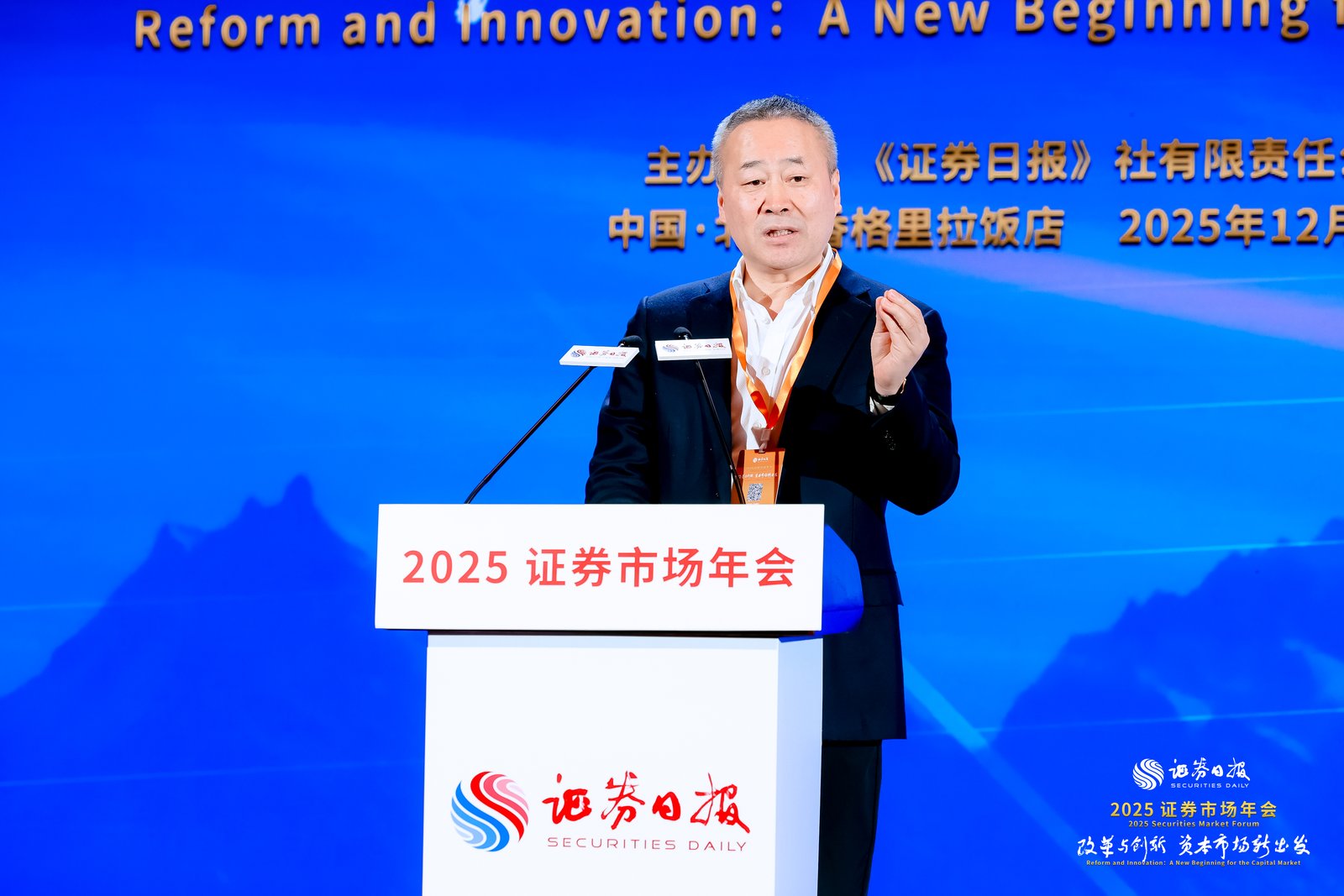
创新,是资本市场拥抱未来、激发活力的核心引擎。科技赋能金融,正在重塑资本市场的业态与服务模 式。金融科技的运用,提升了市场效率,优化了投资体验,也催生了新的产品与服务。与此同时,资本 市场更肩负着支持科技创新、助力产业升级的重任。通过制度创新、产品创新、服务创新,资本市场正 努力为"硬科技"、"专精特新"、绿色低碳等领域的优秀企业,提供更为通畅的融资渠道和成长沃土,推 动科技、资本与实体经济的正向循环。创新,让资本市场更具敏锐性与包容度,更能适应并引领新经济 发展的需求。 "新出发",意味着在改革与创新的双轮驱动下,资本市场已经站在了新的历史起点。这要求我们以更开 阔的视野审视未来,以更系统的思维谋划发展。"新出发",是服务高质量发展新要求、贯彻新发展理念 的再深化;是应对国内外复杂环境、提升核心竞争力的再动员;也是回应广大投资者新期待、增强市场 获得感与信任度的再承诺。 尊敬的各位领导,各位嘉宾: 上午好! 今天,我们共聚一堂,开启这场以"改革与创新资本市场新出发"为主题的思想盛宴。我谨代表会议主办 方,对各位领导、专家、业界同仁以及媒体朋友们的光临,表示最热烈的欢迎和最诚挚的感谢! 当前,我国资本市场正站 ...
吴晓求:让资本市场没有“雷”,这个要求并不高,未来五年我们要努力做到这一条
Xin Lang Cai Jing· 2025-12-26 03:56
Group 1 - The core argument emphasizes the need for the financial system to evolve from traditional to modern finance, driven by increasing wealth management demands and technological advancements [4][16] - Market disintermediation is identified as a key force transforming the financial structure, allowing both fund demanders and suppliers to bypass intermediaries like banks and engage directly in capital markets [4][16] - Technological progress is highlighted as the second transformative force in finance, extending and enhancing financial functions, particularly through innovations in payment systems [4][16] Group 2 - The capital market reform during the "14th Five-Year Plan" period aims to eliminate financial "landmines" such as fraudulent accounting practices that have plagued listed companies [6][18] - A significant concern is the collusion between listed companies and intermediary institutions, which has led to sustained financial misreporting [6][18] - The removal of these "landmines" is deemed essential for restoring investor confidence and ensuring a stable investment environment [7][19] Group 3 - Legal reforms are proposed to increase penalties for financial fraud, suggesting that the current penalties are insufficient to deter misconduct [8][20] - The establishment of a group litigation mechanism for small investors is recommended to enhance accountability and provide a means for redress [8][20] - The goal is to create a market free of "landmines" within the next five years, which is considered a fundamental objective [9][21] Group 4 - The mid-term goal of capital market reform is to position the market as a primary mechanism for wealth management, addressing the current asset structure where 60% of household assets are tied up in real estate [10][21] - Transitioning to financial assets, particularly securitized financial assets, is emphasized as a crucial direction for enhancing consumer spending and economic growth [10][21] - Reforms are needed on both the supply and demand sides of the capital market to facilitate its evolution into a wealth management market [11][22] Group 5 - The long-term objective of capital market reform is to open up and establish China as a new international financial center by 2035 [12][24] - Key conditions for achieving this include a robust legal framework, strong contractual integrity, and improved transparency [12][24] - Currently, foreign investor participation is low, at only 4.5%, necessitating efforts to increase this proportion to enhance market internationalization [12][24]

欧洲经济将在2026年迎来三大结构性变革
Shang Wu Bu Wang Zhan· 2025-12-25 14:35
Group 1 - The core viewpoint of the articles highlights that Europe's development opportunities post-2026 will stem from structural changes in its economic operations rather than just consumer growth or new technology trends [1][2] Group 2 - The first layer of change involves discussions on European countries allocating 5% of their GDP to defense spending, which signifies a renewed focus on enhancing European security integration [1] - The second layer pertains to the EU's grid infrastructure plan, with an estimated total investment of €600 billion in grid construction by 2030, translating to approximately €120 billion annually [1] Group 3 - The third layer addresses the accumulation of idle capital, with European households and businesses holding trillions of euros in savings due to historically loose monetary policies, representing a potential growth multiplier effect [2] - The integration of intermediary tools like capital market alliances and personal investment accounts is seen as a direction for future development, potentially injecting stronger momentum into European economic activities [2]
讨论真问题,提供真价值 | 年度财经思想者揭晓人
Sou Hu Cai Jing· 2025-12-25 09:12
Core Insights - The article emphasizes the importance of rationality, professionalism, and courage in economic discussions, particularly in the context of the "Yi Cai Hao" platform and its annual recognition of outstanding thinkers in finance [1][2]. Group 1: Achievements and Impact - Over the past year, the "Qian V Plan" has produced over 700 in-depth articles and more than 1,500 videos, achieving over 60 million views [2]. - The "Da V Liu Shui Xi" live broadcast attracted 4.64 million viewers, while the previous year's "Annual Financial Thinker Ceremony" engaged 7.41 million participants, generating a total communication flow of 40 million [2]. Group 2: Economic Outlook - A survey of 180 economists and researchers indicates that over 60% expect China's GDP growth target for 2026 to be between 4.5% and 5.0%, reflecting a pragmatic balance between stability and progress [3]. - 88.2% of experts believe that significant advancements in 2026 will occur in "technological innovation and industrial upgrading," with a focus on artificial intelligence, robotics, and semiconductor localization as key strategic areas [3]. Group 3: Consumer Trends and Market Dynamics - Health and elderly care, along with cultural and experiential consumption, are viewed as the most promising new consumer engines, with approximately 70% agreement among experts [4]. - In the real estate sector, the focus has shifted from simple stimulus to urban renewal and improvement, indicating a transition from "housing for all" to "livable housing" [4]. Group 4: Global Economic Context - Experts anticipate that the Federal Reserve will gradually enter a rate-cutting phase in 2026, maintaining a neutral global liquidity environment, with the US dollar index expected to remain stable within a certain range [4]. - The article highlights the importance of understanding global variables to navigate domestic policy space and market fluctuations [4].
资本市场支持新质生产力路径探索
Zhong Guo Zheng Quan Bao· 2025-12-24 09:33
Core Viewpoint - The development of new quality productivity is essential for enhancing productivity in the context of unprecedented changes and rapid advancements in information and biotechnology, requiring new theoretical guidance [1] Group 1: New Quality Productivity - New quality productivity inherits the theoretical and practical achievements of advanced productivity development in China, providing fundamental guidelines for productivity enhancement in the new era [1] - The core elements of productivity development are technological level (labor tools) and the quality of laborers, which must be integrated through enterprises to achieve results [1] - Capital markets play a crucial role in supporting the development of new quality productivity, particularly for technology-driven and small and medium-sized enterprises (SMEs) [1] Group 2: Data as a Key Production Factor - The evolution of human civilization has seen a shift in dominant production factors, with data emerging as a key factor in the digital economy era [3] - Data is recognized as the seventh production factor, characterized by non-consumable and infinite nature, low-cost replication, and increasing marginal returns [3] - The market for data circulation is expected to exceed 200 billion by 2025, injecting strong momentum into new quality productivity [3] Group 3: Role of SMEs - SMEs are pivotal in technological innovation, contributing 70% of the nation's technological innovation results, with "specialized, refined, distinctive, and innovative" SMEs holding an average of 115 patent applications each [4] - The flexible structure and decision-making of SMEs allow them to excel in exploring optimal technological routes, making them key players in cutting-edge technology competition [4] - SMEs also support the resilience of industrial and supply chains, particularly in areas where large enterprises cannot fully cover [4] Group 4: Capital Market Support for SMEs - As of July 31, 2023, 41.5% of the 12,192 specialized SMEs have recorded financing in the primary market, indicating strong financing demand [6] - The Beijing Stock Exchange (BSE) has a significant concentration of specialized SMEs, with over 60% of its listed companies being such enterprises, benefiting from its supportive structure for SMEs [7] Group 5: Policy Recommendations for Capital Market Support - There is a need to explore equity investment in the data factor industry, encouraging state-owned venture capital to lead and provide comprehensive support for early-stage data enterprises [9] - The BSE should accelerate its high-quality expansion and focus on supporting innovative SMEs in the data factor industry, enhancing its role as a core stock exchange for new quality productivity [10]
个税收入为何增长快?
Ren Min Ri Bao Hai Wai Ban· 2025-12-23 22:59
Core Viewpoint - The rapid growth of personal income tax (PIT) in China is attributed to stable increases in residents' disposable income, enhanced tax administration for high-income groups, and the active capital market, which collectively support the tax revenue growth [4][11]. Group 1: Personal Income Tax Growth - From January to November this year, China's personal income tax revenue reached 14,689 billion yuan, marking an 11.5% year-on-year increase [4]. - The growth rate of personal income tax has been accelerating, with quarterly increases of 7.1%, 8%, and 9.7% in the first, second, and third quarters respectively [4]. - The increase in personal income tax is primarily driven by high-income individuals, with over 60% of actual taxpayers falling under the lowest 3% tax rate [6][10]. Group 2: Tax Administration Enhancements - The tax administration has strengthened oversight on high-income earners, particularly those with overseas income and internet platform operators, leading to improved compliance and increased tax revenue [6][7]. - The implementation of the "Golden Tax Phase IV" system has significantly enhanced the efficiency of personal income tax collection, utilizing big data for better tax governance [8][10]. - As of December 8, over 7,000 domestic and foreign platforms have complied with tax information reporting requirements, contributing to a 12.7% year-on-year increase in tax payments from platform operators [7][10]. Group 3: Capital Market Influence - The active capital market has positively impacted personal income tax revenue, with high-income earners contributing significantly to tax collections [11][12]. - The trading volume in the stock market has remained high, with daily transactions exceeding 1 trillion yuan for 143 consecutive trading days, indicating robust market activity [11]. - Historical data suggests that during periods of capital market activity, personal income tax revenue growth typically outpaces overall economic growth [12].

聚焦中央经济工作会议 | 持续深化资本市场投融资综合改革
Xin Hua She· 2025-12-23 11:24
Group 1 - The core viewpoint emphasizes the importance of "continuously deepening the comprehensive reform of capital market investment and financing" for the healthy circulation of the capital market and overall economic development in China [1] - The 2024 Central Economic Work Conference highlights the need to enhance the inclusiveness and adaptability of capital market systems, aiming to address bottlenecks in long-term capital entering the market [1] - The focus on comprehensive reform indicates a commitment to improving the overall stability and coordination of the capital market, enhancing its attractiveness and competitiveness [1] Group 2 - Recent years have seen comprehensive investment and financing reform become a key focus of capital market reform, with significant measures taken to optimize public fund reforms and encourage long-term capital market entry [2] - As of the end of August this year, various types of long-term funds held approximately 21.4 trillion yuan in A-share market value [2] - In the financing aspect, initiatives such as the "16 Articles for Science and Technology Innovation" and the establishment of the Science and Technology Innovation Board have been introduced, leading to a significant increase in A-share refinancing, which surpassed 800 billion yuan in the first three quarters of this year, a year-on-year increase of 258% [2]
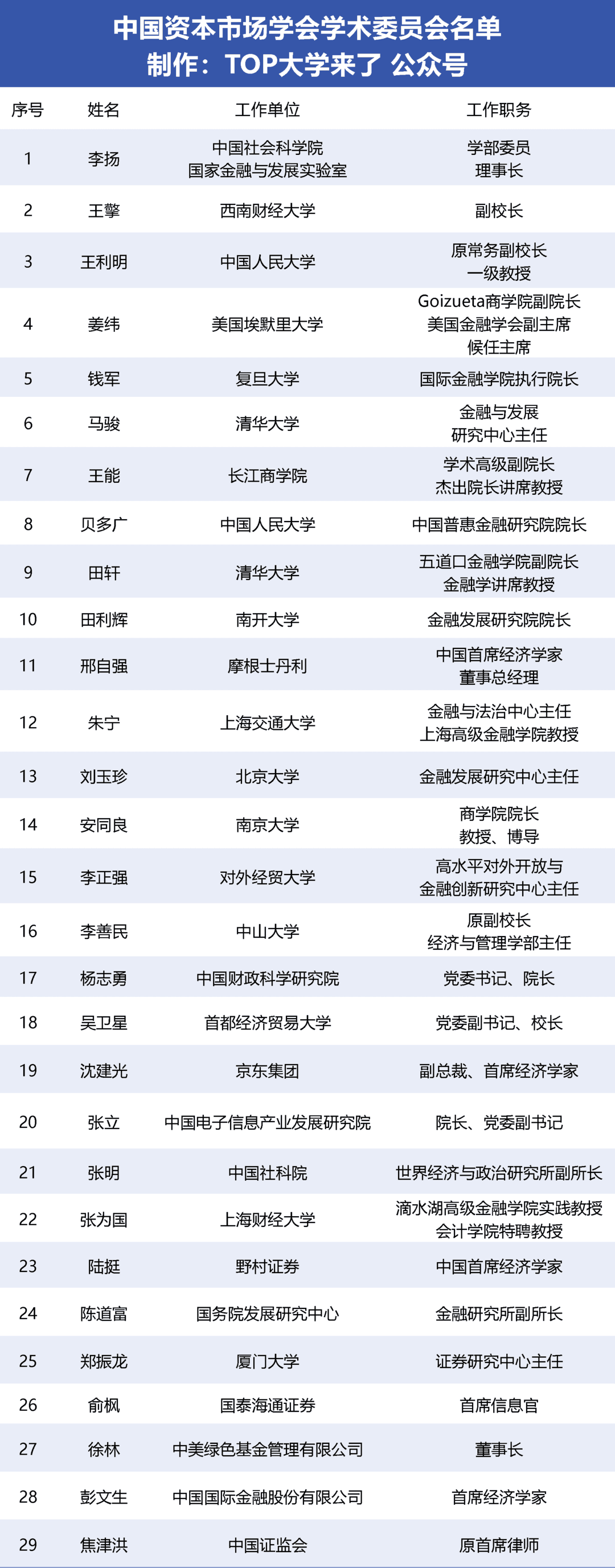
清华北大南大等高校顶尖教授入选资本市场“国家超级智囊团”
Yang Zi Wan Bao Wang· 2025-12-23 11:11
Core Viewpoint - The establishment of the Academic Committee of the China Capital Market Society aims to provide intellectual support for the high-quality development of the capital market, consisting of 29 authoritative experts from various fields [1]. Group 1: Committee Composition - The Academic Committee is the highest academic institution of the China Capital Market Society, comprising 29 experts and scholars from government research institutions, universities, overseas scholars, and market experts [1]. - The committee includes a diverse range of members, with a significant proportion from top universities such as Tsinghua University, Peking University, and Fudan University, ensuring a strong academic research foundation [1]. Group 2: Member Backgrounds - The committee features experts from various sectors, including policy think tank experts from the Chinese Academy of Fiscal Sciences and the State Council Development Research Center, as well as economists from international investment banks like Morgan Stanley [4]. - The diverse composition allows the committee to examine capital market issues from multiple perspectives, avoiding a singular research viewpoint [4]. Group 3: Objectives and Focus Areas - The Chairman of the China Securities Regulatory Commission emphasized the importance of strengthening theoretical research in the capital market to develop a theoretical system that aligns with both market principles and China's realities [5]. - The committee will focus on key issues such as market inclusiveness, pricing efficiency, financial technology, and legal construction, aiming to enhance the theoretical framework and methodology for building a robust capital market [6].