
脑机接口

Search documents
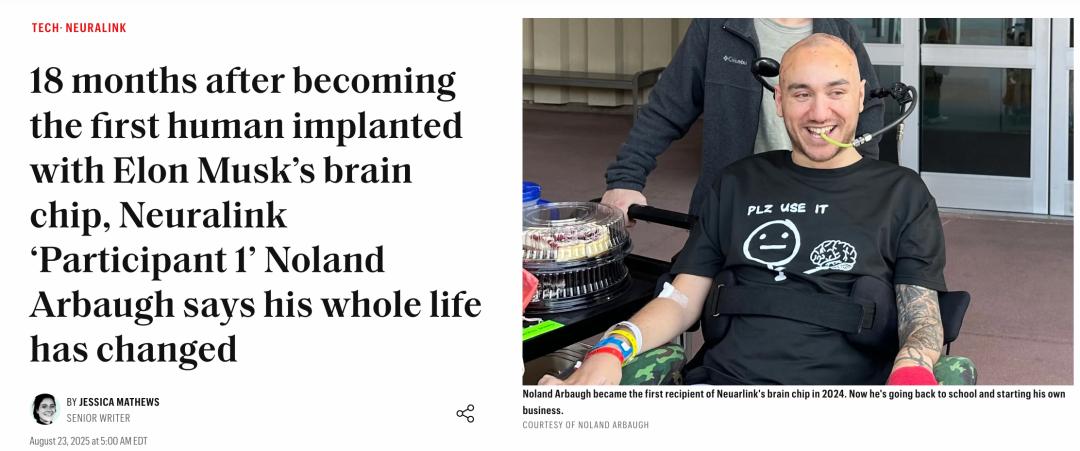
「机械飞升」18个月后,马斯克首位脑机植入者重磅发声:我重生了
3 6 Ke· 2025-08-25 03:34
Core Insights - Noland Arbaugh, the first human participant in Neuralink's brain-machine interface trial, describes his experience as life-changing, allowing him to control devices and regain a sense of purpose after being paralyzed for years [1][4][18] - Neuralink's technology features over 1,000 electrodes implanted in the motor cortex, providing a higher connectivity rate compared to competitors, and operates wirelessly, requiring charging approximately every five hours [12][8][11] - The company aims to expand its clinical trials and has plans for future projects, including restoring vision for the blind and developing robotic arms for participants [40][41][44] Company and Technology Overview - Neuralink is at the forefront of brain-machine interface technology, with a history of over 50 years in neurological research and several companies conducting limited human trials since 1998 [11] - The device implanted in Arbaugh allows him to control computers and play video games using only his thoughts, breaking records for speed and accuracy in cursor control [8][9] - The invasive nature of Neuralink's approach, while criticized, is seen as a significant advancement in the field compared to less invasive methods used by competitors [12][44] Participant Experience and Impact - Arbaugh's journey from paralysis to regaining autonomy has garnered public attention, leading to increased interest in Neuralink's trials and technology [16][45] - Since Arbaugh's surgery, additional participants have joined the trials, indicating growing momentum for Neuralink's research and development efforts [16][44] - The participant's positive outlook on the technology reflects a broader belief in the potential of tech advancements to address disabilities and improve quality of life [46][18]

四大证券报精华摘要:8月25日
Zhong Guo Jin Rong Xin Xi Wang· 2025-08-25 00:08
Group 1: Brain-Computer Interface Development - The brain-computer interface (BCI) technology is entering a period of accelerated development, with Xiangyu Medical launching 13 BCI devices and forming strategic partnerships to enhance clinical applications [1] - Favorable policies are emerging, such as the implementation of medical service pricing projects related to BCI in Hohhot, which supports the practical application of this technology [1] - The BCI industry is expected to gradually achieve commercialization, with market size anticipated to continue expanding due to technological advancements in the upstream sector [1] Group 2: A-Share Market Performance - As of August 24, 2025, 978 out of 1688 listed companies in the A-share market reported a year-on-year increase in net profit, with a total proposed cash dividend amounting to 164.7 billion yuan [1] - Notable companies planning significant cash dividends include China Mobile, China Telecom, and Sinopec, indicating strong financial performance [1] Group 3: ETF Market Dynamics - Over 40% of the more than 1000 ETFs in the A-share market have reached new net asset value highs, particularly in the technology sector, including chips and artificial intelligence [6] - The ETF market is acting as a barometer for equity market sentiment, with significant interest in technology-themed ETFs, while some sectors like consumer and new energy are lagging behind [6] Group 4: Insurance Asset Management - Four insurance asset management institutions reported a combined operating income of 6.9 billion yuan and a net profit of 3.5 billion yuan for the first half of 2025, reflecting a year-on-year growth of 15.4% and 29.3% respectively [7] - Bond funds have shown strong performance, with several exceeding their benchmarks, indicating effective management in a volatile market [7] Group 5: Institutional Research and Investment Trends - There has been a surge in institutional research activity among companies listed on the Beijing Stock Exchange, focusing on growth drivers, new product development, and market expansion [4] - Companies are increasing R&D investments in high-potential sectors such as renewable energy and semiconductors, demonstrating a strong commitment to growth [4]
脑机接口发展加速多领域协同推进成果转化与临床落地
Zhong Guo Zheng Quan Bao· 2025-08-24 20:10
Core Insights - Brain-computer interface (BCI) technology is entering a period of accelerated development, with companies like Xiangyu Medical launching multiple BCI devices and forming strategic partnerships to enhance clinical applications and technology transfer [1][4] - The market for rehabilitation medical devices in China is projected to reach approximately 71.46 billion yuan in 2024, driven by innovations in BCI products [2] - The BCI industry is experiencing significant technological advancements, with a focus on integrating various fields such as microelectronics, materials science, and neuroscience [3][6] Product Development Acceleration - Xiangyu Medical has introduced five series of BCI products aimed at rehabilitation, including solutions for physical therapy, occupational therapy, and cognitive rehabilitation [1][2] - The BCI PT solution enables precise movement control for patients recovering from strokes and injuries, showcasing the potential for market disruption in rehabilitation technology [2] Industry Collaboration - The collaboration between Xiangyu Medical and Henan Provincial People's Hospital aims to leverage clinical expertise and R&D capabilities to explore innovative applications of BCI technology in rehabilitation [4] - The establishment of joint laboratories and partnerships between companies and research institutions is fostering the integration of research and clinical applications, accelerating the commercialization of BCI technologies [4][5] Policy and Investment Landscape - Recent government policies, including the establishment of independent billing codes for BCI services, are providing a regulatory framework to support the industry's growth [5] - The investment landscape for BCI technology is robust, with significant funding activities projected to exceed 800 million yuan in the first half of 2025, indicating strong investor interest in the sector [5][6] Market Outlook - The BCI market in China is expected to grow from approximately 2.3 billion yuan in 2024 to over 10 billion yuan by 2029, with a compound annual growth rate exceeding 35% [5] - The industry is anticipated to evolve into a trillion-yuan market by 2040, driven by increasing demand and technological advancements [5]

首批21个跨区域质量强链联动项目发布
Zheng Quan Ri Bao· 2025-08-24 15:45
Core Viewpoint - The release of the first batch of 21 cross-regional quality strong chain projects aims to enhance quality cooperation and support across various industries, including both emerging and traditional sectors, thereby improving the resilience and safety of industrial chains [1][2][3] Group 1: Emerging and Traditional Industries - The cross-regional projects encompass both emerging industries such as robotics, brain-computer interfaces, low-altitude economy, and commercial aerospace, as well as traditional industries like textiles, engineering machinery, and coal chemical [1] - Experts believe that the implementation of these projects will help break through key technological bottlenecks in the industrial chain, facilitating the industrialization of technological achievements and expanding application scenarios [2] Group 2: Quality Improvement and Economic Development - The quality strong chain initiative is seen as essential for accelerating the development of new productive forces and is a key measure to enhance domestic circulation and meet the high-quality living needs of the population [2] - The projects aim to introduce new technologies and models to improve product and service quality in traditional industries, thereby achieving a transformation of old and new driving forces [2] Group 3: Collaboration and Coordination - It is recommended that involved regions and departments establish a regular communication mechanism to enhance coordination, integrate quality technology innovation resources, and promote policy linkage and resource sharing [3] - Companies are encouraged to strengthen collaboration with universities and research institutions to address quality bottlenecks and create more significant breakthroughs [3]
国泰海通|宏观:前瞻“十五五”:预期目标与产业机遇
国泰海通证券研究· 2025-08-24 13:35
Core Insights - The "14th Five-Year Plan" focuses on expanding consumption, new productive forces, common prosperity, deepening reforms, and green transformation, with an emphasis on emerging future industries, services, marine and green low-carbon sectors, and potential beneficiaries such as private tech firms and state-owned enterprises in emerging industries [1] Summary by Sections Economic Growth and Innovation - The GDP annual growth target for the "14th Five-Year Plan" period is expected to be set between 4.5% and 5.0%, with a bottom line of over 4.5% to ensure the successful completion of the 2035 long-term goals [2] - The innovation-driven target for the "14th Five-Year Plan" is anticipated to be significantly higher than that of the "13th Five-Year Plan," emphasizing the national innovation system and the vitality of various innovation entities and talent support [2] Common Prosperity and Reforms - The plan aims to enhance the well-being of citizens by adding new targets related to housing, healthcare, elderly care, and childcare, with a focus on investing more resources in human capital and public services [3] - Over 300 reform measures from the 20th National Congress are expected to be key focuses of the "14th Five-Year Plan," targeting the reduction of logistics costs and promoting a unified national market [4] Green Transformation - The green low-carbon goals may include a primary focus on controlling carbon emission intensity, with supplementary total control measures, aiming to reduce carbon emissions per unit of GDP [5] - The plan aims to achieve carbon peak by 2030, with clear frameworks for the development goals of energy-saving and environmental protection industries, new energy, and low-carbon transportation [9] Industry Opportunities - Emerging and future industries such as electronic information manufacturing, humanoid robots, and brain-computer interfaces are expected to see rapid market penetration and technological breakthroughs [6] - There is significant potential for growth in service consumption sectors like retail, healthcare, elderly care, telecommunications, and internet services, as well as in productive service industries like science and technology, finance, and information services [7] - The marine industry, particularly in marine tourism, transportation, shipbuilding, electricity, and biomedicine, is projected to accelerate due to favorable policies and market conditions [8]

「机械飞升」18个月后,马斯克首位脑机植入者重磅发声:我重生了!
Sou Hu Cai Jing· 2025-08-24 11:34
Core Insights - Noland Arbaugh, the first participant in Neuralink's brain-machine interface trial, describes his experience as life-changing, allowing him to control devices and regain a sense of purpose after being paralyzed for years [2][5][20]. Neuralink Technology and Innovations - Neuralink's device features over 1,000 electrodes, providing a higher connectivity rate compared to most existing brain-machine interfaces [15]. - The device is implanted in the motor cortex, a more invasive approach than competitors like Synchron or Precision Neuroscience [15]. - Neuralink's technology is wireless, requiring charging approximately every five hours, with a charging coil integrated into Arbaugh's hats for convenience [15][12]. Clinical Trials and Participant Experience - Arbaugh underwent surgery at Barrow Neurological Institute, where a robot-assisted procedure implanted the device, allowing him to control computers with his thoughts [7][9]. - Since Arbaugh's participation, eight additional individuals have enrolled in Neuralink's clinical trials, which are ongoing in the U.S., Canada, the UK, and the UAE [18][20]. - The trials focus on patients with paralysis or ALS, aiming to expand the understanding and application of brain-machine interfaces [18]. Future Directions and Goals - Neuralink aims to develop a complete brain interface and is planning trials to help blind individuals regain vision, as well as creating robotic arms for participants [43][44]. - The company is also exploring the integration of its technology with Tesla's Optimus robot, potentially allowing users to control robotic limbs [44]. Public Perception and Challenges - Neuralink faces scrutiny regarding its invasive methods and treatment of test animals, although the company asserts it operates ethically [47]. - Arbaugh's public persona has led to increased media attention and scrutiny, highlighting the societal implications of such technologies [18][49]. Industry Impact and Vision - The advancements in Neuralink's technology are seen as pivotal in the future of medicine, particularly for treating disabilities through technological solutions [50]. - Arbaugh's experience reflects a broader narrative of hope and potential in the intersection of technology and healthcare, emphasizing the transformative power of innovation [51].

前瞻“十五五”:预期目标与产业机遇
Haitong Securities International· 2025-08-24 09:13
Economic Growth and Policy Goals - The GDP annual growth target for the "15th Five-Year Plan" is set between 4.5% and 5.0%, with a minimum of 4.5% to ensure the 2035 vision is achieved[2]. - The focus on developing new productive forces will see a significant increase in innovation-driven targets compared to the "14th Five-Year Plan"[2]. - The plan aims to enhance living standards with new targets in housing, healthcare, and elderly care, emphasizing investment in human resources[2]. Reform and Green Transition - Over 300 reform measures from the 20th Central Committee will be prioritized in the "15th Five-Year Plan," focusing on comprehensive reforms[2]. - The green transition will shift from energy consumption control to carbon emission control, aiming for a 65% reduction in carbon intensity by 2030 compared to 2005 levels[19]. Industry Opportunities - Emerging industries such as electronic information manufacturing and humanoid robots are expected to see rapid market penetration and technological breakthroughs[3]. - The service sector, including retail, healthcare, and telecommunications, has significant growth potential, driven by rising consumer demand[3]. - The marine economy, particularly in tourism and transportation, is projected to grow rapidly, with a focus on policy support[3]. Risks and Challenges - There are risks related to misinterpretation of policies and unexpected changes in domestic and international macroeconomic conditions[39].
布局未来看产业 财米油盐丨脑机接口,把科幻“接”入现实
Ren Min Wang· 2025-08-23 02:30
Group 1 - Brain-computer interface (BCI) technology is making significant advancements, enabling applications such as early screening for autism, aiding non-verbal individuals, and allowing paralyzed patients to engage in gaming [1] - BCI technology is categorized into invasive and non-invasive types, with invasive methods involving surgical implantation of electrodes for precise neural signal collection, while non-invasive methods collect signals externally through techniques like electroencephalography (EEG) [1] - The BCI market in China is projected to reach a size of 3.2 billion yuan in 2024, with a growth rate of 18.8%, and is expected to grow to 6.14 billion yuan by 2028 [1] Group 2 - The Chinese government has implemented several policies to support the practical application of BCI technology, including a guideline from the National Healthcare Security Administration for pricing medical services related to the nervous system [2] - A joint opinion from multiple departments aims to elevate the BCI industry's comprehensive strength to a leading global position by 2030, with local governments like Beijing, Shanghai, and Shandong also introducing targeted policies [2] - The strategic layout indicates a focus on future industries and innovation, positioning China to seize opportunities as the BCI sector evolves [2]
市场监管总局发布首批21个跨区域质量强链联动项目
Xin Lang Cai Jing· 2025-08-22 23:29
Core Viewpoint - The State Administration for Market Regulation has officially launched the first batch of 21 cross-regional quality strong chain linkage projects to enhance the resilience and safety of industrial and supply chains [1] Group 1: Project Overview - The 21 cross-regional quality strong chain linkage projects encompass both emerging industries such as robotics, brain-computer interfaces, low-altitude economy, and commercial aerospace, as well as traditional industries like textiles, engineering machinery, and coal chemical [1] - The projects aim to promote cross-regional collaboration in industrial chain supply division, addressing quality issues through targeted cooperation [1] Group 2: Implementation and Goals - The State Administration for Market Regulation has instructed leading provinces of each project to strengthen coordination and promote a series of "small but beautiful" quality collaborations [1] - The initiative focuses on solving specific quality problems, breaking through key common quality bottlenecks, and achieving significant landmark breakthroughs in quality [1]
脑机接口,AI喜临门的新跳板
Zhong Guo Chan Ye Jing Ji Xin Xi Wang· 2025-08-22 08:17
Core Viewpoint - Brain-Computer Interface (BCI) technology is rapidly advancing from science fiction to reality, with companies like Neuralink leading the charge in applications that can significantly improve the quality of life for individuals with disabilities [1][2]. Group 1: Industry Challenges and Opportunities - Despite the potential of BCI technology, there are significant challenges in its practical application, particularly in the medical rehabilitation sector, necessitating broader consumer applications [2]. - The Chinese government is actively supporting the development of non-invasive BCI technologies, aiming to accelerate their integration into various sectors such as industrial manufacturing and healthcare [2]. - A recent collaboration between Xilinmen and Qiangnao Technology aims to address sleep issues by introducing BCI technology into sleep aids, highlighting a tangible application of BCI in everyday life [2]. Group 2: Sleep Health Crisis - Global sleep disorders are a widespread issue, with over 2 billion people suffering from insomnia, and only 13% of individuals achieving quality sleep [3]. - In China, approximately 65.91% of surveyed individuals have experienced sleep disturbances, with many adults averaging less than 7 hours of sleep per night [3]. - Poor sleep quality is linked to various health issues, including cognitive decline and increased risk of diseases like Alzheimer's, prompting a surge in demand for effective sleep solutions [3]. Group 3: Market Response and Consumer Sentiment - Over 80% of Chinese consumers express willingness to use smart sleep devices, with significant purchases of products like smart eye masks and electronic sleep aids [4]. - Despite consumer enthusiasm, there are criticisms regarding the effectiveness of some sleep products, indicating a gap between expectations and actual performance [4]. Group 4: Technological Innovations - BCI technology, particularly through EEG (electroencephalography), is being explored for its potential to enhance sleep quality by monitoring brain activity [6][7]. - Non-invasive BCI products, such as the "Deep Dolphin Smart Sleep Instrument," have shown promising results in improving sleep quality, with over 70% of users reporting reduced time to fall asleep [7]. - The industry is moving towards more comfortable and integrated solutions, such as embedding sensors in pillows and mattresses to enhance user experience [7]. Group 5: Strategic Collaborations and Product Development - Xilinmen's partnership with Qiangnao Technology has led to the development of the "Baobao·BrainCo" AI mattress, which utilizes BCI technology for real-time sleep management [8]. - This collaboration aims to create a comprehensive sleep ecosystem, allowing users to maintain personalized sleep settings across different environments, including hotels [9]. Group 6: Long-term Vision and Company Evolution - Xilinmen's collaboration with Qiangnao Technology reflects a strategic shift towards integrating advanced technology into sleep solutions, marking a significant evolution in their business model [10]. - The company has undergone multiple strategic transformations over the years, focusing on technological innovation and expanding its product offerings to include smart sleep management systems [12][13]. - Recent financial results indicate a positive response to these transformations, with a reported revenue of 4.021 billion yuan and a net profit increase of 14.04% [14]. Group 7: Future Outlook - The sleep health sector is poised for significant transformation, driven by advancements in BCI technology and a growing focus on comprehensive health management solutions [16]. - As policies support innovation and technology continues to evolve, the future of sleep systems is expected to be more personalized, comfortable, and effective in addressing sleep-related issues [16].
