零售

Search documents
一般零售板块1月27日跌1.04%,上海九百领跌,主力资金净流出5.61亿元
Zheng Xing Xing Ye Ri Bao· 2026-01-27 08:50
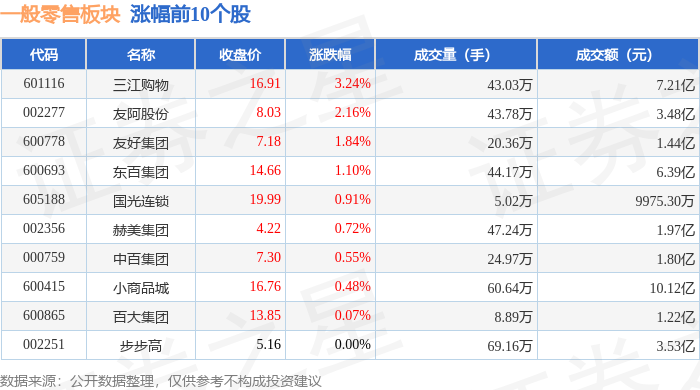
Core Viewpoint - The general retail sector experienced a decline of 1.04% on January 27, with Shanghai Jiubai leading the drop, while the Shanghai Composite Index rose by 0.18% and the Shenzhen Component Index increased by 0.09% [1] Group 1: Market Performance - The Shanghai Jiubai stock closed at 13.33, down 7.30%, with a trading volume of 490,400 shares and a transaction value of 6.57 billion yuan [2] - The top gainers in the general retail sector included Sanjiang Shopping, which rose by 3.24% to close at 16.91, with a transaction value of 7.21 billion yuan [1] - The overall net outflow of main funds in the general retail sector was 561 million yuan, while retail investors saw a net inflow of 464 million yuan [2][3] Group 2: Individual Stock Analysis - Sanjiang Shopping had a main fund net outflow of 57.71 million yuan, with retail investors contributing a net inflow of 84.01 million yuan [3] - Xiaogoods City saw a main fund net inflow of 21.03 million yuan, while retail investors had a net outflow of 36.95 million yuan [3] - Tianhong Shares experienced a main fund net inflow of 10.44 million yuan, with a net outflow from retail investors of 9.84 million yuan [3]


镰刀妹AI智能写作 | 1月27日湘股涨跌TOP5
Chang Sha Wan Bao· 2026-01-27 08:14
Market Overview - As of January 27, the Shanghai Composite Index rose by 0.18%, closing at 4139.9041 points, while the Shenzhen Component Index increased by 0.09%, closing at 14329.906 points [1] Top Gainers in Hunan Stocks - Hunan Gold opened at 27.800 and closed at 27.800, with a daily increase of 10.01%, maintaining the same price throughout the day, with a trading volume of 30,416 lots [2] - Zhongbing Hongjian opened at 19.070 and closed at 19.650, rising by 2.50%, with a daily high of 19.670 and a low of 19.030, and a trading volume of 690,833 lots [2] - Kaimete Gas opened at 22.770 and closed at 23.450, up by 2.31%, reaching a high of 23.800 and a low of 22.670, with a trading volume of 496,264 lots [2] - Youa Shares opened at 7.790 and closed at 8.030, increasing by 2.16%, with a daily high of 8.080 and a low of 7.720, and a trading volume of 437,837 lots [2] - Dianguang Media opened at 11.380 and closed at 11.580, up by 2.03%, with a high of 11.600 and a low of 11.060, and a trading volume of 876,399 lots [2] Top Losers in Hunan Stocks - Hengli Tui opened at 0.160 and closed at 0.150, falling by 11.76%, with a daily high of 0.170 and a low of 0.150, and a trading volume of 611,606 lots [3] - Taijia Shares opened at 22.130 and closed at 20.190, down by 9.01%, with a high of 22.130 and a low of 19.970, and a trading volume of 238,463 lots [3] - *ST Gaosi opened at 12.750 and closed at 12.160, decreasing by 4.48%, with a high of 13.140 and a low of 12.090, and a trading volume of 233,058 lots [3] - Zhejiang Construction Investment opened at 8.800 and closed at 8.570, down by 2.83%, with a high of 8.820 and a low of 8.450, and a trading volume of 210,227 lots [3] - Changlan Technology opened at 21.910 and closed at 21.460, falling by 2.68%, with a high of 22.000 and a low of 20.730, and a trading volume of 105,940 lots [3]






从“持久战”到“闪电战”:中国品牌出海的速度革命靠什么?
Guo Ji Jin Rong Bao· 2026-01-27 07:31
Core Insights - The report by Kearney highlights a significant acceleration in the timeline for Chinese brands to establish recognition overseas, reducing the period from 10 years to 3-5 years due to factors like cross-border e-commerce and social media [1] - The transformation in the paradigm of Chinese consumer goods going global is evident, shifting from merely selling products to building ecosystems and localizing manufacturing [3][4] Group 1: Changes in Globalization Strategy - External uncertainties, such as geopolitical tensions and trade protectionism, have become the new normal for Chinese brands going global, altering their pathways and success logic [3] - The shift from "product export" to "capacity export/local investment" necessitates establishing a complete R&D, production, and marketing loop in target markets [3][4] Group 2: Brand Success Factors - Brands like Pop Mart and Miniso exemplify the transformation in the export paradigm, achieving rapid global consumer engagement through a combination of strategic choices and systemic capabilities [5] - The success of these brands is attributed to their ability to tap into "emotional consumption," driven by the rise of the global Z generation and effective use of social media [5][6] Group 3: Systemic Capabilities - Three core barriers to sustainable advantage are identified: a flexible supply chain for rapid product transformation, integration of content and retail for emotional engagement, and the ability to resonate deeply with local cultures [6] - The current wave of Chinese brand globalization differs from the American model, emphasizing localized narratives and cultural integration rather than standardized outputs [8] Group 4: Comparative Analysis - Similarities between Chinese and American brands include leveraging large domestic markets for global expansion, universal emotional appeals, and the backing of national strength [7] - Key differences lie in the brand establishment cycle, with Chinese brands utilizing advanced infrastructure to shorten this period significantly, and a focus on localized strategies rather than a one-size-fits-all approach [8]



贵州促消费新举:落实带薪错峰休假 发展谷子经济、悦己经济
Zhong Guo Xin Wen Wang· 2026-01-27 07:21
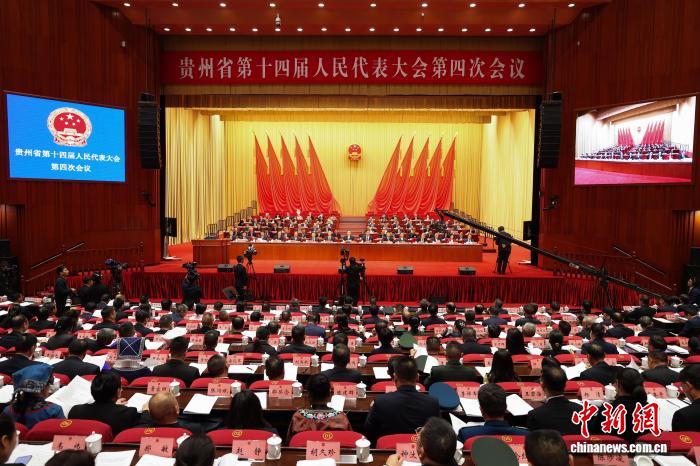
贵州将清理消费领域不合理或"一刀切"限制性措施,落实职工带薪错峰休假制度,让大家有时间、有场 景、有意愿消费。 为着力优化消费供给,贵州将强化品牌引领、标准升级,适应消费新趋势,挖掘服务消费潜力,大力发 展首发经济、银发经济、演艺经济、票根经济、谷子经济、悦己经济等,因地制宜打造玩具手办、国潮 IP等年轻化消费产品,推出一批非遗夜市、中医药文化夜市等主题消费场景,培育更多消费增长点。 贵州在政府工作报告中首次明确提出带薪错峰休假,发展演艺经济、票根经济、谷子经济、悦己经济 等,目标直指"有意愿消费"的人群。官方公布,2026年上半年贵州将围绕"跟着赛事来贵州、参赛观赛 享健康"专项行动举办640项、1800场体育赛事活动。被誉为"爱乐之城"的贵州省会贵阳计划在2026年举 办大型演唱会及音乐节45场以上、路边音乐会200场以上。贵州将以演艺经济等为支点,撬动文旅消费 市场全面升级,实现从"流量聚集"到"消费赋能"的质变,让文化资源转化为经济动能。(完) 贵州促消费新举:落实带薪错峰休假 发展谷子经济、悦己经济 中新网贵阳1月27日电 (记者 张伟)贵州省第十四届人民代表大会第四次会议27日在贵阳开幕,贵州省政 ...
力促国货潮品“上架”拓展市场 成都举办都市圈免退税产品供需对接会
Sou Hu Cai Jing· 2026-01-27 06:08
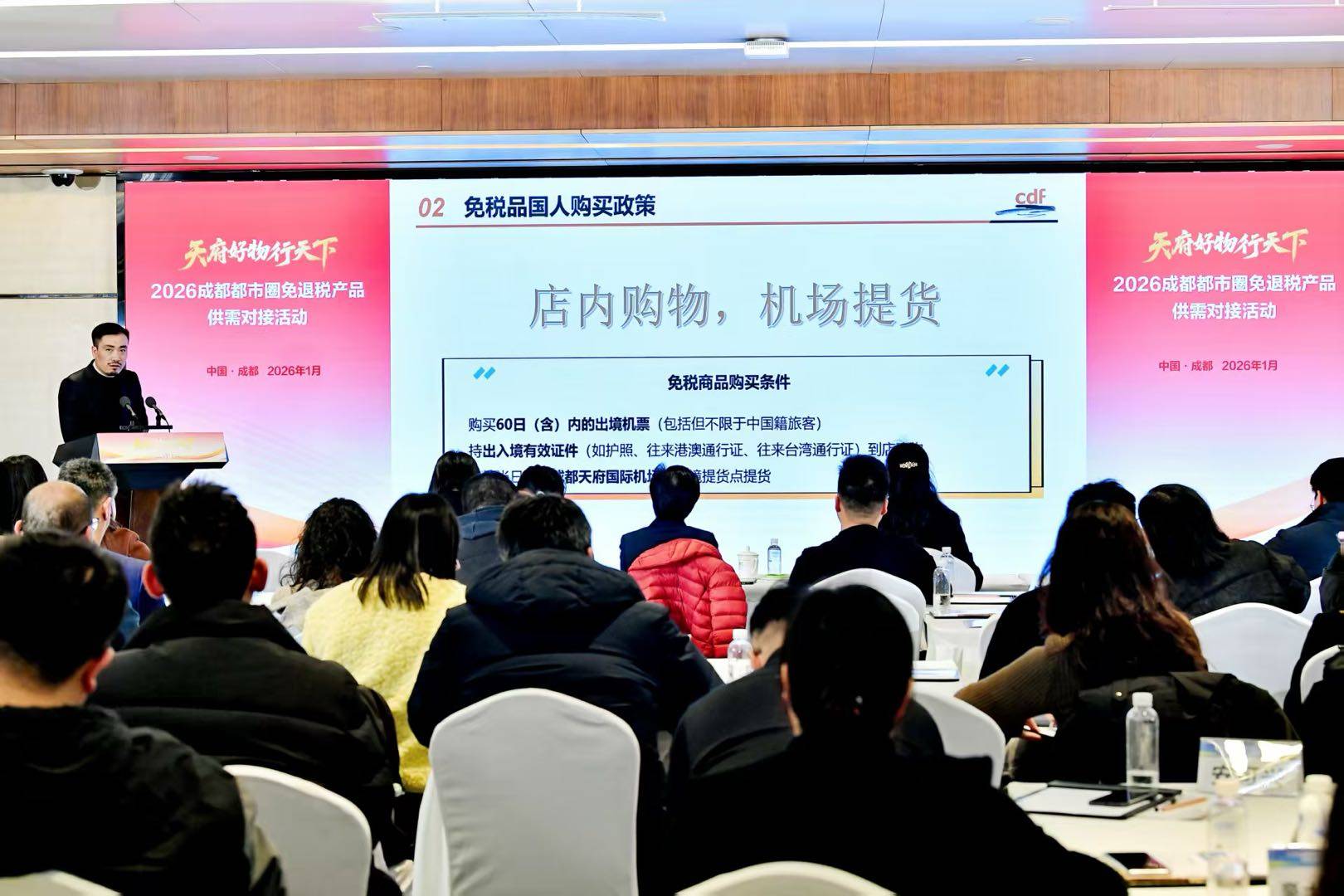
Group 1 - Chengdu is enhancing its duty-free shopping experience by increasing the variety of products available in duty-free stores, aiming to promote local brands and products internationally [3][5] - As of November 30, 2025, Chengdu has over 600 duty-free stores, with more than 180 offering an "immediate purchase and refund" service, which has been optimized to include multiple refund methods [3][4] - The Chengdu Business Bureau is actively analyzing consumer preferences among international tourists to better tailor product offerings in duty-free stores, focusing on local cultural products and high-tech items [4][6] Group 2 - Local companies, such as Qianli Beiyikang Medical Technology Co., are keen to enter duty-free stores to enhance brand visibility and access high-value consumer segments, with products already reaching 70 countries [5][6] - The strategy of including more local products in duty-free stores is expected to improve the shopping experience for tourists and increase inbound consumption [5][6] - The competitive edge of domestic products is being validated through sales data, with popular categories including clothing, bags, and electronics, indicating a strong market for culturally significant items [6]
千店选手扎堆赶考,2026或成餐饮、零售“IPO元年”
3 6 Ke· 2026-01-27 05:54
Core Viewpoint - The article discusses the recent surge of food and beverage companies in China seeking to go public, indicating a shift from "scale-driven" to "capital-driven" growth in the industry, with a focus on supply chain, standardization, and ESG principles [2][13]. Group 1: IPO Trends - Companies like "Mingming Hen Mang" and "Qian Dama" have recently submitted IPO applications to the Hong Kong Stock Exchange, with over 20 food and beverage companies in line for listing within a month [2][3]. - "Mingming Hen Mang" is set to become the first stock in the Hong Kong market for bulk snacks, attracting significant investment from major firms like Tencent and Temasek, totaling approximately $195 million [1][2]. - The collective IPO push reflects a broader trend in the Chinese restaurant industry, emphasizing the importance of scale and capital in a competitive landscape [2][13]. Group 2: Business Models and Revenue Sources - Many of the companies pursuing IPOs, such as "Mingming Hen Mang" and "Yuanji Yunjiao," rely heavily on a network of franchisees, with over 99% of their revenue coming from sales to these franchise stores rather than franchise fees [6][4]. - "Mingming Hen Mang" has expanded to over 19,517 stores across 28 provinces, while "Yuanji Yunjiao" has reached 4,266 stores, showcasing rapid growth and a strong franchise model [3][4]. - The reliance on franchise networks allows these brands to scale quickly while minimizing operational risks, as franchisees bear the expansion costs [4][6]. Group 3: Market Dynamics and Challenges - The competitive landscape in the food and beverage sector is intensifying, with companies facing high cash burn rates and declining same-store sales, necessitating IPOs for capital infusion [10][12]. - The overall growth in the restaurant industry has been sluggish, with a reported 3.3% increase in revenue year-on-year, indicating a challenging environment for new entrants [12][14]. - The increasing concentration of market power among leading brands post-IPO could further marginalize smaller players, leading to a more pronounced "Matthew Effect" in the industry [14][18]. Group 4: Strategic Expansion and Future Outlook - Companies are not only focusing on domestic growth but are also eyeing international markets, with "Yuanji Yunjiao" already establishing a presence in Singapore and planning to expand into Southeast Asia and beyond [18]. - The capital raised through IPOs will enable these companies to enhance their competitive edge, allowing for aggressive expansion and better terms for franchisees [14][18]. - The article suggests that while IPOs provide immediate financial benefits, the future will require companies to continuously prove their value in a more competitive and scrutinized market environment [18].

消费规模与体验双升级 北京消费季晒2025年成绩单
Bei Jing Shang Bao· 2026-01-27 04:51
Group 1 - The Beijing Consumption Season has achieved a dual upgrade in consumption scale and experience, with significant growth in key commercial areas during the Spring Festival and Mid-Autumn National Day holidays [1] - During the Spring Festival, key commercial areas saw a foot traffic of 35.46 million and sales of 8.1 billion yuan, representing year-on-year increases of 12.8% and 4.2% respectively [1] - The Mid-Autumn and National Day holidays recorded over 59.67 million in foot traffic and sales of 9.51 billion yuan, with nighttime foot traffic increasing by over 20%, highlighting the vibrancy of the consumption market [1] Group 2 - The Beijing Consumption Season has implemented three major initiatives to innovate consumption scenarios, including the establishment of a comprehensive activity system and the promotion of a unified theme logo [2] - The initiative emphasizes collaboration with Tianjin and Hebei to enhance regional consumption integration, facilitating marketing opportunities for over 20 traditional and foreign trade enterprises [2] - The event features over 20 activities during the China International Fashion Week and Beijing Fashion Week, driving significant increases in foot traffic in various commercial areas, with notable growth of 12.9% and 10.7% in specific districts [2]
从“多点开花”到“能级跃升” 2025年北京首店数量同比增长11.3%
Bei Jing Shang Bao· 2026-01-27 04:36
Group 1 - The core viewpoint of the article highlights Beijing's ambitious plan to achieve significant growth in its "first store economy" by 2025, with a target of adding 1,068 new first stores, representing an 11.3% year-on-year increase, and an average of 3 new stores daily, marking a milestone of over 1,000 stores for the first time [1] - The distribution of new stores is concentrated in popular areas such as Sanlitun, CBD, Shuangjing, Xidan Financial Street, and Wangfujing, while emerging areas like Xinchao and Longfu Temple are also gaining traction, contributing to new growth points in urban consumption [1] - The brand structure is characterized by a rise of local brands and an influx of international brands, with notable entries including Le Labo's first courtyard store globally, Dior's first store in the country, and Graff's first double-decker flagship store, enhancing brand recognition and boosting Beijing's appeal as a consumer destination [1] Group 2 - The distribution of consumer categories is balanced, with innovative business models standing out, such as the first flagship store of Qimeng Island and the Beijing store of POPOP, which focus on cross-industry integration and online-offline synergy, revitalizing the market [2] - In the restaurant sector, local brands like "Beijing Milk Company" from Sanyuan Foods and "Jinghua Snow" from Jinghua Tea highlight a trend of local dominance and diversity, with scene innovation and cultural integration being key features [2] - In the service consumption sector, projects like "Yuxun Jingxi" art non-heritage flagship store by Beijing Gongmei Group and the first traditional Chinese medicine clinic "Zhiyetang" by JD Health showcase a focus on vertical segmentation, meeting personalized demands in entertainment, sports, and health, thereby stimulating market potential and upgrading service consumption [2]
宏观点评:转型加速,内需偏弱-20260127
Minmetals Securities· 2026-01-27 03:42
Global Macro - Global manufacturing shows moderate expansion with a PMI of 50.4% in November, while the US manufacturing PMI is at 51.8% and the Eurozone at 48.8%[7] - The US manufacturing sector is benefiting from geopolitical tensions, while the Eurozone, particularly Germany, faces significant challenges with a PMI of 47%[7] Domestic Macro - China's GDP growth target for 2025 is set at 5%, with nominal GDP growth at 4%[11] - Consumption contributes 2.6% to GDP growth, investment contributes 0.77%, and net exports contribute 1.64%[11] - December data shows a 0.9% year-on-year increase in retail sales, but significant declines in sectors like construction materials (-11.8%) and home appliances (-18.7%)[17] Investment Trends - Fixed asset investment in December fell by 16%, with manufacturing investment down 10.5% and real estate investment down 36.3%[19] - The stock market outlook remains positive, driven by a rapid economic transition and significant capital inflows from under-allocated savings[33] Policy Environment - The policy focus remains on stability rather than aggressive stimulus, with measures aimed at supporting demand and managing external risks[30] - The financial cycle is in a downward trend, with inflation showing signs of recovery but lacking strong momentum[24] Risks - Potential risks include escalating geopolitical conflicts and unexpected downturns in the Chinese economy[34]
大公司日报丨肯德基回应外卖产品调价;iPhone Air降2500元
Sou Hu Cai Jing· 2026-01-27 03:13
Consumption - Dongpeng Beverage has launched its H-share offering with a price not exceeding 248 HKD per share, expecting to end on January 29, and reported revenue exceeding 16.8 billion CNY for the first three quarters [2] - Xibei's founder, Jia Guolong, announced a return to core business focus, abandoning personal branding efforts, as the company faces losses exceeding 600 million CNY [2] - Yanghe Distillery anticipates a net profit decline of over 60% for 2025, primarily due to deep adjustments in the liquor industry and reduced market demand [2] - KFC has slightly raised prices on some delivery items by an average of 0.8 CNY starting January 26, while in-store prices remain unchanged [2] Technology - Jieyue Star has appointed Yin Qi as chairman, responsible for overall strategic direction and technology, and has reportedly completed a multi-billion B+ round of financing [2] - Samsung has raised NAND flash supply prices by 100% in Q1, indicating severe supply-demand imbalance in the semiconductor market [3] - AI chip supplier Aixin Yuanzhi has passed the Hong Kong Stock Exchange hearing [3] Health - Yiling Pharmaceutical expects a net profit of 1.2 to 1.3 billion CNY for 2025, driven by stable market performance in its cardiovascular and respiratory product lines [3] Mobility - Wuxi Xian Dao Intelligent Equipment has passed the Hong Kong Stock Exchange main board listing hearing, with CITIC Securities and JPMorgan as joint sponsors [4] - GAC Group has received nearly 2,000 orders for its GOVY AirCab by the end of 2025 [4] - Ideal Auto plans to close approximately 100 underperforming retail stores in a channel transformation effort [7] Health (Continued) - The first version of the commercial health insurance innovative drug directory took effect on January 1, 2026, aimed at providing more access to innovative drugs through commercial insurance [11] - Nine departments have issued a document encouraging innovative drugs to enter retail pharmacies, aiming to enhance the quality of the pharmaceutical retail industry [13]