
银行

Search documents
北京农商银行"金色时光"养老服务生态:金融机构参与养老服务新思路
Jin Rong Jie Zi Xun· 2026-02-27 09:24
Core Viewpoint - Beijing Rural Commercial Bank has launched the "Golden Time" elderly service ecosystem, extending financial services into various elderly care scenarios through a model of ecological integration, multi-party cooperation, platform openness, and shared construction [1][2]. Group 1: Elderly Care Ecosystem Components - The "Elderly Finance + Law" ecosystem includes a partnership with legal service institutions to provide legal lectures, one-on-one consultations, and a dedicated hotline for elderly clients, addressing core concerns such as inheritance [1]. - The "Elderly Finance + Culture and Tourism" ecosystem features offline courses in calligraphy, singing, modeling, and photography, as well as online digital courses and health live broadcasts to help elderly individuals bridge the digital divide [1][2]. - The "Elderly Finance + Health" ecosystem plans to establish elderly service stations at 75 branches, offering free services like health monitoring and policy consultations, showcasing the bank's innovative approach to elderly care [2]. Group 2: Social Responsibility and Market Trends - The launch of the "Golden Time" ecosystem represents not only a business expansion for the bank but also a commitment to social responsibility, addressing the increasingly diverse and personalized needs of the aging population in China [2]. - As the aging population grows, traditional financial service models are insufficient to meet the comprehensive needs of elderly clients, prompting the bank to integrate various resources and create an open, shared service platform [2].
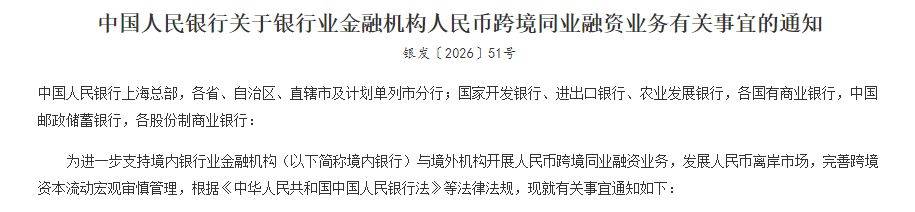
央行规范银行开展人民币跨境同业融资业务 不对单向融出余额提要求
Sou Hu Cai Jing· 2026-02-27 09:21
Core Viewpoint - The People's Bank of China (PBOC) has issued a notice that sets a cap on the net outbound balance for RMB cross-border interbank financing, while not imposing limits on the one-way lending balance, aiming to support and regulate banks in this area to better serve the real economy and promote a risk-neutral mindset among banks [1][2][3]. Group 1: Regulatory Framework - The notice links the net outbound balance of RMB cross-border interbank financing to the capital levels and funding strength of domestic banks, allowing for adjustments through cross-border business parameters and macro-prudential parameters [2][4]. - The notice covers various RMB cross-border interbank financing activities, including account financing and bond repurchase, which are crucial for providing RMB liquidity offshore and promoting the use of RMB in cross-border transactions [3][4]. - The PBOC aims to support the standardized development of these financing activities, ensuring stable liquidity in the offshore RMB market and promoting its cross-border use [3][4]. Group 2: Changes from Previous Proposals - The final notice does not impose a uniform hard limit on the duration of RMB cross-border interbank financing, differing from the draft proposal which suggested a maximum term of one year [5]. - The initial value for risk management factors has been adjusted based on the type of financial institution, rather than being uniformly set at 0.06 as proposed earlier [5]. - Five specific types of transactions are excluded from the net outbound balance calculation, including those based on genuine trade financing, transactions with offshore RMB clearing banks, and other recognized activities by the PBOC [5][6].

金融行业双周报(2026、2、13-2026、2、26)-20260227
Dongguan Securities· 2026-02-27 09:04
Investment Ratings - Banking: Overweight (Maintain) [1] - Securities: Market Weight (Maintain) [1] - Insurance: Overweight (Maintain) [1] Core Insights - The report indicates a stabilization and recovery in social financing growth, with significant improvement in short-term loans for residents [1] - As of January, the total social financing stock was 449.11 trillion yuan, with a month-on-month growth rate increase of 1.1 percentage points to 1.6% [44] - The report highlights a notable increase in personal short-term loans, reflecting stronger consumer sentiment ahead of the holiday season [44] - The insurance sector showed a robust performance in 2025, with total premium income reaching 61,194 billion yuan, a year-on-year growth of 7.43% [47] Summary by Sections Market Review - As of February 26, 2026, the banking, securities, and insurance indices experienced declines of -1.61%, -1.61%, and -4.91% respectively, while the CSI 300 index rose by 0.15% [9] - Among the sub-sectors, Huaxia Bank (+1.06%), First Venture (+5.83%), and New China Life (-4.16%) were the best performers [9] Valuation Situation - As of February 26, 2026, the banking sector's price-to-book (PB) ratio was 0.68, with state-owned banks, joint-stock banks, city commercial banks, and rural commercial banks having PB ratios of 0.72, 0.56, 0.72, and 0.61 respectively [19] - The securities sector's PB ratio was 1.43, indicating potential for valuation recovery [23] Recent Market Indicators - The average daily trading volume in the A-share market was 24,023.87 billion yuan, reflecting a 14.70% increase week-on-week [33] - The average margin balance remained stable between 26,142 billion and 26,585 billion yuan, indicating a slight recovery in investor sentiment [46] Industry News - In January 2026, the incremental social financing was 7.22 trillion yuan, exceeding the previous year's figure by 1,662 billion yuan [40] - Insurance funds are expected to continue entering the market in 2026, with a significant increase in stock allocations anticipated [41] Company Announcements - Ningbo Bank announced a valuation enhancement plan approved by its board [43] - Ping An Bank plans to redeem all of its preferred shares on March 9, 2026, totaling 20 billion yuan [43] Weekly Perspectives - The banking sector is advised to focus on regional banks with strong performance certainty, such as Ningbo Bank and Chengdu Bank [45] - The securities sector should consider stocks with restructuring expectations, including Zheshang Securities and Guolian Minsheng [46] - The insurance sector is recommended to focus on companies with leading premium growth, such as China Pacific Insurance and China Life [49]
宁夏固原普惠金融改革试点成效显著 金融活水精准滴灌乡村振兴
Zhong Guo Xin Wen Wang· 2026-02-27 09:00
Core Viewpoint - The People's Bank of China emphasizes the importance of inclusive finance reform in Guoyuan City, which has been selected as a pilot city for promoting rural revitalization and the development of characteristic industries since September 2025 [1] Group 1: Financial Reform Achievements - Guoyuan City has made significant progress in reforming its financial mechanisms, services, and product innovations, focusing on rural revitalization and characteristic industry development [1] - The city has established a multi-party linkage mechanism with a dedicated team and a comprehensive list to promote financial services [2] - By the end of 2025, loans in key inclusive finance areas reached 35.28 billion yuan, an increase of 8% year-on-year [2] Group 2: Financial Services and Products - Guoyuan has set up a microfinance service demonstration branch and deployed 57 village financial officers and 11 special representatives, achieving 100% coverage of basic financial services in rural areas [2] - Innovative credit products such as "Niu Jin Loan," "Qing Zhi Loan," "Starch Loan," and "Village Collective Loan" have been introduced to address challenges like lack of collateral and information asymmetry [2] - The financing amount for accounts receivable reached 1.098 billion yuan, providing credit support of 160 million yuan to 795 rural collective economic organizations [2] Group 3: Financial Ecosystem Optimization - The local financial ecosystem has been continuously optimized, with 132,000 credit users evaluated and 18,800 untrustworthy farmers released from restrictions, allowing 9,243 households to regain access to credit [2] - The non-performing loan rate remains stable at 1.50%, indicating a healthy financial environment [2] Group 4: Future Plans - The next steps include further deepening inclusive finance reforms, enhancing service systems, innovating suitable products, and strengthening risk management to ensure financial resources align more precisely with characteristic industries and inclusive groups [2]
渣打集团(02888)2月26日斥资1492.27万英镑回购81.36万股
智通财经网· 2026-02-27 08:59
Group 1 - The core point of the article is that Standard Chartered Group announced a share buyback plan, intending to repurchase 813,600 shares at a cost of £14.92 million on February 26, 2026 [1] Group 2 - The total amount allocated for the share buyback is £14.92 million [1] - The number of shares to be repurchased is 813,600 [1]
时隔3年半央行再次使用这一工具,用意何在?
Sou Hu Cai Jing· 2026-02-27 08:59
Core Viewpoint - The People's Bank of China (PBOC) announced a reduction in the foreign exchange risk reserve ratio for forward foreign exchange sales from 20% to 0% effective March 2, 2026, to promote the development of the foreign exchange market and support enterprises in managing exchange rate risks [1][3]. Group 1: Policy Implications - The reduction in the foreign exchange risk reserve ratio is a macro-prudential management tool aimed at lowering the cost of forward foreign exchange purchases for enterprises and encouraging them to engage in foreign exchange hedging [1][3]. - This policy is part of a broader set of measures announced by the PBOC to enhance the level of exchange rate risk management services provided by financial institutions [3]. Group 2: Market Context - Since the beginning of the year, the Chinese yuan has appreciated against the US dollar, influenced by a weakening dollar index [3]. - The current international environment is complex, with increasing geopolitical conflicts and uncertainties that could lead to greater volatility in the global foreign exchange market and affect the yuan's exchange rate [3]. Group 3: Future Outlook - By 2025, the hedging ratio for enterprises is expected to rise to 30%, and the proportion of trade settled in renminbi is also projected to increase to nearly 30%, indicating that a significant number of enterprises will be less affected by exchange rate risks [3]. - The PBOC emphasizes the importance of maintaining a neutral stance on exchange rate risks and encourages enterprises and financial institutions to manage these risks effectively amid potential fluctuations in the yuan's value [3].
中银量化多策略行业轮动周报–20260226-20260227
Bank of China Securities· 2026-02-27 08:52
Core Insights - The report highlights the current industry allocation of the Bank of China’s multi-strategy system, with the highest allocations in basic chemicals (22.8%), telecommunications (10.2%), and home appliances (10.1) [1] - The report tracks the performance of various strategies, indicating that the S1 industry profitability tracking strategy has outperformed the benchmark by 3.3%, while the S2 implied sentiment momentum strategy has outperformed by 4.3% [2][3] - The report identifies the top three industries based on profitability expectations as telecommunications, basic chemicals, and home appliances [14][19] Recent Industry Performance Review - The average weekly return for the CITIC primary industries was 0.8%, with the best-performing sectors being steel (5.7%), defense and military (5.3%), and electronics (4.4%) [10][11] - The worst-performing sectors included media (-6.4%), consumer services (-5.8%), and non-bank financials (-2.6%) [10][11] Industry Valuation Risk Warning - The report employs a valuation warning system based on the past six years of PB ratios, identifying industries with PB ratios above the 95th percentile as overvalued. Currently, industries such as retail, computers, non-ferrous metals, and defense are flagged for high valuation risk [12][13] Single Strategy Performance - The S1 high profitability industry rotation strategy currently has the highest weight at 21.7%, while the S3 macro style industry rotation strategy has the lowest weight at 17.9% [3] - The top three industries based on the S1 strategy are telecommunications, basic chemicals, and home appliances [14][15] Macro Style Rotation Strategy - The macro style rotation strategy identifies the top six industries based on macroeconomic indicators as banking, telecommunications, oil and petrochemicals, construction, home appliances, and coal [23][24] Long-term Reversal Strategy - The long-term reversal strategy recommends industries such as comprehensive, pharmaceuticals, basic chemicals, electric equipment and new energy, and consumer services for investment [27]
北京农商银行以“可持续发展挂钩贷款”助力企业绿色转型
Sou Hu Cai Jing· 2026-02-27 08:29
Core Viewpoint - Beijing Rural Commercial Bank has achieved a significant breakthrough in green finance by successfully launching sustainable development-linked loans in collaboration with Shou Nong Food Group, marking an innovative financial product that adjusts interest rates based on the completion of agreed environmental goals [1][2]. Group 1: Financial Innovation - The sustainable development-linked loans represent a departure from traditional credit models, directly linking a company's environmental performance to its financing costs, thereby creating a positive incentive mechanism for improving environmental performance [2]. - This innovative financial product design reflects a customer-centric service philosophy, effectively guiding enterprises to increase environmental investment and optimize resource allocation efficiency [2]. - The bank's city sub-center branch, as a specialized green finance institution, has integrated party building with business development to accurately meet the financing needs of enterprises under high-quality development and "dual carbon" goals [2]. Group 2: Regional Collaboration - The successful implementation of sustainable development-linked loans demonstrates Beijing Rural Commercial Bank's strategic integration into the regional mainstream economy, effectively guiding the financial support for the green industrial chain [3]. - Through deep cooperation with key regional enterprises like Shou Nong Food Group, the bank has not only addressed financing challenges but also provided new ideas for the green transformation of the agricultural industry in the region [3]. - The bank aims to use this loan as a starting point to further explore innovative green finance development models that meet real financing needs, actively responding to national "dual carbon" strategic goals [3]. Group 3: Broader Implications - In the context of global consensus on green development, the innovative practices of financial institutions like Beijing Rural Commercial Bank are crucial for guiding enterprises to take on environmental responsibilities, achieving a win-win situation for economic and social benefits [4]. - As the green finance system continues to improve, similar innovative products are expected to play a significant role in a wider range of fields, supporting the construction of a modern society in harmony with nature [4].
年内首家省级农商银行获批筹建 新增4省明确统一法人模式
Zhong Guo Jing Ying Bao· 2026-02-27 08:29
Core Viewpoint - The establishment of Gansu Rural Commercial Bank marks a significant step in the reform of rural financial institutions in China, transitioning to a unified legal entity model, which is expected to enhance capital strength and financial services for rural areas [1][2]. Group 1: Gansu Rural Commercial Bank Establishment - The approval for Gansu Rural Commercial Bank's establishment was granted on February 9, 2023, making it the first provincial-level unified legal entity rural commercial bank approved in the country by 2026 [1]. - The establishment process must be completed within six months of the approval [1]. - Gansu's rural financial institutions currently have a total agricultural loan balance of 259.9 billion yuan, with 65% of loans directed to farmers [2]. Group 2: Impact on Rural Financial Institutions - The reform will consolidate resources from 37 rural commercial banks and 41 county-level cooperatives, covering 90% of farmers through 1,904 outlets, thereby significantly improving service capabilities [2]. - The reform aims to enhance operational efficiency and management coordination by moving away from a decentralized management structure to a unified provincial strategy [2]. - A unified risk management system will allow for more effective risk identification and mitigation, ensuring the stability of the rural financial system [2]. Group 3: Broader Context of Reform - As of early 2026, 13 provinces have completed their provincial-level cooperative reforms, with six opting for a unified legal entity model and seven for a cooperative bank model [3]. - The choice of reform model varies by region, with unified legal entities being more suitable for provinces with smaller economies and more historical issues, while coastal regions may benefit from cooperative models [3]. - The ongoing push for quality improvement in small financial institutions suggests that more provinces will finalize their reform paths in 2026 [3].
AI终局对决:“资本吃掉人类”,还是“历史重演”?
Ge Long Hui· 2026-02-27 08:23
当讨论AI时,绝大多数人还在纠结"工作会不会被抢走"。但德银认为,这个视角或许有点狭窄了。 第一种结局是"彻底替代"。 如同180多年前马克思的预言与如今马斯克的愿景:在经济学的生产要素中,"资本"本身变成了"劳动 力"本身,劳动价值归零,资本主义将变得过时。 AI大规模取代人类工作,财富和收入高度集中在少数资本所有者手中,普通人的收入和需求被削弱, 经济陷入"东西很多、但没人买得起"的困境。 第二种结局则是"历史重演"。 AI像以往技术革命一样提高效率,却没有彻底取代人类劳动,仅仅是"赋能"人类,新的工作不断出现, 政策体系仍能修补冲击。 据追风交易台,德银外汇研究全球主管George Saravelos撰写的最新报告,推演了AI发展的两个极端终 局: 责任编辑:钟离 在这种情况下,经济运行逻辑与过去几十年相似,通胀、利率和股市更可能温和上行。 财经频道更多独家策划、专家专栏,免费查阅>> ...