
制造

Search documents
伯克希尔财报公布 巴菲特连续第11季净卖股
财联社· 2025-08-02 23:38
Core Viewpoint - Berkshire Hathaway reported a slight decline in Q2 operating profit and warned that high tariffs imposed by the U.S. government could negatively impact its business [1][12]. Financial Performance - Q2 revenue was $92.515 billion, down from $93.653 billion in the same period last year [2]. - Excluding investment-related items, Q2 operating profit was $11.16 billion, lower than $11.6 billion year-over-year, primarily due to weak insurance underwriting profits [2]. - Currency fluctuations negatively impacted post-tax operating profit by $877 million, contrasting with a $446 million gain from a strong dollar in the previous year [2]. - If currency effects are excluded, Q2 operating profit would actually be higher than the previous year [3]. - Net profit for Q2 was $12.37 billion, a significant drop from $30.3 billion in the same period last year [4]. Cash Flow and Investment Strategy - Cash reserves remained high at $344.1 billion, slightly below the $347 billion reported at the end of March [6]. - The substantial cash reserve provides ammunition for future acquisitions but highlights the difficulty in finding reasonably priced investment targets in the current high-valuation market [7]. - The company has net sold stocks for the 11th consecutive quarter, with total stock sales amounting to approximately $6.92 billion and purchases at $3.9 billion [8]. - The fair value of the top five holdings accounts for 67% of the portfolio, including American Express, Apple, Bank of America, Coca-Cola, and Chevron [8]. - Despite a 10% decline in Berkshire's Class A shares since reaching a record high on May 2, the company has not repurchased any shares in the first half of the year, maintaining a cautious stance [9][10]. Impairment and Future Outlook - Berkshire significantly reduced the book value of its Kraft Heinz holdings, recording an impairment loss of $3.8 billion, bringing the holding value down to $8.4 billion [11]. - The company expressed serious concerns regarding the potential impacts of U.S. tariff policies on its operations, indicating that most, if not all, of its operating businesses and equity investments could face adverse effects [12]. - This quarterly report is the first since Warren Buffett announced plans to step down as CEO at the end of the year, with current Vice Chairman Greg Abel set to take over [13].


海南即将封关!174个国家抢滩,外资暴增7倍:第二个香港要来了?
Sou Hu Cai Jing· 2025-08-01 08:05
Core Insights - Global capital is rapidly flowing into Hainan due to the announcement of the island's full closure on December 18, 2025, which has sparked significant interest in investment opportunities [1][3] - Hainan is being positioned as a new super free trade port, with a scale 32 times that of Hong Kong, attracting major global corporations [5][19] Investment Trends - Prior to the closure announcement, there was already a surge in foreign investment, with 2,072 new foreign enterprises established in Hainan in 2024, approximately seven times the number in 2018 [3] - The number of countries and regions investing in Hainan increased from 43 in 2018 to 174 [3] Economic Potential - Hainan's current GDP is only 79 billion yuan, which presents a significant growth opportunity, with projections suggesting it could grow tenfold in the next decade [21] - The island's policies, including zero tariffs on 6,600 types of goods and a maximum personal income tax of 15%, are designed to create a favorable business environment [8][19] Strategic Advantages - Hainan's geographical location is advantageous, serving as a gateway between mainland China and ASEAN, with access to major shipping routes [15] - The island's status as a natural barrier enhances regulatory oversight, making it less susceptible to smuggling [17] Market Dynamics - The establishment of a comprehensive bonded zone allows for significant capital efficiency, enabling businesses to defer tax payments and improve cash flow [10][12] - Hainan aims to attract processing industries from Southeast Asia, creating a quasi-international market within China [14] Future Outlook - The closure of Hainan is seen as a strategic move by China to counter global protectionism and to open up its market further [24][26] - Predictions indicate that Hainan could evolve into a 2 trillion yuan GDP economy, serving as a major hub for high-end manufacturing and trade [26][28]

飞达控股(01100)发盈喜 预计中期股东应占溢利同比增加至不少于5800万港元
智通财经网· 2025-07-31 11:05
Core Viewpoint - The company, Feida Holdings (01100), anticipates a significant increase in its unaudited interim profit attributable to shareholders for the six months ending June 30, 2025, projecting at least HKD 58 million, compared to approximately HKD 35.3 million for the interim report ending June 30, 2024 [1] Group 1: Financial Performance - The projected net profit growth is primarily attributed to the increase in revenue and profit from the manufacturing segment, particularly in Bangladesh [1] - Contributing factors to this growth include: - A shift of more orders from countries affected by high tariffs imposed by the United States to Bangladesh [1] - Improvements in production efficiency [1] - Enhanced cost control measures [1] Group 2: Business Segment Performance - Despite the positive outlook for the manufacturing segment, the anticipated growth in the interim results for 2025 will be partially offset by underperformance in the trading segment [1]
飞达控股(01100.HK)预期中期溢利将不少于5800万港元
Xin Lang Cai Jing· 2025-07-31 10:49
Core Viewpoint - The company anticipates a significant increase in net profit for the six months ending June 30, 2025, with expected profit not less than HKD 58 million, compared to approximately HKD 35.27 million for the interim report of 2024 [1] Group 1: Financial Performance - The expected net profit growth is primarily attributed to the increase in revenue and profit from the manufacturing segment, particularly in Bangladesh [1] - Contributing factors to the manufacturing segment's performance include: - A shift of more orders from countries affected by high U.S. tariffs to Bangladesh [1] - Improvements in production efficiency [1] - Enhanced cost control measures [1] Group 2: Trade Business Impact - Despite the positive outlook for the manufacturing segment, the anticipated growth in the 2025 interim results will be partially offset by underperformance in the group's trading business segment [1]
日本央行行长植田和男:希望审查关税是否影响日本制造商及其工资。
news flash· 2025-07-31 06:59
Core Viewpoint - The Governor of the Bank of Japan, Kazuo Ueda, expressed the intention to review whether tariffs are affecting Japanese manufacturers and their wages [1] Group 1 - The Bank of Japan is considering the impact of tariffs on the manufacturing sector [1] - There is a focus on how these tariffs may influence wage levels within Japanese manufacturing companies [1]
美国7月ADP就业增10.4万超预期 仍难掩劳动力市场降温现实
智通财经网· 2025-07-30 13:33
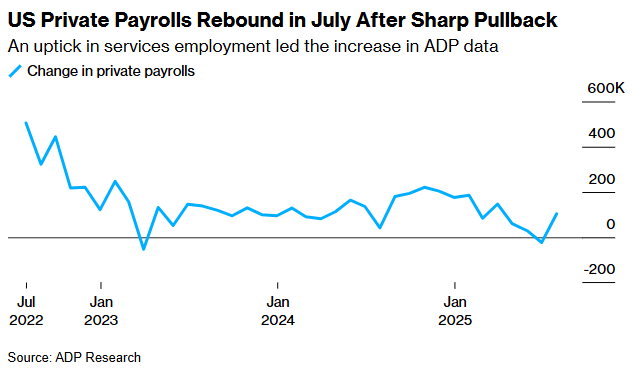
Core Insights - The U.S. private sector job market showed unexpected growth in July, with ADP reporting an increase of 104,000 jobs, the largest since March, surpassing the market expectation of 75,000 jobs [1][4] - Despite the positive job growth, there is a notable cooling in the overall labor market, as the proportion of consumers finding it "hard to get a job" has reached a near four-and-a-half-year high, coinciding with a rising trend in initial unemployment claims [1][4] Employment Sector Analysis - The most significant feature of the July job market is sectoral differentiation, with leisure and hospitality, as well as financial activities, being the main hiring sectors, while education and health services have seen layoffs for the fourth consecutive month [4] - The construction sector added 15,000 jobs, showing an acceleration from June's 9,000 jobs; manufacturing saw a notable slowdown, adding only 7,000 jobs in July compared to 15,000 in June; trade, transportation, and utilities added 18,000 jobs, up from 14,000 in June; financial services rebounded strongly with 28,000 new jobs, reversing a loss of 14,000 in June [4] - Professional and business services improved slightly from a decline of 56,000 jobs in June, adding only 9,000 jobs in July, indicating that future trends need to be monitored [4] Economic Outlook - ADP's Chief Economist Nela Richardson noted that current hiring and wage data reflect a healthy economic state, with employers gaining confidence in consumer demand; however, private sector hiring remains significantly below last year's average levels, and companies are becoming increasingly cautious in staffing decisions amid heightened policy uncertainty [4] - Initial unemployment claims remain low, but the extended reemployment cycle for unemployed workers indicates a decline in labor market fluidity [4] - The market anticipates that the upcoming U.S. Labor Department's non-farm payroll report will show an increase of 110,000 jobs, with the unemployment rate potentially rising from 4.1% in June to 4.2% in July [5] - Salary growth remains stable, with a 4.4% year-over-year increase for retained employees and a 7% increase for job switchers; the service sector recovery is a primary driver of job growth, although education and health sectors have experienced a net loss of jobs this year [5]
上海科技金融领域再创新——16家市属国企联合设立公益基金会 引资金活水注入基础研究动力
Jie Fang Ri Bao· 2025-07-30 02:03
Core Viewpoint - The establishment of the Shanghai Qiyuan State-owned Assets Innovation Fund marks a significant step in diversifying funding sources for basic research in Shanghai, addressing the current reliance on government funding [1][2]. Group 1: Fund Establishment - The Qiyuan Fund is the first public foundation in China initiated by local state-owned enterprises to support basic research [1]. - The fund will provide financial support through donations for forward-looking and disruptive basic research and its results transformation [1]. Group 2: Current Challenges - Shanghai's basic research funding has seen rapid growth, but it remains heavily reliant on government sources, with 90% coming from fiscal funds, lacking a diversified funding mechanism [2]. - The focus of local enterprises has primarily been on applied research due to the long cycles and high risks associated with basic research [2]. Group 3: Fund Composition - The fund is managed by the Shanghai State-owned Assets Supervision and Administration Commission and involves 16 state-owned enterprises from various sectors, including finance, manufacturing, and energy [3]. - The aim is to leverage state-owned capital to fill the investment gap in basic research and reduce the risk costs associated with technological breakthroughs [3]. Group 4: Target Areas - The fund will focus on four key areas: tackling "bottleneck" technologies, exploring "unmanned" frontiers, connecting the "transformation chain," and supporting young scientists [4][5]. - Specific sectors of interest include integrated circuits, biomedicine, artificial intelligence, quantum technology, and deep-sea exploration [4][5]. Group 5: Collaboration and Future Plans - The fund plans to collaborate with Fudan University and Shanghai Jiao Tong University to enhance support for basic and applied research [5]. - There are intentions to mobilize more social forces to join the technology public welfare initiative, promoting a shift from "single-point breakthroughs" to "ecological co-construction" in Shanghai's tech philanthropy [5].

@求职者 现代服务、医疗卫生等4个线上招聘专场来了
Yang Shi Xin Wen Ke Hu Duan· 2025-07-30 01:35
Core Points - The "Hundred Days of Millions of Recruitment Special Action" launched online recruitment events in four sectors: modern services, healthcare, chain operations, and the internet, with participation from 25,000 employers and a recruitment demand exceeding 916,000 positions [1] Group 1: Modern Services Sector - The modern services sector will feature over 8,600 employers offering positions such as software testing engineers, after-sales engineers, and sales managers, with a recruitment demand of 141,000 positions [1] Group 2: Healthcare Sector - The healthcare sector will involve over 1,200 employers providing roles like pharmaceutical formulation researchers, medical affairs consultants, and medicinal chemistry researchers, with a recruitment demand of 9,000 positions [1] Group 3: Chain Operations Sector - The chain operations sector will include 12,000 employers offering positions such as store managers, purchasers, and salespersons, with a recruitment demand of 651,000 positions [1] Group 4: Internet Sector - The internet sector will have over 3,100 employers providing roles like software development engineers, data analysts, and operational support, with a recruitment demand of 115,000 positions [1] Group 5: Live Streaming Recruitment Event - On July 31, a live streaming recruitment event titled "Employment Online" was held, featuring employment officials from Shaanxi, Gansu, and Ningxia, showcasing job opportunities in manufacturing, finance, real estate, and business services, including positions like mechanical design engineers, breeding technicians, wealth managers, property managers, and e-commerce specialists [1]
百日千万招聘专项行动推出线上招聘专场
Ren Min Ri Bao· 2025-07-29 23:23
Group 1 - The "Hundred Days of Millions of Recruitment" initiative is launching online recruitment events for four sectors: modern services, healthcare, chain operations, and the internet, with participation from 25,000 employers and a recruitment demand exceeding 916,000 positions [1] - The modern services sector will involve over 8,600 employers, offering positions such as software testing engineers, after-sales engineers, and sales managers, with a recruitment demand of 141,000 [1] - The healthcare sector will have over 1,200 employers, providing roles like pharmaceutical formulation researchers, medical affairs consultants, and medicinal chemistry researchers, with a recruitment demand of 9,000 [1] - The chain operations sector will include 12,000 employers, offering positions such as store managers, purchasers, and salespersons, with a recruitment demand of 651,000 [1] - The internet sector will feature over 3,100 employers, providing roles like software development engineers, data analysts, and operational support, with a recruitment demand of 115,000 [1] Group 2 - On July 31, a live-streaming recruitment event titled "Employment Bureau Chief Enters the Live Room" will be held, featuring employment officials from Shaanxi, Gansu, and Ningxia, focusing on industries such as manufacturing, finance, real estate, and business services [2] - The event will offer positions including mechanical design engineers, breeding technicians, wealth management advisors, property management, and e-commerce specialists [2] - Employers and job seekers can access the recruitment events through platforms like the China Public Recruitment Network, the National Talent Network, and the main page of the Employment Online initiative [2]
百日千万招聘专项行动推出线上招聘专场 招聘需求超91.6万人次
Ren Min Ri Bao· 2025-07-29 21:56
Group 1 - The "Hundred Days of Millions of Recruitment" initiative is launching four online recruitment events in the modern services, healthcare, chain operation, and internet industries, with participation from 25,000 employers and a recruitment demand exceeding 916,000 positions [1] - The modern services sector will involve over 8,600 employers, offering positions such as software testing engineers, after-sales engineers, and sales managers, with a recruitment demand of 141,000 [1] - The healthcare sector will have over 1,200 employers, providing roles like pharmaceutical formulation researchers, medical affairs consultants, and medicinal chemistry researchers, with a recruitment demand of 9,000 [1] - The chain operation sector will include 12,000 employers, offering positions such as store managers, purchasers, and salespersons, with a recruitment demand of 651,000 [1] - The internet sector will involve over 3,100 employers, providing roles like software development engineers, data analysts, and operational support, with a recruitment demand of 115,000 [1] Group 2 - On July 31, a live-streaming recruitment event titled "Employment Bureau Chief Enters the Live Room" will be held, featuring employment officials from Shaanxi, Gansu, and Ningxia, focusing on industries such as manufacturing, finance, real estate, and business services [2] - Employers will offer positions including mechanical design engineers, breeding technicians, wealth managers, property managers, and e-commerce specialists [2] - Job seekers can access the recruitment events through platforms like the China Public Recruitment Network, the National Talent Network, and the main page of the Employment Online initiative [2]