风险投资

Search documents
钛媒体首届硅谷峰会成功举办,400+全球商业领袖精彩瞬间回顾 | NEX-T 2025
Sou Hu Cai Jing· 2025-10-16 03:12
Core Insights - The NEX-T Summit 2025, themed "New Era of X-Tech," was successfully held at Stanford University, focusing on AI trends, investment strategies, and the growth of Asian youth, attracting over 400 global leaders from various sectors [2][3]. Group 1: Event Overview - The summit featured keynotes, roundtable discussions, startup pitches, and thematic discussions, emphasizing the intersection of technology, capital, and innovative ideas in the context of AI and sustainable development [3]. - The event was co-hosted by prominent organizations including NextFin.AI, GALA, Shanda Group, and Barron's China, highlighting a collaborative effort to bridge Silicon Valley with Asia [2][3]. Group 2: Keynote Speakers and Themes - Notable speakers included Robin Lewis, Fiona Ma, Chiling Tong, and Jany Hejuan Zhao, who emphasized the importance of empowering Asian innovators and fostering cross-sector collaboration [6][7][8]. - John L. Hennessy, former Stanford president, discussed the historical evolution of Silicon Valley technology and the dual-edged nature of AI, which presents both opportunities and challenges [10]. Group 3: Roundtable Discussions - Discussions on AI's transformative impact in healthcare highlighted the importance of data ownership and the potential for AI to enhance diagnostics and patient care [13][16]. - The roundtable on AI applications in entrepreneurship addressed the challenges and opportunities presented by AI across various industries, advocating for the meaningful application of AI technology [22]. - A session on AI and public trust explored the implications of AI on media consumption and the need for industry standards to combat misinformation [37]. Group 4: Future Perspectives - The summit aimed to define a new chapter in globalization by leveraging AI and technology to create value and foster innovation across borders [46]. - The discussions underscored the necessity for global cooperation to address technological challenges and the evolving landscape of investment opportunities in the AI sector [32].


伟大公司不靠运气,靠时间
Hu Xiu· 2025-10-15 10:04
Core Insights - Sequoia Capital is a highly respected name in the venture capital industry, having supported companies that created trillions of dollars in market value globally [1] - Roelof Botha, representing the third generation of Sequoia, discusses the challenges in the venture capital industry, organizational innovations, views on the Chinese market, and lessons learned from mentors [2] Investment Strategy - The Sequoia Scout program was launched in 2009, allowing successful founders to invest in early-stage entrepreneurs with Sequoia's funding, resulting in a total fund return of 26 times [3][4] - Sequoia's highest returning funds, Venture 12 and Venture 13, achieved returns exceeding 20 times, with notable companies like Airbnb and Stripe [4] Industry Challenges - Roelof Botha highlights that the venture capital industry is currently facing an excess of capital and low returns, with annual investments around $150 billion to $200 billion [5][6] - To achieve reasonable returns, the industry would need over $1 trillion in exit value annually, which is unrealistic given the current market conditions [6][8] - The number of companies achieving exits over $1 billion is limited, with only about 20 companies doing so each year [8] Organizational Innovation - Sequoia Capital adopts a "self-enhancing" approach, with a significant portion of its operational team dedicated to supporting its investment team [10][11] - The firm has developed numerous internal tools, including an AI system for summarizing business plans and assessing team quality [12][13][14] Market Perspective - Roelof Botha reflects on the challenges faced by the Chinese market, noting a drastic decline in new company formations from 51,000 in 2018 to 1,200 in 2023, a 98% drop [17] - He emphasizes that while the entrepreneurial spirit in China is strong, it has shifted to regions like Latin America, Singapore, Japan, and Europe [19] Long-term Investment Philosophy - Sequoia Capital Fund was launched in 2022 to hold shares of public companies, allowing for long-term compounding growth [21] - The fund has generated an additional $6.7 billion for LPs in just 3.5 years by adopting a patient investment strategy [22][23] Cultural Values - The firm's culture, established by Don Valentine, focuses on finding "outstanding but difficult" individuals who are often non-conformists [25][26] - Investment decisions at Sequoia are made through a consensus mechanism, allowing any partner to veto an investment [26] Mentorship and Learning - Roelof Botha credits his mentors, Michael Moritz and Doug Leone, for teaching him the importance of heart and imagination in venture capital [27][28][29] Legacy and Goals - Sequoia Capital prioritizes long-term excellence over scale, aiming to be the preferred investment manager for LPs rather than managing the most capital [30][31]
高盛(GS.US)斥资高达9.65亿美元收购VC公司Industry Ventures 大举切...
Xin Lang Cai Jing· 2025-10-14 00:13
Group 1 - Goldman Sachs (GS.US) has agreed to acquire venture capital firm Industry Ventures for up to $965 million, with an initial payment of $665 million in cash and equity, and potential additional payments of up to $300 million based on performance by 2030 [1][2] - Industry Ventures, founded in 2000 and based in San Francisco, manages approximately $7 billion in assets, primarily through secondary market investments, co-investments, and providing capital to external venture funds [1][2] - The acquisition is expected to enhance Goldman Sachs' presence in the venture capital space, which is a key growth area in the U.S. economy, particularly as many companies remain private and benefit from trends in artificial intelligence and infrastructure development [2] Group 2 - Industry Ventures' founder Hans Swildens and two senior colleagues will join Goldman Sachs as partners, with Swildens reporting to Michael Brandmeyer, a senior executive in Goldman’s external investment division [2] - Swildens noted that Industry Ventures has been involved in about 20% of the U.S. venture capital market through approximately 10,000 underlying investment companies and over 325 partner firms, achieving a capital return rate of 2.2 times for investors since its inception [2] - Goldman Sachs' asset and wealth management head, Marc Nachmann, emphasized the stability of investment returns as a key factor for the acquisition, highlighting the challenge of maintaining such performance over 20 years [2]

红杉掌门人 Roelof Botha:伟大公司不靠运气,靠时间
投资实习所· 2025-10-12 12:58
Core Insights - Sequoia Capital is a highly respected name in the venture capital industry, having supported companies that created trillions of dollars in market value, with Roelof Botha representing the third generation of leadership [1] Investment Environment - The venture capital industry is currently facing a dilemma of excessive capital and low returns, with annual investments ranging from $150 billion to $200 billion, necessitating over $1 trillion in exit value each year to achieve reasonable returns [5][8] - Only about 20 companies each year achieve exits exceeding $1 billion, indicating that more capital does not necessarily lead to more successful founders [8] Organizational Innovation - Sequoia Capital has adopted a "self-enhancing" approach, equipping its investment team with technology rather than building a large operational structure [9][10] - The firm has developed numerous internal tools, including an AI system that quickly summarizes new business plans and evaluates team quality and competitive landscape [12][13] China Market Insights - Roelof Botha expressed concerns about the Chinese market, noting a dramatic decline in new company formations from 51,000 in 2018 to 1,200 in 2023, a drop of 98% [15] - He believes that the entrepreneurial spirit has not disappeared but has shifted to regions like Latin America, Singapore, Japan, and Europe [17] Long-term Investment Strategy - Sequoia Capital has launched the Sequoia Capital Fund to hold shares of public companies, allowing for long-term compounding growth [18] - This fund has generated an additional $6.7 billion for LPs in just 3.5 years by adopting a patient approach to holding stocks [19] Decision-Making and Culture - The firm emphasizes a culture of curiosity and seeks out "outstanding but difficult" individuals who challenge the status quo [21][22] - Investment decisions are made through a consensus mechanism, allowing any partner to veto an investment, which can lead to both positive and negative outcomes [22][23] Mentorship and Learning - Roelof Botha credits his mentors, Michael Moritz and Doug Leone, for teaching him the importance of imagination and emotional resilience in venture capital [24][25] Legacy and Values - Sequoia Capital prioritizes long-term excellence over scale, aiming to be the preferred investment manager for LPs rather than managing the most capital [26][27]

郭田勇:构建同科技创新相适应的科技金融体制
Jing Ji Ri Bao· 2025-10-10 00:03
Core Insights - The article emphasizes the critical role of technology finance in enhancing national competitiveness and supporting economic transformation through innovation [1][2][3] Group 1: Importance of Technology Finance - Technology finance serves as a vital bridge connecting financial capital with technological innovation, increasingly recognized as essential in the current global economic restructuring [2] - The Chinese government prioritizes technology finance as a key area for development, alongside green finance, inclusive finance, pension finance, and digital finance [2] - Financial capital acts as a catalyst for transforming technological innovations into practical applications, thereby enhancing the innovation ecosystem [2][3] Group 2: Achievements and Policies in Technology Finance - Significant progress has been made in technology finance in China, with enhanced policy support and a diversified financial service system for technology enterprises [4] - The People's Bank of China and other departments have issued policies to improve the service capabilities of financial institutions in supporting technology innovation [4] - The total balance of technology loans reached 44.1 trillion yuan, with a year-on-year growth of 12.5%, indicating a strong preference for technology financing [5] Group 3: Challenges in Technology Finance - The current financing structure is predominantly indirect, with banks favoring established companies over startups, which often struggle to meet traditional credit requirements [6] - The vitality of the venture capital market needs enhancement, and the participation of private capital remains low [6] Group 4: Recommendations for Improvement - A unique technology finance system should be developed that aligns with China's financial structure and industrial ecosystem, leveraging the strengths of the banking sector [7] - Banks should enhance their service capabilities for technology innovation by developing products tailored to the needs of high-growth, asset-light enterprises [8] - A mechanism for linking investment and loans should be established to support technology enterprises through various stages of development [8] - Government investment funds should be managed more effectively to support strategic innovation projects and improve post-investment management [9] - Direct financing channels for technology enterprises should be streamlined, encouraging private capital participation and enhancing market transparency [9]
ABB与软银签约拟54亿美元出售机器人业务
Zheng Quan Shi Bao Wang· 2025-10-09 13:17
Core Insights - ABB has signed an agreement to sell its robotics business unit to SoftBank Group for an enterprise valuation of $5.375 billion, abandoning previous plans for an independent IPO of the robotics unit [1] - The transaction is subject to regulatory approval and customary closing conditions, expected to be completed in mid-2026 [1] - SoftBank's CEO Masayoshi Son stated that the next strategic frontier for SoftBank is Physical AI, aiming to integrate super artificial intelligence with robotics technology [1] Group 1: Transaction Details - The sale reflects the long-term strength of ABB's robotics division and is expected to create immediate value for ABB shareholders [1] - ABB will use the proceeds from the transaction according to its established capital allocation principles, maintaining its focus on long-term strategies in the electrical and automation sectors [1] - The deal is anticipated to generate approximately $2.4 billion in non-operating pre-tax book gains, with expected net cash proceeds of about $5.3 billion after transaction costs [2] Group 2: Business Impact - Following the agreement, ABB will restructure its financial reporting into three main divisions, with the robotics unit classified as a "discontinued operation" starting from Q4 2025 [2] - The mechanical automation business unit, currently part of the robotics and discrete automation division, will be integrated into the process automation division [2] - ABB's robotics unit employs around 7,000 people and is projected to generate $2.3 billion in sales revenue in 2024, accounting for 7% of ABB's total revenue, with an operating EBITDA margin of 12.1% [3] Group 3: SoftBank's Strategic Vision - SoftBank is positioning itself as a leader in the AI and robotics sectors, with recent investments in AI projects, including a $500 billion initiative for data centers and a partnership with OpenAI for enterprise-level AI services [3] - The acquisition of ABB's robotics business aligns with SoftBank's broader strategy to enhance its capabilities in next-generation computing and sustainable AI [3]


诺和诺德母公司投资 全球最大规模量子专项风投基金成立
Sou Hu Cai Jing· 2025-10-05 11:03
Core Insights - Novo Nordisk's parent company, Novo Holdings, has established a quantum-focused venture capital fund named 55 North, which has raised approximately €300 million in its first funding round [1] - Novo Holdings and the Danish Export and Investment Fund (EIFO) are cornerstone investors, contributing €134 million [1] - 55 North is now the largest quantum-focused venture capital fund globally [1]
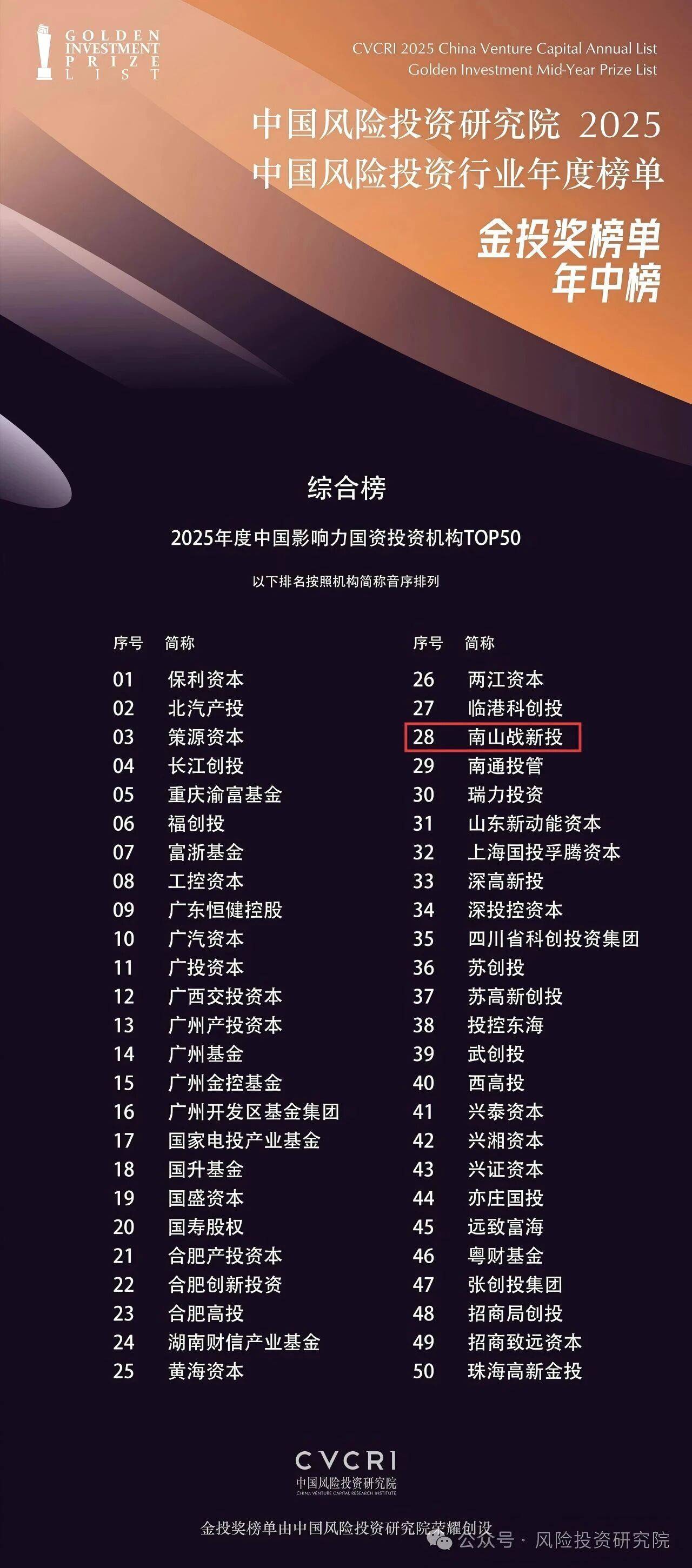
排位28!南山战新投跻身年度中国影响力国资投资机构TOP50榜单
Sou Hu Cai Jing· 2025-10-04 04:21
Group 1 - The core viewpoint of the article highlights that Shenzhen Nanshan Strategic Emerging Industry Investment Co., Ltd. has been recognized as one of the "Top 50 Influential State-owned Investment Institutions in China for 2025" by the China Venture Capital Research Institute [1][8] - The evaluation covered both comprehensive and industry-specific rankings, with a total of 13 sub-lists, assessing institutions based on fundraising, investment, management, exit strategies, and overall impact [7] - Nanshan Strategic Emerging Investment is a wholly state-owned limited liability company established by the Nanshan District Government in Shenzhen, focusing on strategic emerging industries and future industries [7][8] Group 2 - The company emphasizes investment in core areas such as new generation information technology, high-end equipment manufacturing, biomedicine, and digital economy, aiming to support major industrial projects and cultivate new driving forces for development [7] - Nanshan Strategic Emerging Investment operates two wholly-owned subsidiaries, Huirong Investment and Zhirong Guarantee, which serve as platforms for equity investment and financing guarantee, respectively [7] - The recognition of Nanshan Strategic Emerging Investment in this ranking reflects the market's high regard for its investment strategy and overall strength [8]
清流资本刘博:40而利,我终于失去了“时间”这个朋友
Sou Hu Wang· 2025-10-03 10:32
Group 1 - Liu Bo, a partner at Qingliu Capital, has been in the VC industry for 12 years and has experienced significant changes in the economy and industry dynamics [3][5][7] - The VC industry has evolved from a "handcrafted" approach to a more industrialized model, with specialization in project sourcing, valuation, and post-investment management [4][5] - The current generation of investors, represented by Liu Bo, is characterized by mentorship and structured learning, contrasting with earlier generations that relied on personal style [4][5] Group 2 - The consumer sector faced severe challenges, leading Liu Bo to reassess her career and investment strategies as she approaches her 40th birthday [5][6][8] - The liquidity crisis in the primary market has made it difficult for projects to secure funding, impacting the risk-reward balance for VCs [7][8][11] - The shift in focus from consumer investments to sectors like renewable energy and AI reflects the need for adaptability in response to market conditions [14][15][18] Group 3 - The VC industry is experiencing a transformation where traditional methods of project evaluation and relationship management are being challenged by new dynamics [17][19] - The importance of maintaining optimism and learning agility is emphasized as essential traits for success in the VC field [19][20] - The perception of age and experience in the VC industry is evolving, with a call for more visibility and representation of individuals over 40 [21][22][23] Group 4 - Liu Bo's insights suggest that the VC landscape is becoming more competitive, with fewer opportunities and a need for deeper engagement with projects [18][24] - The exploration of family office perspectives on VC investments indicates a shift in how assets are evaluated and managed in the current market [24][25] - The focus on exit strategies is highlighted as crucial for realizing the value of past investments, underscoring the importance of timing in the investment cycle [25]
如何打通科创企业融资“最后一公里”?
Sou Hu Cai Jing· 2025-09-29 14:06
Core Viewpoint - The rise of technology is profoundly reshaping the financial landscape, with the integration of technology and finance driving innovation in the financial sector, creating new trends, models, and ecosystems that are key engines for high-quality economic development [1] Group 1: Current Challenges in Technology Finance - There is a mismatch between banks' risk appetite and the needs of technology enterprises, leading to difficulties in financing [8] - The shortage of professional talent in the banking sector limits its ability to effectively support technology enterprises compared to VC/PE firms [8] - The phenomenon of "difficult and expensive financing" arises from the inherent contradictions in market demands, where banks require risk compensation that often results in higher costs for technology firms [6] Group 2: Advantages of Bank Financing - Banks have significant advantages such as large scale, low and stable funding costs, and the ability to provide comprehensive financial services like supply chain and cross-border finance, which are valuable for technology enterprises [3][5] - As of Q2 2025, 274,000 technology SMEs received loans, with a loan approval rate of 50%, reflecting a 3.2 percentage point increase year-on-year [3] Group 3: Limitations of Bank Financing - Banks face limitations in providing technology finance, including a lack of differentiated competition and a tendency to follow similar practices due to regulatory influences [5][9] - The current banking model does not adequately support the cultivation of early-stage technology enterprises, which require more than just capital [8] Group 4: Recommendations for Improvement - Encouraging differentiated routes for financial institutions and fostering a more robust financial ecosystem is essential for supporting technology innovation [7] - Establishing specialized institutions focused on technology finance could help alleviate the constraints faced by traditional banks [10] - Cultivating "patient capital" and ensuring clear exit strategies for investments can enhance the overall investment ecosystem [10] Group 5: Impact on Economic Structure - The transformation of financing methods from traditional collateral-based approaches to cash flow or technology-based financing will lead to significant changes in economic structure, shifting from tangible to intangible assets [12] - A complete financial ecosystem aims to foster innovation and sustainable growth, moving away from factor-driven growth to innovation-driven growth [12]