
服装零售

Search documents
Abercrombie & Fitch raises annual profit forecast on Hollister strength; shares jump
Reuters· 2025-11-25 12:41
Core Insights - Abercrombie & Fitch has raised its annual profit forecast, indicating confidence in strong demand for its Hollister brand, particularly for dresses and jackets during the holiday season [1] Company Summary - The company is experiencing a surge in demand for in-trend apparel, which is driving the positive outlook for its financial performance [1]



丰城市程子于服饰有限公司成立 注册资本10万人民币
Sou Hu Cai Jing· 2025-11-25 04:16
天眼查App显示,近日,丰城市程子于服饰有限公司成立,法定代表人为程丹华,注册资本10万人民 币,经营范围为一般项目:互联网销售(除销售需要许可的商品),工艺美术品及礼仪用品销售(象牙 及其制品除外),鞋帽批发,鞋帽零售,服装服饰零售,服装服饰批发,箱包销售,服装辅料制造,珠 宝首饰制造,钟表与计时仪器销售,珠宝首饰回收修理服务,工艺美术品及收藏品零售(象牙及其制品 除外),包装材料及制品销售,国内贸易代理,钟表销售,平面设计,珠宝首饰批发,珠宝首饰零售, 专业设计服务(除依法须经批准的项目外,凭营业执照依法自主开展经营活动)。 ...
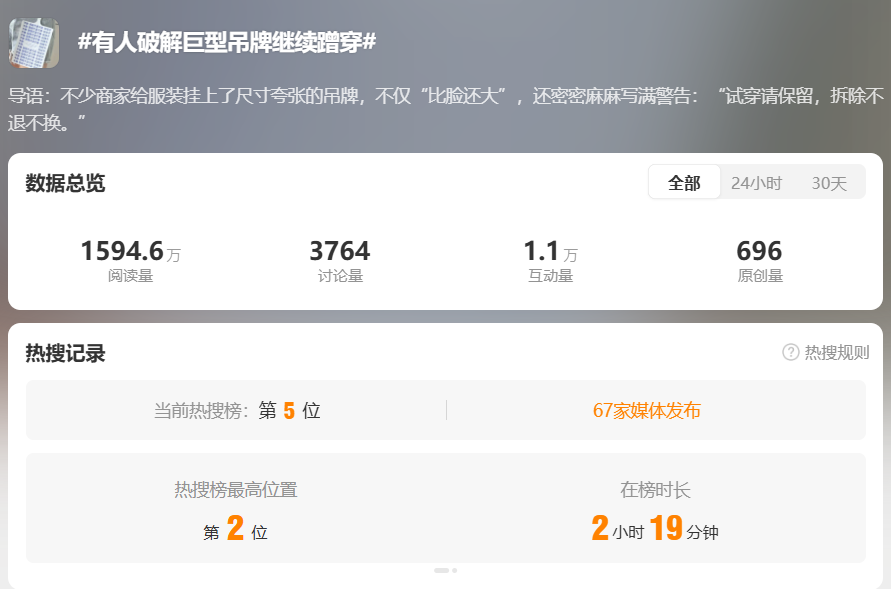
退货率太高,商家想出绝招防“薅羊毛”:挂上巨型吊牌,就没法穿出门了!但还是被人破解……
Mei Ri Jing Ji Xin Wen· 2025-11-24 12:38
Core Viewpoint - The introduction of oversized tags by merchants aims to combat the high return rates in the apparel industry, which have been exploited by consumers taking advantage of the "seven-day no-reason return" policy [1][5]. Group 1: Oversized Tags Implementation - Merchants have started using oversized tags that are significantly larger than typical tags, with warnings stating "please keep for fitting, no returns if removed" [1]. - Some merchants have even attached locks to zippers, providing the combination only after the consumer confirms receipt of the item [1]. - The cost of producing these oversized tags can be as low as 0.2 yuan each, while the return cost for a 200 yuan garment is approximately 40 yuan, making this strategy financially viable for merchants [5]. Group 2: Impact on Return Rates - After implementing oversized tags, one online store reported a significant drop in malicious return rates from 42% to 18% [5]. - Despite the effectiveness of oversized tags, some consumers have found ways to circumvent the system, such as using clips to keep the tags on the inside of garments [5]. Group 3: Consumer Reactions - Consumer opinions on oversized tags are mixed, with some supporting the merchants' efforts while others argue that high return rates are due to poor product quality, which affects the fitting experience [5]. Group 4: Alternative Tag Concepts - A merchant in Jiangsu created mouse pad tags, which unexpectedly became popular, leading to no returns on those items [6]. - The cost of these mouse pad tags is higher than traditional paper tags, but the merchant chose not to pass the extra cost onto consumers, maintaining a focus on perceived value [6]. Group 5: Expert Opinions - An expert suggests that while oversized tags may provide a temporary solution to high return rates, a long-term strategy is needed to rebuild trust between buyers and sellers [8]. - Recommendations include improving consumer credit ratings on platforms and enhancing service environments to reduce malicious return behaviors [8].
实体店一件衣服500元,为何电商却只卖几十块?答案被揭开了
Sou Hu Cai Jing· 2025-11-24 11:45
Core Insights - The significant price difference between clothing in physical stores and online platforms is attributed to various factors including material quality, design, operational costs, and supply chain differences [1][5][6]. Material Quality - Clothing sold in physical stores often uses high-quality materials such as silk and pure cotton, which provide better comfort and durability compared to the synthetic fibers commonly found in cheaper online options [3][5]. - The difference in fabric quality is likened to the contrast between premium and lower-end alcoholic beverages, emphasizing the substantial cost difference in materials used [3]. Design and Craftsmanship - Physical store garments are typically designed by professionals, involving extensive time and effort in crafting the fit and details, which contributes to higher costs [3][5]. - In contrast, cheaper online clothing often mimics popular styles with simpler production methods, resulting in lower quality and durability [3][6]. Operational Costs - The operational expenses for physical stores, including rent, utilities, and wages, significantly impact pricing, necessitating higher prices to cover these costs [5][6]. - Online retailers benefit from lower overhead costs, often operating from less expensive locations and utilizing direct factory sourcing, which allows for lower pricing [5][6]. Supply Chain Differences - Online sellers typically purchase directly from manufacturers in bulk, reducing costs compared to physical stores that rely on multiple intermediaries, which increases the final retail price [5][6]. - The inventory management in physical stores also leads to higher prices due to limited stock and the need to maintain profitability [5]. Sales Strategies - Online platforms often adopt a low-margin, high-volume sales strategy, allowing them to sell products at lower prices while still achieving significant profits through high sales volumes [6]. - Physical stores, facing limited foot traffic, must maintain higher prices to ensure sustainability, leading to a contrasting business model focused on higher unit prices [6]. Future Trends - There is a growing trend of brands integrating online and offline sales strategies, which may lead to a narrowing of price differences between physical and online stores [6]. - Despite potential changes in sales strategies, the principle of "you get what you pay for" remains relevant, with quality and experience differing significantly between low-cost and higher-priced options [6][7].

顾客被店员备注“买双鞋子都嫌贵”,FILA官方回应
第一财经· 2025-11-24 09:47
Core Viewpoint - The incident involving a FILA children's store in Zhengzhou highlights customer service issues, where a staff member made inappropriate remarks about a customer in a group chat, leading to public backlash and an apology from the company [3][4][7]. Group 1: Incident Details - A customer reported that after a quick shopping experience at the FILA children's store, the staff member added a note in a group chat describing the customer as "just buying one pair of shoes" and "always finding them expensive" [3][4]. - The store manager's response to the incident was to dissolve the group chat, which did not address the customer's concerns adequately [4][7]. Group 2: Company Response - FILA's customer service issued a formal apology, acknowledging the inappropriate behavior of the employee and stating that such actions are unacceptable [8]. - The company expressed a commitment to improving service quality and invited the affected customer to discuss the matter further [8]. Group 3: Company Background - FILA is a subsidiary of Xiamen Anta Trading Co., Ltd., established in February 2013, with a registered capital of 50 million RMB, focusing on retailing clothing, footwear, and accessories [10]. - The company is currently facing multiple legal disputes, including "sales contract disputes" [10].
网购女装现“巨型吊牌”:防“蹭穿” 商家开启“物理防御”
Yang Shi Wang· 2025-11-23 17:14
Group 1 - The core issue is the emergence of oversized tags on clothing purchased online, which are intended to deter consumers from abusing the "seven-day no-reason return" policy by trying on clothes without the intention of keeping them [1][3] - The trend of oversized tags has led to a significant increase in demand, with a Sichuan-based tag manufacturer receiving thousands of inquiries and orders reaching 700,000 to 800,000 sets in the three months leading up to "Double Eleven" [2] - Consumers' behavior of exploiting return policies has prompted businesses to adapt their strategies, highlighting the tension between maintaining customer trust in online shopping and preventing policy abuse [3]
不止汽车,日系品牌也在迎来“全线溃败”
创业邦· 2025-11-23 03:32
Core Viewpoint - Japanese automakers are facing significant challenges due to U.S. tariffs, leading to a collective profit decline of 1.5 trillion yen (approximately 68.78 billion RMB) in the first half of 2025, marking a 27.2% year-on-year decrease [6][7]. Group 1: Impact of Tariffs - The North American market has severely impacted Mazda and Subaru, with Mazda's U.S. sales accounting for about 30% of its global sales, resulting in a profit drop of approximately 97.1 billion yen (about 4.45 billion RMB) due to tariffs [6]. - Subaru, with nearly 80% of its sales in the U.S., faced a tariff impact of 154.4 billion yen (around 7.08 billion RMB), nearly offsetting its profits from vehicle sales [6][7]. Group 2: Domestic Market Saturation - Japan's domestic car market is saturated, with a new car sales forecast of approximately 4.42 million units in 2024, a decline of about 7.5% from 2023 [8]. - The younger generation in Japan shows a declining interest in car ownership, with 32% citing "sufficient family cars" and 28% concerned about high car prices [8]. Group 3: Global Market Challenges - Japanese automakers have historically relied on overseas markets, which account for nearly 80% of their sales, but are now facing increased competition and market share losses, particularly in China and Southeast Asia [8][9]. - From 2021 to 2024, Japanese automakers lost significant market share in Southeast Asia, with declines of 5% in Malaysia, 6% in Indonesia, and 12% in Thailand [9][12]. Group 4: Declining Sales in China - Japanese automakers have seen a decline in sales in China, with Toyota's sales down 1.7% to 1.908 million units, Honda's down 10.1% to 1.234 million units, and Nissan's down 16.1% to 794,000 units in 2023 [9]. - The market share of Japanese brands in China dropped from 20.6% in 2021 to 11.2% in 2024, largely due to the rise of domestic electric vehicle brands [9][12]. Group 5: Shift in Consumer Preferences - The younger generation in Southeast Asia is increasingly favoring electric vehicles and brands that offer better value and technology, leading to a shift away from traditional Japanese automakers [12][17]. - Japanese automakers are struggling to adapt to the electric vehicle trend, with their market share in the rapidly growing EV segment remaining below 30% in Southeast Asia [16][17]. Group 6: Financial Performance and Future Outlook - Despite challenges, Toyota remains the world's most profitable automaker, with a profit of 31.2579 billion USD (approximately 224.5 billion RMB) in 2025, significantly outperforming competitors [17][21]. - The overall performance of Japanese brands in other sectors, such as convenience stores and cosmetics, is declining, indicating a broader struggle beyond the automotive industry [18][21].



东光县男代舍九取一服装店(个体工商户)成立 注册资本1万人民币
Sou Hu Cai Jing· 2025-11-21 22:47
天眼查App显示,近日,东光县男代舍九取一服装店(个体工商户)成立,法定代表人为王磊,注册资 本1万人民币,经营范围为一般项目:服装服饰零售;服装服饰批发;皮革制品销售;箱包销售;鞋帽 零售;日用百货销售;日用品销售;户外用品销售;互联网销售(除销售需要许可的商品)(除依法须 经批准的项目外,凭营业执照依法自主开展经营活动)。 ...
Gap Stock Surges on Q3 Beat-and-Raise
Schaeffers Investment Research· 2025-11-21 16:52
Core Insights - Gap Inc's stock surged by 8.8% to $25.05 following better-than-expected third-quarter results and an increased full-year forecast [1] - The retailer experienced a surprising sales increase attributed to a viral denim advertisement featuring the girl group Katseye, with CEO Richard Dickson highlighting a strong start to the holiday shopping season [1] Stock Performance - The stock has entered positive territory for 2025, although it faces resistance at the $25 level, which is limiting further gains [2] - Gap Inc's stock has surpassed all significant moving averages from the 20-day to the 320-day trendlines, with recent support identified at the 60-day moving average [2] Options Activity - Options trading has seen significant activity, with 37,000 calls and 13,000 puts exchanged, which is four times the usual volume for this time [3] - The November 25 call option is the most popular, indicating new positions being opened [3] - Short interest in Gap Inc represents 9.8% of the stock's available float, suggesting that it would take over two days for short positions to cover at the current trading pace [3]


今夜美股前瞻 | 美联储威廉姆斯称仍有降息空间,欧洲股市齐跌,三大股指期货涨跌互现
Sou Hu Cai Jing· 2025-11-21 13:36
Market Overview - US stock index futures showed mixed results with Dow futures up 0.14% and S&P futures up 0.08%, while Nasdaq futures fell 0.12% [1] - Major European stock indices declined, with the Euro Stoxx 50 down 1.14%, FTSE 100 down 0.35%, CAC 40 down 0.3%, and DAX 30 down 0.84% [1] - WTI crude oil prices fell by 1.51% to $58.11 per barrel, and Brent crude oil dropped 1.26% to $62.58 per barrel [1] - Gold prices decreased by 0.39% to $4044.1 per ounce [1] Economic Indicators - Federal Reserve's Williams indicated that there is still room for interest rate cuts [1] - The volatility index in European markets reached its highest level since May [1] - The Indian rupee fell to a historic low against the US dollar at 89.1613 [1] - The World Steel Association reported a 5.9% year-on-year decline in global crude steel production for October [1] - ECB President Lagarde stated that reducing internal trade barriers in the EU could offset the economic impact of US tariffs through increased internal trade [1] Company News - Sony's stock rebounded over 3.4% after Nomura upgraded its rating from "Neutral" to "Buy" and raised the target price from 4700 JPY to 5300 JPY, citing growth in PS Plus memberships and music business [1] - H&M announced a 1 billion SEK stock buyback plan aimed at returning capital to shareholders and adjusting its capital structure, effective from November 21 until January 28 or earlier [1] - Astana Airlines signed a memorandum of understanding to purchase up to 50 Airbus A320neo aircraft, marking the largest procurement in the company's history with 25 firm orders and 25 options [1] Upcoming Economic Data - Key economic data to be released includes Canada's September retail sales month-on-month at 21:30, US November S&P Global Manufacturing PMI and Services PMI preliminary values at 22:45, and Michigan University Consumer Sentiment Index final value at 23:00 [1]
