航天

Search documents
晚报 | 2月10日主题前瞻
Xuan Gu Bao· 2026-02-09 14:49
Group 1: Robotics and Electric Vehicles - China's first national standard for electric vehicle charging robots has been officially initiated, marking significant progress in the standardization of intelligent charging technology for electric vehicles [1] - The standard aims to address the limitations of traditional charging stations, such as fixed locations and complex operations, as the demand for electric vehicles continues to rise [1] - The charging robot industry is transitioning from technology validation to large-scale commercialization, with an expected surge in demand driven by the proliferation of autonomous driving technology and increased penetration of electric vehicles [1] Group 2: Drama Industry - The "Three-Year Action Plan for the Revitalization of Drama (2026-2028)" has been jointly issued by several government departments, aiming to enhance creativity and quality in the drama sector [2] - The plan emphasizes the use of traditional media and new technologies, such as the internet and AI, to expand the reach and influence of drama [2] - The drama industry is shifting from a "box office economy" to an "ecological economy," with a projected market size exceeding 80 billion yuan by 2025, growing at an annual rate of over 10% [3] Group 3: Energy Storage - The world's first and largest single-unit compressed air energy storage compressor has passed third-party testing, achieving international leading standards [4] - This compressor boasts over 100% power increase compared to existing models, with significant cost reductions and enhanced efficiency [4] - Compressed air energy storage technology is rapidly transitioning to large-scale applications, playing a crucial role in promoting renewable energy consumption and achieving carbon neutrality goals [4] Group 4: Commercial Aerospace - The China Maritime Safety Administration has announced a rocket recovery operation in the South China Sea scheduled for February 10-12, 2026 [5] - The successful launch of the Zhuque-3 rocket by the end of 2025 will signify China's entry into reliable commercial rocket capabilities, driving growth in satellite launches and related industries [5] - The government is actively supporting the commercial aerospace sector through various policies, including customized IPO guidelines for commercial rocket companies [5] Group 5: Rare Earths - Prices of rare earth products have surged, with praseodymium and neodymium oxide prices increasing by 7.59% and 6.27% respectively on February 9, 2026, and a cumulative increase of 34% year-to-date [6] - Supply constraints due to production declines and tight raw material availability are expected to continue driving price increases in the rare earth market [6] - The global demand for rare earths is anticipated to grow significantly, particularly in emerging sectors such as electric vehicles and humanoid robots, leading to an expanding supply-demand gap from 2026 onwards [6] Group 6: Macro and Industry News - The Ministry of Commerce is set to implement measures to enhance automotive consumption in 2026 [7] - Qinghai Province is inviting private enterprises to invest in the "South Xinjiang to Sichuan" ultra-high voltage direct current project, with total investments of 31.1 billion yuan and 24.6 billion yuan for related projects [7] - Major tech companies, including Microsoft and Amazon, plan to invest over $600 billion in capital expenditures by 2026, reflecting a sustainable growth trend in AI infrastructure [7]


马斯克放狠话!特斯拉要冲百万亿市值,10年内要建月球城市
Sou Hu Cai Jing· 2026-02-09 13:15
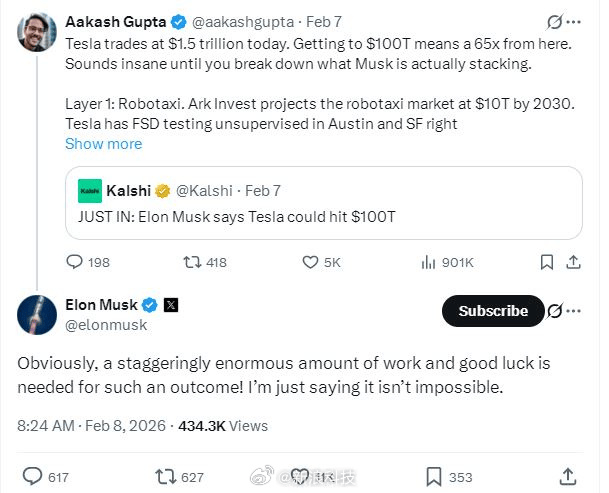
Core Viewpoint - The ambitious claims made by Elon Musk regarding Tesla's potential market value reaching $100 trillion and the establishment of a city on the Moon within 10 years are viewed as unrealistic and speculative, with skepticism surrounding their feasibility [1][2][5]. Group 1: Tesla's Market Value - An aggressive investor has suggested that Tesla's market value could reach $100 trillion, which would require a 65-fold increase from its current value of $1.5 trillion [1]. - The combined market capitalization of the top ten companies, including Nvidia, Apple, Microsoft, and Tesla, is approximately $26 trillion, making the proposed target seem implausible [1]. - Musk acknowledged the difficulty of achieving such a target, stating that it would require immense effort and luck, but he did not dismiss the possibility entirely [1]. Group 2: SpaceX and Lunar City - Musk announced that SpaceX is shifting its focus to building a self-expanding city on the Moon, with a goal to achieve this within 10 years, while a mission to Mars would take over 20 years [2][4]. - The feasibility of constructing a city on the Moon is attributed to more favorable conditions for lunar travel compared to Mars, with launch opportunities occurring every 10 days for the Moon versus every 26 months for Mars [4]. - Despite having secured a $4 billion contract with NASA for lunar landing projects, there are concerns about Musk's track record of project delays and unfulfilled promises [7][8].

放弃幻想!别盯着特朗普了,手握8520亿的马斯克,才是中国真正对手
Sou Hu Cai Jing· 2026-02-09 12:53
很多人至今仍将特朗普视为中国科技崛起的最大阻碍,忌惮他动辄挥舞的关税大棒和脱钩断链的把戏。但事实上,这位四年一换、政策朝令夕改的大佬,带 来的不过是短期干扰。真正让人夜不能寐、暗藏致命威胁的,是埃隆·马斯克。 随着SpaceX和xAI强强联合,其估值飙升至1.25万亿美元。随之而来的是马斯克个人财富的爆炸式增长,根据最新数据,其身家已达8520亿美元,创下历史 新高。更令人震惊的是,他每四个月就会刷新一次财富纪录,按照这个速度,今年内成为万亿美元富翁已是大概率事件。这笔财富并非泡沫堆砌,而是扎根 于航天、新能源、AI等硬科技领域,足以支撑他颠覆多个行业、重构全球规则。 特朗普的打法是"堵门",靠政策限制制造壁垒,我们还是有应对方案的,也算是你来我往,谁也不吃亏。而马斯克的打法,则让我们很苦恼,他将SpaceX、 特斯拉、xAI、Optimus人形机器人串联成闭环生态,掌控通信、数据、能源、制造等核心命脉,悄悄制定新的技术规则。更值得警惕的是,xAI已与美国国 防部门也达成了合作。星链更是早已成为美军军事体系的一部分,很重要的一部分。而作为其核心掌控者的马斯克,是不是更可怕? 当然了,面对这份威胁,中国并非毫无 ...
有红包没段子的行情
Datayes· 2026-02-09 11:52
Core Viewpoint - The article highlights the optimistic sentiment in the market, particularly in the U.S. stock market, with indicators suggesting a peak in positions and liquidity, while also identifying key investment opportunities in international stocks, Chinese consumer sectors, and emerging market resource producers [1][3]. Group 1: Market Sentiment and Indicators - The Bull & Bear Indicator from Bank of America has reached 9.6, the highest level since March 2006, indicating a peak in positions, liquidity, and inequality [1]. - The recent market rebound has led to a surge in optimism, with investors positioning themselves ahead of the holiday season [1]. Group 2: Investment Opportunities - The best investment directions towards 2026 include international stocks, the Chinese consumer sector, and emerging market resource and commodity producers [3]. - The AI computing demand is still in its early growth phase, with Nvidia's CEO stating that high investments will continue for the next 5-10 years, alleviating concerns about "overcapacity" in computing power [3]. Group 3: Sector Performance and Trends - The optical communication sector has seen significant gains, driven by Nvidia's rebound and the growing demand for AI computing [3][10]. - The A-share market has shown strong performance, with major indices rising and significant trading volumes, particularly in the optical communication and AI application sectors [10]. Group 4: Industry Developments - Nvidia's CPO (Coherent Photonic Optics) is expected to begin mass production in Q4 2026, with major clients likely to include Microsoft and Oracle [7]. - The AI application sector is gaining traction, with companies like Rongxin Culture and Haikan Co. seeing stock price surges due to advancements in AI models [10][12]. Group 5: Chemical and Real Estate Insights - The chemical sector is experiencing price increases, with companies like Xinhecheng raising export prices for vitamin E [19]. - The real estate market shows a year-on-year increase in second-hand housing transactions, indicating a potential recovery in the sector [21].



单周斥资超10亿元 104家公募机构参与网下“打新”
Xin Hua Cai Jing· 2026-02-09 11:43
Group 1 - Public institutions are actively participating in the offline allocation market for new A-shares, with 104 institutions involved in three new stock allocations from February 2 to 8, 2026, resulting in a total allocation of 68.73 million shares and an investment amount of 1.023 billion yuan [1] - The stock "Electric Science Blue Sky" has attracted significant attention from public institutions, with a total allocation amount of 568 million yuan and 59.96% of the final offline issuance [1] - "Easy Thinking" follows closely, with public institutions receiving 38.1 million yuan and 54.56% of the final offline issuance [1] Group 2 - The active participation of public institutions in offline new stock allocations signals multiple positive market indicators, including more reasonable new stock pricing and relatively certain returns, which can enhance portfolio returns and control volatility in a fluctuating market [2] - Public institutions are focusing on hard technology and advanced manufacturing sectors, reflecting their recognition of the real economy and industrial upgrading, which helps guide long-term capital towards quality growth enterprises [2] - Concentrated and rational participation by institutions is beneficial for optimizing the new stock pricing mechanism, suppressing irrational speculation, and improving overall pricing efficiency in the capital market [2]
一眼心动的中国|在这里,体验“未来生活”
Xin Hua She· 2026-02-09 11:22
Group 1 - The event showcased the world's first humanoid robot "Half Horse" [2] - A new car rolls off the production line every 76 seconds [2] - Autonomous driving is increasingly integrated into urban infrastructure [2] Group 2 - Over 75% of commercial rocket manufacturing companies are based in Beijing Yizhuang [2] - The event emphasized the experience of "future life" through music and technology [2]
中国发现比黄金珍贵的金属,一吨价值19亿,有着不可替代的作用
Sou Hu Cai Jing· 2026-02-09 10:52
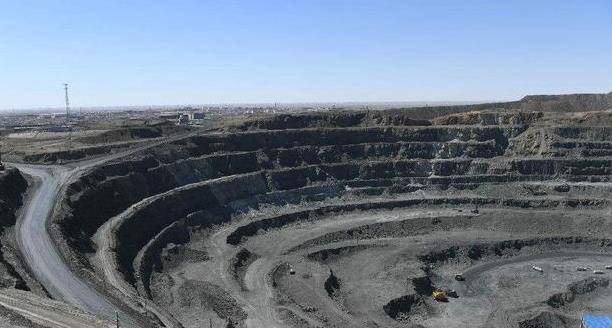
Core Insights - China has discovered a rare metal, rubidium, which is valued at 1.9 billion per ton, highlighting its significance for the country's development [1][3][11] Group 1: Discovery and Significance - Rubidium is an extremely rare metal, with China being the only country to have discovered it globally, emphasizing its scarcity [3] - The rubidium deposit is located in Guangdong Province, with a total reserve of 170,000 tons, and the global total reserve is only 180,000 tons, indicating its limited availability [3] - The discovery of rubidium is a major breakthrough for China, providing a strong impetus for future development in various high-tech fields [11] Group 2: Applications and Industries - Rubidium has extensive applications in cutting-edge fields such as renewable energy, ion propulsion engines, and new materials, as well as in defense, aerospace, medicine, and environmental protection [5][7] - In the aerospace sector, rubidium is essential for developing ion propulsion engines, while in new materials, it is used for manufacturing circuit connection materials due to its unique properties [7] - The medical field also benefits from rubidium, as it is used in the production of lenses for endoscopic medical devices [7] Group 3: Research and Development - Chinese researchers have recognized the importance of rubidium resources and have established research institutions to conduct comprehensive studies, resulting in numerous patents [9] - The application prospects for rubidium are broad, with expectations for significant contributions to technological advancements in China [9] - The availability of rubidium resources ensures that China will not rely on external supplies, enhancing national strategic security, particularly in military applications [11]
中国未来最大敌人,不是特朗普,而是即将手握万亿美元的马斯克
Sou Hu Cai Jing· 2026-02-09 10:51
Group 1 - Elon Musk's personal wealth has surpassed $800 billion, making him the first billionaire to reach this milestone, with a net worth of $852 billion following SpaceX's acquisition of xAI [1][6] - Musk's wealth is increasing rapidly, with records being broken every four months, suggesting he may soon become the world's first trillionaire [3][6] - The merger of SpaceX and xAI has resulted in a combined valuation of $1.25 trillion, with Musk holding 43% of the merged entity [5][6] Group 2 - Musk's influence extends beyond business; he is seen as a long-term competitor to China, unlike political figures whose influence is limited by election cycles [12][30] - SpaceX's technology, particularly the Starlink satellite system, has military applications, enhancing U.S. military capabilities and creating a "soft blockade" against China's space ambitions [14][19][22] - In the renewable energy and electric vehicle sectors, Musk's ventures, including Tesla and its advancements in AI and autonomous driving, pose significant competition to Chinese companies [24][28]
马斯克「吹爆」中国AI:美国将不战而败?
创业邦· 2026-02-09 10:37
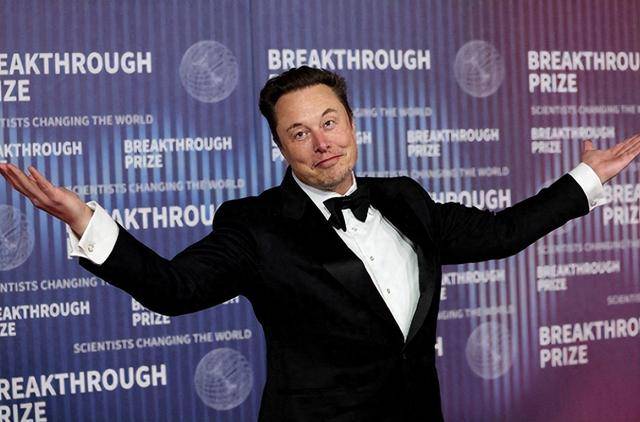
Core Viewpoint - Elon Musk expresses admiration for China's manufacturing capabilities and energy infrastructure, suggesting that without significant innovation, the U.S. may fall behind in AI and robotics, particularly in the context of a potential SpaceX IPO and the establishment of a space-based computing center [5][27]. Group 1: AI and Energy Infrastructure - Musk believes that the efficiency of solar energy generation in space could be five times greater than on Earth, which could address power shortages faced by U.S. data centers [7][13]. - He highlights that the U.S. is experiencing power shortages due to outdated infrastructure, while China's energy supply is more stable and efficient, making it a competitive advantage in AI development [7][11]. - Musk warns that without breakthrough innovations, China could surpass the U.S. in AI and robotics, as both countries are the primary players in this field [8][13]. Group 2: Robotics and Manufacturing - Musk identifies robots with full autonomy as crucial for the U.S. to regain its competitive edge in productivity against China, which is advancing in smart factory deployments [15][17]. - Data from the International Federation of Robotics indicates that by 2024, China will account for over 50% of global industrial robot installations, with significant growth projected for 2025 [17][18]. - In the humanoid robot sector, Chinese companies are leading, with significant market shares and production capabilities compared to Tesla's Optimus, which is still in testing phases [18][20]. Group 3: Space Computing Center Challenges - Musk's vision for a space-based computing center faces numerous challenges, including heat dissipation and maintenance logistics in space, which could complicate the feasibility of such a project [23][25]. - The ambitious timeline set by Musk for resolving these issues within 30 months raises skepticism about the practicality of the plan [25]. - The competition between the U.S. and China in technology is evolving beyond just chips to encompass energy, manufacturing, aerospace, and AI, indicating a broader strategic rivalry [27].
马斯克:将在月球和火星上建城市
第一财经· 2026-02-09 09:13
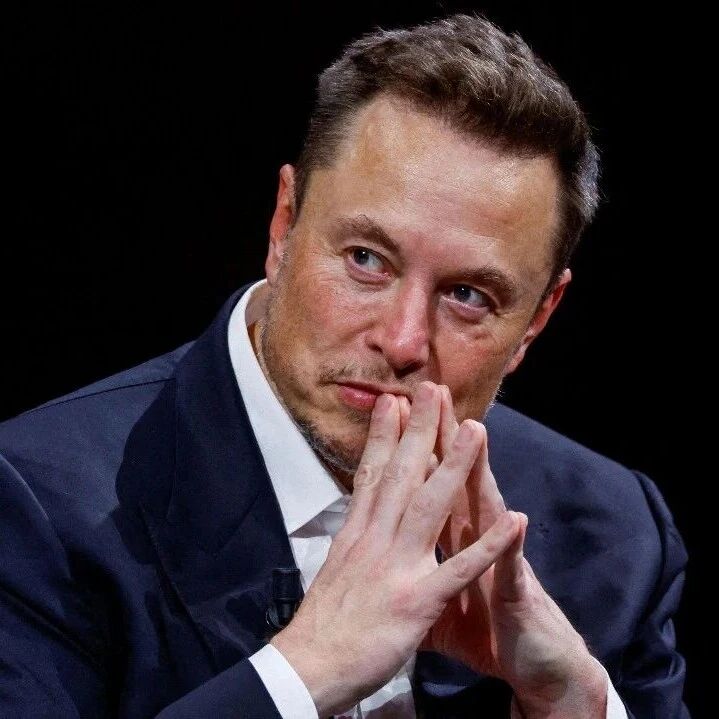
Group 1 - The core viewpoint of the article is that SpaceX is shifting its focus towards building self-sustaining cities on the Moon and Mars, with a potential timeline of achieving this goal within 10 years for the Moon and over 20 years for Mars [3][4]. - Elon Musk announced that SpaceX plans to initiate work on the Mars city within 5 to 7 years [4]. - SpaceX has acquired xAI, an artificial intelligence company also founded by Musk, to integrate AI with rocket technology, space internet, and communication systems, which is seen as a strategic move towards developing "interstellar AI" [4].