
Home Appliances

Search documents
家电有了“保质期”
Xin Lang Cai Jing· 2026-01-05 16:39
Core Viewpoint - The new national standard for household appliances, effective from January 1, 2026, mandates the labeling of safety usage lifespan to address safety risks associated with aging appliances [1] Group 1: New Regulations - The revised national standard requires manufacturers to indicate the safety usage lifespan of household appliances, which must not be less than the warranty period of major components [1] - The labeling must be presented in text or symbols on the product or in the user manual, including risk warnings for products used beyond their safety lifespan [1] Group 2: Implementation Details - The safety usage lifespan is calculated from the date of the consumer's first purchase, or from the completion date of installation for products requiring professional installation [1] - Manufacturers are required to consider all factors affecting the production, usage, and maintenance of appliances, and to implement effective preventive measures through risk management and assessment [1]
Hunter Fan Company Leads Smart Home Revolution with Launch of HunterSMART™ Portfolio and ZenTech Smart Fan at Pepcom’s 2026 Digital Experience!Ⓡ
Globenewswire· 2026-01-05 13:00
Core Insights - Hunter Fan Company is launching its new HunterSMART™ collection and ZenTech smart bladeless fan series at Pepcom's Digital Experience! on January 5, 2026, aimed at enhancing whole-home comfort through smart technology [1][12] - The HunterSMART™ collection is designed for seamless integration into smart home ecosystems, compatible with Apple Home, Amazon Alexa, and Google Home, and built on the Matter standard [1][16] Product Innovations - The HunterSMART™ collection includes a range of Matter-compatible accessories such as a smart plug, dimmer switch, wall panel, and smart fan upgrade kit, allowing users to control devices from anywhere [3][16] - ZenTech is highlighted as the most advanced ENERGY STAR® certified ceiling fan series, featuring a 43% slimmer DC motor, delivering 33% more air velocity compared to leading competitors, and achieving up to 64% energy savings [11][14] User Experience Enhancements - The HunterSMART™ App provides users with the ability to control fan speed, lighting schedules, and seasonal reverse direction, optimizing comfort and energy use automatically [4][12] - The ZenTech fan series offers customizable comfort with TrueLight™ LED technology, allowing for 10 adjustable levels of color temperature and dimming [11][14] Market Positioning - Hunter Fan Company has a 140-year history of innovation, focusing on high-quality products and customer support, positioning itself as a leader in the ceiling fan market [2][9] - The company emphasizes its commitment to performance and energy efficiency, with the ZenTech series being a key part of its strategy to maintain market leadership [11][12]


格力电器:不涨价,暂无铝代铜计划
Guan Cha Zhe Wang· 2026-01-05 07:55
Core Viewpoint - Recent copper price surge has raised concerns about potential air conditioner price increases, prompting companies like Gree Electric to assure consumers of no price hikes and no plans for "aluminum replacing copper" initiatives [1][6]. Group 1: Copper Price Impact - Copper prices have recently reached nearly 100,000 yuan per ton, leading to consumer worries about rising air conditioner prices [1]. - The home appliance industry is increasingly discussing the optimization of "aluminum replacing copper" technology to reduce costs due to soaring copper prices since the second half of 2025 [5]. Group 2: Company Responses - Gree Electric has publicly committed to not raising prices for its home air conditioners and has no current plans for "aluminum replacing copper" [1]. - Gree Electric has expressed concerns regarding the performance and reliability of aluminum compared to copper, citing significant differences in parameters such as melting point, thermal conductivity, resistivity, and corrosion resistance [6]. Group 3: Industry Trends and Standards - The Chinese home appliance industry is accelerating the promotion of "aluminum replacing copper" and related standard formulations, despite existing technical challenges and disagreements regarding the physical advantages of copper [7]. - The China Household Electrical Appliances Association has stated that "aluminum replacing copper" is not inherently negative, emphasizing that quality must not be compromised and consumer rights must be respected [7].


格力承诺家用空调不涨价 暂无“铝代铜”相关计划
Sou Hu Cai Jing· 2026-01-05 04:38
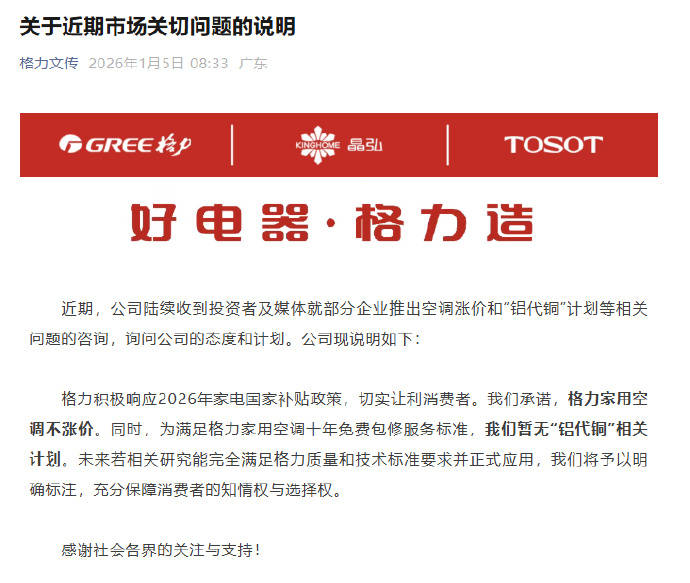
【太平洋科技快讯】1 月 5 日消息,格力电器通过官方公众号"格力文传"发文表示,近期,公司陆续收 到投资者及媒体就部分企业推出涨价和"铝代铜"计划等相关问题的咨询,询问公司的态度和计划。公司 现说明如下: 格力积极响应 2026 年家电国家补贴政策,切实让利消费者。公司承诺,格力家用空调不涨价。同时, 为满足格力家用空调十年免费包修服务标准,公司暂无"铝代铜"相关计划。未来若相关研究能完全满足 格力质量和技术标准要求并正式应用,公司将予以明确标注,充分保障消费者的知情权与选择权。 ...
格力承诺家用空调不涨价,明确暂无铝代铜计划
3 6 Ke· 2026-01-05 04:32
Core Viewpoint - Gree Electric Appliances has committed to not raising prices for home air conditioners and has no current plans to replace copper with aluminum, responding to market concerns about price increases and material changes [1] Group 1: Company Commitment - Gree Electric Appliances is responding to the 2026 national subsidy policy for home appliances by ensuring that consumers benefit from price stability [1] - The company has stated that it will maintain its ten-year free repair service standard for home air conditioners without implementing any "aluminum for copper" plans at this time [1] Group 2: Industry Context - The response from Gree is a public acknowledgment of recent industry dynamics and aligns with the implementation of the 2026 home appliance subsidy policy, indicating a clear brand stance on balancing costs and consumer demand [1]
格力否认空调涨价
Cai Jing Wang· 2026-01-05 02:15
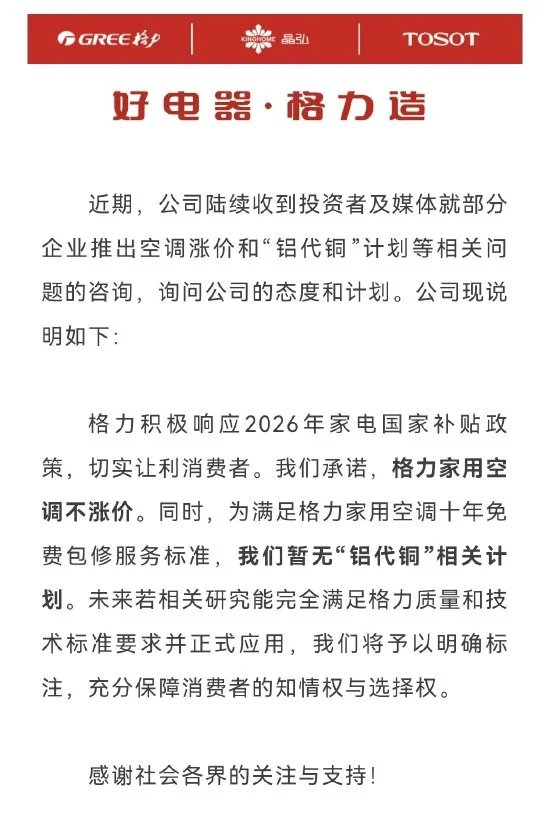
格力电器还表示:为满足格力家用空调十年免费包修服务标准,我们暂无"铝代铜"相关计划。未来若相 关研究能完全满足格力质量和技术标准要求并正式应用,我们将予以明确标注,充分保障消费者的知情 权与选择权。(格力文传) 1月5日,格力发布声明称:近期,公司陆续收到投资者及媒体就部分企业推出空调涨价和"铝代铜"计划 等相关问题的咨询,询问公司的态度和计划。公司现说明如下:格力积极响应2026年家电国家补贴政 策,切实让利消费者。我们承诺,格力家用空调不涨价。 ...
格力:承诺家用空调不涨价,暂无“铝代铜”相关计划
Sou Hu Cai Jing· 2026-01-05 01:12
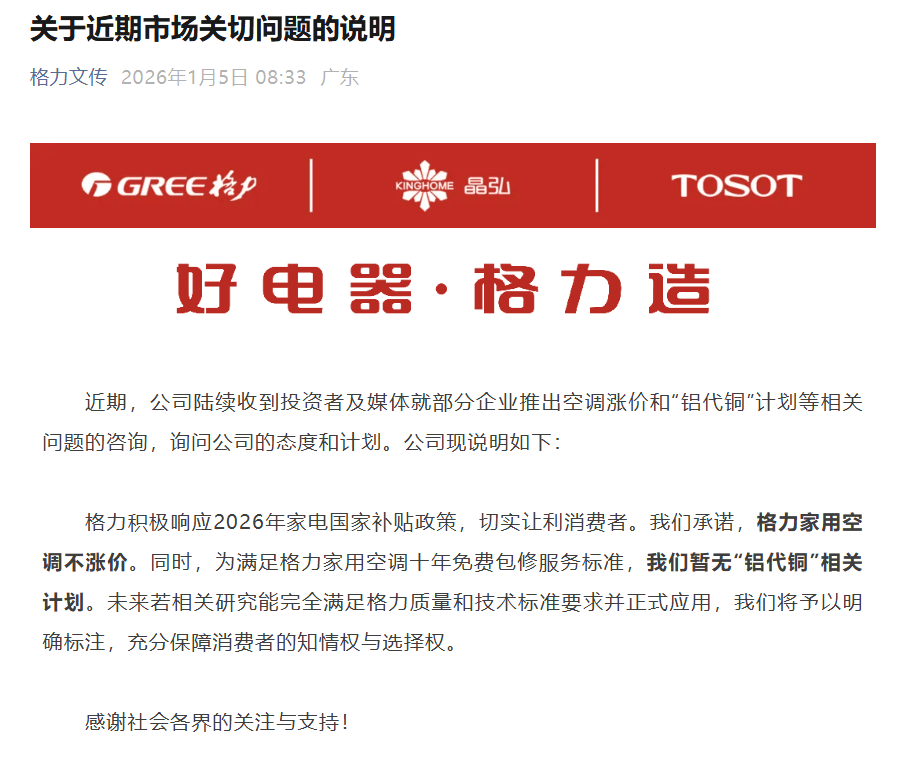
1月5日,格力发布《关于近期市场关切问题的说明》。 近期,公司陆续收到投资者及媒体就部分企业推出空调涨价和"铝代铜"计划等相关问题的咨询,询问公司的态度和计划。公司现 说明如下: 格力积极响应2026年家电国家补贴政策,切实让利消费者。我们承诺,格力家用空调不涨价。同时,为满足格力家用空调十年免 费包修服务标准,我们暂无"铝代铜"相关计划。未来若相关研究能完全满足格力质量和技术标准要求并正式应用,我们将予以明 确标注,充分保障消费者的知情权与选择权。 来源:格力文传 ...
格力电器:家用空调不涨价,暂无“铝代铜”相关计划
2 1 Shi Ji Jing Ji Bao Dao· 2026-01-05 00:49
Core Viewpoint - Gree Electric Appliances has committed to not raising prices for its home air conditioners, responding to inquiries regarding price increases and the "aluminum instead of copper" initiative from other companies [1] Group 1: Company Position - Gree actively supports the national subsidy policy for home appliances set for 2026, aiming to benefit consumers [1] - The company assures that it will not implement any price hikes for its home air conditioners [1] - Gree currently has no plans to adopt the "aluminum instead of copper" strategy to meet the ten-year free repair service standard for its home air conditioners [1] Group 2: Consumer Assurance - Gree emphasizes that if future research allows for the use of alternative materials while meeting quality and technical standards, it will clearly label such changes to protect consumer rights and choices [1]
重庆新一轮消费品以旧换新补贴开启
Xin Lang Cai Jing· 2026-01-04 16:56
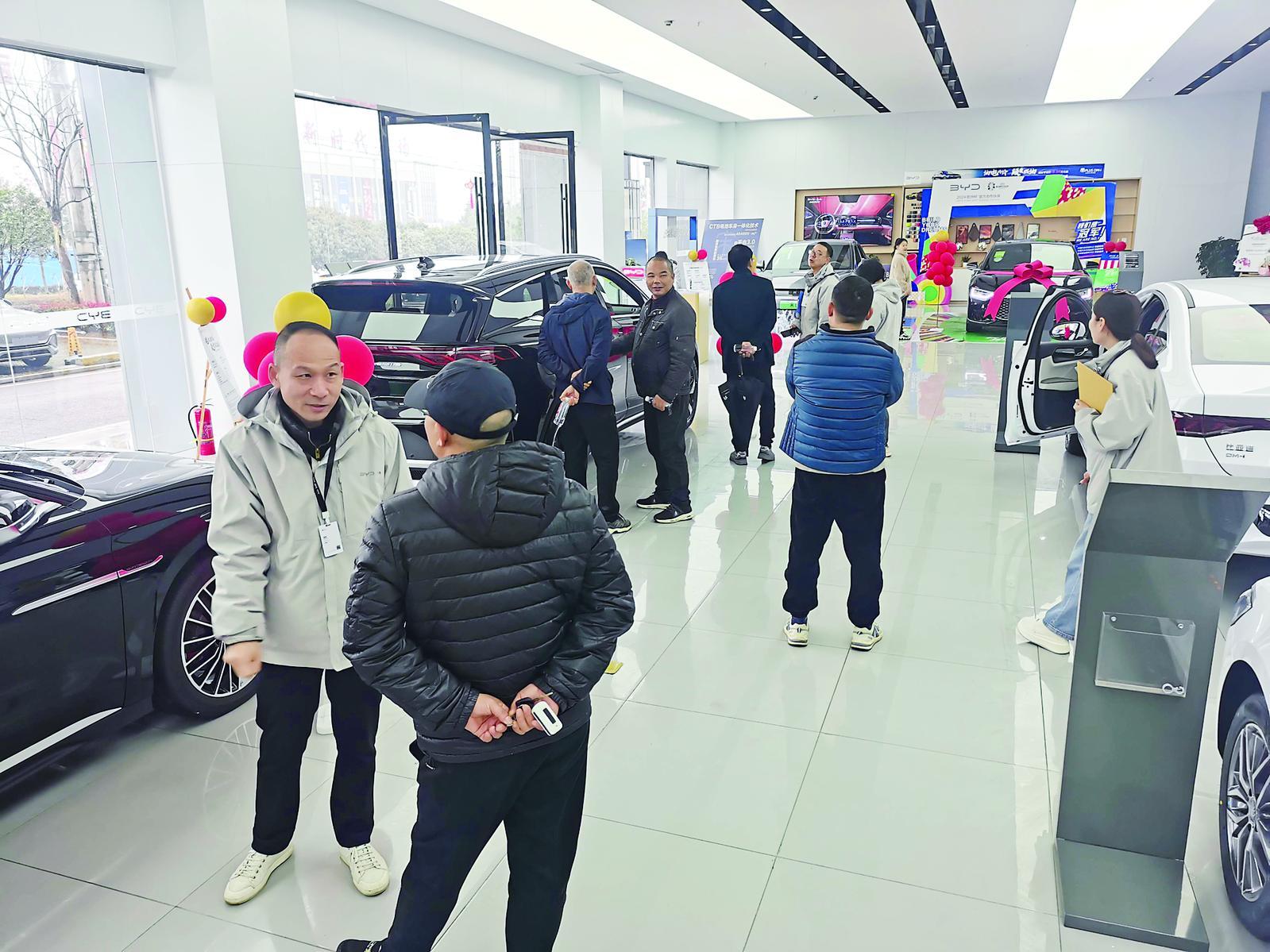
Group 1 - The Chongqing government will launch a comprehensive subsidy policy for vehicle scrapping and replacement, as well as for home appliances and digital products starting January 1, 2026 [2] - The first batch of subsidies for 2026 includes 210 million yuan for vehicle scrapping, 555 million yuan for vehicle replacement, 450 million yuan for home appliances, and 301 million yuan for digital and smart products [2] Group 2 - Consumers can receive a one-time subsidy of up to 20,000 yuan for scrapping eligible gasoline and diesel vehicles registered before specific dates and purchasing qualifying new energy or low-displacement fuel vehicles [3] - The subsidy for scrapping eligible fuel vehicles and purchasing new energy vehicles is set at 12% of the new vehicle sales price, while the subsidy for low-displacement fuel vehicles is 10%, with maximum amounts of 20,000 yuan and 15,000 yuan respectively [3][4] Group 3 - For vehicle replacement, consumers can receive a one-time subsidy of up to 15,000 yuan for purchasing qualifying new energy vehicles and up to 13,000 yuan for low-displacement fuel vehicles [5] - The subsidy for new energy vehicles is 8% of the new vehicle sales price, while for low-displacement fuel vehicles, it is 6% [5] Group 4 - Consumers can receive a 15% subsidy on the sales price of energy-efficient home appliances, with a maximum of 1,500 yuan per item, and can claim one subsidy per category [6] - For digital products like smartphones and tablets, a 15% subsidy is also available, capped at 500 yuan per item, with a limit of one subsidy per category [6] Group 5 - The subsidy policy will be effective from January 1, 2026, to December 31, 2026, and will operate on a "total amount control, balanced use, and first-come, first-served" basis [6]
中政策制定者公布 2026 年 “双升级” 计划实施细则-China_ Policymakers unveil implementation details for 2026 _dual upgrade_ program
2026-01-04 11:35
Summary of the Conference Call on China's "Dual Upgrade" Program Industry Overview - The conference call discusses the **consumer goods industry** in China, specifically focusing on the **2026 consumer goods trade-in and equipment upgrade program**, referred to as the "dual upgrade" program [1][2]. Key Points and Arguments 1. **Program Announcement**: On December 30th, the National Development and Reform Commission (NDRC) and the Ministry of Finance (MOF) released guidelines for the 2026 "dual upgrade" program, adjusting subsidy categories and levels to support areas like livelihood, security, elderly care, green products, and AI [1][2]. 2. **Funding Details**: The initial funding for the program is set at **RMB 62.5 billion**, which is lower than the **RMB 81 billion** allocated in 2025. The total expected funding for 2026 is around **RMB 250 billion**, slightly below the **RMB 300 billion** from 2025 [1][2][6]. 3. **Impact on Retail Sales**: Although retail sales growth is expected to pick up in early 2026 due to the new subsidy quota, full-year nominal retail sales growth is projected to decelerate from **3.8% in 2025 to 2.7% in 2026** due to reduced subsidies and their diminishing impact [1][7]. 4. **Subsidy Adjustments**: The subsidy structure has been modified, with a shift from fixed subsidies per vehicle to a percentage-based subsidy tied to the vehicle's price. For home appliances, subsidies will now only apply to products meeting Level 1 energy-efficiency standards, with a subsidy rate of **15%** (down from **20%**) and a maximum subsidy of **RMB 1,500** per item (down from **RMB 2,000**) [9][2]. 5. **Eligible Products**: The program will focus on products with broad reach, narrowing the scope of qualified home appliances from **12 to 6 sub-categories** and expanding coverage to include digital products like smart glasses and smart home devices for elderly consumers [9][2]. 6. **Implementation Challenges**: The effectiveness of the trade-in program is contingent on both funding and implementation. The previous program's impact faded due to slower subsidy disbursement and tighter application processes, particularly affecting home appliance trade-in applications [2][10]. Additional Important Content - **Long-term Recovery Measures**: To achieve a sustainable recovery in consumption, it is suggested that measures should prioritize job creation and income improvement, such as subsidizing labor-intensive services and enhancing income distribution through mechanisms like raising the minimum wage [7][2]. - **Historical Context**: The initial boost from the trade-in program was noted in Q4 2024 and H1 2025, but its effects have diminished over time, indicating a need for ongoing adjustments to maintain consumer engagement [2][10]. This summary encapsulates the essential points from the conference call regarding the "dual upgrade" program and its implications for the consumer goods industry in China.