
纺织服装

Search documents
望远镜系列35之UA FY2026Q3经营跟踪:调整后业绩超预期,上调全年EPS指引
Changjiang Securities· 2026-02-10 14:41
Investment Rating - The industry investment rating is "Positive" and maintained [8] Core Insights - In FY2026Q3 (October 1, 2025 - December 31, 2025), UA achieved revenue of $1.33 billion, a year-on-year decrease of 5%, which was in line with market expectations [2][6] - Gross margin decreased by 3.1 percentage points to 44.4%, primarily due to increased tariffs, reduced pricing, and weak performance in channel and regional mix [2][6] - Operating profit was -$150 million, but adjusted operating profit was $30 million, with adjusted net profit at $40 million and adjusted EPS at $0.09, outperforming market expectations [2][6] Revenue Breakdown - Overall revenue pressure was noted, with North America and Asia-Pacific regions remaining weak [7] - By region: North America/EMEA/Asia-Pacific/Latin America revenues were down 10.3%/+6.0%/-5.1%/+19.7% to $760 million/$320 million/$190 million/$70 million, with EMEA showing decent growth [7] - By channel: Wholesale/DTC revenues were down 6.4%/-3.9% to $660 million/$650 million, with DTC channel self-operated store revenue down 2% and e-commerce revenue down 7% [7] - By product: Apparel/Shoes/Equipment revenues were down 3.3%/-12.0%/-2.5% to $930 million/$270 million/$110 million, with apparel sales declining mainly due to weak training, golf, and running categories [7] Inventory Situation - As of FY2026Q3, the company's inventory decreased by 2% year-on-year to $1.07 billion, maintaining a reduction trend [7] Performance Guidance - For FY2026, the company expects a revenue decline of approximately 4% (previous guidance was a decline of 4%-5%), with North America expected to decline by about 8% and Asia-Pacific by about 6%, while EMEA is expected to grow by about 9% [7] - Gross margin is expected to decrease by 1.9 percentage points, with adjusted operating profit projected at $11 million and adjusted EPS between $0.10 and $0.11 [7]
2026年2月资产配置月报:全球风险资产波动加剧,宏观政策定调提质增效
Jin Rong Jie· 2026-02-10 10:12
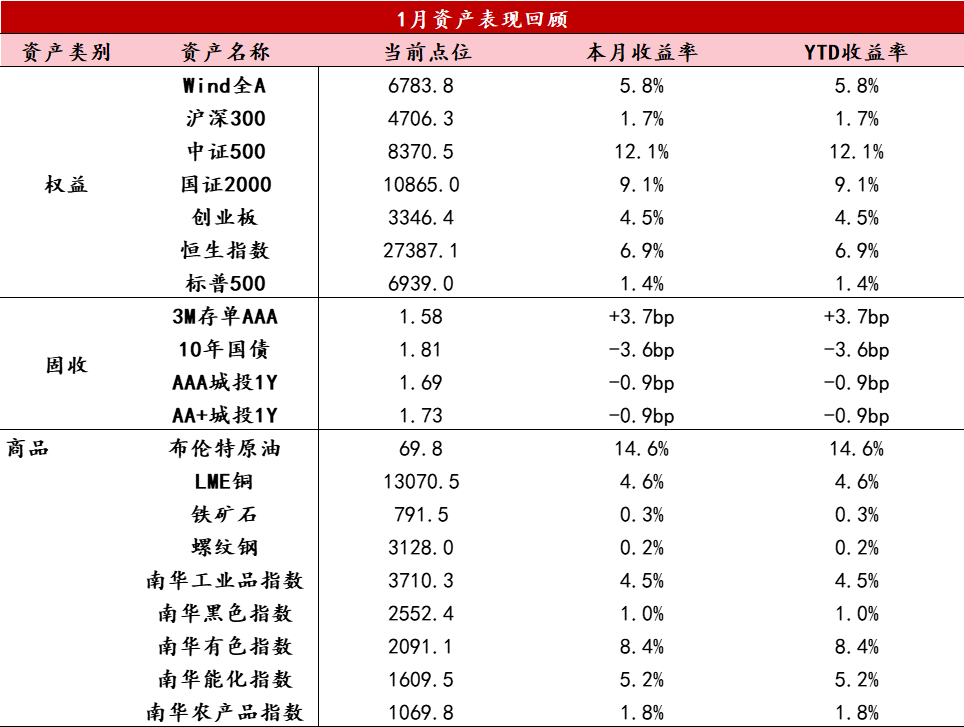
Asset Overview - In January, global risk assets experienced increased volatility due to changes in Federal Reserve interest rate expectations and geopolitical conflicts, with US stocks showing a strong upward trend [1] - The domestic market saw a return of funds, with equity assets continuing the upward trend from the end of last year, although regulatory measures led to a slowdown in growth [1] - The Wind All A index rose by 5.83% for the month, with the CSI 500 and CSI 1000 indices increasing by 12.12% and 8.68% respectively [1] - 80% of the Shenwan first-level industries saw gains, with strong performances in non-ferrous metals (+22.59%) and oil and petrochemicals (+16.31%) [1] - The Hang Seng Index rose by 6.85% in January, with a net inflow of 61.7 billion HKD from southbound funds [1] Bond Market Review - The bond market saw a downward adjustment followed by recovery, with most yield rates declining [2] - The 10-year government bond yield fell by 3.6 basis points to 1.81% during January [2] Commodity Market Review - The commodity market was generally bullish in January, with precious metals leading the gains; London gold prices rose by 13.01% to $4,880 per ounce [3] - Brent crude oil prices increased by 14.64% to $69.83 per barrel, while copper prices also saw gains [3] Macroeconomic Performance - The macroeconomic data for December indicated resilience in production, supported by external demand, while internal demand remained weak [5] - Industrial enterprises' profit margins showed positive growth for several months, with a 5.2% year-on-year increase in industrial value added [5] - Exports continued to exceed expectations, with a 6.6% year-on-year increase in December, driven by strong performance in machinery and high-tech products [6] Policy Outlook - Local government meetings have emphasized a "steady progress" approach, with an average GDP growth target of 5.0% for 2026 [10] - The focus of macroeconomic policy has shifted towards enhancing the quality of internal growth rather than merely expanding scale [10] Asset Allocation Analysis - The current economic environment is characterized by "strong supply, weak demand, and price stabilization," indicating an early recovery phase [24] - The asset performance ranking is expected to be bonds, stocks > commodities in the current phase [24]

量化策略周报(467):静观其变
2026-02-10 03:24
Summary of Key Points from the Conference Call Industry Overview - The report focuses on the A-share market, highlighting recent fluctuations in major indices such as the CSI 300, CSI 500, and ChiNext, which experienced declines of -1.33%, -2.68%, and -3.28% respectively during the week [2][3]. Core Insights and Arguments 1. **Market Volatility**: The A-share market has shown signs of volatility, with major indices declining over the week, indicating a cautious market sentiment [2][3]. 2. **Strong Performance in Specific Sectors**: The food and beverage, as well as textile and apparel sectors, have outperformed others, ranking first and second in terms of weekly gains. Other strong sectors included banking, power equipment, and transportation, while non-ferrous metals and telecommunications lagged behind [2][3]. 3. **Value vs. Growth**: Value stocks have outperformed growth stocks, with the value index declining by 0.53% compared to a 1.99% drop in the growth index. Factors contributing to this performance include dividends, low turnover, low liquidity, and low volatility [2][3]. 4. **Market Sentiment Indicators**: The macroeconomic outlook is cautious, reflected in the macroeconomic expectation difference index. However, the left-side timing indicators suggest a more optimistic view based on valuation levels, market sentiment, and capital flows [3][4]. 5. **Technical Indicators**: The QRS indicator shows a bearish signal for several tracked indices, indicating potential resistance at market tops [3][4]. Additional Important Content 1. **Quantitative Model Performance**: The adaptive rotation model underperformed the industry equal-weight benchmark by 0.2 percentage points, with a recent weekly return of -1.1% compared to -0.8% for the benchmark. However, the model has shown a cumulative return of 29.9% since August 2023, outperforming the benchmark by 4.7% [4]. 2. **Multi-Factor Stock Selection**: The CSI 500 index enhanced strategy outperformed its benchmark by 0.70 percentage points this week, with a cumulative return of 157.70% since January 2019, exceeding the benchmark by 101.33 percentage points [5]. 3. **Active Quantitative Stock Selection**: The growth trend strategy ranked in the top 10% among equity funds this year, despite a weekly return of -3.6%. Since its inception in 2009, it has achieved an annualized return of 30.9% [6]. 4. **Risk Warning**: The models are based on historical data, and there is a potential risk of failure in future predictions [7]. This summary encapsulates the key points from the conference call, providing insights into market trends, sector performances, and quantitative strategies.
四川贵华领服饰有限公司成立,注册资本1000万人民币
Sou Hu Cai Jing· 2026-02-10 02:23
Core Viewpoint - Sichuan Guihua Ling Clothing Co., Ltd. has been established with a registered capital of 10 million RMB, fully owned by Sichuan Huaming Digital Technology Co., Ltd. [1] Company Summary - The legal representative of Sichuan Guihua Ling Clothing Co., Ltd. is Liu Xiang [1] - The company is classified as a limited liability company with a natural person as the sole investor or controller [1] - The business scope includes clothing manufacturing, protective clothing production, and various sales activities related to clothing and textiles [1] Industry Summary - The company operates within the manufacturing industry, specifically in the textile and clothing sector, focusing on garment manufacturing [1] - The registered address is located in the Phoenix Industrial Park, Zizhong Economic Development Zone, Sichuan Province [1] - The business license allows for a range of activities, including import and export of goods, subject to legal regulations [1]
大类资产配置周报-20260210
East Money Securities· 2026-02-10 02:17
Group 1 - The overall equity market experienced adjustments, with the Shanghai Composite Index declining by 1.27% to 4065.58 points, and the Shenzhen Component Index falling by 2.11% to 13906.73 points [8][10] - The convertible bond market showed weak fluctuations, with the China Convertible Bond Index rising by 0.05% and the Shanghai Convertible Bond Index decreasing by 0.36% [15][16] - The bond market saw most yields rise, with the 1-year government bond yield increasing by 2.08 basis points, while the 3-year, 5-year, 7-year, and 10-year yields decreased [18][19] Group 2 - The commodity futures market weakened overall, with significant declines in silver prices, which dropped by 9.06%, while gold prices increased by 1.65% [9][28] - The market for agricultural products showed mixed results, with CBOT soybeans rising by 4.75% and corn increasing by 0.58% [9][10] - The overall commodity index experienced a decline of 4.49%, with precious metals leading the drop at 17.11% [27][30]

金融活水润“冰裳”
Jin Rong Shi Bao· 2026-02-10 02:05
在风景秀美的鸭绿江畔,以鲜美草莓闻名的辽宁丹东正迎来产业发展的新篇章。当地历史悠久的纺织服 装产业,敏锐抓住冰雪经济兴起的新机遇,从传统制造向智能化高端化转型,一批企业借力技术创新与 金融支持,在专业户外服装领域崭露头角。 有了金融活水的滋养,飞马特的发展步伐明显加快。近年来,企业生产总值连年稳步攀升,还通过与高 校、科研机构建立产学研合作,持续加大研发投入力度。"从制造到'智造',我们正致力于打造丹东本 土的高端户外服装品牌。"金勇灿充满信心地表示。 近年来,邮储银行丹东市分行持续加大对中小企业特别是制造业、文旅体育融合产业的信贷支持。数据 显示,该行2025年投放信贷资金超7亿元,有效激发了市场活力。"我们聚焦本地产业转型升级中的金融 需求,特别是冰雪经济这样的新兴增长点,通过精准信贷服务帮助企业突破发展瓶颈。"该行相关负责 人表示。 在鸭绿江的碧波与冰雪运动的热情交织中,丹东这座边境城市正以创新为笔、金融为墨,书写传统产业 转型升级的新篇章。一条江畔、一身"冰裳",丹东的产业多元化发展之路越走越宽,为区域经济高质量 发展注入了源源不断的动力。 丹东纺织服装产业始于20世纪80年代,以化纤、棉、毛、丝绸等 ...
李炳军会见来黔投资的纺织服装行业企业家
Xin Lang Cai Jing· 2026-02-09 22:25
Core Viewpoint - The meeting held in Guiyang on February 9 emphasized the importance of the textile and apparel industry in promoting local employment and improving people's livelihoods in Guizhou province [1]. Group 1: Government Initiatives - The provincial government is committed to high-quality development, focusing on major industries, projects, investment attraction, and operational entities [1]. - The government aims to create six major industrial clusters and three characteristic industries to ensure a strong start for the 14th Five-Year Plan [1]. Group 2: Industry Opportunities - The textile and apparel industry in Guizhou is recognized for its significant advantages and broad market potential [1]. - Industry leaders expressed their commitment to accelerate the construction of cooperative projects, which will attract more upstream and downstream enterprises to Guizhou [1].


让企业安心扎根,茁壮成长
Xin Lang Cai Jing· 2026-02-09 18:13
Group 1 - The meeting aimed to discuss the development of key industries in Xinye County, including textiles, electronics, toys, and food processing, with local entrepreneurs contributing insights on innovation and business environment improvements [1][2] - Xinye County has seen significant growth in its private economy, with 180 industrial enterprises above designated size and 35 national high-tech enterprises, indicating a robust industrial landscape [3] - The county government emphasizes a supportive environment for businesses, focusing on service-oriented governance and creating a fair legal framework to foster enterprise growth [2][3] Group 2 - The county's strategy includes digital transformation and the promotion of intelligent, green, and integrated development to enhance production capabilities [2] - Local enterprises have been recognized for their achievements, such as Yukan Noodle Industry receiving honors for being a green factory and a specialized small and medium-sized enterprise [1] - The total transaction value of technology contracts in the county reached 1.83 billion yuan, reflecting the active engagement in technological innovation [3]
中国经济最强县GDP超5600亿
第一财经· 2026-02-09 12:42
Core Viewpoint - The article highlights the rapid growth of county-level economies in China, with over 70 counties now exceeding a GDP of 100 billion yuan, particularly noting the dominance of Jiangsu province in this trend [3][4]. Summary by Sections Economic Growth and Achievements - Jiangsu province leads with 23 counties in the 100 billion GDP category, accounting for over 30% of the national total [3]. - Baoying County in Jiangsu achieved a GDP of over 100 billion yuan during the 14th Five-Year Plan, with industrial sales reaching 120 billion yuan [3][4]. - Jiangsu accounts for half of the top ten counties by GDP in China, with four of the top five counties being from Jiangsu, known as the "Four Little Dragons of Southern Jiangsu" [3][4]. Key Counties and Their Industries - Kunshan, with a GDP of 561.53 billion yuan and a growth rate of 5.8%, has maintained its position as the top county for 22 consecutive years [4]. - Kunshan is transitioning its main industries from "pen chain" to "fruit chain" and "car chain," while also expanding into emerging sectors like artificial intelligence and high-end food [4]. - Jiangyin, ranked second in comprehensive strength among counties, achieved a GDP of 527.22 billion yuan, showing a significant economic performance [4]. Talent Attraction and Educational Institutions - The developed county economies are attracting a large influx of talent, with Kunshan seeing a net population increase of 107,000, primarily among young people [5]. - A cluster of prestigious universities has established campuses in Southern Jiangsu counties, enhancing local talent cultivation and supporting industrial upgrades [5].

江苏千亿县达23个 中国经济最强县GDP超5600亿
Di Yi Cai Jing· 2026-02-09 11:58
Core Insights - The county economy in China has been growing significantly, with over 70 counties now exceeding a GDP of 100 billion yuan, particularly concentrated in Jiangsu province, which has 23 such counties, accounting for over 30% of the national total [1] Group 1: Economic Growth and Rankings - Jiangsu province has added a new 100 billion yuan county, Baoying, which achieved a GDP of over 100 billion yuan during the 14th Five-Year Plan period, with industrial sales reaching 120 billion yuan [1] - Jiangsu accounts for half of the top ten counties by GDP in China, with four of the top five counties being from Jiangsu, namely Kunshan, Jiangyin, Zhangjiagang, and Changshu [1] - Kunshan remains the leader in county-level economies, maintaining a GDP of 561.53 billion yuan in 2025, with a year-on-year growth rate of 5.8%, and has been ranked first in comprehensive strength for 22 consecutive years [1] Group 2: Industrial Transformation and Talent Attraction - Kunshan is transitioning its main industries from "pen chains" to "fruit chains" and "vehicle chains," while also expanding into "intelligent chains," with emerging industries like AI and high-end food gaining traction [2] - Jiangyin, ranked second among the top 100 counties, aims for a GDP of 527.22 billion yuan by 2025, maintaining a gap of over 300 billion yuan from Kunshan [2] - Changshu, a historical cultural city, is projected to achieve a GDP of 321.07 billion yuan by 2025, with a growth rate of 5.7%, surpassing Suzhou's growth by 0.3 percentage points [2] Group 3: Talent and Education - The developed county economies are attracting a significant influx of talent, with Kunshan experiencing a net inflow of 107,000 people last year, over half of whom are young individuals [3] - A cluster of prestigious universities has established campuses in the southern Jiangsu counties, contributing to local talent cultivation and supporting industrial transformation [3] - Notable institutions include Duke Kunshan University in Kunshan and Nanjing University of Science and Technology in Jiangyin, among others, enhancing the educational landscape in the region [3]