风险投资

Search documents
孙正义,大裁员
3 6 Ke· 2025-09-19 08:19
Group 1 - SoftBank Group is set to lay off nearly 20% of its Vision Fund team globally, marking a significant downsizing in the venture capital industry [1][3] - The Vision Fund currently employs over 300 people, meaning that more than 60 employees will be affected by this decision [3] - The layoffs are part of a strategic restructuring aimed at focusing on investments in artificial intelligence (AI) and breakthrough technologies [3][4] Group 2 - Despite reporting its best performance in four years a month prior, SoftBank's CEO Masayoshi Son announced the layoffs, reflecting a shift in focus towards AI [3][7] - Son has emphasized the importance of AI, stating that the future will redefine various aspects of life and work, with a goal for SoftBank to become the leading provider of Artificial Super Intelligence (ASI) [3][4] - The Vision Fund has made significant investments in AI, including a $9.7 billion investment in OpenAI, with an additional $30 billion expected to be raised by December [4][5] Group 3 - The Vision Fund has shown signs of recovery, reporting a substantial increase in investment returns, with a profit of 726.84 billion yen in Q1 of FY2025-2026, compared to only 1.91 billion yen in the same period last year [7] - The investment strategy has shifted from a broad approach to a more focused one, concentrating on high-potential areas such as AI [8][9] - The venture capital landscape is evolving, with a growing emphasis on technology-driven investments and a move away from the previous scattergun investment strategy [8][9]

孙正义,大裁员
投资界· 2025-09-19 07:52
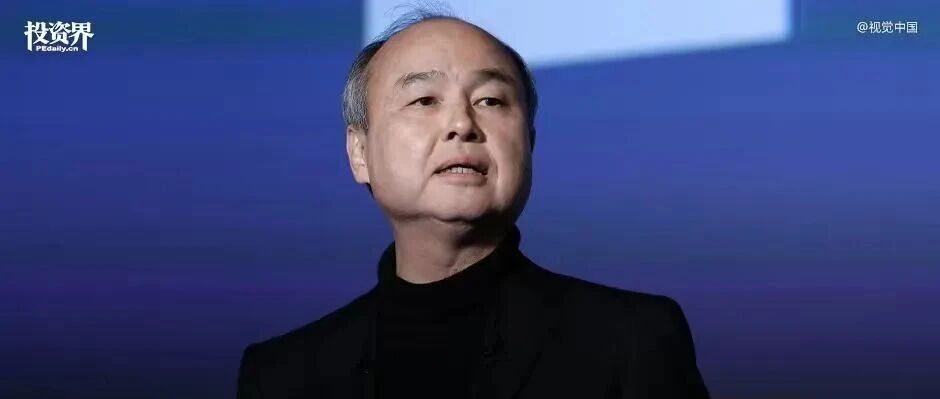
这 一 幕 还 是 来 了 。 收 缩 。 作者 I 周佳丽 余梦莹 报道 I 投资界PEdaily 路透社报道,软银集团将在全球范围内裁掉其愿景基金团队近2 0%的员工,创下风投史上 又一次大规模裁员纪录。 随后愿景基金发言人证实了裁员消息:" 我们不断调整组织结构,以最好地执行我们的长 期战略。 "留下的员工将继续为愿景基金进行新的投资——他们将更加聚焦孙正义雄心勃 勃的AI事业。 然而打了一个翻身仗,孙正义却宣布愿景基金要裁员。路透社援引知情人士报道,软银集 团将在全球范围内裁掉其愿景基金团队近20%的员工。目前愿景基金在全球拥有300多名 员工,这意味着有超6 0名员工将离开这里。 愿景基金发言人证实裁员消息,并在一份声明中表示:" 我们不断调整组织结构,以最好 地执行我们的长期战略——对人工智能和突破性技术进行大胆、坚定的投资,并为我们的 利益相关者创造长期价值 。 " 说起来,这并不突然。 过去很长一段时间里,孙正义大开大合的激进风格让LP心情复杂。亏损反复之间,软银 也总是战略性地频繁调整业务重心,"每次,我们都面临批评,称方向不明确,或被认为 可能很快倒闭。"在202 5财年的软银年度报告中, ...

锤子科技成老赖?内部人士回应
Guan Cha Zhe Wang· 2025-09-18 13:43
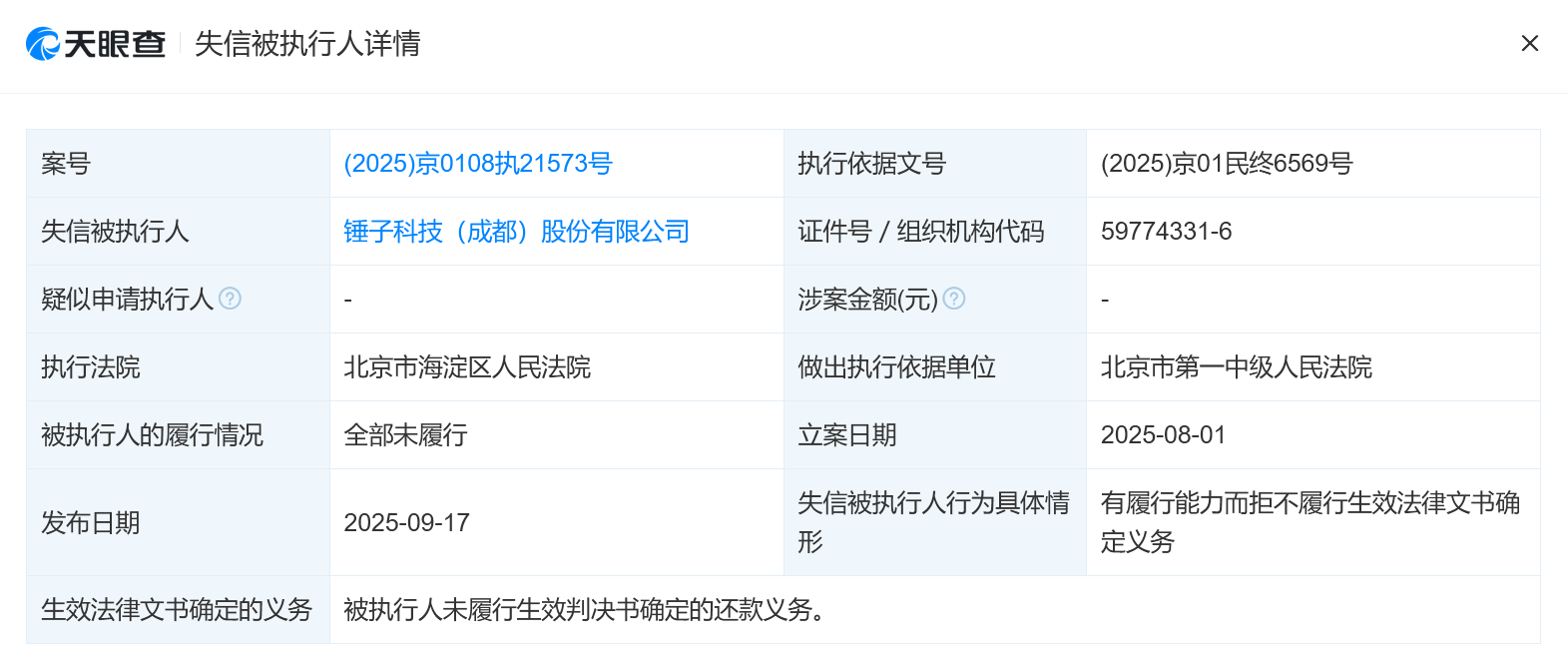
Core Points - On September 17, 2025, Smartisan Technology (Chengdu) Co., Ltd. was listed as a "discredited person" due to failure to fulfill legal obligations related to a loan dispute with Suzhou Zihui Shengwang Venture Capital [1][2] - The company has not fulfilled a total of 21.42 million yuan in obligations, and its legal representative, Guan Zhiliang, has been restricted from high consumption [2][3] Company Background - Smartisan Technology (Chengdu) Co., Ltd. was established in May 2012, with a registered capital of approximately 31.498 million yuan, and its business scope includes software services and cultural activities [3] - Luo Yonghao is the chairman and actual controller of the company, holding 22.67% of its shares [3] Debt and Dispute - The company borrowed a total of 15 million yuan from Zihui Venture Capital, which is classified as company debt rather than personal debt of Luo Yonghao [3] - Luo Yonghao expressed willingness to repay the debt personally, but due to conflicts with Zihui Venture Capital's head, Zheng Gang, he decided to delay addressing the debt [3][4] Relationship Dynamics - Zheng Gang and Luo Yonghao had a long-standing friendship, but public disputes began in January 2023, with Zheng criticizing Luo for mismanaging Smartisan [4][5] - Luo announced plans to sue Zheng in August 2024, indicating ongoing tensions and a complicated relationship between the investor and the entrepreneur [5][6]
创投管理费改革步入深水区,中小GP加速向“轻资产、重绩效”转型
Zheng Quan Shi Bao Wang· 2025-09-18 01:45
Core Insights - The management fee reform in the domestic venture capital industry is entering a "deep water zone," with a general decline in fee rates and a trend towards linking fees to fund performance [1][3] - The shift in management fee structures is forcing the industry, especially small and medium-sized fund managers (GPs), to adjust their operational strategies from relying on management fees to focusing on investment capabilities [1][6] Management Fee Trends - Management fees are now commonly set between 1% and 1.5%, with 2% becoming increasingly difficult to achieve, particularly for funds backed by guiding government funds [1][2] - Some government guiding funds have introduced multiple conditions for management fee payments, leading to increased cash flow pressure for GPs [1][2] - The introduction of annual performance evaluations by government and state-owned LPs has made management fee payments stricter, with penalties for underperformance [2][3] Policy Changes - Recent policies have clarified that management fees for government investment funds should be based on actual contributions or investments [3] - New regulations in various regions have set management fees to not exceed 2% of actual investments per year, with adjustments based on performance evaluations [3] - Some regions require management fees to be paid from fund earnings or interest, not from principal, further tying fees to GP performance [3] Operational Adjustments - GPs are adopting "cost-cutting" measures, including reducing fixed costs and outsourcing non-core functions to lower labor costs [3][4] - Investment strategies are also shifting towards a "lightweight" approach, with GPs minimizing travel expenses and collaborating with other GPs to share project sources and investment teams [4][5] - The stability of core teams and project reserves is crucial for GPs to meet performance standards and ensure investment progress [5][6] Long-term Industry Implications - The tightening of management fee mechanisms is seen as a long-term opportunity for the venture capital industry to refocus on core business activities, such as identifying quality projects and enhancing post-investment management [6] - The industry is transitioning from a focus on fundraising capabilities to investment strength, where successful project outcomes can compensate for lower management fees through carry [6]
创投管理费改革步入深水区 中小GP加速向“轻资产、重绩效”转型
Zheng Quan Shi Bao· 2025-09-17 19:03
Core Viewpoint - The venture capital (VC) industry in China is undergoing significant changes in management fee structures, with a general decline in fee rates and a shift towards performance-based assessments, compelling fund managers to enhance their investment capabilities [1][2][5] Management Fee Trends - Management fees are decreasing, with many funds now charging between 1% and 1.5%, making it difficult to secure the traditional 2% fee [1] - Government and state-owned limited partners (LPs) are implementing stricter payment models, including annual performance evaluations that can lead to fee reductions if targets are not met [2] - New regulations specify that management fees should be based on actual contributions or investments, with some regions capping fees at 2% of actual investments per year [2] Operational Adjustments - The reduction in management fee income is forcing VC firms, especially smaller general partners (GPs), to adopt cost-cutting measures and streamline operations [3] - Many firms are reducing fixed costs by downsizing office spaces and outsourcing non-core functions to lower labor costs [3] - Investment strategies are also being adjusted to save on travel expenses, with remote evaluations becoming more common before on-site due diligence [3] Focus on Investment Capability - GPs are actively seeking to improve their investment skills and resource integration to attract more funding from LPs [4] - There is a growing expectation for GPs to identify potential projects even before the fund is officially established, with some funds completing project evaluations prior to securing capital [4] - The stability of core teams and the ability to maintain a robust project pipeline are critical for GPs to meet performance standards and ensure compliance with LP expectations [4][5] Long-term Industry Implications - The tightening of management fee structures is seen as a long-term shift that encourages GPs to focus on core business activities, such as identifying quality projects and enhancing post-investment management [5] - This transformation presents both challenges and opportunities for smaller GPs, as the emphasis shifts from fundraising capabilities to investment performance [5]
长江商学院苏丹:科技金融应走出真正商业化道路,构建完整金融生态体系
Xin Lang Cai Jing· 2025-09-17 04:07
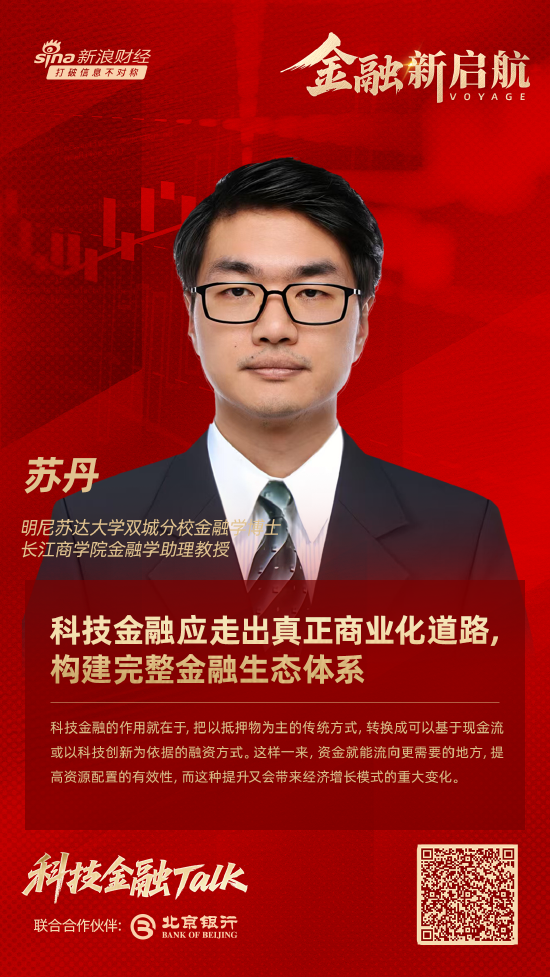
技术的兴起正深刻重塑金融的形态与边界,科技与金融的融合,不仅推动了金融领域的技术 更新,金融也为科技创新提供着有力的服务,为实体经济中的前沿探索源源不断地输送"活 水"。二者的双向互动正在拓展"科技金融"的边界,催生出一系列新趋势、新模式与新生 态。 在此背景下,新浪财经推出《科技金融Talk》系列访谈,深度对话金融机构高管、行业专家 与一线从业者,探寻科技金融的真实落地路径与未来可能性。本期《科技金融Talk》对话明 尼苏达大学双城分校金融学博士、长江商学院金融学助理教授苏丹。 苏丹指出,要想同时通过市场化解决"融资难"和"融资贵"是有较大难度的,因为二者存在一 定相悖性。 从市场化的角度来说,科创企业在初创期,风险和不确定性很高。企业要想拿到贷款,就必 须满足市场化的要求,即银行拿到相对程度的风险补偿。补偿的方式有两种:要么利率高一 点,要么融资方式改变,这就不可避免带来"融资贵"的问题。 苏丹还认为,科技金融的作用就在于,把以抵押物为主的传统方式,转换成可以基于现金流 或以科技创新为依据的融资方式。这样一来,资金就能流向更需要的地方,提高资源配置的 有效性,而这种提升又会带来经济增长模式的重大变化。 " ...
重磅发布 | 最科技T50——中国先锋科技投资机构50强
创业邦· 2025-09-16 00:08
Core Insights - The article discusses the profound systemic and structural changes occurring in China's technology investment sector, driven by policy guidance and technological revolutions [2] - The "Most Tech T50 - Top 50 Pioneer Technology Investment Institutions in China" list was officially released at the 2025 China Venture Capital Forum, aiming to enhance industry awareness of early-stage technology commercialization [2][4] - The list emphasizes the importance of technology achievement transformation as a core indicator, aligning with national strategies and Shanghai's goal of becoming a global technology innovation center [4] Investment Trends - China's technology investment is increasingly focusing on strategic emerging industries, with a more diverse range of investment entities and a notable increase in patient capital characteristics [2] - The list aims to guide capital to align more precisely with national strategies of "investing early and small" and nurturing key development tracks [2][4] Evaluation Criteria - The evaluation of the "Most Tech T50" list is based on three core dimensions: relevance to national strategy, contribution to technology achievement transformation, and investment performance [5] - The selection process involved data analysis, surveys, and professional reviews, resulting in the identification of 50 institutions that stand out in China's technology investment landscape [5] List of Institutions - The article provides a comprehensive list of the top 50 institutions, including notable names such as Zhongke Chuangxing, Zhenge Capital, and Meituan Longzhu, among others [7][8]
人生唯一的赢法就是不竞争:7500亿美元创业流水线的成功法则
Hu Xiu· 2025-09-16 00:00
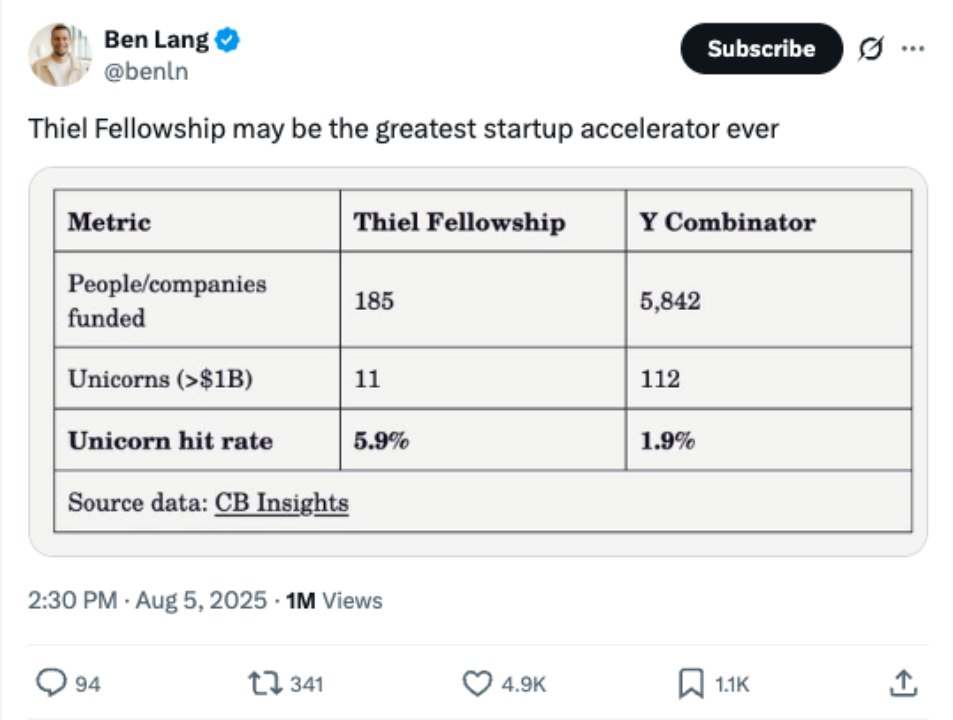
Group 1 - Peter Thiel is a co-founder of PayPal and an influential angel investor known for his contrarian views and the philosophy of creating monopolies while avoiding competition [1][2][3] - Thiel criticizes higher education, particularly Ivy League schools, viewing them as institutions that promote conformity rather than independent thought [4][14] - In 2010, Thiel launched the Thiel Fellowship, providing $100,000 to young individuals under 20 to drop out of school and pursue entrepreneurial ventures [5][6][7] Group 2 - The Thiel Fellowship has evolved from a controversial initiative into a significant entrepreneurial pipeline, generating over $750 billion in value [8][41] - The fellowship's success is highlighted by its unicorn creation rate, which reportedly surpasses that of Y Combinator [18][21] - Thiel's approach emphasizes finding "outliers" rather than traditional high achievers, focusing on creativity and initiative over standardized metrics [22][30] Group 3 - The fellowship operates without structured courses or mandatory lectures, fostering a unique community of innovators who thrive in a competitive yet chaotic environment [34][40] - Members of the fellowship often form tight-knit groups, sharing knowledge organically rather than through formal education [36][37] - The Thiel Fellowship has led to the establishment of successful companies, including Figma and Ethereum, showcasing the potential of its unconventional approach [41][42] Group 4 - The founding of 1517 Fund by former fellowship members aims to address early-stage funding gaps for young entrepreneurs [45][48] - The fund has achieved significant returns, demonstrating the viability of investing in unconventional talent [49][50] - The focus on youth entrepreneurship reflects a broader trend of younger generations embracing innovation in traditionally hard sectors [52][53] Group 5 - Thiel's philosophy advocates for a non-competitive approach to success, emphasizing the importance of creativity and individualism over conformity [55][64] - The Thiel Fellowship serves as a critique of conventional education systems, questioning whether they produce unique thinkers or merely replicate societal norms [66] - The initiative encourages young people to pursue their unique paths rather than follow established routes to success [64][65]

我看好95后陈道臻,他们父子实现五大产业颠覆将造就新首富
Sou Hu Cai Jing· 2025-09-15 10:22
Core Insights - The article highlights the potential of Chen Daozhen and his father Chen Nanping in disrupting five major industries, suggesting they could become significant figures in the investment landscape, possibly even new billionaires in China. Group 1: Background of Chen Nanping - Chen Nanping, the father, is portrayed as a prodigy with a strong background in technology and entrepreneurship, having successfully taken a company public in 2005 and later excelling in venture capital investments [1][3]. - He has invested in over 30 technology projects in Israel, all of which have been successful, showcasing his talent in identifying and nurturing technological innovations [1][3]. Group 2: Investment Strategies - Chen Nanping's investment strategy includes significant stock market investments, such as purchasing over one million shares of Moutai at 12 yuan per share, which have appreciated to 1600 yuan per share, indicating a substantial increase in value [4]. - He has raised a total of 10 billion yuan for a fund, with contributions from various entities, including 4 billion from Everbright and 3 billion from China Shipbuilding, demonstrating his ability to attract large-scale investments [4]. Group 3: Chen Daozhen's Role - Chen Daozhen, the son, is recognized for his strong social skills and ability to connect with influential peers, which has led to partnerships with major investment firms like State Street [6]. - His first fund, in collaboration with BYD, highlights his capability to attract talent and manage diverse investment projects effectively [6]. Group 4: Industry Disruption Potential - Discussions among Chen Daozhen and industry experts focus on revolutionary advancements in the database and chip industries, particularly the development of reconfigurable chips that could significantly enhance efficiency and security [7][11]. - The potential for a new health system based on traditional Chinese medicine principles, combined with big data analytics, could lead to substantial cost savings in chronic disease management for China's social security system [11][12].

2025美国最年轻的十位亿万富豪
3 6 Ke· 2025-09-15 10:11
Core Insights - The youngest billionaires on the 2025 Forbes list include four first-time entrants, with the youngest being Edwin Chen at 37 years old [2][3] - The average age of billionaires on the Forbes list is 70, with 23 individuals over 90 years old, and the oldest being Archie Aldis Emmerson at 96 [2] - There are 33 billionaires under 50 this year, an increase from 26 in 2024, with the youngest ten billionaires all under 42 [2][3] Individual Billionaires - Edwin Chen, 37, has a net worth of $18 billion, founded Surge AI to address the lack of high-quality training data in AI, achieving over $1 billion in annual revenue within five years [5] - Vlad Tenev, 38, co-founder of Robinhood, has a net worth of $5.8 billion, with Robinhood's active accounts nearing 26 million, significantly increasing its market presence [6] - Lukas Walton, 38, with a net worth of $39.8 billion, is the grandson of Walmart's founder and focuses on sustainable investments through Builders Vision [7] - Eduardo Vivas, 39, has a net worth of $3.8 billion, made his wealth through marketing software and mobile games, and is an early investor in AppLovin [8] - Josh Kushner, 40, has a net worth of $5.2 billion, built his wealth through his venture capital firm Thrive Capital, managing over $15.5 billion in assets [9] - Baiju Bhatt, 40, co-founder of Robinhood, has a net worth of $6 billion, played a significant role in the company's growth during the meme stock craze [10] - Brian Venturo, 40, co-founder of CoreWeave, has a net worth of $4.2 billion, with the company transitioning from cryptocurrency mining to AI cloud infrastructure [11] - Dustin Moskovitz, 41, co-founder of Facebook, has a net worth of $12 billion, later founded Asana and is involved in philanthropic efforts [12] - Mark Zuckerberg, 41, has a net worth of $253 billion, significantly increased his wealth by $72 billion over the past year through Meta's stock performance [13] - Nathan Blecharczyk, 42, co-founder of Airbnb, has a net worth of $8.7 billion, contributing to the company's growth in the global rental market [14]