集成电路

Search documents
“国产GPU第一股”来了,下周两只新股可申购
Chang Sha Wan Bao· 2025-11-23 11:23
Group 1: Company Overview - Moer Technology is a leading domestic GPU manufacturer and will become the "first domestic GPU stock" upon listing, with an issue price of 114.28 yuan per share, the highest for new stocks this year [1] - The total share capital after the issuance of Moer Technology will be 470 million shares, with a total market value of 53.7 billion yuan at the time of listing [1] - Baiaosaitu is engaged in preclinical CRO and biotechnology, with four technology platforms for various innovative animal models and drug development services [2][3] Group 2: Financial Performance - Moer Technology has not yet achieved profitability, with projected revenues of 46.0883 million yuan in 2022, increasing to 1.24 billion yuan in 2024, and an expected revenue of 1.218 billion to 1.498 billion yuan in 2025, representing a year-on-year growth of 177.79% to 241.65% [2] - Baiaosaitu's revenues for 2022 to 2024 are projected at 534 million yuan, 717 million yuan, and 980 million yuan, with a net profit of 340 million yuan expected in 2025, marking a year-on-year growth of 303.57% [3] Group 3: Market Position and Competition - Major global players like NVIDIA and AMD dominate the integrated circuit market, while Moer Technology and other Chinese companies are gradually gaining market share in their specialized fields, contributing to the self-sufficiency of China's GPU industry [2] - Moer Technology has launched four generations of GPU architectures since its establishment in 2020, focusing on applications in AI, cloud computing, and personal computing [1]
2025A股涨18%,经济晴雨表藏玄机,这些板块偷偷赚翻了
Sou Hu Cai Jing· 2025-11-23 09:53
Economic Overview - The A-share market has risen from 3350 points at the beginning of the year to around 4000 points, reflecting the real economic fundamentals, with technology and non-ferrous sectors performing well while consumption and coal sectors lagged [1] - Economic growth has been steady in the first three quarters, with the annual target remaining stable, but significant structural changes are occurring beneath the surface [3] Real Estate and Investment Trends - Real estate investment has declined for four consecutive years, with fixed asset investment experiencing its first decline on record, while exports and consumption have taken on a more significant role [3] - The adjustment in the real estate sector has led to a rationalization of housing prices, and new industries are emerging to support economic growth, with state-owned enterprises investing nearly 40% in strategic emerging industries like new energy and integrated circuits [3] Consumption and Export Dynamics - Core CPI has been rising, indicating a stable consumption market, while exports have shown unexpected growth despite a complex external environment, driven by diversified trade layouts [5] - ASEAN has been China's largest trading partner for five consecutive years, with over 90% of manufacturing exports going to this region, particularly in machine tools and auto parts [5] Price Trends and Corporate Profitability - The recent increase in CPI and the narrowing decline in PPI suggest an improvement in supply-demand relationships, with rising prices in industries like photovoltaic equipment and non-ferrous metal smelting, indicating a better profit environment for companies [7] - The best-performing non-ferrous sector is attributed to the continuous rise in gold prices, with the central bank increasing its gold reserves for 12 consecutive months, reaching 74.09 million ounces by the end of October [9] Sector Performance Insights - The communication and electronics sectors have surged due to the explosion of AI computing power and domestic substitution, exemplified by North Huachuang's net profit exceeding 5.1 billion yuan in the first three quarters [9] - Conversely, the consumption and coal sectors have underperformed due to low food prices affecting profitability and international commodity price declines putting pressure on traditional energy companies [10] Capital Flow and Market Dynamics - The continuous decline in 10-year treasury yields and bank deposit rates has lowered the opportunity cost of investing in the stock market, leading to increased capital inflows into equity funds and bank wealth management products [12] - A-share valuations remain reasonable compared to U.S. stocks, with attractive dividend yields, further drawing investor interest [12] Structural Market Trends - Companies like Laplace, a leader in photovoltaic equipment, have shown steady profit growth supported by N-type technology, indicating that market performance is based on solid fundamentals rather than mere speculation [14] - The structural market trends reflect the economic transition, with declining reliance on real estate, the rise of emerging industries, and optimized export patterns, all of which are mirrored in corporate profitability and capital flows [14] Future Outlook - Understanding the direction of economic transformation allows for better interpretation of stock market signals, with a focus on new productive forces, diversified exports, and technological advancements as key opportunities in a structural market [16]

帝奥微:累计回购760万股
Mei Ri Jing Ji Xin Wen· 2025-11-23 09:05
Group 1 - The company DiAo Micro (SH 688381) announced a share buyback of 7.6 million shares, representing 3.07% of its total share capital of approximately 248 million shares, with a total expenditure of around 160 million RMB [1] - The highest and lowest prices for the repurchased shares were 29.34 RMB and 16.96 RMB per share, respectively [1] - For the year 2024, the company's revenue composition is entirely from integrated circuits, accounting for 100% [1] Group 2 - The current market capitalization of DiAo Micro is 5.5 billion RMB [2]

晶晨股份:累计回购约107.35万股
Mei Ri Jing Ji Xin Wen· 2025-11-23 08:54
每经AI快讯,晶晨股份(SH 688099,收盘价:88.88元)11月23日晚间发布公告称,截至2025年11月21 日,公司通过上海证券交易所交易系统以集中竞价交易方式累计回购公司股份约107.35万股,占公司总 股本的比例为0.2549%,回购成交的最高价为96元/股,最低价为65.82元/股,支付的资金总额约为人民 币7993.57万元。 截至发稿,晶晨股份市值为374亿元。 每经头条(nbdtoutiao)——"抛售日本"?GDP负增长,股市跳水,国债被抛,日元贬值!高市早苗"亡 命一搏":"灌水"21万亿!专家:恐赴"特拉斯风暴"后尘 (记者 曾健辉) 2024年1至12月份,晶晨股份的营业收入构成为:集成电路占比100.0%。 ...

新思想引领新征程丨上海浦东:勇当更高水平改革开放的开路先锋、全面建设社会主义现代化国家的排头兵
Yang Guang Wang· 2025-11-23 01:47
Group 1 - The core mission of Pudong is to become a leading area for socialist modernization, as emphasized by President Xi Jinping during the 30th anniversary celebration of Pudong's development and opening up [1][2] - Pudong has made significant progress in high-quality development, reform, and governance, with a focus on streamlining administrative processes, such as reducing the average approval time for food business licenses by nearly 90% and cutting application materials by about 70% through the "one industry, one license" reform [1][2] Group 2 - Pudong has implemented a series of innovative reforms, including the introduction of a comprehensive license for new business formats, which consolidates multiple permits into one, receiving positive feedback from enterprises [1][3] - The region has seen advancements in legal services, allowing foreign law firms to provide comprehensive legal services, which facilitates foreign investment and supports Chinese companies in expanding internationally [3] Group 3 - Pudong is leveraging technological innovation to drive industrial transformation, with over 150 specialized AI model companies established in the Zhangjiang community within 14 months, and the launch of several high-level innovation platforms in cutting-edge fields [4] - The integration of technology and industry has led to significant growth in key sectors such as integrated circuits, biomedicine, and artificial intelligence, with an average growth rate of 11.7% over the past three years [4] Group 4 - In the first three quarters of this year, Pudong achieved a GDP of 1.35 trillion yuan, reflecting a year-on-year growth of 6%, showcasing its robust economic performance as it approaches its 35th anniversary [4] - Pudong aims to continue its strategic mission of becoming a leading area for socialist modernization, focusing on deeper reforms and higher levels of openness in various sectors [5]
莱普科技IPO:技术大拿领薪超236万元,实控人套现超1250万元
Sou Hu Cai Jing· 2025-11-23 01:13
Core Viewpoint - Chengdu Leap Technology Co., Ltd. has recently had its IPO application accepted on the Sci-Tech Innovation Board, with CITIC Securities as the sponsor and Wang Zhiwei and Chen Chen as the sponsoring representatives [4] Shareholding Structure - Before the IPO application, Ye Xiangming and Mao Dong held 26.77% of the company's shares through Dongjun Investment and controlled 66.94% of the voting rights [4] - The National Integrated Circuit Fund Phase II is the largest external shareholder, holding 7.66% of the shares [4] Recent Share Transfers - In August and December 2023, Leap Technology conducted two share transfers, with Dongguan Puying transferring 260,000 and 1,000,000 shares, respectively, raising 7.02 million and 30 million yuan [6] - Ye Xiangming and Mao Dong could realize approximately 12.58 million yuan from these transfers based on their shareholding in Dongjun Investment [6] Management Team - Ye Xiangming and Mao Dong, both high school graduates, have been serving as chairman and director since August 2021, respectively [6] - The management team includes four other directors, all of whom are graduates from prestigious universities, with two holding doctoral degrees [6] Key Personnel Background - Fu Jianwei, born in 1961, has extensive experience in the electronics sector and has been with Leap Technology since its establishment in 2003 [7] - Huang Yongzhong, the current general manager, has been with the company since 2003 and has held various technical roles [7] - Wang Xiaofeng and Pan Lingfeng, both with backgrounds in optics and electronics, joined Leap Technology in 2023 and are among the highest-paid employees [7][8] Compensation Details - In 2024, Wang Xiaofeng received a salary of 2.36 million yuan, Pan Lingfeng received 1.44 million yuan, and Huang Yongzhong received 1.36 million yuan [8][9] Employee Stock Incentives - To attract Wang Xiaofeng and Pan Lingfeng, Leap Technology implemented an employee stock incentive plan in November 2021, issuing 3.59 million shares at 1.5 yuan per share [9] - They collectively hold 7.47% of the company's shares through Dongguan Junfeng, valued at approximately 108 million yuan based on a valuation of 1.445 billion yuan [9] External Board Member - Wang Xiaolai, nominated by the National Integrated Circuit Fund Phase II, is a senior supervisor at Huaxin Investment Management Co., Ltd. and holds positions in various investment committees [10]
我国GDP10强城市更新:上海稳居第1,广州逼近重庆,杭州增速第1!
Sou Hu Cai Jing· 2025-11-22 08:52
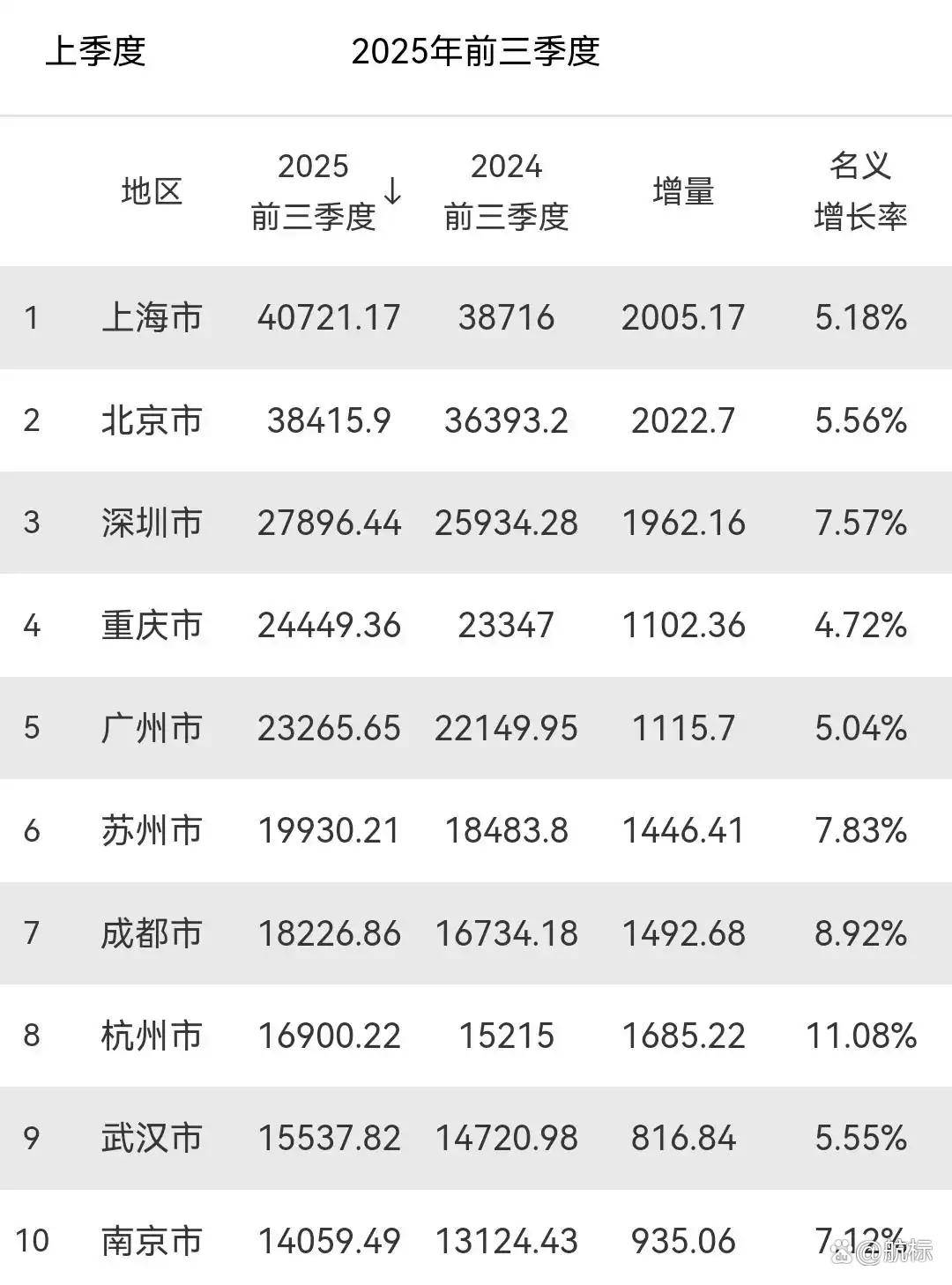
Core Insights - The economic performance of China's top ten cities in the first three quarters of 2025 shows a competitive landscape, with Shanghai maintaining its lead, while Guangzhou and Chongqing are in close competition, and Hangzhou emerging as a standout with significant growth [1][5][11] Group 1: Economic Performance of Top Cities - Shanghai ranks first with a GDP of 40,721.17 billion, showing a year-on-year increase of 2,005.17 billion and a growth rate of 5.18% [4][5] - Beijing follows with a GDP of 38,415.9 billion, reflecting a growth of 2,022.7 billion and a rate of 5.56% [4] - Shenzhen's GDP stands at 27,896.44 billion, with a growth of 1,962.16 billion and a rate of 7.57% [4] - Chongqing's GDP is 24,449.36 billion, with a growth of 1,102.36 billion and a rate of 4.72% [4][6] - Guangzhou's GDP is 23,265.65 billion, showing a growth of 1,115.7 billion and a rate of 5.04% [4][6] - Hangzhou achieves a GDP of 16,900.22 billion with an impressive growth rate of 11.08% [4][8] Group 2: Competitive Dynamics - The competition between Guangzhou and Chongqing is highlighted, with a narrow gap of 1,183.71 billion in GDP, and Guangzhou's growth rate surpassing Chongqing's [6][7] - Chongqing benefits from the Chengdu-Chongqing economic circle, but faces challenges in its automotive sector, impacting overall growth [6] - Guangzhou leverages its position in the Guangdong-Hong Kong-Macau Greater Bay Area, with significant growth in foreign trade and the automotive sector [6] Group 3: Sectoral Insights - Hangzhou's growth is driven by the digital economy, with a 23% increase in cross-border e-commerce and significant advancements in AI applications [8][9] - The city's digital economy is transitioning from scale expansion to practical applications, enhancing its growth sustainability [8][9]
地嘉人善的长三角几何中心,投资魅力几何?
Shang Hai Zheng Quan Bao· 2025-11-22 07:10
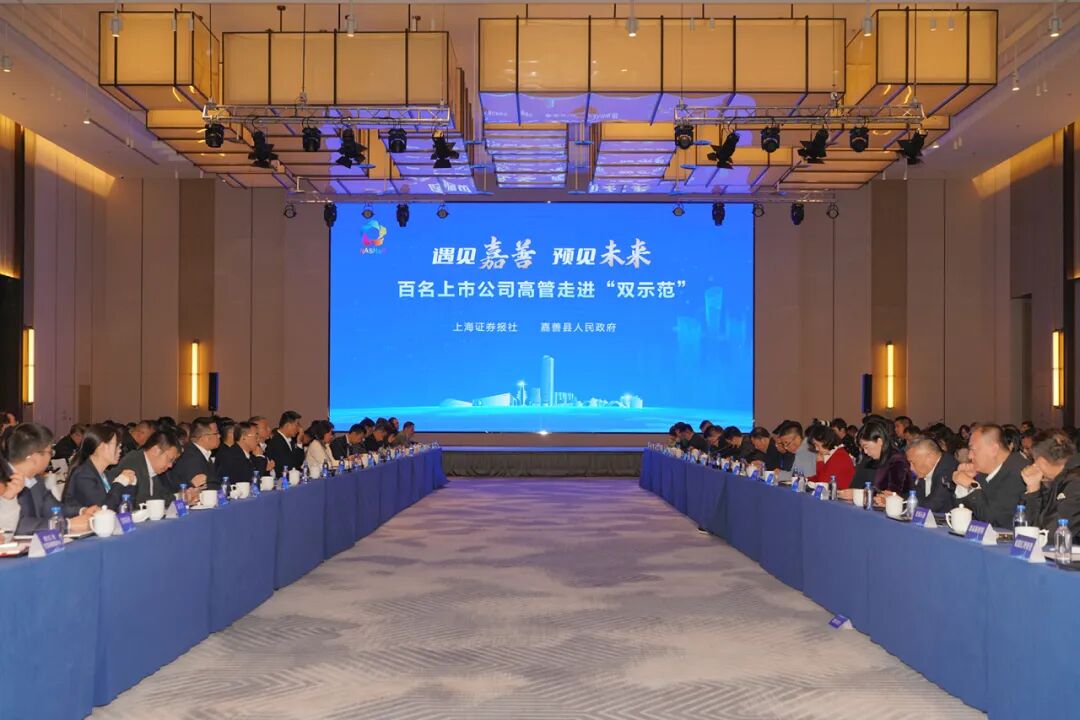
Group 1 - Jiaxing government provides strong support in project construction and talent introduction, creating a warm business environment for enterprises [1][4][13] - Jiaxing has a prominent geographical advantage, advanced industrial layout, and complete supporting facilities, especially in the new display field, showcasing strong industrial agglomeration effects [1][15] - The "Meet Jiaxing, Anticipate the Future" event gathered executives from listed companies and financial institutions to discuss industrial collaboration and project cooperation [1][2][4] Group 2 - Jiaxing is recognized as a national high-quality development demonstration point and a key area for ecological and green integration in the Yangtze River Delta [6][11] - The establishment of financial service platforms aims to support enterprises in capital market development and project financing [4][6] - The event serves as a platform for capital seeking projects and projects attracting capital, promoting information symmetry and resource flow [6][8] Group 3 - Deloitte China released an investment environment white paper, highlighting Jiaxing's economic development and innovation ecosystem [8] - Companies like Fulei New Materials and GeKowei Electronics express strong confidence in Jiaxing's supportive government and industrial foundation [11][13] - Various companies, including TaiLi Technology and RiLian Technology, plan to deepen cooperation with Jiaxing in their respective fields [19][21] Group 4 - SuShang Group aims to explore cooperation in urban renewal and technology upgrades in Jiaxing [25] - New Open Source Medical Group plans to collaborate with Jiaxing in innovative drug development [27] - Companies like Bibo Semiconductor and Lanjian Intelligent express intentions to integrate into Jiaxing's industrial ecosystem [34][40]
北京紫光集成电路科技有限公司成立
Zheng Quan Ri Bao Wang· 2025-11-22 03:16
Group 1 - Beijing Unisoc Integrated Circuit Technology Co., Ltd. has been established with a registered capital of 5 million yuan [1] - The company's business scope includes cloud computing equipment sales and information system integration services [1] - The shareholders of the company are Unisoc Cloud Technology Co., Ltd. holding 70% and Qingji Technology (Beijing) Group Co., Ltd. holding 30% [1]
这款CMOS逻辑芯片,永不消亡
半导体行业观察· 2025-11-22 03:09
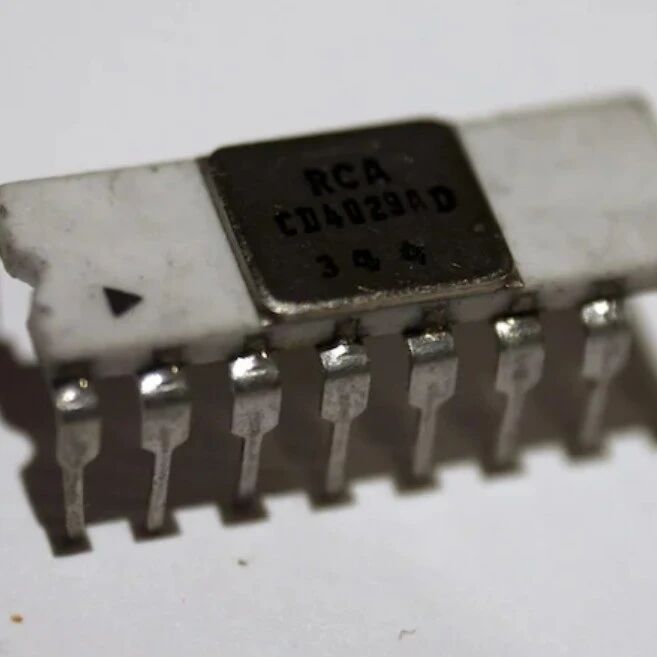
公众号记得加星标⭐️,第一时间看推送不会错过。 来 源 : 内容编译 自 allaboutcircuits,谢谢 。 55 年来,该逻辑系列产品凭借其抗噪声能力、轨道灵活性和无与伦比的持久性,实现了模拟和数字 设计的融合。 到了 20 世纪 60 年代末,TTL 电路凭借其速度、扇出能力以及日益丰富的门电路、锁存器和计数器 产品线,逐渐主导了数字逻辑电路。但它也带来了功耗高、5V 固定电压以及对模拟电路兼容性有限 的缺点。RCA 公司则另有打算。 1968年,该公司推出了CD4000 COS/MOS系列,这是首个完全采用CMOS工艺制造的商用逻辑系 列。CD4000的供电电压范围为3V至18V,输入阈值与VDD相关,静态功耗在纳安级,代表了一种新 型逻辑电路,其特点是寿命长、功耗低和抗噪声能力强。 这是RCA公司早期生产的CD4029A计数器集成电路,采用16引脚陶瓷双列直插式封装。 半个多世纪过去了,CD4000 系列器件仍在生产,并继续解决各种问题。虽然它们在开关速度上永远 无法与同类产品匹敌,但在灵活性、稳健性和与实际模拟信号的兼容性方面,它们仍然无可匹敌。它 们的寿命甚至超过了创造它们的公司以及它们诞 ...