通信电子

Search documents
【招银研究|资本市场快评】如何看待A股与黄金大跌
招商银行研究· 2026-03-23 12:21
Core Viewpoint - The ongoing geopolitical conflict in the Middle East is escalating, leading to heightened expectations of global stagflation and emerging liquidity risks, significantly impacting capital markets and asset prices, particularly in the Asia-Pacific region [1] Group 1: Equity Market - The situation in the Middle East has worsened, with the Strait of Hormuz experiencing substantial navigation restrictions, which is a critical factor for capital market dynamics [2] - A significant adjustment in the A-share market occurred on March 23, primarily driven by the negative macroeconomic combination of escalating geopolitical tensions and stagflation expectations, resulting in the first negative year-to-date returns for major A-share indices [3] - Historical data indicates that the maximum drawdown for the Shanghai Composite Index in any given year is not less than 8%, suggesting that a decline to the range of 3500-3850 points is a normal adjustment within a bull market [4] - The A-share market has seen a substantial release of risks, but a clear stabilization point requires further observation, with a cautious approach recommended for position management [5] Group 2: Gold Market - Gold prices are under pressure due to rising tightening expectations driven by inflation concerns, with significant outflows from major gold ETFs indicating a rapid withdrawal of institutional funds [7] - Speculation exists regarding oil-producing countries potentially selling gold reserves to manage liquidity, reminiscent of past behaviors during financial crises [8] - The future trajectory of gold prices is highly dependent on the evolution of the U.S.-Iran conflict, with three potential scenarios outlined: prolonged strait blockade leading to stagflation concerns, a swift resolution by U.S. forces, or a situation where inflation rises without economic stagnation [9][10]

春节扰动推升物价——2026年2月通胀数据解读【陈兴团队·华福宏观】
陈兴宏观研究· 2026-03-09 13:23
Core Viewpoint - The overall price level in February shows a significant recovery trend, with both CPI and PPI experiencing notable increases due to concentrated consumer demand during the Spring Festival and structural improvements in the economy [2][5][11]. CPI Analysis - In February, the national CPI increased from 0.2% to 1.3% year-on-year, marking the highest level in nearly three years, while the core CPI rose from 0.8% to 1.8% [5][6]. - Food prices shifted from a decline to an increase of 1.7%, contributing approximately 0.30 percentage points to the CPI increase, driven by heightened demand during the Spring Festival [6][7]. - Service prices surged by 1.6% year-on-year, influenced by concentrated consumer demand during the holiday, contributing about 0.75 percentage points to the CPI [6][7]. PPI Analysis - The PPI decreased by 0.9% year-on-year in February, with the decline narrowing by 0.5 percentage points compared to the previous month, marking the third consecutive month of reduced decline [11]. - The prices of production materials recorded a year-on-year decrease of 0.7%, while living materials saw a decline of 1.6% [11]. - Key industries such as electronic components and high-end equipment manufacturing showed price increases, with notable rises in aviation manufacturing (7.7%) and shipbuilding (0.5%) [11][15]. Price Trends - The PPI increased by 0.4% month-on-month in February, maintaining a five-month upward trend, primarily driven by rising production material prices [13]. - Significant price increases were observed in the energy sector, with oil and gas extraction prices rising by 5.1% and refined petroleum products by 0.7% [4][15]. - The prices of non-food industrial consumer goods expanded by 0.1 percentage points to 0.4% month-on-month, influenced by international geopolitical factors and rising commodity prices [7][15].

——2026年2月通胀数据解读:春节扰动推升物价
Huafu Securities· 2026-03-09 12:51
Inflation Overview - In February, the CPI increased by 1.3% year-on-year, the highest in nearly three years, and up 1.0% month-on-month, marking a two-year peak[2] - The core CPI, excluding food and energy, rose to 1.8% year-on-year, driven by strong demand during the Spring Festival[2] - Food prices turned from decline to an increase of 1.7% year-on-year, contributing approximately 0.30 percentage points to the CPI increase[14] PPI Trends - The PPI decreased by 0.9% year-on-year, with the decline narrowing for the third consecutive month, while month-on-month it rose by 0.4%, marking five months of continuous increase[18] - Production material prices increased by 0.5% month-on-month, serving as the main driver for the PPI's month-on-month rise[3] - Significant increases in upstream resource prices were noted, with non-ferrous mining and oil extraction prices rising by 7.1% and 5.1% respectively[3] Market Dynamics - The strong performance of the PPI is attributed to multiple factors, including rising international commodity prices and robust demand for AI computing power, which boosted the communication and electronics sectors[3] - The overall price structure shows a moderate bottoming out with structural differentiation, indicating a transition from policy stimulus to endogenous recovery[8] Risks and Considerations - Potential risks include changes in government policy, slower-than-expected economic recovery, and unforeseen extreme weather impacts on prices[4]
红相股份2025年度归母净亏损1791.25万元
Zhi Tong Cai Jing· 2026-02-26 11:01
Core Viewpoint - Hongxiang Co., Ltd. (300427.SZ) reported a total operating revenue of 738 million yuan for the fiscal year 2025, representing a year-on-year growth of 16.28%. However, the company recorded a net loss attributable to shareholders of 17.91 million yuan, with a basic loss per share of 0.04 yuan [1]. Group 1: Financial Performance - The total operating revenue for 2025 was 738 million yuan, marking a 16.28% increase compared to the previous year [1]. - The net loss attributable to shareholders was 17.91 million yuan [1]. - The basic loss per share was reported at 0.04 yuan [1]. Group 2: Business Segments - The company has been focusing on market expansion, which has driven steady growth in operating revenue [1]. - The power and communication electronics segments continued to show growth compared to the previous year [1]. - There has been an improvement in the company's profitability levels [1].

红相股份(300427.SZ)2025年度归母净亏损1791.25万元
智通财经网· 2026-02-26 09:52
Core Viewpoint - Hongxiang Co., Ltd. (300427.SZ) reported a total operating revenue of 738 million yuan for the fiscal year 2025, representing a year-on-year growth of 16.28%. However, the company recorded a net loss attributable to shareholders of 17.91 million yuan, with a basic loss per share of 0.04 yuan [1]. Group 1 - The company has continuously strengthened market expansion, driving steady growth in operating revenue [1]. - The power and communication electronics segments have maintained a growth trend in operating revenue compared to the previous year [1]. - The company's profitability level has shown some improvement [1].
紧盯这一主线,基金提前布局
Zhong Guo Zheng Quan Bao - Zhong Zheng Wang· 2026-02-04 15:49
Core Insights - Over 2900 A-share listed companies have released their 2025 earnings forecasts, with several high-performing companies attracting significant interest from fund institutions [1][2] Group 1: High-Performing Companies - Zijin Mining is expected to achieve a net profit of 510 billion to 520 billion yuan in 2025, representing a year-on-year growth of 59% to 62% [2] - Industrial Fulian is projected to realize a net profit of 351 billion to 357 billion yuan in 2025, with a year-on-year increase of 51% to 54% [2][3] - Honghe Technology anticipates a net profit of 193 million to 226 million yuan in 2025, showing a remarkable year-on-year growth of 745% to 889% [5] - Baiwei Storage expects a net profit of 850 million to 1 billion yuan in 2025, reflecting a year-on-year increase of 427.19% to 520.22% [7] Group 2: Fund Holdings and Activity - As of the end of 2025, 78 fund companies hold products that include Zijin Mining, with notable funds managed by well-known managers [2] - 96 fund companies have products holding Industrial Fulian, with E Fund being the largest holder [3] - 40 fund companies have products holding Baiwei Storage, with several funds increasing their holdings in the fourth quarter of 2025 [7] - Multiple fund companies have newly entered the institutional investor list for Honghe Technology and Tonghua Dongbao in the fourth quarter of 2025 [6][11] Group 3: Market Trends and Predictions - 604 listed companies are expected to have a lower limit of net profit growth of 100% or more in 2025, indicating a strong performance outlook [4] - Fund companies are focusing on companies with significant earnings growth and those expected to turn losses into profits, such as *ST Songfa and Tonghua Dongbao [9][10]
红相股份(300427.SZ):公司通信电子板块业务未涉及汽车领域
Ge Long Hui· 2026-01-26 14:41
Group 1 - The core viewpoint of the article is that Hongxiang Co., Ltd. (300427.SZ) has clarified that its communication electronics segment does not involve the automotive sector [1]
天和防务(300397) - 300397天和防务投资者关系管理信息20260115
2026-01-15 09:24
Group 1: Business Overview - The company focuses on the research, production, and delivery of low-altitude defense equipment, with three main business systems: "Military Equipment," "Communication Electronics," and "Next-Generation Integrated Electronic Information (Tianrong Project)" [1][2] - The military business is primarily conducted through the subsidiary Tianwei Electronics, while the civilian business is led by Huayang Communication, focusing on the RF industry chain [2] Group 2: Low Altitude Economy - The company has been actively involved in the low-altitude economy since 2001, leveraging its technological and research strengths to support national strategic initiatives [3] - It has developed competitive products for urban low-altitude safety, including monitoring systems and support solutions for general aviation [4][5] Group 3: Revenue Structure - The company has transitioned from a single military product focus to a dual-engine model driven by both military and civilian products, with civilian revenue now exceeding military revenue [5] Group 4: Stock Issuance - The company is in the process of issuing stocks to specific investors, currently under review by the Shenzhen Stock Exchange, with the first round of inquiries already addressed [5] Group 5: Underwater and RF Business - The underwater business focuses on underwater sensors and autonomous underwater vehicles for various tasks, including reconnaissance and environmental monitoring [5] - In the RF chip sector, the subsidiary Chengdu Tongliang offers products for base stations, wireless communication, and radar sensing, including low-noise amplifiers and power amplifiers [6]
蓝思科技微信公众号“剧透”新业务,存在信批“瑕疵”?
Shen Zhen Shang Bao· 2026-01-13 11:37
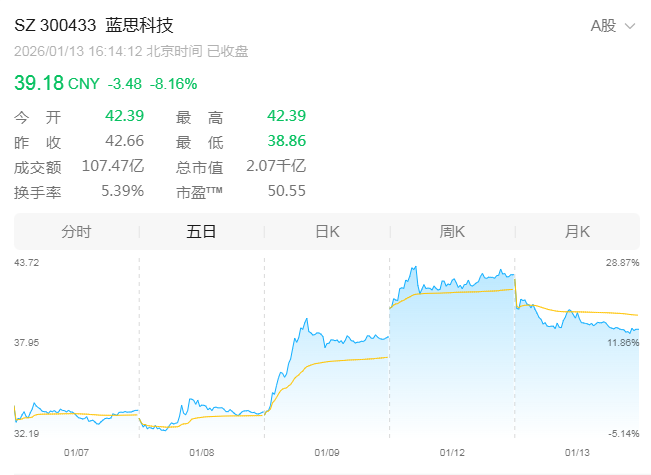
Group 1 - The core viewpoint of the article is that Lens Technology has recently launched several new products that are expected to lead the new infrastructure of space computing, resulting in a significant increase in the company's stock price, which has risen over 100% as of January 13 [1] - The article highlights the key parameters, application scenarios, advantages, and market potential of the new products introduced by the company [1] - Following the announcement, the company's stock price experienced a notable surge, closing at a significant increase [1] Group 2 - Market participants have raised concerns regarding the legality of companies disclosing new product information through WeChat public accounts, suggesting it may violate regulations on information disclosure [8] - The article references past cases where companies faced regulatory penalties for failing to disclose information through the proper channels, emphasizing the importance of compliance with disclosure regulations [9] - It is noted that timely, accurate, and complete disclosure of significant information is essential for the healthy operation of the capital market, and companies are urged to adhere strictly to disclosure regulations [10]

宏观解读 | 地产持续调整,内需动能待增强——2025年11月宏观数据点评
Sou Hu Cai Jing· 2025-12-26 09:46
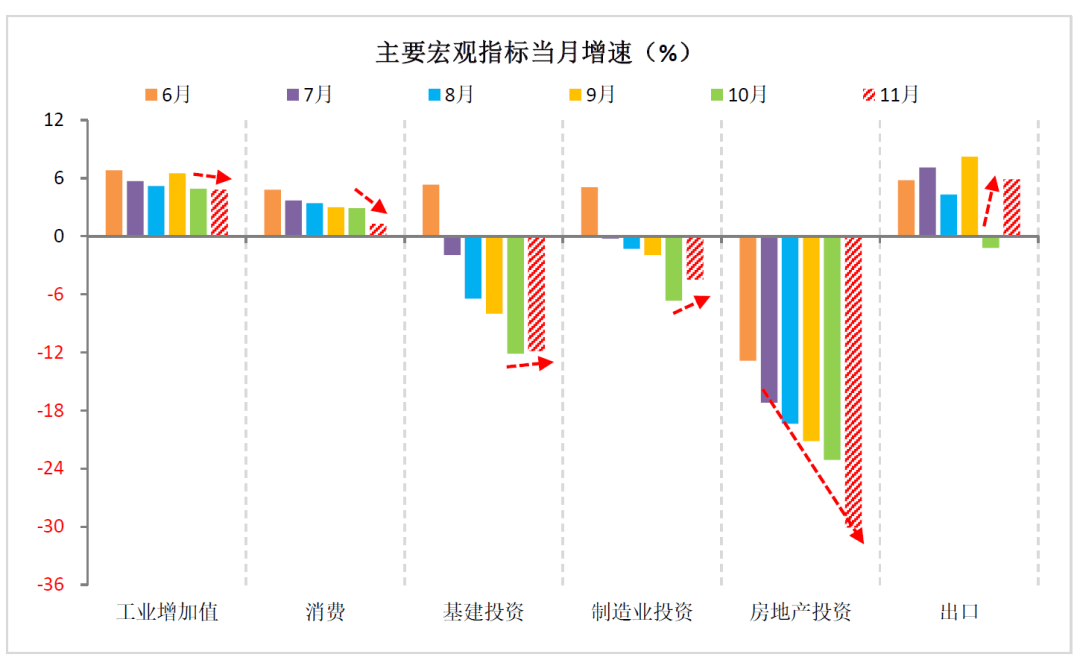
Core Viewpoint - The economic indicators in November show a divergence characterized by "strong production but weak demand, strong external demand but weak internal demand," indicating significant short-term downward pressure on the economy. Industrial production and export resilience are supported by ongoing industrial upgrades, while consumption growth is slowing, and investment continues to decline, highlighting insufficient domestic demand [1][3]. Group 1: Economic Dynamics - The economic indicators reflect a need for policy intervention to stabilize domestic demand as consumption growth slows and investment remains at low levels [3]. - Industrial production remains stable, with a year-on-year increase of 6.0% from January to November, slightly above last year's growth rate [4]. - The service sector shows signs of slowing down, with a year-on-year growth of 5.6% from January to November, indicating pressure from real estate and travel-related sectors [5]. Group 2: Consumption Trends - In November, the total retail sales of consumer goods grew by 1.3% year-on-year, reflecting increased pressure on consumption [8]. - The decline in consumption is notably influenced by the automotive sector and the "old-for-new" policy, which have both turned negative [8]. - Despite the overall slowdown, consumption among low- and middle-income groups remains stable, with service retail growth slightly improving [8]. Group 3: Investment Insights - Fixed asset investment decreased by 2.7% year-on-year from January to November, with a notable decline in real estate investment [12]. - Manufacturing investment shows initial signs of stabilization, with a year-on-year growth of 1.9% from January to November, indicating a potential recovery [14]. - Infrastructure investment remains steady, supported by new policy financial tools and fiscal funding, although traditional sectors face ongoing challenges [14]. Group 4: Export Performance - November exports saw a significant year-on-year increase of 5.9%, driven by low base effects and improved export volumes [18]. - Exports to the EU rebounded significantly, while exports to the US continued to decline due to previous import surges [18]. - The overall export resilience is supported by improvements in various product categories, including home appliances and textiles [18]. Group 5: Inflation Trends - The Consumer Price Index (CPI) rose by 0.7% year-on-year in November, supported by low base effects and rising food prices [22]. - The Producer Price Index (PPI) decreased by 2.2% year-on-year, with a slight month-on-month increase, indicating a mixed inflationary environment [22]. - Future inflation is expected to continue rising, influenced by domestic policies aimed at expanding demand [24]. Group 6: Financing Conditions - Social financing data in November showed a year-on-year increase of 160 billion yuan, indicating marginal improvements in financing demand driven by policy tools [28]. - However, credit growth remains weak, with new loans significantly lower than previous periods, reflecting ongoing challenges in consumer and housing market confidence [28][29]. - The M1 and M2 money supply growth rates continued to decline, indicating underlying weaknesses in the economy [29].