
船舶制造

Search documents
*ST松发: 西南证券股份有限公司关于广东松发陶瓷股份有限公司使用募集资金向全资子公司增资暨全资子公司向全资孙公司增资以实施募投项目的核查意见
Zheng Quan Zhi Xing· 2025-08-12 11:14
Summary of Key Points Core Viewpoint - The company, Guangdong Songfa Ceramics Co., Ltd., is utilizing raised funds to increase capital in its wholly-owned subsidiaries and implement fundraising projects, with independent financial advisor Southwest Securities providing a thorough review of the process and compliance with regulations [2][10]. Group 1: Fundraising Overview - The company raised a total of approximately RMB 3.999 billion through the issuance of 109,080,992 shares at a price of RMB 36.67 per share, after deducting issuance costs [2]. - A special account for the raised funds has been established to ensure dedicated use and compliance with regulatory requirements [3]. Group 2: Investment Project Details - The raised funds will be allocated to specific projects, including the "Green High-end Equipment Manufacturing Project" by Henglian Shipbuilding (Dalian) Co., Ltd. and the "International Ship Research and Design Center Project" by Henglian Heavy Industry Group Co., Ltd. [4][5]. - The total investment for the projects is adjusted to approximately RMB 874.35 million, with specific allocations of RMB 400 million and RMB 393.20 million for different components of the projects [4]. Group 3: Capital Increase Structure - The company plans to increase capital in Henglian Heavy Industry by approximately RMB 3.93 billion and subsequently in Henglian Shipbuilding by RMB 3.5 billion [5][6]. - The capital increase will enhance the financial strength and operational capacity of the project implementation entities, promoting overall company growth and competitiveness [7]. Group 4: Approval and Oversight - The capital increase plan has been approved by the company's board and supervisory committee, and it will be submitted for shareholder approval [8][9]. - The independent financial advisor has confirmed that the process adheres to legal and regulatory standards, ensuring no detriment to the company or shareholders [10].

松发股份重大重组完成 40亿元配套融资落地
Zheng Quan Ri Bao Wang· 2025-08-12 10:43
Group 1 - The core viewpoint of the news is that Guangdong Songfa Ceramics Co., Ltd. successfully completed a major asset swap and issuance of shares to raise nearly 4 billion yuan in supporting funds [1][2] - The project faced challenges such as limited investment institutions, small circulation leading to difficulties in investor reduction, and high pricing difficulties, but the team from Southwest Securities overcame these obstacles [1] - The issuance attracted 22 quality investors, with a total subscription scale of 4.395 billion yuan, and the final issuance price was set at 36.67 yuan per share [1] Group 2 - The asset swap involves the integration of Hengli Heavy Industry Group's shipbuilding and high-end equipment manufacturing business, which will enable self-controlled production of marine engines and reduce reliance on foreign core components [2] - Hengli Heavy Industry is ranked fifth globally and fourth in China for new orders in 2024, and the funds raised will be directed towards green high-end equipment manufacturing projects and an international ship research and design center [2] - The successful completion of this major asset restructuring and fundraising is seen as a practical example of the capital market serving the real economy and private enterprises responding to national strategies [2]

中国船舶(600150.SH):异议股东收购请求权行权价格为30.02元/股
智通财经网· 2025-08-12 10:43
Core Viewpoint - China Shipbuilding (600150.SH) announced the exercise price for dissenting shareholders' buyout request at 30.02 CNY per share, which may lead to potential losses for those exercising the buyout rights given the current market price [1] Summary by Relevant Sections - **Buyout Request Details** - The exercise price for dissenting shareholders to sell their shares is set at 30.02 CNY per share [1] - Dissenting shareholders who successfully declare their buyout request will receive cash compensation at this price [1] - **Market Comparison** - As of August 12, 2025, the company's stock closed at 38.50 CNY per share, representing a premium of 28.25% over the buyout request exercise price [1] - This significant premium indicates that exercising the buyout rights could result in financial losses for dissenting shareholders [1]

曹中铭:对问题公司的主动退市须从严监管
Xin Lang Cai Jing· 2025-08-12 10:20
Group 1 - The core viewpoint of the articles is that the proactive delisting of companies like *ST Tianmao raises concerns about regulatory oversight and the need for stricter measures for problem companies in the market [1][3] - The number of companies voluntarily delisting has increased, with 30 companies announced to be delisted this year, including 5 that chose to delist voluntarily [1][2] - The proactive delisting trend is expected to continue, with 2025 projected to be a significant year for voluntary delistings, contrasting with previous years where the numbers were much lower [2][3] Group 2 - The current delisting rate in the Shanghai and Shenzhen markets is notably low, with less than 1% of listed companies delisting annually, indicating a need for improvement compared to mature markets [2][3] - There are concerns regarding the effectiveness of the current delisting regulations, particularly in cases of financial fraud, where many companies are not forced to delist despite engaging in fraudulent activities [2][3] - The case of *ST Tianmao highlights the complexities surrounding voluntary delisting, including ongoing investigations by regulatory bodies and the need to protect investor rights even after delisting [3]
多项指标领先全球 中国船舶制造业正乘风远航
Xin Hua Wang· 2025-08-12 05:47
Core Insights - The launch of China's first domestically built large cruise ship "Aida·Modu" marks a significant milestone in the country's shipbuilding capabilities, indicating a shift from being a shipbuilding power to a strong shipbuilding nation [1][2][3] Shipbuilding Capacity Improvement - "Aida·Modu" is 323.6 meters long, 37.2 meters wide, and has a total tonnage of 135,500 tons, featuring 2,125 cabins and the capacity to carry 5,246 passengers, comparable to European-built cruise ships [2] - In 2023, China's shipbuilding completion volume, new orders, and hand-held orders accounted for 50.1%, 65.9%, and 53.4% of the global total, respectively, ranking first in the world [3] - Chinese shipyards secured 59% of the global new ship order volume in 2023, with a total of 24.46 million compensated gross tons (CGT) [3] Deepening Cooperation in Related Fields - China's shipbuilding industry is positively impacting the global shipping market, with increasing cooperation in trade, ports, and shipping with other countries [4] - By August 2023, the fleet size of Chinese shipowners reached 249.2 million gross tons, holding a market share of 15.9%, making China the largest shipowning nation [4] - Greece has accelerated cooperation with China in shipping infrastructure, with a significant portion of new ships being built in China [4] Prosperity in Related Industries - The rapid development of China's shipbuilding industry is accompanied by a booming shipping sector, with Chinese shipyards receiving over 86% of global orders for new car carriers in 2022 [5] Green Transformation and Quality Upgrade - China's shipbuilding industry is focusing on green transformation, with a goal to produce over half of the world's clean energy-powered ships by 2025 [6] - The "Green Development Action Plan for Shipbuilding Industry (2024-2030)" aims to promote the construction of ships powered by liquefied natural gas, methanol, and other low-carbon fuels [6] - The industry is also accelerating the research and development of new transport vessels powered by liquid ammonia, liquid hydrogen, and liquid carbon dioxide [6] Government Support and Competitive Edge - The restructuring of major Chinese shipbuilding companies in 2019 has positioned them as the largest shipbuilding enterprise globally, enhancing production capacity and competitiveness [7] - The combination of reasonable pricing and improving quality has contributed to China's leading position in new ship orders globally [7]


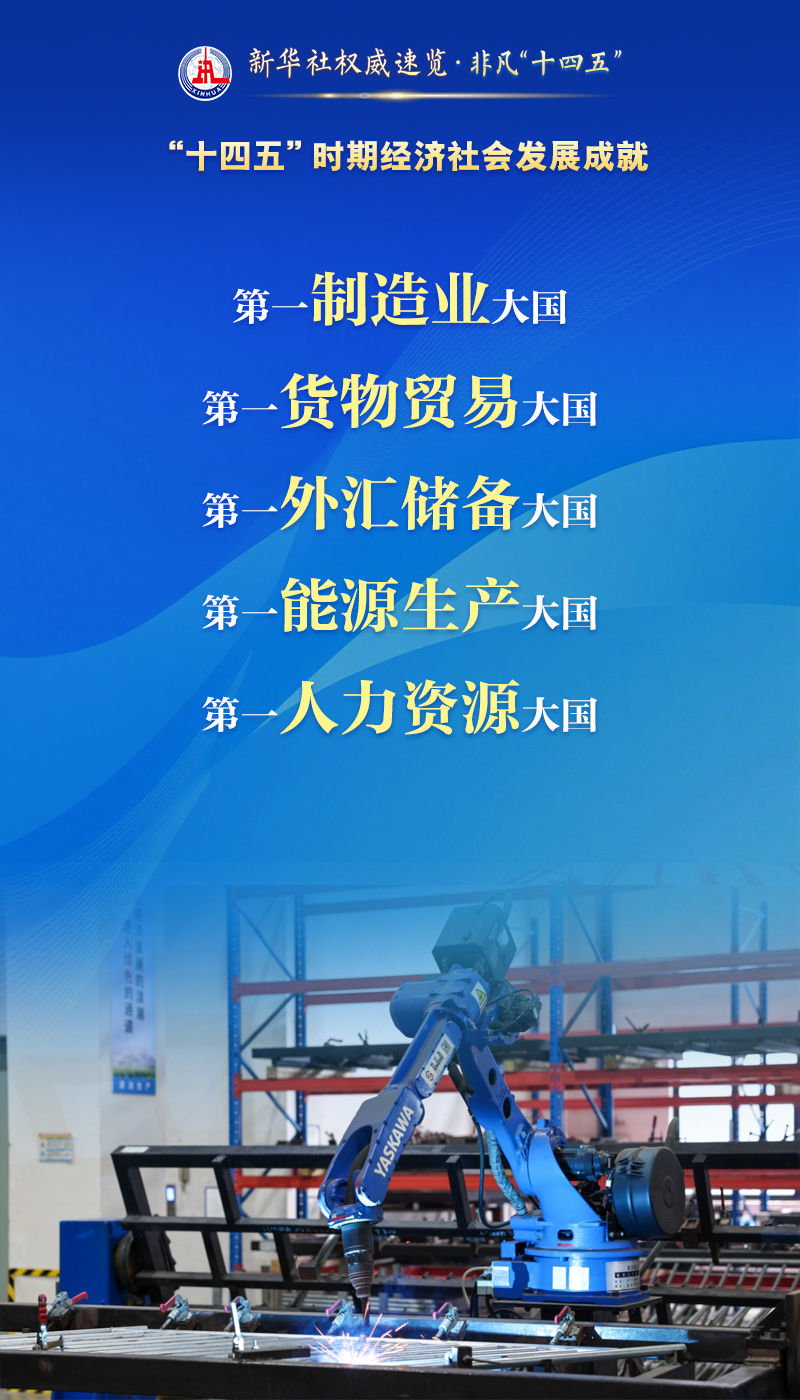
新华社权威速览·非凡“十四五” | 这么多“第一”,不简单!
Xin Hua Wang· 2025-08-12 05:44
Group 1 - The "14th Five-Year Plan" period has seen China achieve significant milestones, including becoming the world's largest manufacturing power and the largest goods trading nation [4][9][14] - China has established the world's largest and fastest-growing renewable energy system, along with the largest middle-income group [13][9] - The country has built the largest education, healthcare, and social security systems globally, and has the highest number of 5G base stations [10][9] Group 2 - Agricultural production in China, including grains, meat, peanuts, vegetables, tea, and fruits, ranks first in the world [7] - The first domestically produced aircraft carrier, the Fujian, has been launched, and the first large cruise ship, the "Aida·Modu," has been completed and put into operation [4] - The successful operation of the first Chinese space station "Tianhe" and the world's first fourth-generation nuclear power plant at Shidao Bay has been achieved [4]
中国船舶吸收合并中国重工 中国船舶产业整合再进一步
Xin Hua Wang· 2025-08-12 05:38
据重组预案,本次交易以换股方式进行,交易金额达1151.5亿元,构成重大资产重组。自2025年5 月8日上交所正式受理申请以来,相关整合工作有序推进。接下来,该交易仍需履行中国证监会注册等 程序。 【纠错】 【责任编辑:黄海荣】 此次合并不仅是两家上市公司的资本操作,更是中国船舶集团有限公司在2019年由原"两船"集团联 合重组基础上的进一步整合深化,是中国船舶工业体制改革的重要延续。早在1999年,原中国船舶工业 总公司便分拆成立中国船舶工业集团有限公司和中国船舶重工集团有限公司,分别聚焦造船制造的不同 体系。两大集团长期在装备制造、船舶建造等领域并行发展。2019年10月,经党中央决策、国务院批 准,双方实施联合重组,设立中国船舶集团有限公司,推动产业整合纵深发展。 据上交所并购重组审核委员会发布的公告显示,2025年7月4日,上海证券交易所并购重组审核委员 会召开2025年第8次审议会议,审议并通过了中国船舶工业股份有限公司(以下简称"中国船舶")申请 通过向中国重工全体换股股东发行A股股票的方式吸收合并中国船舶重工股份有限公司(以下简称"中 国重工")的重大资产重组事项。 公告中称,随着重组顺利推进, ...

两家公司同日退市引关注 主动退市案例增多
Huan Qiu Wang· 2025-08-12 04:36
Core Viewpoint - The A-share market has seen a significant increase in both voluntary and involuntary delistings, indicating a tightening regulatory environment and a shift towards higher quality standards in the capital market [3][4]. Group 1: Voluntary Delistings - As of August 10, 2023, there have been five companies that voluntarily delisted through shareholder resolutions or mergers, surpassing the annual average of 1-4 cases from 2020 to 2024 [3]. - Companies such as 中航产融 (AVIC Capital) and 玉龙股份 (Yulong Co.) have already completed their delistings, while *ST天茂 (ST Tianmao) is in the process of withdrawing its listing due to failure to disclose financial reports [3]. - The proactive delisting of *ST天茂 is attributed to its inability to disclose the 2024 annual report, which could trigger mandatory delisting if not resolved by early September [3]. Group 2: Involuntary Delistings - Ten companies have triggered mandatory delisting criteria due to serious violations, with *ST高鸿 (ST Gaohong) being a notable case involving systematic financial fraud, including inflated revenues of 3.5 billion and profits of 4 billion [3]. - The chairman of *ST高鸿 has been fined 7.5 million and banned from the market for life, with total penalties for responsible parties amounting to 167 million [3]. Group 3: Regulatory Changes - New regulations effective in 2024 will raise the financial delisting revenue threshold from 100 million to 300 million, and introduce new criteria for delisting due to severe fraud [4]. - Eight companies have already been delisted this year for failing to meet the new market capitalization requirement of 500 million or for having share prices below par [4]. Group 4: Market Trends - A total of 30 companies have been delisted this year, with a balanced distribution among those delisted for major violations, financial issues, and trading problems [5]. - The regulatory body has initiated investigations against 35 out of 55 delisted companies, reflecting a more stringent enforcement approach [5]. - Policies encouraging market-driven delistings and discouraging "shell protection" behaviors have led to 12 cases of mergers, such as the absorption of 海通证券 (Haitong Securities) by 国泰君安 (Guotai Junan) [5].



又添强制退市 2025年A股重大违法退市案例激增
Jing Ji Guan Cha Wang· 2025-08-12 02:56
Core Viewpoint - The implementation of the new delisting regulations has led to an increase in the number of companies delisted from the A-share market, with a focus on companies involved in major violations and financial fraud [2][6][10] Delisting Statistics - As of August 11, 2025, 23 A-share listed companies have been delisted, primarily due to financial issues, trading problems, major violations, and voluntary delisting [2][6] - Among these, 7 companies are suspected of major violations, with 3 already delisted [2][4] - The number of companies delisted for fraud in 2025 has already surpassed the total for 2024, indicating increased regulatory scrutiny [2][6] Case Study: *ST Gao Hong - *ST Gao Hong is facing forced delisting due to serious violations, as indicated by the China Securities Regulatory Commission (CSRC) [3][4] - The company has been found to have engaged in financial fraud from 2015 to 2023, inflating revenues by a total of 198.76 billion yuan and profits by 76.23 million yuan [4] - The fraudulent data was used in a non-public offering in 2020, raising 1.25 billion yuan, constituting fraudulent issuance [4] Regulatory Environment - The new delisting regulations, effective from January 2025, aim to enhance the removal of "zombie" companies and those involved in major violations [6][10] - The CSRC has emphasized the need for a balance between clearing out poor-quality companies and protecting investor rights [2][10] Types of Delisting - The delisting types include trading-related, financial-related, and voluntary delisting, with 9 companies delisted for trading issues and 2 for financial issues as of August 11, 2025 [6][7] - Companies like China Heavy Industries are undergoing voluntary delisting due to mergers, while others like *ST Tianmao are also opting for voluntary delisting amid business adjustments [8][9] Investor Protection Mechanisms - The new regulations include provisions for protecting minority shareholders during voluntary delistings, such as cash exit options [9][10] - For instance, *ST Tianmao has proposed a buyback at a premium price to provide a clear exit path for shareholders [9]
氨燃料二冲程船用发动机首获应用
Zhong Guo Hua Gong Bao· 2025-08-12 01:48
Group 1 - WinGD has successfully installed the X52DF-A engine on a 46,000 cubic meter LPG/ammonia transport vessel for EXMAR, marking it as the first company to bring ammonia-fueled two-stroke marine engines to market [1] - The X-DF-A engine utilizes high-pressure ammonia injection technology and operates with approximately 5% low-dose pilot fuel at full load, achieving comparable load handling, dynamic response, and fuel efficiency to WinGD's diesel fuel X-series engines [1] - Key emissions metrics for the ammonia fuel engine, including nitrous oxide (N2O) and ammonia slip, have shown ideal results during testing, with emissions reduced to single-digit parts per million (PPM) without additional post-treatment devices [1] Group 2 - The 52-cylinder engine was manufactured by HD Hyundai Heavy Industries and installed on the first of four series vessels built by HD Hyundai Shipbuilding & Marine [2] - WinGD's CEO anticipates a more diversified fuel mix in the future, with liquefied natural gas (LNG) as a transitional choice, followed by methanol, and ultimately ammonia becoming mainstream [2] - WinGD has expanded its X-DF platform, initially designed for LNG, to include methanol and ammonia, and has recently introduced the X-DF-P version capable of using LPG [2]