
多式联运

Search documents
交通运输部答每经问:“十四五”时期长江干线主要港口铁路进港率超过九成
Mei Ri Jing Ji Xin Wen· 2026-01-05 13:55
Group 1 - The core viewpoint of the article emphasizes the significant progress and achievements in the development of the Yangtze River Economic Belt over the past decade, particularly in the area of multimodal transport [1] - The Ministry of Transport reported that during the 14th Five-Year Plan period, the railway access rate for major ports along the Yangtze River exceeded 90%, and the annual growth rate of container rail-water intermodal transport surpassed 30% [1][3] - The Ministry of Transport is set to implement a multimodal transport action plan during the 15th Five-Year Plan period, focusing on key nodes such as major ports and logistics parks to enhance the integration of container rail-water transport [2][3] Group 2 - The Ministry of Transport has introduced several policy documents to guide the development of multimodal transport, including the "One Port, One Policy" initiative to promote deep integration of container rail-water transport [2] - A comprehensive multimodal transport service system covering the Yangtze River Economic Belt has been established, with Shanghai and Wuhan serving as key hubs for enhancing international transport capabilities [2][3] - The Ministry of Transport aims to reduce logistics costs and improve efficiency by promoting the transfer of bulk goods from road to rail and water transport, thereby supporting the efficient operation of a unified national market [3]
山东政商要情(12.29—1.4)
Jing Ji Guan Cha Bao· 2026-01-05 05:07
Group 1: Economic Policies - Shandong Province has released a policy list for 2026 aimed at promoting economic stability and quality improvement, consisting of 28 measures, with 20 being reward and subsidy policies to support quality enterprises and project construction [1][2] - The policy emphasizes the importance of the service industry, allocating 50 million yuan to support new and "quasi-standard" enterprises, and 150 million yuan for modern service projects, including 90 million yuan for key areas like artificial intelligence and industrial internet [1][2] Group 2: Private Economy Regulation - The "Shandong Province Private Economy Promotion Regulations" will take effect on January 1, providing legal protection for over 14.4 million private market entities, clarifying rules against unfair competition in public resource transactions [3] - The regulations focus on fair competition, resource support, and rights protection, aiming to eliminate market barriers for private capital [3] Group 3: Elderly Care Services - Shandong has approved measures to enhance community-based elderly care services, aiming to establish a network of service facilities and improve service quality by 2029, including the construction of regional elderly service centers [4] - The measures promote market-oriented, integrated, and smart elderly care services to meet diverse and high-quality demands [4] Group 4: Carbon Footprint Management - An action plan for establishing a carbon footprint management system has been issued, focusing on green transformation and carbon emission control, with pilot projects in cities like Qingdao and Yantai [5] - The plan aims to complete carbon footprint accounting for 300 products by 2027 and 600 by 2030, enhancing the green competitiveness of enterprises [5] Group 5: Education, Technology, and Talent Development - Shandong has introduced 30 fiscal measures to support the integrated development of education, technology, and talent, becoming the first province to strengthen coordination from a fiscal perspective [6] - The measures include establishing a resource coordination mechanism and promoting the transformation of technological achievements to enhance the synergy between education, technology, and talent [6]
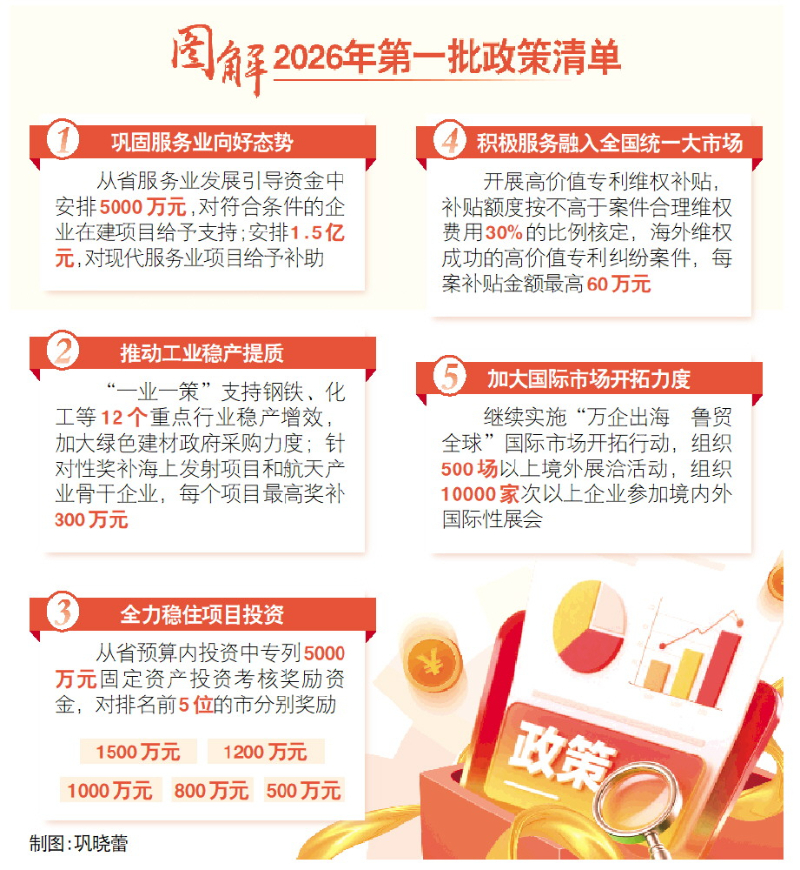
山东:2026年首个“政策包”来了!
Xin Hua Wang· 2026-01-01 03:18
Core Viewpoint - The Shandong Provincial Government has released the first batch of policies for 2026 aimed at promoting economic stability and quality improvement, consisting of 28 measures across five areas, with a focus on supporting high-quality enterprises and project development [4]. Group 1: Economic Support Measures - The 2026 policy list includes 20 reward and subsidy measures, all aimed at enhancing enterprise development and project construction to stimulate market vitality [4]. - The policies are designed to integrate supply and demand, enhance service industry support, accelerate key project construction, and help enterprises explore overseas markets [4][5]. Group 2: Service Industry Focus - Shandong will allocate 50 million yuan from the provincial service industry development fund to support new and "quasi-standard" enterprises, with an additional 150 million yuan for modern service industry projects [5]. - Specific funding includes 90 million yuan for high-end productive service industries such as artificial intelligence and industrial internet, and 60 million yuan for key service sectors like logistics and warehousing [6]. Group 3: Industrial Stability and Quality Improvement - The province will implement tailored support for 12 key industries, including steel and chemicals, to stabilize production and enhance efficiency [6]. - Financial incentives will be provided for commercial space launch projects and key aerospace enterprises, with subsidies up to 3 million yuan per project [6]. Group 4: Investment and Market Integration - The policy aims to stabilize project investment by adjusting fixed asset investment assessments and providing 50 million yuan in rewards for top-performing cities [7]. - New models for attracting investment will be developed, including subsidies for high-value patent protection and support for public service platforms [7][8]. Group 5: International Market Expansion - Shandong will provide financial support for enterprises participating in key exhibitions and developing cross-border e-commerce, with plans for over 500 overseas exhibition activities in 2026 [8]. - The focus will be on traditional and high-value industries, with initiatives to support around 1,000 enterprises in cross-border marketing and brand development [8]. Group 6: Policy Implementation and Accessibility - The effectiveness of the policy package relies on its implementation, with plans to develop detailed measures and improve accessibility through the "Luhuitong" policy platform [9]. - The goal is to ensure that enterprises can quickly benefit from the policies, aiming for a strong economic start in the first quarter of the year [9].

武汉多式联运服务中心:打造“黄金一公里滨江带”产业集聚区
Sou Hu Cai Jing· 2025-12-30 12:15
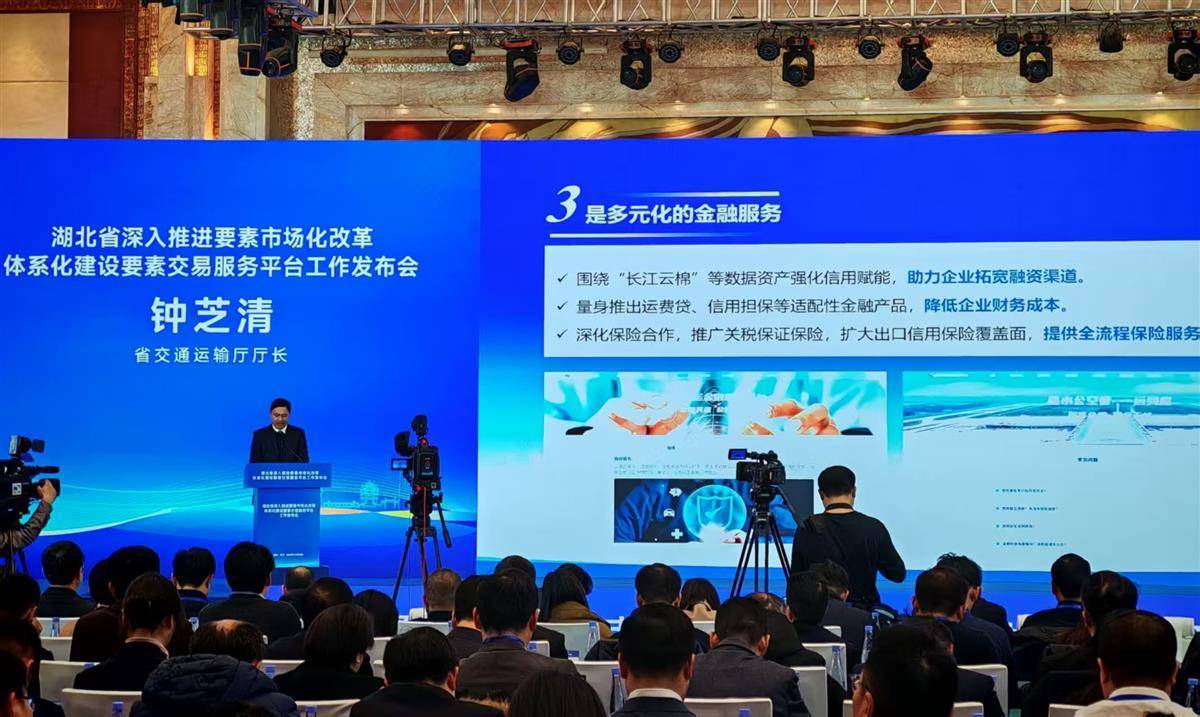
Core Viewpoint - The Wuhan Multimodal Transport Service Center aims to enhance logistics efficiency through innovative mechanisms, platform upgrades, and ecological co-construction, particularly in the Jianghan District with the development of the "Golden Mile Riverside Industrial Cluster" [1][3]. Group 1: Service Offerings - The center provides comprehensive services including full-chain information services, one-stop transaction services, diversified financial services, and centralized supporting services [3]. - Clients can track their shipments from dispatch to receipt through a single platform, which also intelligently matches transport needs with available multimodal products [3]. - The platform will introduce financial products like freight loans and deepen insurance collaborations to help businesses expand financing channels and reduce financial costs [3]. Group 2: Physical Location and Development Plans - The physical entity of the center is located in the Changjiang Shipping Center Building on Yangtze River Avenue in Jianghan District, Wuhan [3]. - The center aims to attract transportation-related entities to establish a collaborative environment where various departments such as transportation, maritime, finance, and taxation can operate together, creating a synergistic industrial ecosystem [3].
上合示范区多式联运中心年度集装箱办理量突破30万TEU
Qi Lu Wan Bao· 2025-12-26 06:46
Core Insights - The annual container handling volume at the SCO Demonstration Zone's multimodal transport center has surpassed 300,000 TEU, marking a year-on-year increase of 29.02%, indicating significant progress in the development of the multimodal transport system and open hub construction [1] - The SCO Demonstration Zone has launched 32 international and domestic train routes, connecting 23 countries and 54 cities involved in the SCO and the Belt and Road Initiative, thereby establishing a comprehensive international logistics channel [2] Group 1 - The SCO Demonstration Zone has operated 1,126 China-Europe freight trains in the first 11 months of the year, reflecting a year-on-year growth of 17.2%, with a total of 92,310 TEU of goods shipped, also up by 17.2% [1] - The implementation of the "SCO Fast Pass" regulatory model aims to enhance the efficiency and service capability of the multimodal transport center, reducing port time by 35% and improving customs clearance efficiency by 60% [1] - By 2025, the multimodal transport center will initiate the construction of a 25,000 square meter intelligent yard to further enhance hub operational support capabilities [1] Group 2 - The SCO Demonstration Zone has cumulatively launched over 5,100 China-Europe freight trains, regularly operating specialized trains for household appliances, tires, vehicles, and grains, serving over 7,000 foreign trade enterprises [2] - The zone is accelerating the construction of the Shandong China-Europe Freight Train (Jiqing) National Gathering Center in Qingdao, with regular operations for storage of goods such as Russian pulp, Central Asian grains, and Southeast Asian rubber [2] - The focus is on enhancing the logistics hub capabilities and strengthening the China-Europe freight train brand, aiming to create a modern logistics comprehensive service system that integrates logistics, trade, and industry [2]
新生力量破局多式联运——专访扬州市班列公司董事长刘冬宁
Sou Hu Cai Jing· 2025-12-22 09:54
Core Viewpoint - The rapid growth of Yangzhou Class Train Company reflects the high-quality development of multimodal transport in Jiangsu, significantly contributing to foreign trade and supply chain stability in the region [1][11]. Group 1: Company Development - Yangzhou Class Train Company officially launched the "Yangzhou-Suzhou-Moscow" China-Europe freight train, marking a significant milestone in its operational capabilities [1]. - The company was established in September 2024 and began operations in October 2024, leveraging its strategic location and modern facilities to enhance multimodal transport efficiency [1]. Group 2: Operational Model - The "Yangzhou-Suzhou-Moscow" train employs an innovative operational model that integrates the Suzhou train platform with mainline connections, addressing logistics pain points and achieving upgrades in efficiency, cost, and stability [4]. - The train's journey takes 10-15 days, saving approximately 40% compared to traditional sea transport, and reduces overall logistics costs by about 10% through optimized resource integration [4]. Group 3: Service Offerings - The company offers a "sea-rail combined + international train" service model, allowing direct delivery from factories to overseas warehouses, significantly reducing inventory pressure and transit times [5]. - Successful shipments of high-value products like photovoltaic panels and automotive components have enhanced the global competitiveness of regional manufacturers [5]. Group 4: Strategic Expansion - The company aims to expand its service network, with plans for stable operations to Shanghai and Ningbo by 2025, and to develop new international routes, including a "China-Kyrgyzstan-Uzbekistan" rail-road combined transport service [7][8]. - The long-term vision includes establishing a modern logistics hub in Jiangsu, focusing on multi-modal transport and comprehensive service platforms [8]. Group 5: Collaborative Efforts - Yangzhou Class Train Company is enhancing its logistics network within Jiangsu by increasing existing routes and developing new connections to major ports, aiming for daily operations to Shanghai and improved service frequency to other ports [10]. - The company plans to expand its reach to Central Asia and Europe through strategic partnerships with other regional hubs, creating a robust multimodal transport framework [10].
重庆:多式联运“一单制”应用取得阶段性成效
Xin Hua She· 2025-12-18 09:27
Core Insights - The Chongqing government reported a significant increase in the issuance of multimodal transport "one document" bills, with a total of 18,377 bills issued from January to November, representing a year-on-year growth of 38.2% [1] - Among these, digital bills accounted for 6,891, marking a substantial year-on-year increase of 67.9% [1] - The total value of the multimodal transport "one document" bills reached approximately 22.95 billion yuan, reflecting a remarkable year-on-year growth of 4.2 times [1]
武汉多式联运服务中心启动运营
Chang Jiang Ri Bao· 2025-12-18 00:34
Core Insights - The Wuhan Multimodal Transport Service Center has officially commenced operations, aiming to enhance logistics efficiency and reduce costs by integrating various transportation modes [1][2] - The center addresses key pain points in multimodal transport, such as information flow issues, through systematic reforms to improve coordination among different transport modes and market participants [1] - The establishment of the center is expected to facilitate faster logistics processes, exemplified by a reduction of over 5 days in transport time for Russian imported timber via the China-Europe Railway Express [1] Group 1 - The center integrates multiple transportation modes including water, rail, road, air, and pipeline, creating a comprehensive service platform to streamline logistics [1] - The center will support the efficient operation of a "single document" system for multimodal transport, promoting seamless transitions among different transport modes [1] - The center aims to build an interconnected data platform to support the "single document" system, facilitating optimal resource allocation and seamless integration of various transport methods [1][2] Group 2 - The center will establish a "one-stop" online trading market, offering standardized and customized multimodal transport products, akin to an efficient "smart Taobao" [2] - It will coordinate with customs, railways, and resources along the Yangtze River to promote cross-regional and cross-sector data sharing and business integration [2] - The center will provide ancillary services such as customs declaration, legal consulting, credit assessment, and talent training, along with regular industry reports and multimodal transport indices [2]
重庆提17条举措促进西部陆海新通道多式联运发展
Zhong Guo Xin Wen Wang· 2025-12-17 23:44
中新社重庆12月17日电 (张旭)重庆是西部陆海新通道物流和运营组织中心。当地17日举行新闻发布会, 解读《加快推进西部陆海新通道"一单制"数字提单应用若干措施(试行)》(下称《措施》)。 以数字提单为载体的多式联运"一单制"改革,是破解多式联运制度瓶颈、创新推动制度型开放的重要探 索。重庆市人民政府口岸和物流办公室等多部门联合印发的《措施》,提出17条具体举措,旨在推动通 道规模化、标准化应用多式联运"一单制"数字提单,为全国多式联运"一单制"实践提供先行探索。 重庆提17条举措促进西部陆海新通道多式联运发展 其中,针对传统纸质单据流转效率低、流程繁琐的问题,重庆鼓励市场主体开通分布式数字身份,通过 区块链技术去中心化、不可篡改的特性,推动数字提单数据上链存证,实现可信数据共享。 针对数据安全问题,重庆支持数字提单平台建设主体采取加密、脱敏、隐私计算等技术手段,减少市场 主体顾虑,在确保企业商业秘密的前提下,实现数据可用。 来源:中国新闻网 编辑:董文博 广告等商务合作,请点击这里 本文为转载内容,授权事宜请联系原著作权人 中新经纬版权所有,未经书面授权,任何单位及个人不得转载、摘编或以其它方式使用。 关注 ...
多领域组建合作联盟,长江中游城市群冲刺“第五极”
Di Yi Cai Jing· 2025-12-15 05:35
Core Viewpoint - The Yangtze River Middle Reaches Urban Agglomeration is striving to become the "fifth pole" of China's economy through collaborative efforts in various sectors such as transportation, technology innovation, healthcare, and public safety [2][4]. Group 1: Intellectual Property and Innovation - In the past five years, the Yangtze River Middle Reaches Urban Agglomeration has achieved over 337,500 effective invention patents [1][5]. - A cooperation agreement was signed among the intellectual property offices of Wuhan, Changsha, Nanchang, and Hefei to establish a collaborative development framework for intellectual property protection [2]. - The agreement includes the creation of a strategic research base for intellectual property, a cross-regional enforcement mechanism, and a one-stop service for patent pre-examination and rights protection [2]. Group 2: Transportation and Logistics - A multi-modal transport enterprise alliance was established to enhance collaboration among key ports and logistics companies, aiming to improve shipping efficiency and reduce logistics costs [3]. - The alliance will focus on tailored logistics solutions for key industries such as automotive, chemicals, and grain, promoting a modernized port cluster [3]. - Future plans include optimizing intercity container services and creating a "water bus" network to facilitate better connectivity among ports [3]. Group 3: Regional Economic Development - The Yangtze River Middle Reaches Urban Agglomeration spans Hubei, Hunan, and Jiangxi provinces, contributing over 12 trillion yuan to the national economy, with GDP expected to exceed 14 trillion yuan this year [5]. - The region is characterized by a multi-center, multi-level spatial structure that supports collaborative development among cities, enhancing its position in the national economic landscape [5]. - The agglomeration is expected to develop new growth poles in advanced manufacturing, green energy, and modern logistics, further strengthening its innovation capabilities [5].