太空探索

Search documents
“木头姐”旗下太空ETF首度买入特斯拉,业界猜测:特斯拉和SpaceX可能合并
Sou Hu Cai Jing· 2026-02-09 10:41
Group 1 - The article discusses the potential merger between Tesla and SpaceX, with speculation that Ark Invest is positioning Tesla within a space ETF due to its ambitions in various industries, including the development of humanoid robots for extraterrestrial endeavors [2] - Analysts suggest that Tesla could achieve a market value of $100 trillion, reflecting its long-term vision and cross-industry aspirations [2] - Internal discussions at SpaceX reportedly include the possibility of merging with Tesla, although no formal negotiations have begun, and details regarding transaction structure and valuation remain undecided [2] Group 2 - SpaceX is also in talks to merge with xAI, a company founded by Elon Musk in 2023, which is developing the Grok chatbot and has synergies with the social media platform X [3] - The discussions regarding the merger with xAI are still in preliminary stages, and there is a possibility that negotiations could fall through [3] - Analysts predict that collaboration between Tesla and SpaceX could occur within the next 12 to 18 months, potentially serving as a key component for Musk to control a broader AI ecosystem [3]


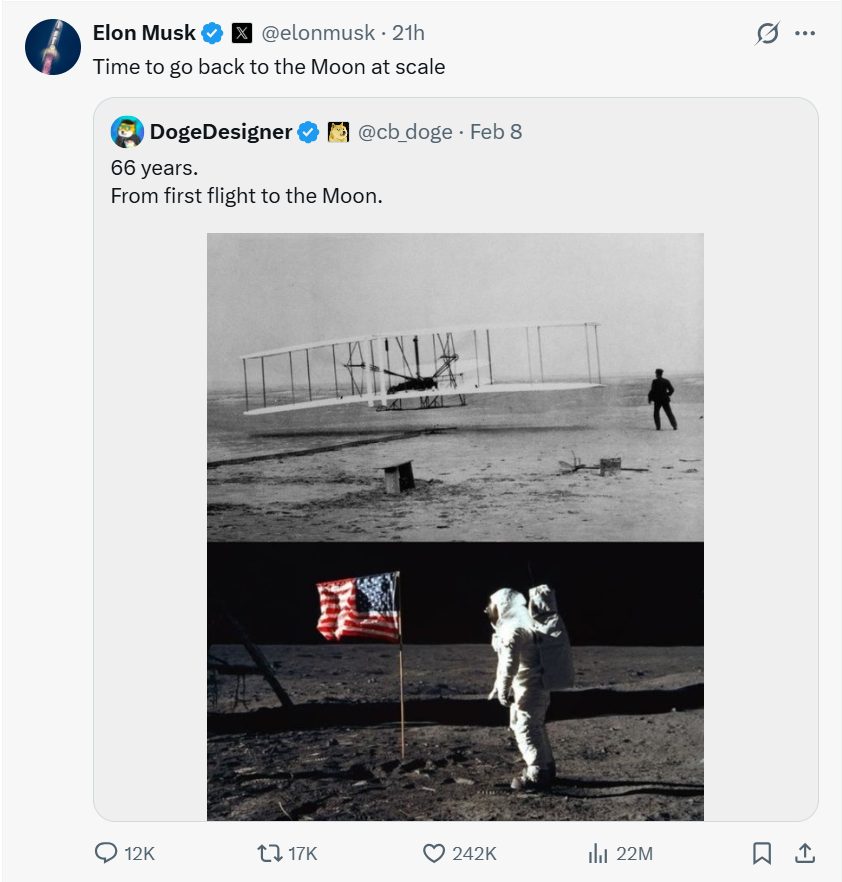
马斯克:SpaceX已将重点转向在月球建城,“每26个月才有一次向火星旅行的发射窗口,而每10天就可向月球发射一次”
Xin Lang Cai Jing· 2026-02-09 10:09
(来源:江苏新闻) 新华社消息,美国企业家埃隆·马斯克8日说,其名下太空探索技术公司(SpaceX)已将重点转向在月球建设一座"自我生长的城市",这可能在不 到10年内实现。 马斯克在社交媒体X平台上写道,SpaceX仍打算在未来5到7年内启动其长期以来在火星上建城的计划,但当务之急是确保"文明的未来",而登 陆月球可更快实现这一目标。 他写道,每26个月才有一次向火星旅行的发射窗口(行程6个月),而每10天就可向月球发射一次(行程2天),"这意味着我们迭代完成月球 城市建设的速度要比火星城市快得多"。 来源丨新华社 编辑丨桃桃 (来源:江苏新闻) 新华社消息,美国企业家埃隆·马斯克8日说,其名下太空探索技术公司(SpaceX)已将重点转向在月球建设一座"自我生长的城市",这可能在不 到10年内实现。 2025年5月27日,美国太空探索技术公司新一代重型运载火箭"星舰"在得克萨斯州实施第九次试飞。新华社/美联 马斯克上述言论呼应美国《华尔街日报》6日一篇报道。报道称,SpaceX已告知投资者,将优先登陆月球,并推迟前往火星的尝试,目标是 2027年3月实现无人登月。 2025年马斯克曾说,其目标是在2026年 ...

马斯克又改口:先造月球城市 再登陆火星
Xin Lang Cai Jing· 2026-02-09 08:56
Core Viewpoint - SpaceX is shifting its focus towards building a "self-sustaining city" on the Moon, which could be realized in less than a decade, while still planning to initiate its long-term Mars colonization project within the next 5 to 7 years [1] Group 1: Lunar Focus - SpaceX aims to prioritize lunar landings, with a target for an unmanned lunar mission by March 2027 [1] - The company believes that constructing a city on the Moon can be achieved more rapidly than on Mars due to more frequent launch opportunities, with a launch window to the Moon every 10 days compared to every 26 months for Mars [1] Group 2: Mars Plans - Despite the shift in focus to the Moon, SpaceX still intends to pursue its Mars colonization plans, with an initial goal of launching an unmanned spacecraft to Mars by the end of 2026 [1] - Elon Musk previously expressed confidence in achieving a manned landing on Mars by the end of 2026, contingent on favorable conditions [1]
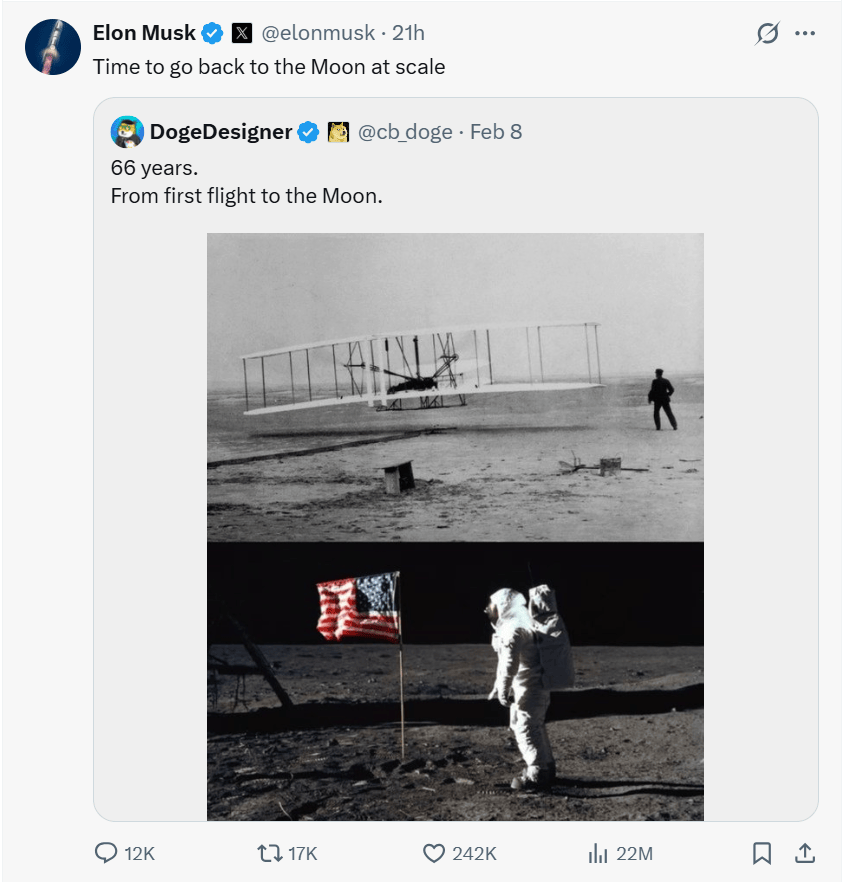
SpaceX大转向!马斯克改口:火星太远月球更快,十年内建“月球城市”
Sou Hu Cai Jing· 2026-02-09 07:50
Core Perspective - SpaceX has shifted its strategic focus from Mars colonization to a lunar mission, aiming for a moon landing by March 2027, marking a significant change in direction for the company [2][3]. Group 1: Strategic Shift - The company has decided to prioritize building a self-expanding city on the Moon, with a goal to achieve this within 10 years, as opposed to the 20+ years required for Mars [3]. - The frequency of lunar missions is more favorable, with launches possible every 10 days compared to the 26-month window for Mars missions, allowing for faster development of lunar infrastructure [4]. Group 2: Financial and Market Implications - SpaceX has acquired xAI, leading to a combined valuation of $1.25 trillion, making it the most valuable private company globally. There are rumors of a potential IPO later this year, with fundraising efforts possibly reaching $50 billion [6]. Group 3: Technological Innovations - Musk envisions a new commercial landscape in space, proposing the establishment of AI data centers in space, which could operate at a cost of only 1/10th of that on Earth due to the absence of atmospheric interference [7]. - The company plans to launch approximately 100 gigawatts of solar and computational payloads annually into orbit, which Musk predicts will exceed the total AI computational power on Earth within five years [8]. Group 4: Industry Concerns - Musk has expressed concerns about the decline of U.S. manufacturing, proposing the integration of humanoid robots and AI to revitalize the sector. He refers to the Optimus robot as an "infinite money printer" due to its potential capabilities [10]. Group 5: Challenges and Timelines - The company faces significant challenges, including the need for frequent Starship launches and the development of in-orbit refueling capabilities to meet the 2027 lunar timeline. Recent delays in NASA's Artemis program serve as a warning for SpaceX [12]. - Musk emphasizes the urgency of developing AI and robotics to complete these goals before potential economic downturns [12].
SpaceX大转向!马斯克改口:火星太远月球更快,十年内要建“月球城市”
Hua Er Jie Jian Wen· 2026-02-09 07:45
Core Viewpoint - SpaceX has shifted its strategic focus from Mars colonization to lunar missions, aiming for a moon landing by March 2027, marking a significant change in direction for the company [2][3][4]. Group 1: Strategic Shift - Elon Musk has emphasized that the moon was previously seen as a distraction, but practical considerations have led to this new focus on lunar exploration [3][5]. - The construction of a self-sustaining city on the moon is now prioritized, with a projected timeline of achieving this within 10 years, compared to over 20 years for Mars [4][5]. Group 2: Technological and Financial Integration - SpaceX has acquired xAI, leading to a valuation of $1.25 trillion, making it the most valuable private company globally [6]. - There are rumors of a potential IPO later this year, with fundraising efforts expected to reach $50 billion [6]. Group 3: Space AI and Computing Power - Musk envisions space as the most cost-effective location for deploying AI, predicting that within 36 months, space will become the cheapest site for AI operations, costing only 10% of ground-based operations [6][7]. - The company plans to launch approximately 100 gigawatts of solar and computing payloads annually, which could surpass the total AI computing power on Earth within five years [7]. Group 4: Manufacturing and Robotics - Musk has raised concerns about the decline of U.S. manufacturing, proposing the integration of humanoid robots (Optimus) and AI (xAI) as a solution [9]. - He describes Optimus as an "infinite money printer," highlighting the exponential growth in digital intelligence, AI chip capabilities, and mechanical dexterity [9]. Group 5: Challenges and Urgency - The timeline for the lunar mission is under pressure, with recent delays in NASA's Artemis 2 program serving as a warning for SpaceX [10]. - Musk acknowledges the need for rapid advancements in AI and robotics to meet the 2027 deadline, emphasizing the urgency of the situation [10].
“木头姐”将特斯拉添加到太空ETF,是否在为马斯克的“太空梦”布局?
Jin Shi Shu Ju· 2026-02-09 07:39
Group 1 - Ark Invest, led by Cathie Wood, has added 35,766 shares of Tesla (TSLA.O) to its Ark Space & Defense Innovation ETF (ARKX), representing 1.99% of the fund's assets, marking the first time ARKX has held Tesla shares [1] - Tesla is expanding into robotics, particularly with its Optimus robot project, which aims to develop general-purpose robots for complex tasks, potentially synergizing with SpaceX's space exploration and xAI's AI business [1] - Ark Invest holds significant positions in Tesla across multiple ETFs, including Ark Innovation ETF (ARKK), Ark Next Generation Internet ETF (ARKW), and Ark Autonomous Technology & Robotics ETF (ARKQ), indicating a positive long-term outlook on Tesla's development and technological innovation [2] Group 2 - The recent merger between SpaceX and xAI has generated market interest, with a combined valuation of $1.25 trillion, aiming to utilize solar energy in space for AI applications, supporting broader space exploration goals [2] - Challenges such as heat dissipation in space, cosmic radiation effects on electronics, and high launch costs are present, but Elon Musk remains confident in reducing launch costs and achieving feasible space data centers for AI computing [2] - There are mixed opinions on whether Tesla will merge with SpaceX/xAI, with potential benefits in resource sharing and technological synergy, but also concerns regarding shareholder dilution and antitrust scrutiny [3]
“木头姐”旗下太空ETF首次买入特斯拉,持仓市值1420.66万美元
Jin Rong Jie· 2026-02-09 07:24
Group 1 - Ark Invest's Cathie Wood has included Tesla stock in her space ETF for the first time, indicating a potential bet on a merger between Tesla and SpaceX [1] - Tesla is actively advancing its Optimus humanoid robot project, which may contribute to extraterrestrial civilization development, possibly influencing Ark Invest's decision to include Tesla in the space ETF [1] - Wood has expressed that Tesla's long-term ambitions across multiple industries could lead to a market capitalization of $100 trillion [1] Group 2 - As of February 6, 2026, the ARK Space and Defense Innovation ETF (ARKX) holds 35,766 shares of Tesla, with a market value of $14.2066 million, representing approximately 2.01% of the fund's portfolio [1]

押注特斯拉与SpaceX合并?“木头姐”旗下太空ETF首度买入特斯拉
Xin Lang Cai Jing· 2026-02-09 07:09
Core Insights - Cathie Wood's Ark Space & Defense Innovation ETF (ARKX) has made its first purchase of Tesla shares, acquiring 35,766 shares, which represents 1.99% of the ETF's total assets, raising speculation about potential restructuring within Elon Musk's business empire [1][2][3] Group 1: Investment Actions - The purchase of Tesla shares by ARKX marks the first time the fund has included Tesla in its space and defense investment portfolio, occurring at a critical time when reports suggest a merger between SpaceX and xAI has been completed [1][2] - This rare buying behavior highlights the limited public investment channels into SpaceX and suggests potential capital operations, as a merger with Tesla would require complex regulatory reviews and shareholder approvals [2][8] Group 2: Investment Rationale - Market interpretations of ARKX's purchase suggest two main motivations: one being a strategic positioning for a potential shareholder vote on a merger between Tesla and SpaceX/xAI, and the other being based on fundamental logic related to Tesla's advancements in robotics, particularly the development of the Optimus robot [3][9] - The ETF has identified "adaptive robotics" as a core investment theme, aligning with Tesla's efforts to leverage robotics technology for broader goals, including space exploration [3][9] Group 3: Holdings Overview - This acquisition reinforces Ark Invest's position as a strong supporter of Musk's companies, with Tesla being a major holding in several of Ark's ETFs, including ARK Innovation ETF (ARKK), ARK Next Generation Internet ETF (ARKW), and ARK Autonomous Technology & Robotics ETF (ARKQ), with holdings of approximately 10.99%, 10.39%, and 9.93% respectively [4][10] - Ark Venture Fund also holds significant stakes in Musk-related companies, with SpaceX as the largest holding at 11.23%, followed by xAI at 6.31%, and Tesla at 1.05% [4][10] Group 4: Market Sentiment - Analysts on Wall Street are closely monitoring the potential for Musk to consolidate his business empire, with investor Chamath Palihapitiya suggesting a "reverse merger" of SpaceX into Tesla, and Wedbush analyst Dan Ives noting an increasing likelihood of a merger between Tesla and the newly formed SpaceX/xAI entity [5][12] - The growing AI ecosystem is seen as a logical foundation for such a merger, although it would require shareholder approval and regulatory scrutiny [5][12] Group 5: SpaceX Investment Landscape - SpaceX remains one of the largest private companies globally, with limited avenues for public investment, primarily through Ark Invest's funds or by holding shares in publicly traded companies like Bank of America, Alphabet, and EchoStar [6][13] - While Musk has hinted at an IPO for SpaceX, no formal documents have been submitted, with speculation suggesting a potential IPO could occur as early as June 2026 [6][13]
马斯克放大招:10年内建月球城,火星计划推迟!百万亿梦还远吗?
Sou Hu Cai Jing· 2026-02-09 06:35
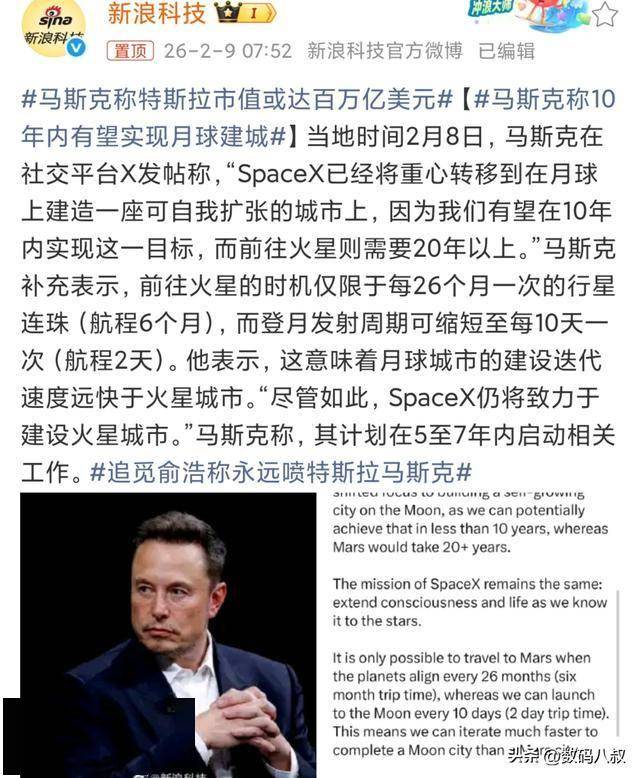
马斯克又一次抛出了震撼全球的"太空野心"。当地时间2月8日,他在社交平台X上宣布,SpaceX已将重 心转移至在月球建造一座可自我扩张的城市,并宣称有望在10年内实现这一目标,而前往火星的计划则 需要20年以上。这一言论迅速引爆科技圈,与他此前"特斯拉市值或达百万亿美元"的豪言壮语交相辉 映,再次将这位科技狂人推至舆论中心。 在马斯克的最新规划中,月球成为了人类迈向深空的"前哨站"。他解释道,前往火星的时机受限于每26 个月一次的行星连珠,航程长达6个月;而登月的发射周期可缩短至每10天一次,航程仅需2天。这意味 着月球城市的建设迭代速度将远快于火星。尽管如此,他强调SpaceX仍将致力于建设火星城市,并计 划在5至7年内启动相关工作。这份"月球优先、火星紧随"的路线图,让人们看到了人类文明跨行星生存 的清晰路径。 然而,马斯克的宏大叙事也伴随着巨大的争议。一方面,支持者认为他的愿景正在推动人类科技的边 界,从电动汽车到太空探索,特斯拉和SpaceX的每一步都在改写行业规则。另一方面,批评者则质疑 其计划的可行性,认为在月球建造城市面临着材料、能源、生命支持等一系列难以逾越的技术壁垒, 而"百万亿美元市值"的 ...
马斯克剑指“外星造城”,时间表曝光!月球只需不到10年
Bei Jing Shang Bao· 2026-02-09 05:48
Core Viewpoint - SpaceX has shifted its focus to building a self-expanding city on the Moon, with expectations to achieve this within a decade, while still pursuing its Mars vision which is projected to take over 20 years [3][4]. Group 1: Strategic Shift - Elon Musk announced that SpaceX's primary goal is now the construction of a lunar city, which can be developed much faster than a Martian city due to shorter travel times and more frequent launch opportunities [3][4]. - The lunar city concept emphasizes self-sufficiency and continuous expansion through automation and robotics, akin to cellular growth, rather than relying on supplies from Earth [6]. Group 2: Technological Development - SpaceX is reportedly hiring engineers in Austin and Seattle to develop AI satellites and space data centers, indicating a push towards advanced technology to support lunar and Martian endeavors [4]. - Previous demonstrations by SpaceX have shown the feasibility of using lunar regolith for building materials and extracting oxygen and water, aligning with the vision of a self-sustaining lunar city [6]. Group 3: Collaboration and Future Plans - SpaceX is concentrating resources on NASA's Artemis program, which aims to establish a lunar base and explore further space opportunities, including the extraction of helium-3 isotopes [6][8]. - The U.S. government has set ambitious goals for lunar exploration, including a return to the Moon by 2028 and the establishment of a permanent lunar outpost by 2030, which will involve collaboration with private companies like SpaceX [11][12].